
Verifying DOJ Representations After the Todd Blanche Exodus
- Authority
- New York City Bar Association
- Rule type
- ethics opinion
- Jurisdiction scope
- US federal
- Source text
- Read primary rule text ↗
If DOJ counsel makes a representation in federal court tomorrow, the safer question is no longer whether the statement sounds routine. It is whether the lawyer making it has verified access to the underlying file, whether the career staff who knew the matter are still in place, and whether any internal accountability channel remains available if the representation proves wrong. That is the practical edge of the confirmation hurdles facing Todd Blanche: the fight has surfaced an operational reliability problem that litigators have to manage at case level.
This is not legal advice. It is a litigation-risk framework for lawyers and legal departments deciding how much weight to place on government representations in pending matters.
The source record needs a clean label before it is used. The staffing figures most often cited in this controversy—approximately 16,000 DOJ departures, including 4,000 lawyers, FBI agents, and analysts—come through a Justice Connection fact sheet as relayed by the New York City Bar Association’s July 13 letter opposing Blanche’s nomination; they are not, in the materials available here, independently verified DOJ personnel records.[1][2] The strongest litigation facts are bench-level findings or court-described conduct cited in that letter and related commentary. The weakest item for litigation planning is the claim that grand juries have refused to return indictments; the NYC Bar letter asserts it, but the available record does not include a specific docket citation.
Why a confirmation fight becomes a counterparty-risk problem
Blanche’s nomination fight matters to a litigator only to the extent it exposes whether the Department can still produce reliable litigation positions under pressure. A confirmation hearing can tolerate broad claims about leadership style. A status conference cannot. When a government lawyer says documents were searched, a witness is unavailable, a factual predicate has been checked, or a settlement has been authorized, the court and the opposing party need to know whether that statement rests on a functioning chain of custody inside the agency.
The NYC Bar’s opposition letter treats staffing loss, removal of career personnel, and alleged damage to accountability offices as confirmation-relevant. Its posture is advocacy, not neutral audit. But advocacy posture does not make the cited litigation episodes disappear. For a practitioner, the important question is narrower: do the available facts justify changing how counsel verifies DOJ representations? On this record, yes.
The site’s earlier account of how Acting AG Todd Blanche reshaped DOJ reliability covers the exodus at a higher level. A separate piece on four litigation risks from the Todd Blanche confirmation controversy maps broader categories. The question here is more immediate: what should opposing counsel verify before relying on DOJ’s next email, discovery certification, charging representation, or settlement statement?
The facts that justify heightened verification
Personnel churn alone does not prove litigation unreliability. A large department can lose people and still maintain records, supervisors, ethics review, and trial-level discipline. The risk changes when departures are paired with allegations that the ordinary internal correction mechanisms—career review, the Office of Professional Responsibility, and Inspector General oversight—have been weakened or unavailable.
That is the combination now in view. Justice Connection’s fact sheet says Blanche told a March 2026 CPAC audience that he had “cleaned house,” and it also describes a March 2026 whistleblower complaint alleging that no functioning Inspector General was in place to investigate abuses within the Department.[2] The NYC Bar letter, relying on that and other cited materials, argues that the departures include not just political leadership turnover but substantial losses among lawyers, agents, and analysts.[1]
A litigator does not need to resolve every institutional claim to act prudently. If the people who knew the file are gone, and if the office that would normally investigate misconduct is alleged to be impaired, the ordinary assumption that DOJ has already internally stress-tested its representation becomes less safe. The burden shifts in practice, even if not formally by rule: the receiving lawyer has to build a record showing what was represented, by whom, on what basis, and with what opportunity to correct.
Court-grounded friction matters more than atmospherics
The most serious examples are not press descriptions of politicization. They are situations in which judges had to address DOJ conduct from the bench or in written rulings.
In the Abrego Garcia matter in Tennessee, the NYC Bar letter cites court findings that “Blanche started the investigation to implicate” Abrego Garcia, framing the episode as retaliatory prosecution.[1] That is the kind of finding that alters how an opponent should treat charging-position assurances. It is not merely a claim that a political appointee had a view of an enforcement priority; it is a court-grounded concern about the purpose and direction of a specific prosecution.
In the IRS settlement episode before Judge Kathleen Williams in Florida, The Hill’s account says the court described the settlement as “the product of collusion” and “a fraud on the court,” and sent the opinion to the New York bar for ethics review.[3] Settlement representations are often treated as the least dramatic part of government litigation because they arrive wrapped in authorization language. That assumption becomes dangerous if the settlement itself is the object of the court’s ethics concern.
The Maryland discovery episode is more familiar to civil and criminal practitioners because it goes directly to production conduct. The NYC Bar letter reports that a federal judge found DOJ had engaged in “willful and bad faith refusal to comply with its discovery obligation.”[1] A discovery violation with that wording should change how counsel receives later assurances that a search is complete, a privilege review is final, or a production delay is harmless.
The grand-jury refusal point belongs in a different category. The NYC Bar letter asserts that grand juries have refused to return indictments, but the available materials do not include a docket number or case-specific judicial finding.[1] That may still be relevant to charging-risk analysis, but it should not be treated as verified court data in a motion or client memorandum unless counsel independently locates the underlying record.
| Assertion type | How to treat it in litigation planning |
|---|---|
| Court findings or orders cited in the record | Use as the strongest basis for heightened verification, while checking the underlying docket before quoting in filings. |
| Advocacy-letter factual relays | Treat as risk indicators, not final proof; identify the original source before relying on precise figures or causation claims. |
| News or opinion accounts of judicial rebukes | Useful for issue spotting; verify the opinion or order before making the account do legal work. |
| Unspecified grand-jury refusal claims | Caveat heavily unless and until a docket, transcript, or case-specific source is located. |
A verification protocol for DOJ representations
The point is not to accuse every DOJ lawyer of unreliability. Many career attorneys will still be trying to protect the record with fewer colleagues, more political noise, and less institutional cover. The point is to stop treating the Department’s representation as a finished fact when the available record suggests the internal machinery behind that representation may be uneven.
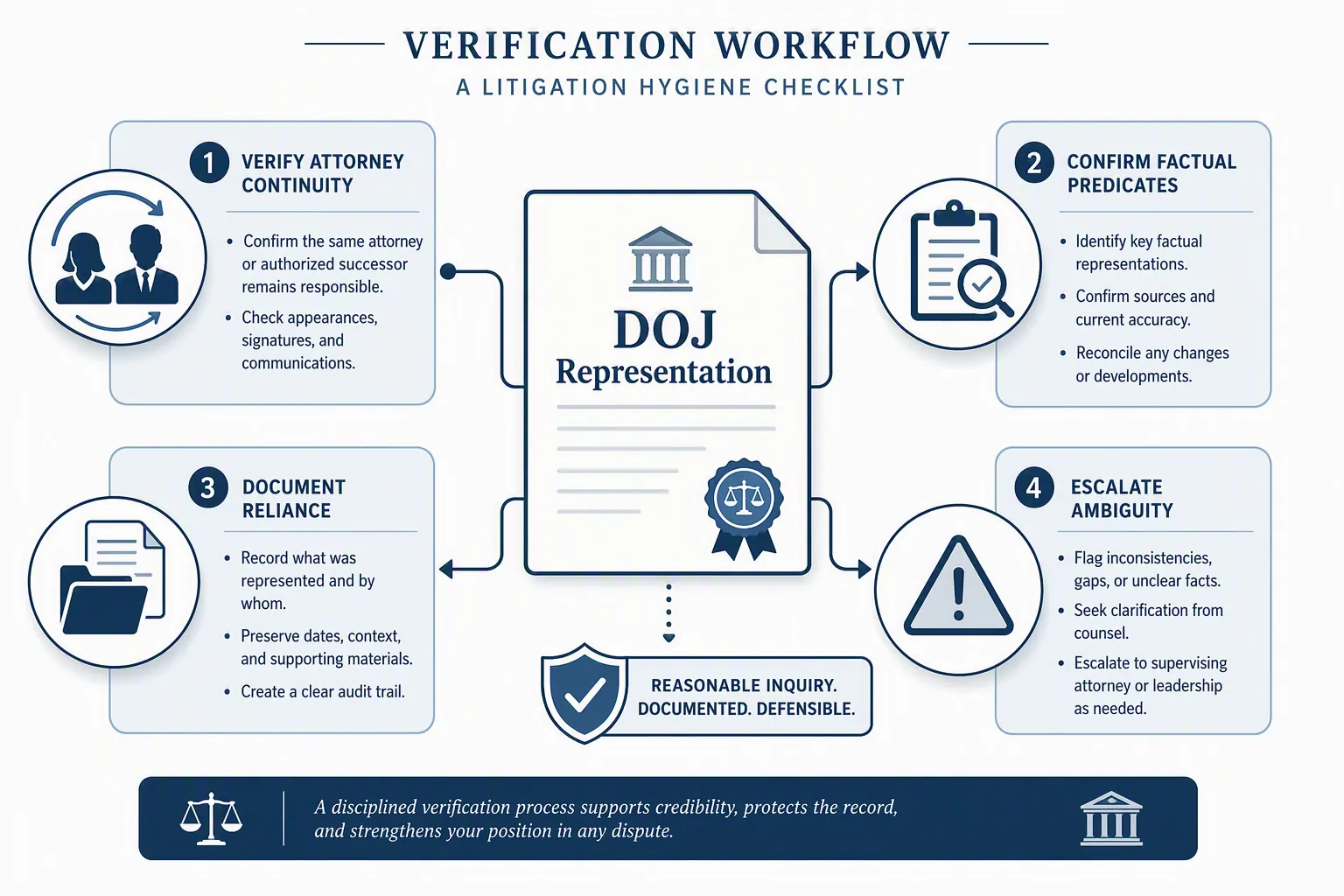
A practical protocol has four checkpoints.
- Verify attorney continuity: identify who has actual file knowledge, who recently entered, who left, and who has supervisory authority.
- Confirm factual predicates: ask what records, databases, agents, components, or client representatives support the statement.
- Document reliance: make the representation, its limits, and your reliance visible in email, letters, stipulations, or conference statements.
- Escalate ambiguity: move unresolved uncertainty to a supervisor, written clarification, court conference, discovery request, or motion before prejudice hardens.
1. Verify attorney continuity before relying on file-level assurances
Continuity is the first reliability variable. When DOJ says a factual position has been checked, counsel should know whether the speaker personally reviewed the file, inherited the matter last week, or is relying on a predecessor who is no longer available. This is especially important where the representation concerns historic agency action, prior charging decisions, witness communications, privilege calls, or settlement authority.
The inquiry can be professional and non-accusatory. Ask DOJ counsel to identify the current matter team, the component responsible for the representation, and whether any attorney or agent with material file knowledge has departed or become unavailable. If the answer is incomplete, write back with the narrow gap: “We understand your position to be based on the current Civil Division team’s review, but we do not yet understand whether prior component counsel or case agents were consulted.” That sentence gives the other side room to correct without turning the exchange into a sanctions letter.
Continuity checks matter most when the government asks for deference based on institutional knowledge. “The Department has determined,” “the United States understands,” and “agency records show” are not self-authenticating phrases. They are prompts to ask who inside the Department actually made the determination, what they reviewed, and whether the person with original knowledge remains reachable.
2. Confirm the factual predicate, not just the position
A government representation usually contains two things: a litigation position and a factual predicate. The position may be obvious. The predicate is where errors hide.
If DOJ says no responsive documents exist, the predicate is the search: custodians, repositories, terms, time period, and components. If DOJ says a witness is unavailable, the predicate is the communication history and the reason for unavailability. If DOJ says a settlement has approval, the predicate is the approval path. If DOJ says a charging decision was made for a permissible reason, the predicate includes the chronology and decision participants.
The request should be proportional to the stakes. In a minor scheduling dispute, a short confirming email may be enough. In a case involving liberty, large financial exposure, injunctive relief, or sensitive production obligations, counsel should ask for more durable confirmation: a declaration, a certification, an identification of custodians, or a statement that a supervisor has reviewed the factual basis.
| DOJ representation | Predicate to verify | Possible verification method |
|---|---|---|
| Production is complete | Search locations, custodians, date range, excluded repositories | Written search description, Rule 26 conference record, targeted follow-up requests |
| Privilege review is final | Review process, privilege log scope, clawback position | Privilege-log protocol, sample challenge, meet-and-confer letter |
| A witness or agent is unavailable | Reason for unavailability, prior communications, expected duration | Written confirmation, alternative date proposal, request for substitute witness |
| Settlement authority exists | Approving component, scope of authority, conditions not yet satisfied | Term sheet language, on-the-record confirmation, court-noticed status update |
| Charging or enforcement decision rests on stated grounds | Chronology, decision participants, non-retaliatory factual basis | Targeted discovery where available, preservation demand, record citation request |
3. Document reliance while there is still time to cure
The worst record is the one in which everyone remembers a different version of the same government assurance. If a DOJ representation affects a deadline, a production decision, a deposition sequence, a plea posture, a settlement recommendation, or a decision not to seek emergency relief, counsel should document the reliance close in time.
A useful reliance email is not theatrical. It should identify the representation, the action being taken because of it, and the date by which correction is needed. For example, in a hypothetical civil enforcement matter: “Based on your statement that the Department has completed its search of the identified custodians and does not intend to supplement before Friday’s deposition, we will proceed with the deposition as scheduled. If that understanding is inaccurate, please advise by 5 p.m. tomorrow.” The details are deliberately plain. The point is to make prejudice traceable if the statement later changes.
Where the representation is made during a call, send a same-day confirmation. Where it is made in court, ask for the transcript or ensure the statement is captured in a minute order, status report, or proposed order. Where it is made in a draft stipulation, avoid vague recitals such as “the parties have conferred.” Say what was represented and what remains unresolved.
4. Escalate ambiguity before it becomes prejudice
Ambiguity is not always misconduct. In a depleted institution, it may be a symptom of missing staff, incomplete handoff, or a lawyer who is waiting for another component to answer. The receiving lawyer still has to protect the client. The mistake is waiting until the missed production, expired deadline, or completed deposition turns uncertainty into harm.
Escalation can move in stages. First, ask for clarification in writing. Second, request that DOJ identify whether the statement has been confirmed by the responsible component or supervisor. Third, propose a short status conference if the ambiguity affects scheduling or prejudice. Fourth, seek targeted relief: an extension, a preservation order, a supplemental certification, a narrowed deposition, or leave to reopen a record if the representation changes.
The tone should stay measured because courts are more likely to act on a clean chronology than on generalized distrust. A motion that says “DOJ can no longer be believed” is easy to dismiss as rhetoric. A motion that says “on Monday DOJ represented X, on Wednesday we relied by doing Y, on Friday DOJ disclosed Z, and the missing information prevents A” gives the judge a litigation problem to solve.
Where the protocol should be tightened first
Not every interaction with DOJ needs the same level of verification. The protocol should be heaviest where the representation is hard to unwind, where the opposing party cannot independently inspect the facts, or where the court will later ask why counsel did not raise the issue sooner.
- Discovery completion statements: require enough detail to understand search scope, custodians, exclusions, and supplementation obligations.
- Privilege and law-enforcement sensitivity claims: separate the legal basis from the factual basis for withholding.
- Settlement representations: confirm authority, conditions, and whether any component approval remains outstanding.
- Charging or enforcement explanations: preserve chronology and decision-maker information where retaliation, selective enforcement, or improper purpose may become relevant.
- Emergency-relief representations: ask for rapid written confirmation because the court may act before a full factual record exists.
Discovery deserves the earliest attention because the Maryland finding, as reported by the NYC Bar letter, involved a “willful and bad faith refusal” to comply with discovery obligations.[1] That kind of language is a warning against accepting broad production assurances without a record of what was searched and what was withheld. It also supports asking courts for more concrete status-report requirements in cases where DOJ has already missed deadlines or changed positions.
Settlement is the second high-risk area because reliance can become irreversible quickly. Clients change reserves, boards approve terms, parallel proceedings shift, and courts close administrative loops based on settlement representations. After Judge Williams’s reported finding that an IRS settlement was “the product of collusion” and “a fraud on the court,” lawyers should be more careful about confirming who approved a deal and whether all material terms have been disclosed to the tribunal.[3]
Charging-position representations require a different kind of caution. Defense counsel and civil targets often cannot obtain internal deliberations. But when the available record includes a court finding, as cited by the NYC Bar letter, that Blanche started an investigation to implicate a specific person, counsel should preserve any chronology suggesting a shift in enforcement posture after protected conduct, public criticism, refusal to comply with an informal demand, or political attention.[1]
How to write to DOJ when the record is uncertain
The best letters are narrow enough that a responsible DOJ lawyer can answer them. They do not need to cite every controversy involving Blanche. They need to make the case-specific reliability problem visible.
| Situation | Better formulation |
|---|---|
| A new DOJ lawyer appears after prior counsel handled discovery | “Please confirm whether you have reviewed prior counsel’s discovery correspondence and whether any member of the prior matter team remains available to verify the production history.” |
| DOJ says no additional documents exist | “Please identify the custodians or repositories covered by that statement, or confirm that the statement is limited to the repositories searched to date.” |
| DOJ relies on agency records without describing them | “Please confirm whether the representation is based on a review of agency records, interviews with agency personnel, or both.” |
| A settlement term appears to depend on unstated approval | “Please confirm whether all required component approvals have been obtained and whether any condition remains before the United States can perform the agreed terms.” |
| A government position changes after reliance | “Please identify when the Department first learned the prior representation was inaccurate and what steps were taken to notify the parties and the court.” |
Those formulations do two things. They reduce the chance of an honest misunderstanding, and they create a record if the representation later collapses. They also avoid asking a line attorney to defend the entire Department. The question is not whether DOJ is institutionally trustworthy in the abstract. The question is whether this representation, in this case, can safely support reliance.
Motion practice: use the pattern carefully
Judges do not need a lecture on national institutional decline when a discovery order has been violated. They need the order, the representation, the reliance, the breach, and the remedy. The broader pattern may matter at the remedy stage, but it should not substitute for the case record.
Use the documented pattern when it bears on proportional relief. If DOJ has changed counsel repeatedly, ask for a named attorney responsible for compliance. If production assurances have shifted, ask for a certification identifying search scope. If the government seeks more time because a component has not responded, ask the court to require a date certain and a status report explaining which component is outstanding. If a representation affected a deposition or hearing, ask for targeted reopening rather than a broad sanction unless the record supports more.
The court-confirmed episodes are strongest when used to explain why counsel acted promptly, not as proof that the lawyers in the present case acted in bad faith. The Abrego Garcia, IRS settlement, and Maryland discovery matters support a practical proposition: federal judges have recently had to police serious DOJ conduct issues in live litigation.[1][3] That proposition can justify a tighter compliance architecture. It does not automatically prove misconduct in the next case.
What in-house counsel and risk teams should change
For companies and institutions facing DOJ enforcement risk, the verification problem should be moved into matter management. Outside counsel should be asked not only what DOJ said, but how the statement was verified and how reliance was preserved. A board or general counsel evaluating settlement, cooperation, or litigation posture should know whether the government position rests on a stable matter team or a newly assembled group without obvious file continuity.
- Add a DOJ-representation log for significant matters, capturing date, speaker, substance, verification request, response, reliance, and follow-up.
- Require outside counsel to flag when DOJ changes attorneys, supervisors, components, or stated factual bases.
- Separate settlement authority risk from settlement merits; a favorable term is not useful if approval or disclosure is uncertain.
- Build preservation letters around specific factual predicates rather than general accusations of politicized enforcement.
- When reporting to management, distinguish court-confirmed conduct from advocacy-letter allegations and unverified press claims.
That last distinction matters. A risk memo that overstates the source record can create its own credibility problem. The 16,000-departure figure and the figure for 4,000 lawyers, agents, and analysts are serious, but the available chain runs through Justice Connection and the NYC Bar letter rather than original personnel records.[1][2] The grand-jury claim should be treated as a lead for further research, not as a verified trend. The judicial rebukes carry more weight because they are tied to court action, quoted findings, or ethics referral descriptions in the cited materials.[1][3]
The confirmation outcome will not fix the file
As of July 30, 2026, the committee vote belongs in the category of pending process, not completed fact. The result may change Blanche’s title, authority, or political vulnerability. It will not, by itself, restore departed lawyers, recreate lost matter knowledge, or prove that OPR and Inspector General channels are functioning.
That is why the litigation adjustment should survive either confirmation outcome. Until DOJ can demonstrate that its internal accountability and file-continuity systems are operating reliably, lawyers appearing against the Department should treat DOJ representations as verifiable inputs rather than presumptively reliable facts.
References
- Oppose Todd Blanche Attorney General Nomination, New York City Bar Association, July 13, 2026.
- Fact Sheet: Todd Blanche’s Devastating Leadership DOJ, Justice Connection, March 2026.
- Blanche unfit attorney general, The Hill.
Operationalizing workflow
No workflow has been explicitly linked to this obligation yet. See Workflows generally.
Illustrative cases
No illustrative case is currently tracked for this obligation. See Risk Digest for documented incidents generally.
← Back to RegulationReport a correction or tip
Spotted an outdated figure, a misstated fact, or a ruling this regulation entry should reflect? Public comments are disabled for this content given the professional cost of a misreported case outcome, penalty amount, or rule text — use the structured correction channel instead.
Report a correction or tip for this record →