
Visa Overstay Rights During ICE Workplace Raids
- Authority
- National Immigration Law Center
- Rule type
- regulation
- Jurisdiction scope
- US federal
- Effective date
- Apr 1, 2026
- Source text
- Read primary rule text ↗
Employers must not permit ICE entry into non-public workplace areas without a judicial warrant and must designate trained staff to handle ICE interactions.
A visa overstay is not the same legal category as an unlawful entry. That distinction still matters in an ICE workplace arrest. A person who entered through inspection and later remained past the authorized period is generally facing a civil immigration violation, not a criminal offense for the overstay itself. The distinction can affect eligibility for adjustment of status, cancellation of removal, voluntary departure, and the right to have a case heard rather than moved through faster removal channels.
But in Q3 2026, that legal distinction is no longer a reason for workplace complacency. It is a reason to prepare more precisely. The question is not only whether ICE can arrest a visa overstay. It is whether the worker, the receptionist, the shift supervisor, and HR understand the few procedural lines that still control what happens at the workplace threshold: public versus non-public space, administrative versus judicial warrant, silence versus panicked speech, and compliance versus consent.
This is legal-risk analysis for workplace planning, not individualized legal advice. The evidence base is mixed: state and legal-aid guidance explains the protective rules; enforcement data describes the weather outside those rules; law-firm advisories show what employers are being told to expect; and data-sharing reports change how visa overstays should think about ordinary compliance records.
The overstay baseline still matters
Lawful entry is not a sentimental fact. It is a legal one. A visa overstay may be removable for remaining beyond the period authorized, but the overstay itself is treated as a civil immigration violation rather than a standalone criminal offense. That matters when counsel evaluates relief, admissibility problems, and procedural protections.
Time in the United States also matters. NILC’s detention guidance states that people who have been in the United States for more than two years generally have the right to appear before an immigration judge rather than being processed through expedited removal, while those with less than two years of presence may face a faster process depending on the facts.[1]
That is the first correction to the common workplace assumption. “I entered legally” is not a shield against arrest. “I have no criminal record” is not a promise that ICE will ignore a workplace. And “I pay taxes” is not, in 2026, a purely stabilizing fact. But lawful entry, duration of presence, and relief eligibility can still change what happens after the handcuffs or the notice to appear.
The workplace threshold is where rights either operate or disappear
Most workplace rights analysis becomes too abstract until someone is standing at the front desk. The real sequence is shorter and harsher: agents arrive, someone asks why they are there, someone is shown paper, someone either opens a door or does not, and workers decide whether to speak before anyone has found a lawyer.

The first physical line is public versus non-public space. The New York Attorney General’s workplace guidance explains that immigration officers may enter areas open to the public, but they need either employer consent or a valid judicial warrant to enter non-public areas of a workplace.[2] NILC’s employer guide draws the same operational line: public areas are different from private work areas, break rooms, kitchens, offices, storage areas, and other places not open to the public.[3]
That line is not cosmetic. If the lobby, reception counter, or retail floor is open to customers, ICE may generally stand there. If the work floor is behind a badge door, “employees only” sign, locked gate, or ordinary access boundary, the employer should not treat an officer’s presence in the lobby as authority to move through the building.
Legal Aid at Work’s worker guidance puts the worker-facing version plainly: workers have the right to remain silent, the right not to sign documents they do not understand, and the right not to show immigration documents without a valid reason to do so.[4] Those rights do not depend on having current status. They belong to people.
Administrative warrants are not judicial warrants
The paper matters. ICE frequently uses administrative warrants, including Forms I-200 and I-205. Those forms are issued within the immigration enforcement system. They are not signed by a judge. The NY Attorney General, NILC, and Legal Aid at Work all treat that distinction as central: an administrative warrant does not authorize ICE to enter non-public workplace areas without consent.[2][3][4]
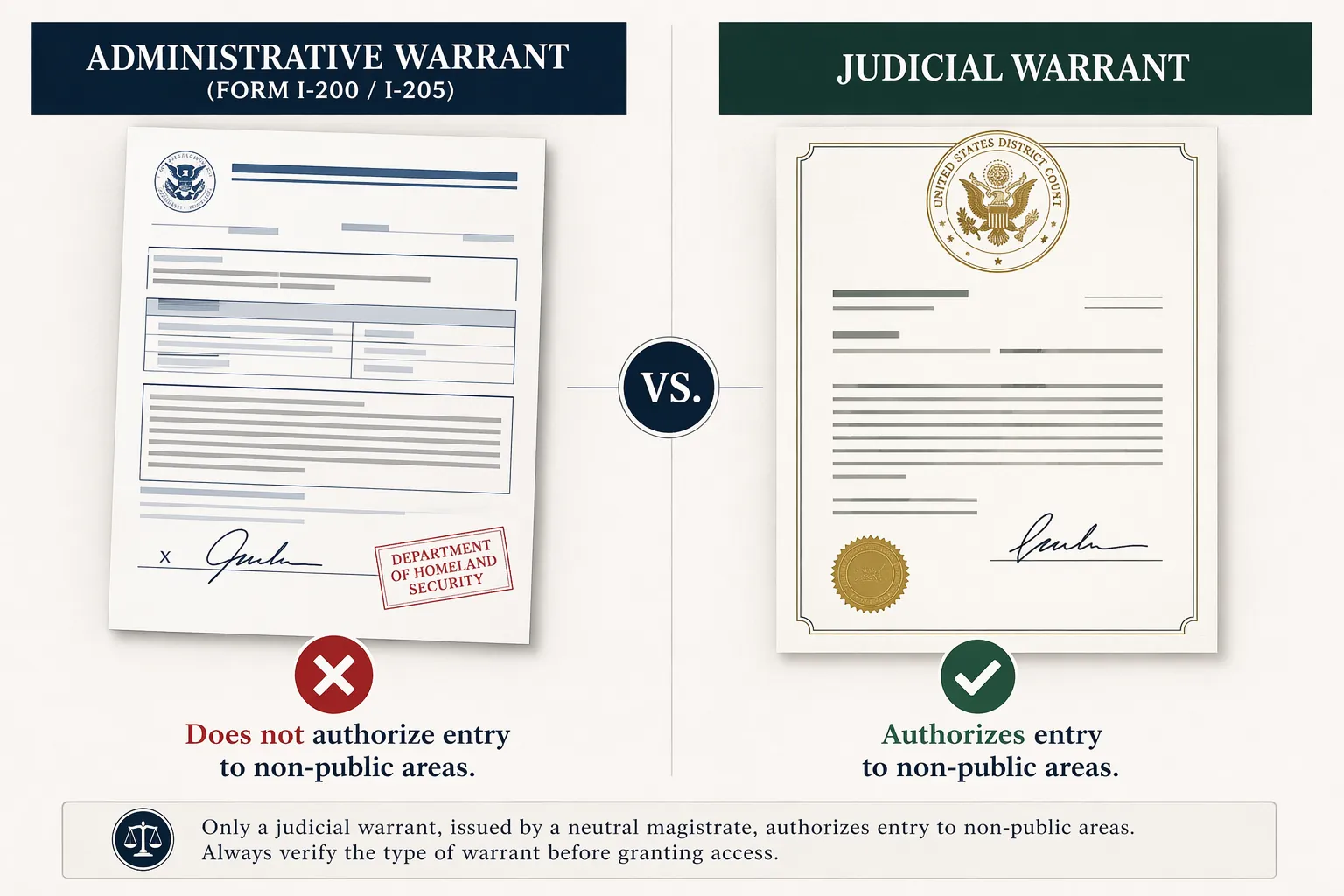
A judicial warrant is different. It should be signed by a judge or magistrate, identify the place to be searched, and fit the area agents seek to enter. Employers do not need to argue in the hallway, but they do need a trained person to read the document before anyone unlocks non-public space. The practical script is modest: ask agents to wait in the public area, request the warrant, make a copy or photograph if possible, send it to counsel or the designated response lead, and do not consent to entry beyond what the document authorizes.
This is where 2026 creates a real conflict between law on paper and enforcement behavior. DHS has taken the position that ICE does not need judicial warrants to make arrests. That position may describe what agents believe they can do during an operation. It does not erase the workplace-access guidance from state and legal-aid sources, which remains the safer rights-preserving framework for employers and workers confronting entry into non-public areas.[2][3][4]
The employer’s first response can create consent
Workplace planning often fails because it assigns the problem to HR, while the first person to meet ICE is a receptionist, security guard, floor supervisor, or night manager. Consent does not always look like a signed form. It may look like buzzing agents through a locked door, walking them to the production floor, or saying “go ahead” because the person at the desk is afraid to appear obstructive.
NILC’s employer guidance recommends designating staff who are authorized to interact with immigration agents and training other employees not to give permission for agents to enter private workplace areas.[3] That is not resistance theater. It is basic role discipline. The person with the least information should not be the person who decides whether the Fourth Amendment boundary has been waived.
| Moment | Rights-preserving action | Risk if mishandled |
|---|---|---|
| Agents enter the lobby | Keep them in the public area while the designated contact is called | Front-desk staff may unintentionally allow access to non-public areas |
| Agents present Form I-200 or I-205 | Treat it as an administrative warrant and seek legal review before granting private-area access | Employer may mistake it for a judge-signed warrant |
| Agents present a judicial warrant | Read the address, scope, names, dates, and signature before complying | Employer may allow a broader search than the warrant authorizes |
| Workers are questioned | Workers may remain silent and avoid signing documents they do not understand | A frightened worker may provide damaging or false information |
Silence is safer than improvisation
For visa overstays, the most dangerous sentence in a workplace encounter may not be an admission of overstay. It may be a false claim to U.S. citizenship. NILC warns that falsely claiming U.S. citizenship can create a permanent inadmissibility bar under INA § 212(a)(6)(C)(ii) and may also be prosecuted as a federal crime under 18 U.S.C. § 911.[1]
This is why “just say nothing” is not a slogan; it is damage control. Workers should not lie about citizenship, birthplace, immigration status, documents, or identity. They should not sign papers because an officer says signing will make things easier. They should not hand over foreign passports or immigration documents unless counsel has advised them or a legally valid basis exists. Legal Aid at Work and FWD.us both emphasize the right to remain silent and the risk of signing documents without understanding them.[4][5]
Employers have a parallel problem. They must not coach workers to hide, flee, lie, or destroy records. But they also do not have to become informal immigration deputies. The narrow lane is compliance with valid legal process, preservation of workplace boundaries, nondiscriminatory employment practices, and immediate referral to counsel when agents request records, access, or worker interviews.
The 2026 exposure machinery is different from the old assumptions
The enforcement numbers do not prove that every visa overstay is now a worksite target. They do show that the background risk has changed. The Deportation Data Project reported that, during the first nine months of the second Trump administration, street arrests were up elevenfold and arrests of people without criminal convictions were up sevenfold.[6] Those are population-wide enforcement indicators, not overstay-specific measurements. They matter because visa overstays are often exactly the people who have assumed that lack of a criminal record keeps them away from enforcement priority.
Post-arrest conditions also matter. Vera Institute reported that ICE detention reached more than 73,400 people as of March 2026, a record level in its detention trends dashboard.[7] For a worker arrested at a job site, a crowded detention system changes the practical value of speed: who has the A-number, who knows the lawyer’s name, who can locate the passport, who can prove two years of presence, and who can reach family before transfer.
Funding expands the same pressure. Wilentz reported that the One Big Beautiful Bill Act includes about $29.9 billion for ICE enforcement and more than 12,000 new officers.[8] Again, that is not an overstay-specific targeting figure. It is capacity. Capacity changes how often marginal cases become reachable cases.
Tax and employer records now feel less neutral
The most unsettling 2026 development for visa overstays is not a raid statistic. It is the possibility that ordinary compliance records can become lead-generation material. Modern Law Group reported that an IRS-DHS data-sharing agreement effective in April 2026 gave ICE access to approximately 1.28 million employer tax records and tied SSN mismatches to worksite enforcement risk.[9]
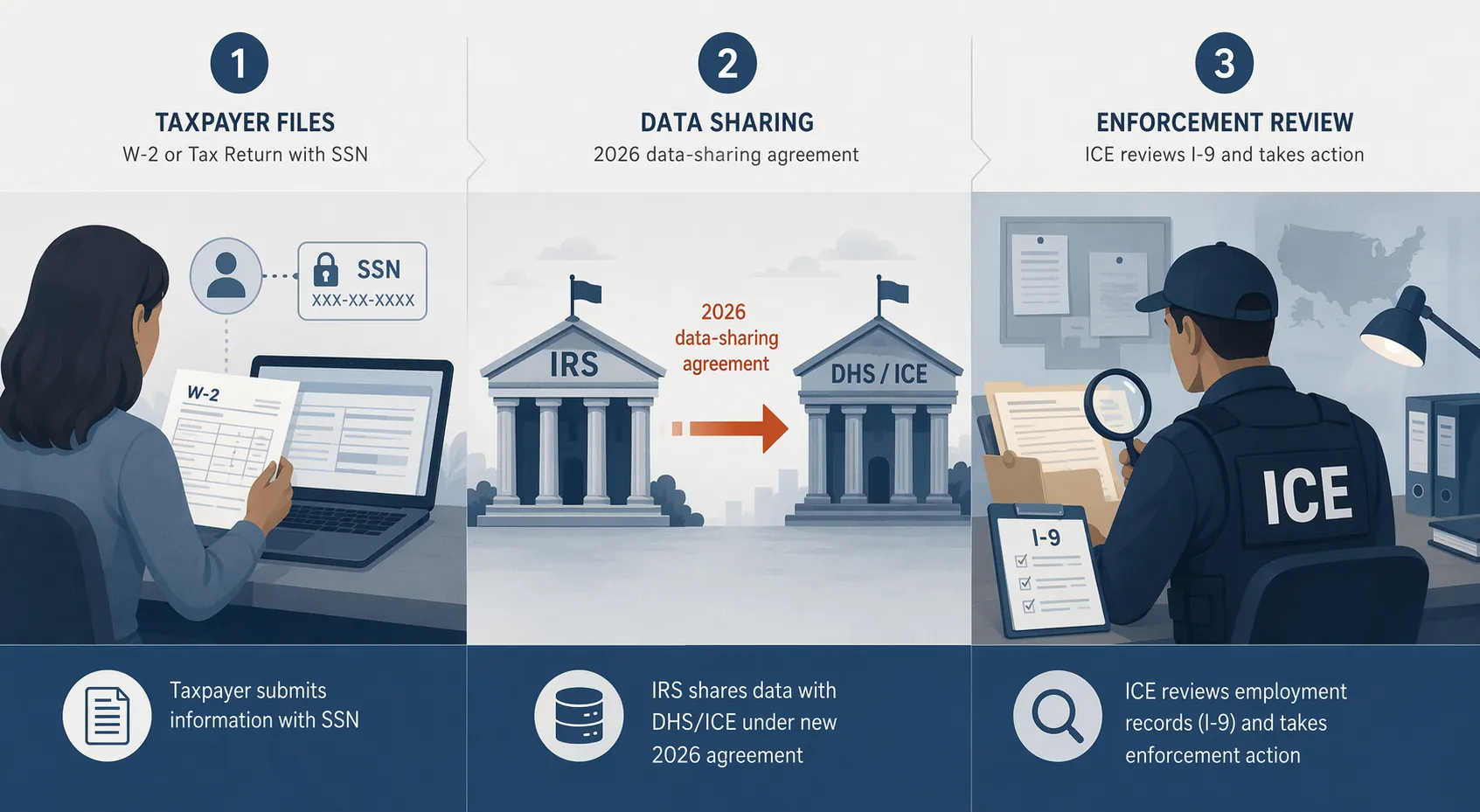
That point must be handled carefully. Filing taxes does not itself prove removability. A Social Security number mismatch does not automatically identify a visa overstay. Employer records can be wrong for reasons that have nothing to do with immigration status. But the psychology of compliance changes when records that once felt like evidence of responsibility may also become discoverability channels.
The reported data-sharing arrangement is also legally contested. Privacy-law litigation and judicial scrutiny may narrow, interrupt, or reshape how agencies use shared tax information. That uncertainty should temper any claim that every mismatch will become an ICE file. It should not restore the older assumption that tax filing and payroll presence are invisible to immigration enforcement.
I-9 audits are pressure, not proof
Modern Law Group estimated that I-9 audits increased by roughly 800% in Q1 2026.[9] Because that figure comes from a law-firm advisory rather than a government dataset, it should be treated as an estimate, not a settled official measurement. It is still directionally consistent with the broader employer-alert environment, including Wilentz’s warning that worksite enforcement is poised to increase dramatically.[8][9]
For employers, I-9 pressure creates two distinct risks. The first is classic compliance risk: missing forms, late reverification, inconsistent document practices, or failure to respond properly to a notice of inspection. The second is civil-rights risk: overcorrecting by rechecking only workers who “seem foreign,” demanding extra documents from employees with accents, or treating a mismatch as proof of unlawful status.
For visa-overstay workers, an I-9 audit is not the same event as an arrest. It may never involve agents entering the workplace. But it can surface records, names, document histories, and inconsistencies that make a later encounter more likely. That is the practical bridge between paperwork and the shop floor.
What preparation can and cannot assume
Preparation should not promise immunity. It should reduce avoidable surrender of rights. A workplace plan for visa-overstay risk needs fewer inspirational posters and more assigned tasks.
- Identify who may speak with immigration agents and who may not grant access to non-public areas.
- Train front-desk, security, and shift leads to distinguish an administrative ICE warrant from a judge-signed judicial warrant.
- Keep a copy-and-review process for warrants, subpoenas, notices of inspection, and requests for employee records.
- Tell workers, without asking about status, that they may remain silent and should not sign documents they do not understand.
- Audit I-9 files consistently across the workforce, not selectively against workers who appear or sound foreign.
- Maintain emergency contact procedures that do not require workers to disclose immigration status to supervisors.
The worker-side version is equally concrete. A visa overstay should know whether they have been present for more than two years, where proof of that presence is stored, which lawyer or legal-aid number family should call, and what not to say if questioned. The worst time to learn the difference between “I decline to answer” and “I am a citizen” is when an officer is already asking.
None of this eliminates the need for individualized counsel. A person who overstayed after lawful entry may have facts that improve or worsen the case: marriage to a U.S. citizen, prior removal orders, unauthorized work, fraud allegations, criminal history, unlawful presence bars, or a past statement on a form. Workplace scripts preserve time. They do not solve the immigration case.
The narrow conclusion for 2026
Visa overstays still have enforceable protections during ICE workplace encounters. Overstay is not the same legal category as unlawful entry. The Fourth Amendment still matters at the boundary between public and non-public workplace space. Administrative warrants still should not be treated as judge-signed warrants. Silence still protects more than improvisation. A false claim to U.S. citizenship can do damage that the original overstay did not.
The changed risk is that 2026 enforcement has made more people findable, more workplaces reviewable, and more ordinary records relevant. Rights still exist, but they operate only at specific pressure points: who opens the door, who reads the warrant, who releases records, who speaks, and who has already planned for the minutes before counsel arrives.
References
- “What to Do if You Are Arrested or Detained by Immigration,” NILC, April 2025.
- “Dealing with ICE in the workplace,” NY Attorney General, September 2025.
- “A Guide for Employers: What to Do if Immigration Comes to Your Workplace,” NILC, January 2025.
- “Workplace Raids: Workers' Rights,” Legal Aid at Work, January 2025.
- “Knowing Your Rights in the Workplace,” FWD.us, March 2026.
- “Immigration Enforcement in the First Nine Months of the Second Trump Administration,” Deportation Data Project / UCLA & Berkeley Law, January 2026.
- “Ten Things Vera's ICE Detention Trends Dashboard Reveals,” Vera Institute, March 2026.
- “Employer Alert: ICE Worksite Enforcement Is Poised to Increase Dramatically,” Wilentz, May 12, 2026.
- “ICE Workplace Raids 2026: What Workers and Employers Need to Know,” Modern Law Group, May 2026.
Operationalizing workflow
No workflow has been explicitly linked to this obligation yet. See Workflows generally.
Illustrative cases
No illustrative case is currently tracked for this obligation. See Risk Digest for documented incidents generally.
← Back to RegulationReport a correction or tip
Spotted an outdated figure, a misstated fact, or a ruling this regulation entry should reflect? Public comments are disabled for this content given the professional cost of a misreported case outcome, penalty amount, or rule text — use the structured correction channel instead.
Report a correction or tip for this record →