
How Many Voters Lost Registration to Proof-of-Citizenship Laws
- Authority
- U.S. Court of Appeals for the Tenth Circuit
- Rule type
- statute
- Jurisdiction scope
- US state
- Source text
- Read primary rule text ↗
Block voter registration without documentary proof of citizenship; database checks cause false cancellations
Verification snapshot
| Item | Current reading |
|---|---|
| Current date | July 27, 2026, UTC. |
| Scope | U.S. voter-registration cancellation, rejection, or exclusion tied to documentary proof-of-citizenship requirements or database citizenship checks. |
| Core answer | The documented injury is already in the tens of thousands. Kansas alone produced roughly 31,000–32,000 blocked registrations, with the state conceding that more than 99% of the blocked applicants were citizens. [1] |
| Database warning | SAVE-based checks have generated material false-positive records: Texas flagged 2,724 voters, more than 5% of checked cases across 29 counties were confirmed citizens, and Denton County’s confirmed-citizen rate was roughly 46% among resolved cases, or at least 14% when unresolved cases are included. [2] |
| What this is not | This is not a claim that every proof-of-citizenship rule has produced a statewide cancellation total, or that every flagged voter was removed. The legally important distinction is between a lead, a rejection, a cancellation, and a voter’s loss of the ability to cast a full ballot. |
| Non-advice note | This article is a litigation and compliance record review, not legal advice for any particular voter, county, campaign, or agency. |
The practical question behind the phrase “voter registration revoked proof of citizenship requirement law” is no longer whether the risk is theoretical. The harder question is which jurisdictions have a countable injury record, which have only a document-access risk, and which are now administering systems with notice that their data can misclassify citizens.
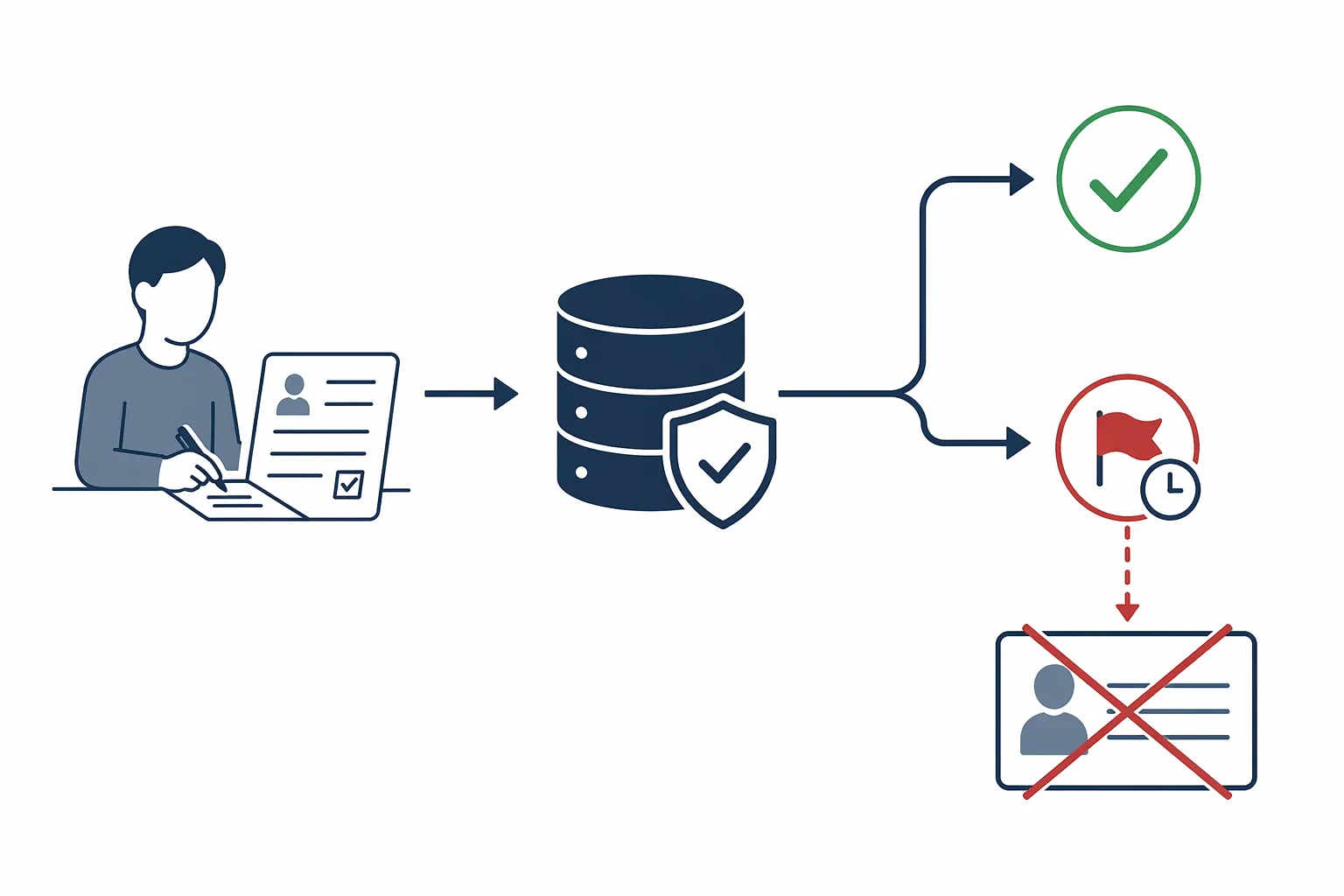
Jurisdictional scan: counted harm, pending risk, and database error
| Jurisdiction or system | What the record shows | Legal posture and caution |
|---|---|---|
| Kansas | Roughly 31,000–32,000 eligible citizens were blocked from registering under documentary proof-of-citizenship requirements; the state conceded more than 99% were citizens. [1] | The Tenth Circuit record in Fish v. Schwab is the strongest scale-and-liability anchor. |
| New Hampshire | About 250 voters were turned away in low-turnout 2025 town elections under HB 1569. [3] | The law was struck down on May 28, 2026, on First and Fourteenth Amendment grounds. [3] |
| Indiana | June 2026 data showed that more than half of flagged naturalized-citizen voters had registrations rejected or canceled. [4] | LWVIN v. Morales remains pending, so the current record is operational evidence and pleaded litigation risk, not a final merits judgment. [4] |
| Texas | The SAVE process flagged 2,724 voters; more than 5% of checked cases across 29 counties were confirmed citizens, and Denton County’s resolved cases showed 12 citizens among 26 resolved records, with 58 unresolved. [2] | At least one citizen, Anthony Nel, lost registration entirely after a 30-day deadline ran. [5] |
| Utah | About 5,000 registered voters were flagged; a state review of more than 2 million voters found one confirmed noncitizen registration and zero noncitizen votes. [6] | This is chiefly an administrative-mismatch warning, not a documented mass-revocation count. |
| Arizona | About 258,000 voters, or 6.3% of the electorate, were blocked from state and local elections under the state’s proof-of-citizenship regime. [7] | This figure must not be overstated: these voters can still cast federal-only ballots, so it is a state/local-election exclusion count rather than a total voting-ineligibility count. |
| St. Louis County, Missouri | Initial SAVE findings identified 691 potential noncitizens; after DHS added passport data, the number fell to 133, a 77% reduction. [2] | The revision is useful because it shows how much the result can change when the database input changes. |
| Federal SAVE database overhaul | On June 22, 2026, Judge Sparkle Sooknanan of the U.S. District Court for the District of Columbia issued a 75-page ruling blocking the Trump administration’s SAVE overhaul. [8] | The ruling puts database design and executive authorization into the litigation record, not merely the background technology stack. |
Kansas is the case that makes the warning hard to dismiss
Kansas is not important because it proves every later proof-of-citizenship law will fail in the same way. It is important because Fish v. Schwab gives the cleanest record of scale, eligibility, state knowledge, and judicial consequence in one file. The state’s documentary proof-of-citizenship requirement blocked roughly 31,000–32,000 applicants, and the state conceded that more than 99% of those applicants were citizens. [1]
That concession changes the legal character of the policy. A state can describe a citizenship check as an eligibility screen before the numbers come in. After the record shows that the overwhelming majority of blocked applicants were qualified citizens, the same screen looks much more like a state-created obstacle that eligible voters must repair one document at a time.
The Tenth Circuit’s treatment of the Kansas and Arizona proof-of-citizenship requirements for federal races matters for later jurisdictions because it joins the burden and the remedy. The court did not have to rely on generalized predictions about turnout or civic participation; it had blocked applicants, a statutory registration scheme, and a record showing that the requirement was catching citizens in large numbers. [1]
For compliance counsel, the liability lesson is narrower and stronger than the slogan version. The danger is not merely that a state asks for proof of citizenship. The danger is that a state or county treats missing papers, an incomplete database return, or an unresolved match as enough to block registration when the jurisdiction already has reason to know the process will capture eligible citizens.
How a database flag becomes a lost registration
The SAVE-related records are useful because they expose the machinery between a neutral-sounding database check and a real voter’s cancellation notice. A flag is generated. A county receives a list. Some voters must respond within a deadline. Some records remain unresolved. Some people are confirmed to be citizens only after the registration harm has already started.
In Texas, the reported statewide batch involved 2,724 flagged voters. Across 29 counties, more than 5% of checked cases were confirmed citizens. Denton County’s numbers were worse in the resolved subset: 12 of 26 resolved records were confirmed citizens, while 58 cases remained unresolved. Counting the unresolved cases in the denominator produces a minimum error rate of about 14%; looking only at resolved cases produces a much higher confirmed-citizen share. [2]
The individual injury is not abstract. Anthony Nel, a U.S. citizen, lost his voter registration after a federal database error and a 30-day response deadline. [5] One anecdote does not establish a statewide rate, but it does show how the administrative sequence can end: the citizen, not the database operator, is forced to cure the government’s error.
St. Louis County supplies the same warning from another angle. Initial SAVE findings listed 691 potential noncitizens. After the Department of Homeland Security added passport data, the number dropped to 133, a 77% reduction. [2] That is not a minor clerical adjustment. It is a reminder that the label “potential noncitizen” can depend heavily on which government dataset happens to be connected at the time the list is produced.
This is where local election officials get squeezed. They may receive a federal or state list under statutory pressure, with a short calendar and no practical ability to audit the underlying immigration or passport records. If the rule then converts nonresponse or unresolved status into cancellation, the county becomes the place where a remote data defect turns into a denial of registration.
SAVE overhaul litigation puts the infrastructure itself in issue
The June 22, 2026, D.D.C. ruling blocking the Trump administration’s SAVE overhaul should be read as part of the same record, even though it is not a voter-by-voter cancellation table. Judge Sparkle Sooknanan’s 75-page ruling treated the attempted overhaul as a legal event subject to judicial restraint, not as an internal software update beyond election-law scrutiny. [8]
For jurisdictions considering SAVE-based verification, that matters. Once a database is used as a gatekeeping device for registration, questions about statutory authorization, accuracy, data sources, and timing become questions about the voter’s legal status. The database is no longer just a back-office tool.
New Hampshire and Indiana show the post-2024 pattern
Kansas supplies the older, load-bearing precedent. New Hampshire and Indiana show why the issue is current. New Hampshire’s HB 1569 produced about 250 turned-away voters in low-turnout 2025 town elections, and on May 28, 2026, the law was struck down on First and Fourteenth Amendment grounds. [3]
The New Hampshire count should be kept in its lane. It is not a 30,000-person Kansas-style registration backlog. It is a shorter, post-2024 record of voters being turned away under a proof regime, followed by a federal constitutional ruling. For litigation screening, that is still meaningful: it shows a contemporary court treating the burden on qualified voters as legally actionable.
Indiana is in a different posture. In litigation over HEA 1264 and HEA 1680, June 2026 data showed that more than half of flagged naturalized-citizen voters had registrations rejected or canceled. [4] Because LWVIN v. Morales is pending, the safer description is not that the final merits have been decided. The safer description is that the state’s process has already generated rejection and cancellation data for a class of citizens whose records are especially vulnerable to stale or incomplete citizenship databases.
Naturalized citizens are a predictable stress point in these systems. A motor-vehicle, immigration, or citizenship database may contain an older noncitizen status even after naturalization. If the election rule gives the later citizenship event less practical weight than the older database entry, the result is not verification. It is an administrative presumption against the voter until the voter proves otherwise.
Arizona, Utah, and the document-access problem should not be collapsed into one number
Arizona’s number is large, but it is often misstated. About 258,000 voters, or 6.3% of the electorate, were blocked from state and local elections under the state’s proof-of-citizenship law. [7] That is not the same as saying 258,000 voters were wholly ineligible to vote. The narrower and more accurate statement is that they were excluded from state and local contests while remaining able to cast federal-only ballots.
Utah belongs in the article for a different reason. The state flagged about 5,000 registered voters, but a review of more than 2 million voters found one confirmed noncitizen registration and zero noncitizen votes. [6] That record does not prove mass revocation. It does show how a large flagged population can shrink almost entirely when the state moves from suspicion to confirmation.
The national document-access figure is broader still. A Brennan Center analysis found that 21.3 million American citizens of voting age, or 9.1% of the voting-age population, do not have ready access to citizenship documents that would satisfy proof-of-citizenship laws. [9] That figure is not a cancellation count. It is an exposure count: the pool of citizens likely to face delay, rejection, or extra administrative burden if documentary proof becomes the registration gate.
The legal theories follow the injury record
The cleanest way to read the cases is not to start with doctrine and then hunt for voters. Start with the injury record, then ask which legal theory the court used to stop it.
| Theory or posture | Where it appears in the current record | Why it matters for liability |
|---|---|---|
| NVRA-based challenge | Kansas and Arizona proof-of-citizenship requirements for federal races were struck down in the Tenth Circuit record. [1] | The theory is most important when documentary proof is added to a federal registration framework that already requires an eligibility attestation. |
| First and Fourteenth Amendment challenge | New Hampshire’s HB 1569 was struck down on May 28, 2026, on First and Fourteenth Amendment grounds. [3] | The relevant burden is not just paperwork in the abstract; it is the exclusion of eligible voters who cannot satisfy the documentary demand at the required moment. |
| Pending statutory and constitutional litigation | Indiana’s LWVIN v. Morales challenge concerns laws under which flagged naturalized-citizen voters have already experienced rejection or cancellation. [4] | Pending posture means no final merits holding yet, but the rejection and cancellation figures are notice evidence for future administrators. |
| Database and executive-authority challenge | The D.D.C. ruling blocked the Trump administration’s SAVE overhaul. [8] | When a database becomes the registration gatekeeper, its legal authorization and design choices become part of the election-administration risk analysis. |
The available remedies in the record are correspondingly practical: injunctions against enforcement, rulings invalidating proof requirements for covered elections, and litigation aimed at stopping rejection or cancellation practices before database errors become final registration losses. The remedy question is not limited to whether a voter can eventually prove citizenship. The litigation question is whether the government can impose that cure burden after its own system generated the defect.
The practical posture as of July 2026
The safest current count is not a single national revocation total. It is a register of documented harms. Kansas supplies the largest proven block of eligible citizens: roughly 31,000–32,000. Texas supplies a live database-error record, including a citizen who lost registration after a deadline. New Hampshire supplies a post-2024 constitutional ruling. Indiana supplies pending litigation with rejection and cancellation data for flagged naturalized citizens. Arizona supplies a large state/local-election exclusion count that must not be mistaken for total voter ineligibility.
For jurisdictions implementing proof-of-citizenship or SAVE-based processes, the foreseeable-error record is now difficult to avoid. A policy that treats a database flag as a legal fact, or makes an eligible citizen cure the government’s stale data under a short deadline, carries litigation exposure under the same pattern courts have already seen: a qualified voter, an administrative mismatch, a lost registration or ballot opportunity, and a remedy ordered after the damage became traceable.
References
- Court Strikes Down Kansas and Arizona Proof of Citizenship Laws for Federal Races — Brennan Center
- SAVE tool keeps mistakenly flagging voters as noncitizens — ProPublica / Texas Tribune
- Federal judge bars Trump from implementing proof of citizenship requirement to vote — PBS News
- League of Women Voters of Indiana v. Morales — League of Women Voters
- How a U.S. citizen lost his voter registration to a federal database error — NPR/VPM, December 13, 2025
- The SAVE Act: What Every American Voter Needs to Know — Vote.org
- The SAVE Act: How a Proof of Citizenship Requirement Would Impact Elections — Institute for Responsive Government
- Federal judge blocks Trump administration's overhaul of SAVE database — Votebeat, June 22, 2026
- 21.3 Million American Citizens of Voting Age Don't Have Ready Access to Citizenship Documents — Brennan Center
Operationalizing workflow
No workflow has been explicitly linked to this obligation yet. See Workflows generally.
Illustrative cases
No illustrative case is currently tracked for this obligation. See Risk Digest for documented incidents generally.
← Back to RegulationReport a correction or tip
Spotted an outdated figure, a misstated fact, or a ruling this regulation entry should reflect? Public comments are disabled for this content given the professional cost of a misreported case outcome, penalty amount, or rule text — use the structured correction channel instead.
Report a correction or tip for this record →