
When does a strike end WestJet passenger legal rights?
- Authority
- Canadian Transportation Agency
- Rule type
- regulation
- Jurisdiction scope
- Canada (federal)
- Source text
- Read primary rule text ↗
Pre-strike cancellations can trigger 9-hour rebooking, care, and $400–$1,000 compensation; in-progress strikes limit relief to 48-hour rebooking-or-refund.
Last verified: Aug. 2, 2026. This article addresses Canadian Air Passenger Protection Regulations obligations for WestJet-operated flights and comparable Canadian-carrier APPR claims. It is legal information, not legal advice. The useful question is not whether the word “strike” appears somewhere in the travel file. It is whether the flight was cancelled before or after an actual work stoppage began.
Under the APPR, a labour disruption that is actually underway is treated as outside the carrier’s control. That classification removes cash compensation, but it does not erase all passenger rights: the carrier still has to move the passenger through the outside-control rebooking-or-refund pathway. A cancellation made before the stoppage, by contrast, can remain a carrier-control decision. That distinction is where many WestJet strike passenger legal rights will be won or lost.

The legal classification changes at the stoppage, not at the rumor
Section 10(1)(j) of the APPR places a “labour disruption within the carrier or within an essential service provider such as an airport or an air navigation service provider” in the outside-the-carrier’s-control category. That is the provision carriers invoke when a labour interruption is already preventing ordinary operations. The provision matters because the APPR builds different remedies depending on whether the disruption is within the carrier’s control, within its control but required for safety, or outside its control.[1]
The hard part is not reading the words “labour disruption.” The hard part is applying them to an airline schedule that may have been cut before any employee stopped work. A carrier can have sensible operational reasons to cancel flights early: aircraft and crews cannot be left in the wrong cities, and a same-day collapse can strand more passengers than a planned drawdown. But operational prudence is not the same legal event as an underway strike.
For passenger-rights purposes, the timestamp on the cancellation notice is therefore not clerical decoration. It is the first fact to preserve. If WestJet cancelled a flight while the labour dispute was still only anticipated, the file may sit on the carrier-control side of the APPR. If the cancellation occurred because a stoppage had already begun and was disrupting operations, the APPR’s labour-disruption carve-out does real work.
Pre-strike cancellation and strike-in-progress are different APPR files
| Record fact | Likely APPR classification | Passenger remedy consequence |
|---|---|---|
| Flight cancelled before any work stoppage began, because the carrier was planning around a possible strike | Potentially within the carrier’s control | The 9-hour rebooking duty, care obligations, and cash compensation tiers may be in issue |
| Carrier lockout or other employer-initiated pre-stoppage operational step | Potentially within the carrier’s control, depending on the control analysis | The carrier should not be allowed to label the file outside-control merely because labour conflict was nearby |
| Flight disrupted after an actual strike or labour stoppage is underway | Outside the carrier’s control under APPR s. 10(1)(j) | No cash compensation; passenger moves to the 48-hour rebooking-or-refund pathway |
This is why the same WestJet labour dispute can produce different legal outcomes for passengers on the same weekend, or even on the same route. The dispute is not the unit of analysis. The cancellation is. A notice sent before the stoppage and a notice sent after the stoppage may refer to the same labour conflict, but they do not necessarily carry the same APPR classification.
That distinction also prevents a common overcorrection. Passengers are sometimes told that “strikes are outside airline control,” as if that sentence disposes of every file in a labour dispute. It does not. The narrower and more accurate statement is that a labour disruption actually operating on the carrier’s service is outside control under s. 10(1)(j). A cancellation made in advance of that disruption still needs a control analysis.
The Lareau control test is the hinge
The Lareau control test is useful because it asks a disciplined question: was the immediate cause of the passenger’s disruption the labour stoppage itself, or was it the carrier’s own anticipatory decision about how to run its network before the stoppage occurred? The answer cannot be supplied by the airline’s broad disruption label. It has to be supplied by sequence.
A preemptive cancellation is not legally identical to a cancellation forced by employees already off the job. In the first situation, the carrier has made a business and network-management decision under uncertainty. It may be a rational decision; it may even reduce later harm. But the APPR does not classify every rational carrier decision as outside the carrier’s control. Control asks who made the operative decision that removed the passenger’s seat from the schedule.
A lockout requires the same care. If the employer initiates the step that prevents work from continuing, the file should not be mechanically treated as though an external event disabled the carrier. The question is not whether the broader context involved labour relations. It is whether the carrier had control over the act that made the flight unavailable to that passenger at that time.
This control-line analysis is administrable because it can be tested against records. The passenger does not have to prove the whole labour dispute. The passenger needs the cancellation notice, the time the notice was issued, the stated reason, any later change in the carrier’s explanation, the time any work stoppage actually began, and the rebooking or refund options offered afterward.
What a passenger should preserve
- The original booking confirmation and itinerary.
- The first cancellation notice, including the time sent and the reason code or wording.
- Screenshots or emails showing whether WestJet later changed the stated cause.
- The time at which the strike, lockout, or work stoppage actually began.
- All rebooking offers, including departure and arrival times.
- Meal, hotel, transport, and communication expenses while waiting.
- The refund option, if offered, and whether the passenger accepted or rejected it.
Those records matter because APPR liability is not decided by sympathy for the passenger or annoyance with the carrier. It is decided by fitting the facts into the regulation’s categories. A vague statement that the flight was affected by “labour action” is not enough if the notice was sent before labour action existed as an operational fact.
The remedy difference is not cosmetic
Once a cancellation stays on the carrier-control side of the line, the APPR consequences are materially broader. For a large carrier, if alternate travel arrangements do not leave within 9 hours of the original departure time, the carrier must book the passenger on any carrier, including a competitor, when necessary to get the passenger to the destination. The APPR also imposes standards of treatment, including food and drink in reasonable quantities, access to communication, and hotel accommodation plus transport when an overnight wait is required.[1]
Cash compensation is also tied to classification. For delays or cancellations within the carrier’s control and not required for safety, the APPR compensation tiers for large carriers are $400, $700, and $1,000, depending on the length of the arrival delay. Those amounts come from s. 19, not from a general sense that a cancelled trip deserves payment.[1]
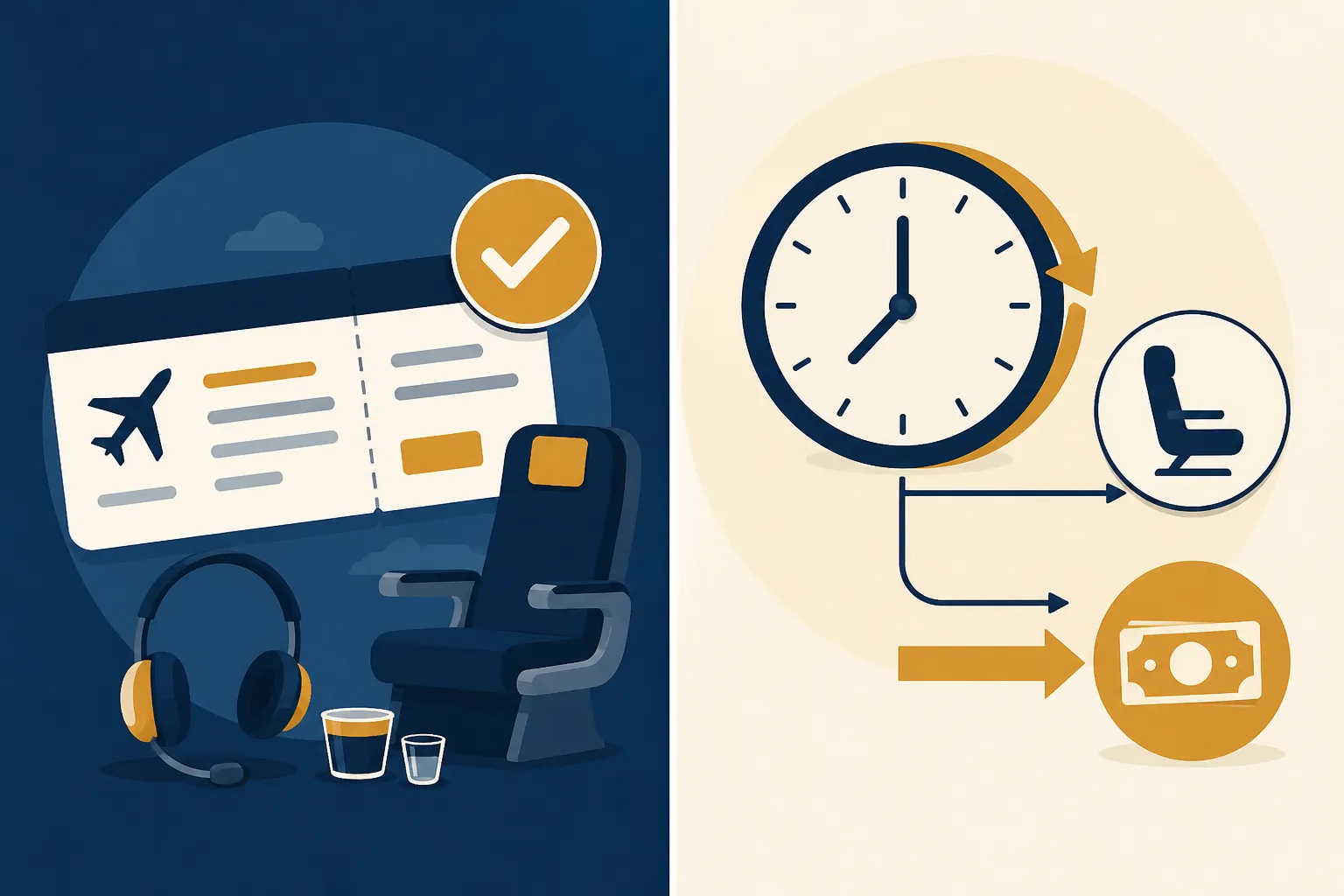
If the disruption is outside the carrier’s control because a strike is actually underway, the remedy narrows. The passenger is not entitled to the APPR cash-compensation tiers. The carrier must instead provide alternate travel arrangements through the outside-control pathway and, if it cannot provide the required rebooking within 48 hours, offer the passenger a refund. The refund must be paid within 30 days when the passenger chooses that option.[1]
| Issue | Pre-strike cancellation potentially within carrier control | Strike-in-progress outside carrier control |
|---|---|---|
| Cash compensation | $400, $700, or $1,000 may be available if the APPR conditions are met | Not available under the labour-disruption carve-out |
| Rebooking timing | The 9-hour threshold can require booking on other carriers when needed | The outside-control 48-hour rebooking-or-refund pathway applies |
| Care while waiting | Food, drink, communication, and possible hotel/transport obligations may apply | Care obligations are more limited and depend on the outside-control framework |
| Refund | Refund may be one remedy depending on the failed transportation and passenger choice | Refund becomes the capped route if the required rebooking is not available within the outside-control period |
| Main record question | Did WestJet cancel before the work stoppage, as an anticipatory operational decision? | Was the flight disrupted because the stoppage was already underway? |
The compensation point should not be overstated. A pre-strike cancellation does not automatically produce $1,000. The passenger still has to satisfy the APPR’s conditions, including the length of arrival delay and the absence of a valid safety-based or outside-control classification. But a carrier should not be allowed to reach the no-compensation result merely by pointing to a strike that had not yet begun when the flight was cancelled.
How the 2026 WestJet flight-attendant dispute fits
The 2026 WestJet flight-attendant dispute matters because it replays the fact pattern that makes the control line important: flights can be cancelled in the shadow of a possible work stoppage before the legal and operational event has actually occurred. Those passengers should not let the dispute-wide label do all the work. Their claim depends on the cancellation record.
A passenger whose flight was cancelled before any stoppage began should frame the APPR claim around the sequence. The claim is not “WestJet had a labour dispute, therefore compensation is owed.” It is narrower: “WestJet cancelled my confirmed transportation before the labour stoppage was underway, treated the file as outside-control, and failed to provide the rebooking, care, or compensation required for a carrier-control cancellation.”
A passenger disrupted after an actual strike began is in a different position. That passenger still has rights, but the rights are channelled into alternate travel arrangements and, if timely rebooking is not available, the refund route. The APPR does not convert an underway strike into cash compensation simply because the consequences were severe.
A practical claim frame
For a pre-stoppage cancellation, the strongest passenger record is chronological. Start with the scheduled departure. Add the exact cancellation timestamp. Add the official start time of the stoppage. Then list the carrier’s offered replacement itinerary, the time that replacement would have departed, and the actual arrival time if the passenger travelled. After that, add care expenses and the carrier’s written explanation for denying compensation.
For an in-progress strike disruption, the record serves a different purpose. The passenger is usually not building a cash-compensation file. The question becomes whether WestJet offered the required alternate travel within the outside-control timeline and whether the passenger was given the refund choice when that timeline was not met.
What not to collapse into the word “strike”
Three moments need to stay separate. First, there is the bargaining dispute, which may create a risk of disruption. Second, there is the carrier’s preemptive schedule decision, which may cancel flights before the risk becomes an actual stoppage. Third, there is the work stoppage itself, which can bring s. 10(1)(j) into full effect. Public summaries often compress all three into “strike cancellations.” The APPR does not work well when the timeline is flattened.
The enforceability threshold is therefore narrow but real. Passengers cancelled before any work stoppage may have viable APPR claims notwithstanding the labour-disruption carve-out. Passengers disrupted by an actual strike are not left without rights, but their relief is capped at the 48-hour rebooking-or-refund pathway and excludes cash compensation. The file turns on the timestamp.
References
- Air Passenger Protection Regulations (SOR/2019-150), Justice Laws Website, https://laws-lois.justice.gc.ca/eng/regulations/SOR-2019-150/
Operationalizing workflow
No workflow has been explicitly linked to this obligation yet. See Workflows generally.
Illustrative cases
No illustrative case is currently tracked for this obligation. See Risk Digest for documented incidents generally.
← Back to RegulationReport a correction or tip
Spotted an outdated figure, a misstated fact, or a ruling this regulation entry should reflect? Public comments are disabled for this content given the professional cost of a misreported case outcome, penalty amount, or rule text — use the structured correction channel instead.
Report a correction or tip for this record →