
Why the 1st Circuit Blocked Trump's Mail-In Voting Order
- Authority
- 1st Circuit Court of Appeals
- Rule type
- standing order
- Jurisdiction scope
- US federal
- Effective date
- Jul 25, 2026
- Source text
- Read primary rule text ↗
Block enforcement of EO 14399 provisions on DHS list compilation, USPS ballot restrictions, and DOJ threats.
The 1st Circuit did not block President Trump's mail-in voting executive order because it resolved whether mail voting is safe, unsafe, efficient, or vulnerable to fraud. The court's July 25, 2026 ruling treated the order as something more basic and more legally consequential: an attempt to move federal executive agencies into state election administration without a constitutional or statutory foothold.
In a 2-1 decision, the appeals court left in place a preliminary injunction against Executive Order 14399, which Trump issued on March 31, 2026. The injunction applies to 23 states and the District of Columbia and matters immediately because the disputed provisions would affect administration of the November 2026 midterms, with September primaries already approaching in some states.[1][2][3]
The court's own framing is the cleanest entry point. As reported consistently by Reuters and Democracy Docket, the panel said the order directed "unprecedented levels of involvement by federal officials in how states administer elections" and would "sow confusion and threaten disenfranchisement" of eligible voters.[1][2] Those are not throwaway phrases. They connect the constitutional allocation of election power to the practical work of running an election: lists must be built, ballots mailed, eligibility checked, officials trained, and voters told which rules govern them.
One caution about source discipline is necessary at the start. The full 20-page 1st Circuit ruling was not independently crawled for this article. The quoted language and procedural details here are drawn from multiple contemporaneous reports that describe the ruling consistently. Where the available reporting does not provide detail, especially on the partial dissent, this article does not fill the gap with inference.
The Holding Turns On Who Has Election Authority
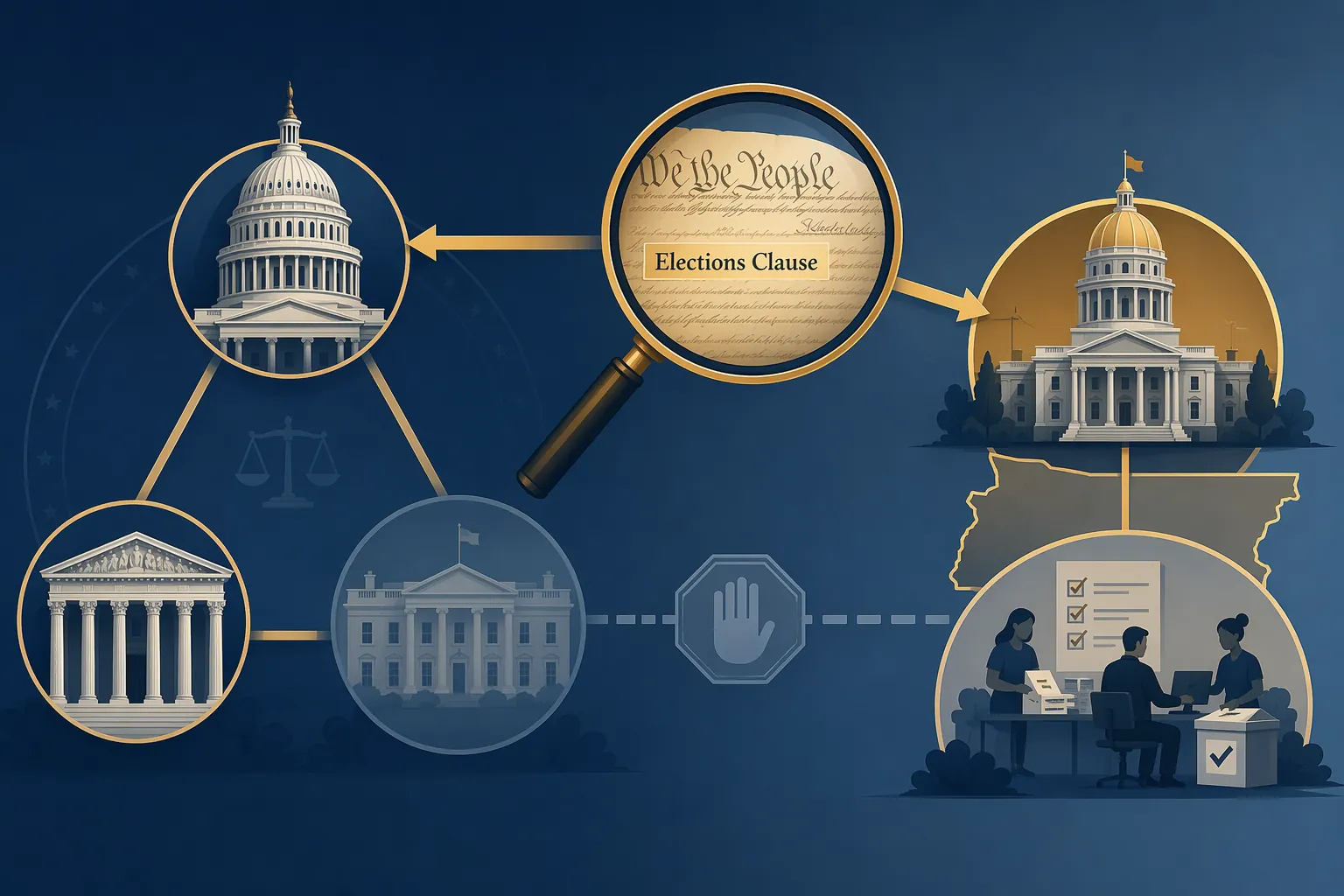
The constitutional provision doing the work is Article I, Section 4: the Elections Clause. It gives state legislatures the initial power to prescribe the "Times, Places and Manner" of congressional elections, while giving Congress authority to alter those rules. The president is not named in that allocation.
That omission is not ornamental. In election litigation, it changes the order of analysis. A president may have views about election integrity. Federal agencies may possess databases, enforcement lawyers, postal networks, and operational expertise. None of that answers the threshold question: did the Constitution or Congress authorize the president to use those tools to impose voter-qualification or ballot-handling rules on states?
The 1st Circuit's answer, at least at the preliminary-injunction stage, was no. That is why a voter-fraud record did not carry the decision. Even a legitimate policy concern needs a lawful channel. The panel saw the executive order as bypassing the Elections Clause channel by putting DHS, USPS, and DOJ into roles that would pressure or override state election administration.
For readers tracking the broader constitutional terrain, the site's prior analysis of the First Circuit's constitutional holding on Trump mail voting order covers the companion ruling context. The point here is narrower: the mechanics of the order explain why the court treated the case as a separation-of-powers problem rather than a referendum on mail voting.
The Order Was Not Merely Expressive
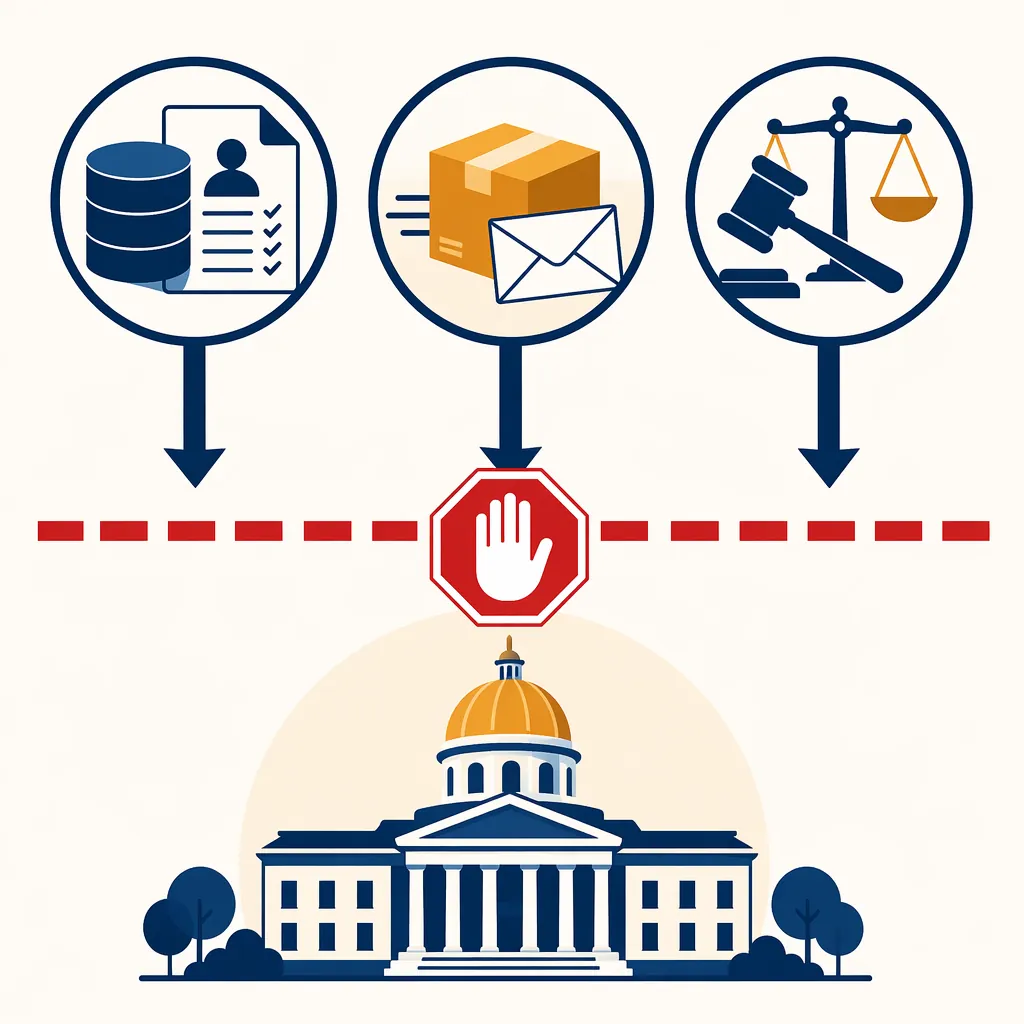
Presidential statements about elections are politically noisy but often legally thin. This order was different because it assigned work to federal agencies and created consequences for states and local officials. The disputed architecture had three main parts: DHS citizenship-list compilation through the SAVE database, USPS ballot-delivery restrictions tied to federal-approved lists, and DOJ enforcement threats against state and local election officials.
| Provision | Federal actor | Administrative effect the court had to confront |
|---|---|---|
| Citizenship-list compilation | DHS using SAVE | Federal production of state-by-state voter-eligibility lists based on a database not designed as a voter-roll system |
| Ballot-delivery restrictions | USPS | Potential refusal to deliver ballots to voters not appearing on federally approved lists |
| Enforcement threats | DOJ | Pressure on state and local officials who administered elections contrary to the executive order's list-based framework |
That structure matters because each provision converted an executive preference into pressure on the machinery of state elections. A county clerk does not experience such an order as a civics debate. She experiences it as a question about which list controls, which ballot may move through the mail, which state deadline still applies, and whether routine administration could become the subject of federal enforcement.
DHS and SAVE: A Database Becomes an Election Tool
The most important provision directed the Department of Homeland Security to compile state-by-state citizenship lists using the Systematic Alien Verification for Entitlements database, commonly known as SAVE. The Brennan Center's analysis describes SAVE as a system designed for benefits eligibility verification, not as a voter-roll database, and warns that using it for voter-list matching can produce erroneous flags of eligible citizens as noncitizens.[4]
That distinction is not a technicality. Databases are built around purposes. A benefits-verification tool may contain fields, update cycles, identifiers, and matching assumptions that make sense for agency-benefits screening but are poorly suited to deciding whether a registered voter should remain eligible or receive a ballot. When such a system is repurposed, the legal problem is not just that the error rate may be troubling. The legal problem is that the president has directed an executive agency to create a federal eligibility screen in a field the Constitution assigns to states and Congress.
Issue One's provision-by-provision analysis similarly identifies the risk that list matching could frequently flag eligible citizens as noncitizens, particularly where records are incomplete, outdated, or mismatched across systems.[5] A court does not need to find that every mismatch will disenfranchise someone to understand the election-administration risk. If a state must respond to a federal list close to an election, officials need time to decide whether the list is valid, how voters may cure errors, what notice is required, and whether state law permits the proposed action at all.
This is where constitutional structure becomes concrete. The Elections Clause is not just a map of institutional dignity. It determines who may create rules that county offices must operationalize. If DHS can be directed by presidential order to generate voter-eligibility lists and push them into state systems, then a federal executive agency has effectively entered the rulemaking space reserved to states unless Congress has authorized that role.
The lower court had already drawn that line. U.S. District Judge Denise Casper Talwani's June 25, 2026 preliminary injunction found that the president lacked authority to direct DHS to compile voter-eligibility lists in this manner.[6] The 1st Circuit's ruling did not treat that as an abstract separation-of-powers concern. It treated it as a source of immediate administrative pressure before an election.
USPS: Ballot Delivery Cannot Be Rewritten By Presidential Instruction
The postal provision sharpened the same constitutional problem from a different angle. The executive order directed the Postal Service to refuse delivery of mail ballots to voters who were not on federally approved lists, according to the Brennan Center's analysis of the order.[4]
A ballot-delivery rule is not a back-office preference. It changes the point at which an eligible voter may be stopped. Instead of a state election office applying state law, a postal-delivery decision could become contingent on a federal list. The person who feels the consequence is not the president, DHS counsel, or a litigation team. It is the voter waiting for a ballot and the local official who must explain why the ordinary delivery path no longer works.
Judge Talwani's injunction also found that USPS lacked statutory authorization to adopt binding mail-in voting regulations of this kind.[6] That finding matters because the Postal Service is not simply an extension cord for presidential election policy. If Congress has not authorized USPS to impose binding mail-voting rules, and if the Elections Clause does not place presidential direction in the election-rule chain, the ballot-delivery provision has no obvious legal home.
DOJ: Enforcement Threats Change The Practical Stakes
The Justice Department provision made the order harder to characterize as aspirational. Issue One described the order as threatening enforcement against state and local election officials, including a concern that the provision lacked a mens rea requirement and could expose routine election administration to federal pressure based on inaccurate lists.[5]
The mens rea point is not academic in this setting. Election workers make deadline-driven decisions with imperfect information. They process registrations, cure notices, address changes, returned mail, provisional ballots, and late-arriving records. If federal enforcement threats attach to list-based determinations without a clear culpability threshold, the safer bureaucratic move may be to freeze, delay, or over-exclude rather than risk becoming the test case.
That is why the panel's language about confusion and disenfranchisement fits the doctrine instead of floating above it. The court was not saying that any federal anti-fraud effort is illegitimate. It was saying that executive enforcement pressure, attached to election rules the president lacked authority to impose, creates a legally cognizable risk before ballots are even counted.
Why The Case Was Not Too Early
The government argued that the challenge was premature because agencies had not yet issued final rules. In ordinary administrative litigation, that argument can have force. Courts often hesitate to review agency action before the agency has fixed its position and before regulated parties know what the final rule actually requires.
Election cases compress that timeline. The 1st Circuit rejected the prematurity argument because the executive order set rapidly approaching deadlines that forced states to respond before September 2026 primaries and the November midterms.[1][2] Waiting for final agency action would not preserve the status quo. It would leave states preparing systems, training officials, revising voter communications, and making contingency plans under the shadow of an order the plaintiffs said was unconstitutional.
That timing point is easy to understate. Election administration does not begin on Election Day. A rule about who appears on a list affects database pulls, vendor instructions, ballot-printing schedules, mail procedures, cure processes, poll-worker scripts, call-center answers, and litigation strategy. By the time a final rule lands, some of those choices may already be embedded.
The court's ripeness analysis therefore sits directly beside its Elections Clause analysis. If the president lacks authority to initiate the federal machinery, states should not have to reorganize election administration first and litigate authority later. The injury is not limited to a completed enforcement action; it includes the immediate institutional pressure created by deadlines, uncertainty, and conflicting commands.
What The 2-1 Split Does, And Does Not, Tell Us
The ruling was not unanimous. Judge Seth Aframe, joined by Judge O. Rogeriee Thompson, formed the majority, while Judge Joshua Dunlap, a Trump appointee, dissented in part, according to contemporaneous reporting.[1][2] The available materials do not detail the full reasoning or exact boundaries of Judge Dunlap's partial dissent, so the split should be read with restraint rather than used as a proxy for arguments the reporting does not supply.
What can be said is narrower. A divided panel upheld an injunction at a preliminary stage. That does not finally resolve every merits question, and it does not foreclose Supreme Court review. But it does mark the operative legal boundary for now: the challenged provisions may not be implemented against the plaintiff states while the case proceeds.
CBS News and USA Today reported the ruling as upholding Judge Talwani's injunction and blocking the order in the 23 plaintiff states plus the District of Columbia.[3][6] For state officials in those jurisdictions, the practical effect is not theoretical. They do not need to rebuild 2026 mail-ballot administration around the DHS, USPS, and DOJ mechanisms described in the order while the injunction remains in place.
The Fraud Debate Is Not The Load-Bearing Issue
A court can take election integrity seriously and still ask whether the chosen actor has authority to act. That is the discipline of this ruling. The panel did not need to decide the full empirical debate over mail-ballot fraud because the executive order failed at an earlier step: the president was using agencies to impose or pressure election rules that the Constitution assigns elsewhere.
That distinction matters for legal risk. If Congress enacts a statute governing some aspect of federal elections, the analysis begins with congressional power under the Elections Clause and any other constitutional limits. Readers following that parallel track may want the site's discussion of why the SAVE Act's proof-of-citizenship requirement is likely unconstitutional. But an executive order is different. It must be tied to presidential authority, delegated statutory authority, or a lawful agency role. The 1st Circuit did not see that tie here.
The result is not a broad judicial endorsement of every state mail-voting practice. Nor is it a holding that federal law can never touch election administration. It is a narrower separation-of-powers ruling: the president cannot unilaterally direct DHS to build voter-eligibility lists, USPS to condition ballot delivery on those lists, and DOJ to threaten officials who do not conform to that framework.
The Supreme Court Horizon
The Justice Department may seek Supreme Court review, according to reports on the ruling.[1][2] If it does, the emergency posture will matter. The government would likely be asking the Court to disturb an injunction shortly before major election-administration deadlines, in a case where the lower courts identified immediate risks of confusion and disenfranchisement.
That does not make Supreme Court intervention impossible. It does make the question institutionally stark. The dispute is not primarily about weighing competing studies of fraud and access. It is about whether Article II permits the president to push executive agencies into a field where Article I assigns rulemaking authority to states and Congress.
For now, the 1st Circuit's boundary is clear enough for officials and counsel advising them: election administration remains a constitutionally allocated field. Federal executive machinery cannot be used to impose voter-qualification or ballot-handling rules simply because the president has identified an election-integrity objective.
References
- US appeals court rules Trump cannot implement mail-in voting order, Reuters, July 25, 2026.
- Trump's anti-mail voting order gets blocked again, this time by federal appeals court, Democracy Docket, July 25, 2026.
- Trump order on mail-in ballots blocked by appeals court in 23 states, USA Today, July 25, 2026.
- Analyzing the President's Executive Order on Mail Voting, Brennan Center for Justice, March 2026.
- Explainer: Executive Order on Mail-in Ballot Rules and Federal Voter Eligibility Lists, Issue One, April 2026.
- Federal appeals court upholds ruling blocking Trump's order to create federal voter list, CBS News, July 25, 2026.
Operationalizing workflow
No workflow has been explicitly linked to this obligation yet. See Workflows generally.
Illustrative cases
No illustrative case is currently tracked for this obligation. See Risk Digest for documented incidents generally.
← Back to RegulationReport a correction or tip
Spotted an outdated figure, a misstated fact, or a ruling this regulation entry should reflect? Public comments are disabled for this content given the professional cost of a misreported case outcome, penalty amount, or rule text — use the structured correction channel instead.
Report a correction or tip for this record →