
Why Lifting CAATSA Alone Can't Unlock the F-35 for Turkey
- Authority
- U.S. Congress
- Rule type
- statute
- Jurisdiction scope
- US federal
- Source text
- Read primary rule text ↗
Joint certification that Turkey no longer possesses the S-400 system is required before F-35 transfer
President Trump’s July 2026 pledge to lift sanctions on Turkey is a real legal development, but it is not the legal unlock for an F-35 transfer. Reuters reported on July 7, 2026, that Trump said the United States would lift sanctions on Turkey and praised President Recep Tayyip Erdogan; the problem is that the sanctions track and the F-35 transfer bar are not the same track.[1]
Status note: current as of July 30, 2026. Category: regulation and ethics. This analysis is not legal advice. The principal sources are CRS IN12710, JINSA’s July 2026 statutory analysis, Reuters reporting on Trump’s announcement, The Hill’s reporting on congressional opposition, and the July 22 State Department letter as reported by The Jerusalem Post.
The two locks are separate
There are two operative legal questions. The first is whether CAATSA Section 231 sanctions on Turkey’s defense procurement agency, the Presidency of Defense Industries, or SSB, can be lifted or waived. The second is whether Section 1245 of the FY2020 National Defense Authorization Act still bars transferring F-35 aircraft to Turkey because of Turkey’s S-400 system. CRS treats these as distinct statutory frameworks, not as one sanctions dispute with different labels.[2]
| Legal track | What it does | Why it matters to an F-35 transfer |
|---|---|---|
| CAATSA Section 231 | Sanctions imposed in connection with Turkey’s acquisition of the Russian S-400 system. | Relief matters because sanctions on SSB are a practical and legal obstacle to renewed defense trade, but lifting them does not itself authorize an F-35 transfer.[2] |
| FY2020 NDAA Section 1245 | A separate bar on transferring F-35 aircraft to Turkey unless statutory certification conditions are met. | The relevant gate is a joint certification by the Secretaries of State and Defense, including that Turkey no longer possesses the S-400.[2] |
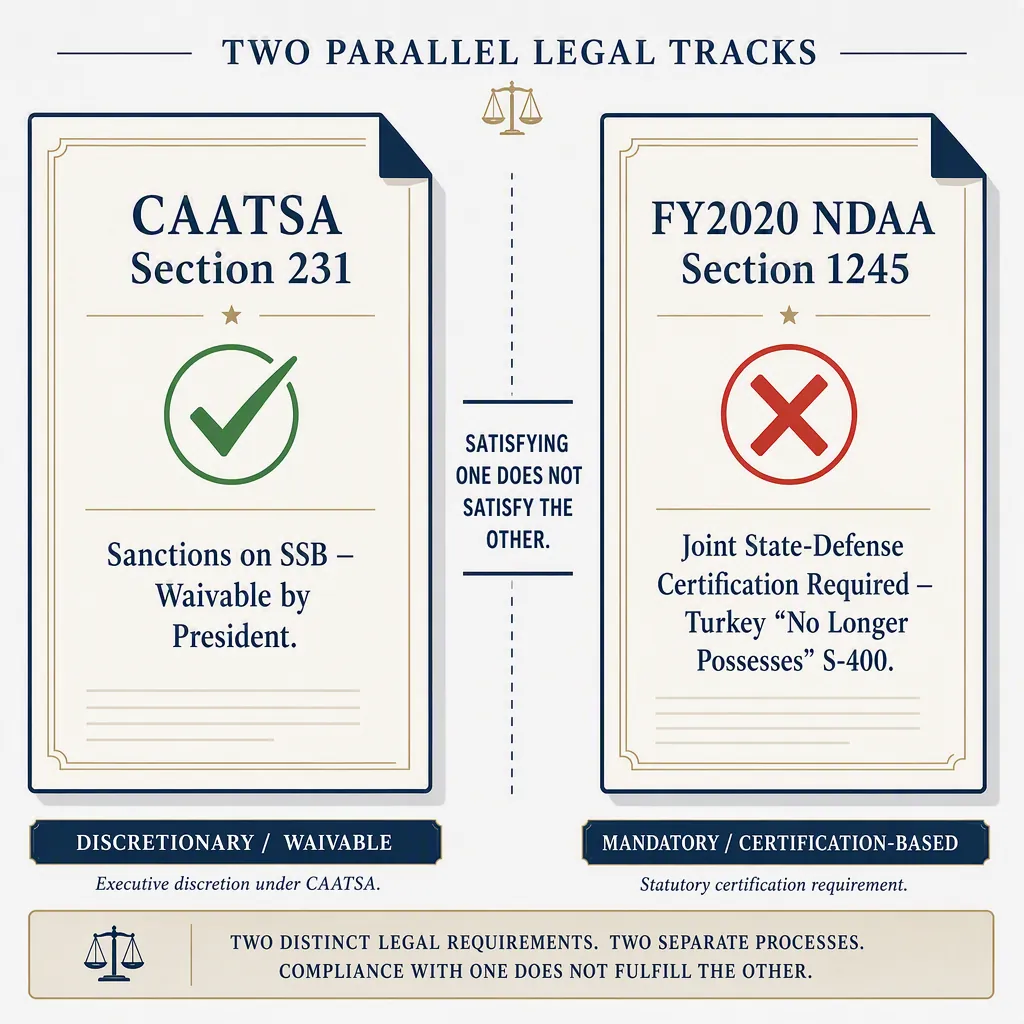
That distinction is the part most likely to disappear in a headline. CAATSA relief may be necessary before any sale can move safely through the executive branch and industry compliance channels. It is not sufficient. Section 1245 remains an independent statutory command.
CAATSA relief can remove one sanctions problem
CAATSA Section 231 is the sanctions framework triggered by significant transactions with Russia’s defense or intelligence sectors. In Turkey’s case, the relevant sanctions were imposed over the S-400 acquisition and targeted SSB. CRS’s July 2026 summary explains that sanctions relief can involve waiver authority and congressional review, with the review period depending on timing: 30 days or 60 days depending on when the notification is submitted.[2]
That timing matters for anyone trying to model a transaction calendar. A defense contractor cannot treat a presidential statement as a license, and congressional staff cannot treat a waiver discussion as the same thing as aircraft transfer authority. CAATSA relief may clear sanctions exposure around SSB, but the F-35 question then runs into another statute.
There is also a narrower CAATSA waiver issue that should not be inflated. CRS describes modified waiver authority connected to the S-400 activity, including a possible certification that the activity would not significantly increase the risk of compromising U.S. defense systems.[2] That is a hard fit with the long-running U.S. concern that S-400 access could compromise F-35 stealth and operational data. But even if CAATSA relief were lawfully achieved, the Section 1245 bar would still have to be satisfied.
Section 1245 asks who possesses the S-400
Section 1245 of the FY2020 NDAA is the center of the analysis because it does not ask whether Turkey’s S-400 is politically inconvenient, diplomatically embarrassing, or temporarily inactive. As summarized by CRS, it bars the transfer of F-35 aircraft to Turkey unless the Secretaries of State and Defense jointly certify, among other things, that Turkey no longer possesses the S-400.[2]
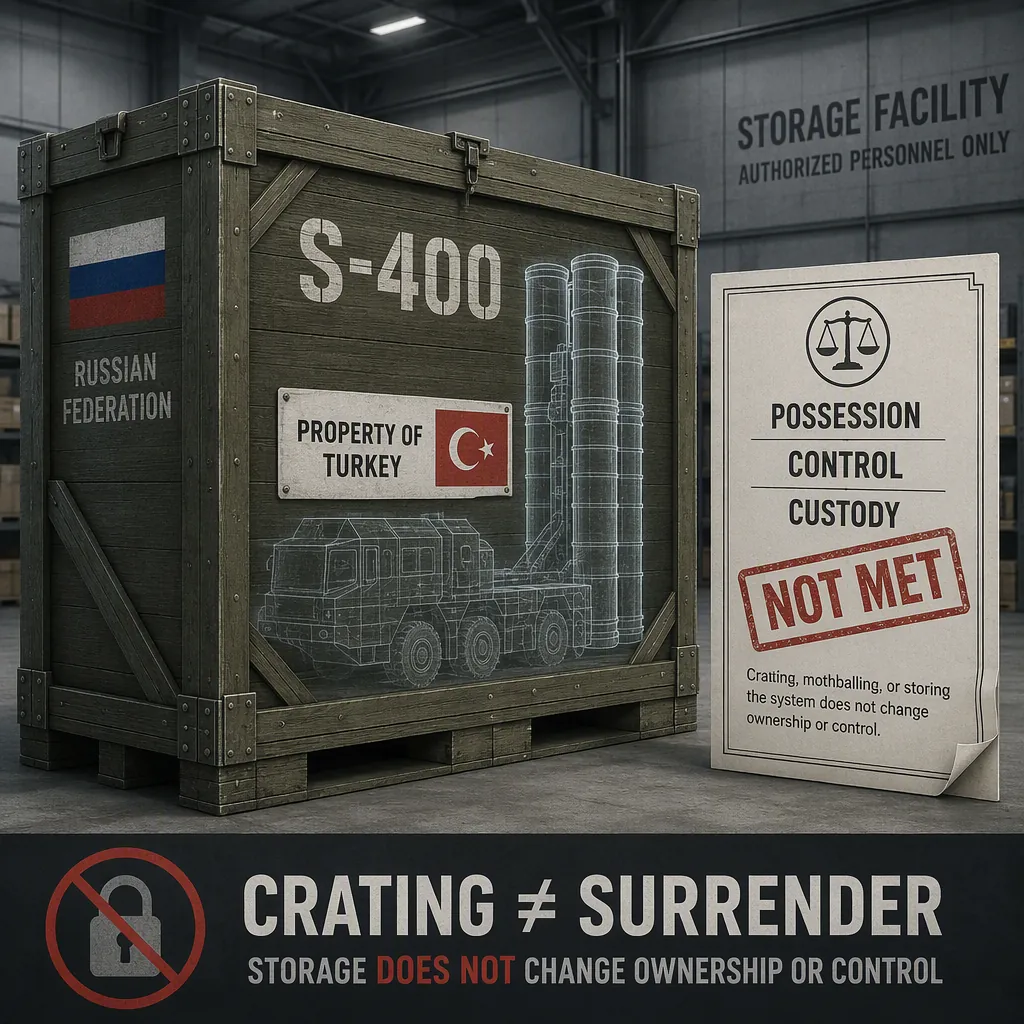
That phrase should be read as a possession, control, and custody condition. JINSA’s July 9 analysis states the point cleanly: “a crated S-400 is still possessed by the government that owns it and can uncrate it.”[3] The legal defect is not cured by changing the system’s operational posture if the Turkish government still owns it, stores it, guards it, can restore it, or can decide when another party may access it.
This is not a semantic quibble. Administrable legal standards matter in export-control and defense-transfer practice because agencies and companies need to know what fact they are clearing. “No longer possesses” gives them a concrete fact pattern to verify. “Temporarily not using” or “presently inoperable” does not.
The executive branch has not treated the statutory condition as satisfied. The Jerusalem Post reported that, in a July 22, 2026 letter to Congress, the State Department said Turkey “has not yet met these conditions” for receiving the F-35.[4] Because the reporting is mediated through The Jerusalem Post rather than a publicly available full letter text in the research record, it should be cited with that limitation. Still, for present clearance purposes, it is the most important current executive-branch statement: as of July 22, the government was not saying the Section 1245 gate had opened.
Why the familiar workarounds do not carry the certification
Most proposed compromises fail for the same reason: they change the condition of the S-400, not the fact of possession. The statutory question is not whether the system is embarrassing to display, whether its radar is powered on, or whether its missiles are ready. The question is whether Turkey still possesses it.
Crating or mothballing
Crating is visually appealing because it lets officials say the system is not deployed. It does not answer the possession question. If the crate is Turkish property, on terms controlled by Turkey, and capable of being reopened by Turkey, the legal fact remains possession. JINSA’s analysis is especially useful here because it separates operational availability from legal custody instead of treating the crate as a diplomatic symbol.[3]
Relocating the system to Incirlik
Moving the S-400 to Incirlik or another controlled location may create monitoring opportunities, but location is not ownership. Unless the arrangement removes Turkish possession rather than merely supervising it, the same Section 1245 problem remains. A U.S.-linked or NATO-linked facility does not automatically convert Turkish custody into non-possession.
Removing a component and calling the system inoperable
The “inoperable” proposal has been circulating since at least September 2025. AEI reported on a possible approach under which Turkey would declare the S-400 inoperable by removing a component, while warning that such a step would be reversible and could set a precedent other states might cite.[6]
For Section 1245, reversibility is the problem. If the missing component can be restored and Turkey retains ownership or access rights over the system, the arrangement looks like suspended use, not relinquished possession. A certification that Turkey “no longer possesses” the S-400 would have to rest on more than a present-tense declaration that the system cannot be fired today.
Third-country transfer
A genuine third-country transfer is different. If Turkey transferred ownership and control of the S-400 to another state, that could plausibly support a finding that Turkey no longer possesses the system. It is the only workaround in the current public discussion that attacks the statutory fact rather than the optics.
Even then, the route is unresolved. The research record notes that such a transfer could face constraints under Russian end-user arrangements and would require Russia’s consent. Without a completed transfer that actually removes Turkish ownership, custody, and restoration authority, it remains a possible legal theory rather than a cleared transaction.
Congress is not just a spectator
The congressional record around a possible Turkey F-35 sale is already active. The Hill reported that a July 2 bipartisan Lawler-Sherman letter had 10 House members, a July 7 Titus letter had 18 House Democrats, Sen. John Cornyn publicly opposed providing F-35s to Turkey, and Reps. Chris Pappas and Gus Bilirakis sought answers from the State Department.[5]
Those letters do not themselves decide the Section 1245 question. They do show why a clean legal theory matters. If the administration tries to move from sanctions relief to aircraft transfer on a workaround theory, the fight will not be only about foreign policy. It will be about whether the required certification can be made on the facts available.
Israel and QME issues would remain separate fallback barriers
The legal implications for Israel should not be folded into the CAATSA issue either. Israel’s qualitative military edge, Israeli-linked F-35 subsystem concerns, and broader congressional alliance politics may all matter to a final sale. They are independent barriers and bargaining points, not substitutes for the Section 1245 certification.
That sequencing matters. If Turkey still possesses the S-400, the F-35 transfer remains barred before the analysis needs to reach the hardest Israel-related questions. If Turkey somehow resolves the possession problem through a real transfer out of its control, then QME review, technology sensitivities, congressional notification, and alliance strategy would become more important. They do not erase the current statutory gate.
The clearance memo answer
A careful clearance memo should separate the answer into two lines. First: CAATSA Section 231 relief may remove sanctions-related obstacles involving SSB, subject to the applicable waiver, certification, notification, and congressional review rules. Second: Section 1245 of the FY2020 NDAA independently bars an F-35 transfer unless the Secretaries of State and Defense jointly certify that Turkey no longer possesses the S-400.
As of late July 2026, the second line is not satisfied on the public record. The State Department letter reported on July 22 says Turkey has not yet met the conditions, and the most discussed workarounds do not remove Turkish possession if Turkey keeps ownership, custody, or the practical ability to restore access. Lifting CAATSA may open the first lock. It does not open the second.
References
- Trump says US will lift sanctions on Turkey, heaps praise on Erdogan, Reuters, July 7, 2026
- Turkey (Türkiye): Possible F-35 Sale and Sanctions Relief, EveryCRSReport.com
- After Ankara: Lifting CAATSA Doesn't Unlock the F-35 for Turkey, JINSA, July 9, 2026
- Turkey does not meet legal requirements to receive F-35, State Department says, The Jerusalem Post, July 22, 2026
- Trump faces fight over lifting Turkey sanctions, supplying F-35s, The Hill, July 2026
- Scoop: Turkey to Declare S-400 "Inoperable" to Gain F-35 Stealth Fighter Deal, AEI, September 2025
Operationalizing workflow
No workflow has been explicitly linked to this obligation yet. See Workflows generally.
Illustrative cases
No illustrative case is currently tracked for this obligation. See Risk Digest for documented incidents generally.
← Back to RegulationReport a correction or tip
Spotted an outdated figure, a misstated fact, or a ruling this regulation entry should reflect? Public comments are disabled for this content given the professional cost of a misreported case outcome, penalty amount, or rule text — use the structured correction channel instead.
Report a correction or tip for this record →