
Three Regulatory Regimes for Samsung Galaxy Card AI Credit Scoring
- Effective date
- Jul 21, 2026
The Samsung Galaxy Card is still a proposed product, not a live credit program. The public anchors are narrow: a Samsung Galaxy Card trademark application filed with the USPTO on February 12, 2026, reporting that Barclays is expected to partner on the card, and no confirmed launch date, rewards structure, credit criteria, or underwriting method. The prior Samsung Financing program ended on December 31, 2024, but that fact does not answer how a future card would evaluate applicants or whether any machine-learning model would be used in credit scoring or underwriting.[1]
That uncertainty matters. The legal and regulatory implications of AI credit scoring for a Samsung Galaxy Card cannot be assessed as if the product already exists. The safer analysis is a pre-compliance roadmap: if Samsung, Barclays, or a vendor uses AI or machine-learning techniques to score applicants, segment risk, detect fraud in a way that affects approval, or support credit-line assignment, the legal work has to be mapped before launch materials harden into product commitments.

| Launch-readiness fact | Current status |
|---|---|
| Product status | Samsung Galaxy Card has not launched. |
| Public product anchors | USPTO trademark filing dated February 12, 2026, and reported Barclays partnership. |
| Prior Samsung consumer-finance program | Samsung Financing ended December 31, 2024. |
| Unknowns that control the legal analysis | Underwriting method, model type, data inputs, adverse-action process, vendor roles, and launch jurisdictions. |
| Important separation | Samsung Card in Korea should not be treated as evidence of the U.S. Galaxy Card’s design; it is a separate entity from Samsung Electronics’ U.S. initiative. |
The problem is not one AI rulebook
A U.S. card launch in 2026 would run into three regulatory clocks that are close enough to belong on the same readiness chart, but different enough that one workstream will not satisfy all of them. Colorado’s AI Act becomes effective June 30, 2026. The CFPB’s Regulation B final rule becomes effective July 21, 2026. The EU AI Act’s high-risk obligations for credit-scoring AI become applicable August 2, 2026.[2][3][4]
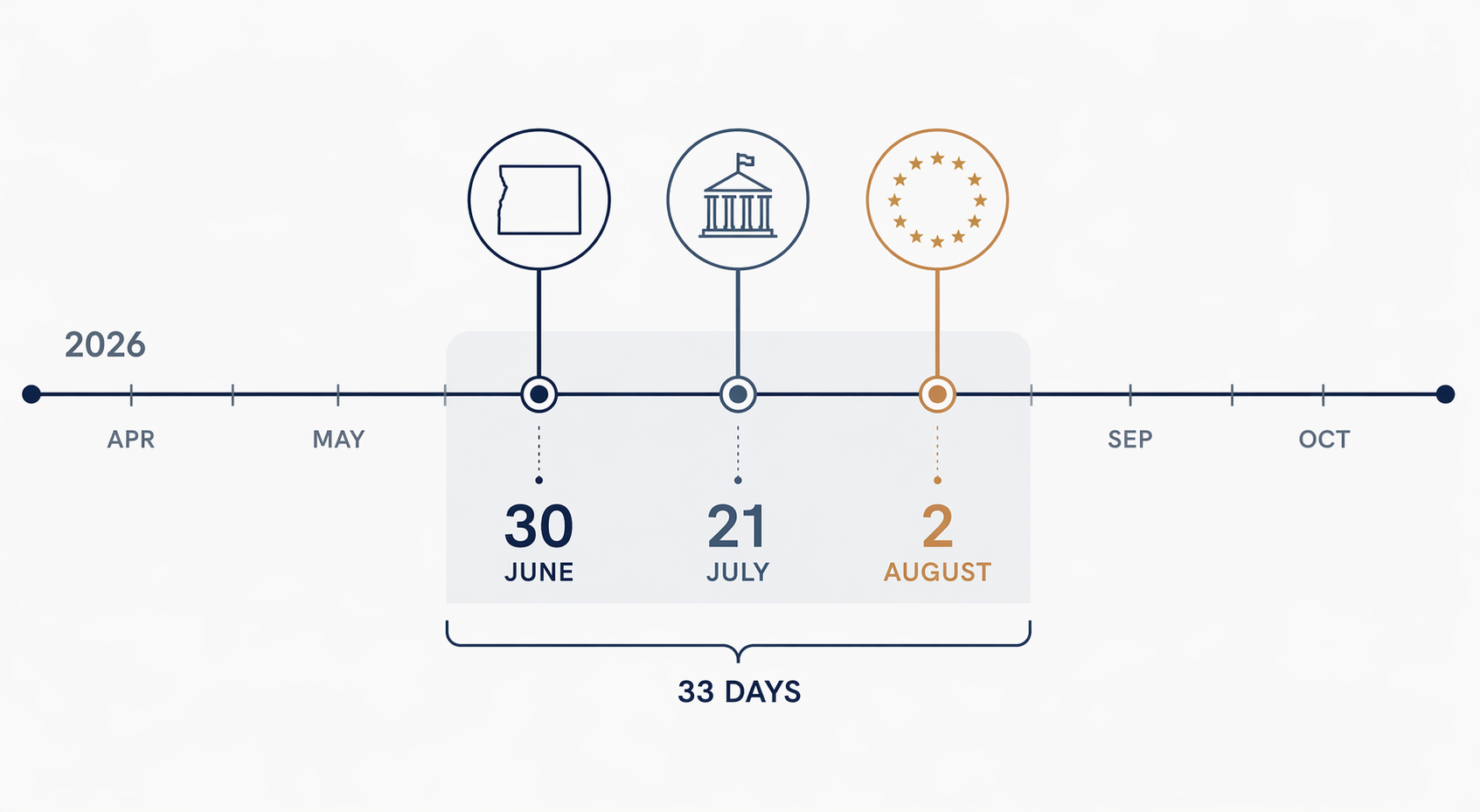
The dates are the nuisance. A team can describe them as privacy, fair lending, AI governance, and credit-notice issues, but an applicant denied in August 2026 will not experience them as separate legal taxonomies. The applicant will want to know what data mattered, why the decision came out the way it did, whether a person can review it, and whether the explanation is specific enough to be useful.
| Regime | Mid-2026 trigger | What it pressures before launch |
|---|---|---|
| U.S. federal: ECOA / Regulation B | CFPB final rule effective July 21, 2026 | Specific adverse-action reasons remain necessary even though the final rule removes disparate-impact liability under ECOA. |
| U.S. state: Colorado and other state AI rules | Colorado AI Act effective June 30, 2026 | Credit decisions can be consequential decisions requiring governance, impact assessments, and consumer notice. |
| EU: AI Act and GDPR | EU AI Act high-risk credit-scoring obligations effective August 2, 2026 | Credit-scoring AI falls into the high-risk category; determinative scoring may also raise GDPR Article 22 issues. |
Federal law still asks for a reason, not just a model output
The CFPB’s April 22, 2026 Regulation B final rule is easy to misread if it is reduced to a headline. The rule eliminates disparate-impact liability under ECOA, but it does not eliminate the adverse-action notice obligation or the requirement to provide specific reasons when credit is denied or otherwise adversely affected.[2]
For an AI-enabled Galaxy Card underwriting process, that distinction is operationally important. A lender cannot solve the notice problem by saying that an algorithm ranked the applicant below an approval threshold. The CFPB had already warned in 2023 that creditors using complex algorithms must still provide accurate and specific statements of reasons for adverse action; boilerplate reasons or generic references to a scoring system do not do the work.[5]
The hard case is not a conventional scorecard where a few variables plainly move the result. It is a model that ingests many signals, uses interactions that are hard to summarize, and produces a denial or less favorable credit term. If the system cannot translate its output into reasons a consumer can understand and a compliance team can defend, the model is not launch-ready for credit decisioning merely because its validation metrics look attractive.
This is also where vendor management becomes more than procurement hygiene. If a bank partner or third-party model provider controls the features, documentation, or explanation layer, the card program still needs an adverse-action process that works at the point of denial. The party facing the applicant cannot wait until a regulator, examiner, or plaintiff asks how the model selected the stated reasons.
The final rule is not procedurally quiet. It drew more than 64,500 comments, and the CFPB’s 2026 rulemaking may face litigation risk. That does not make the July 21, 2026 effective date irrelevant; it means launch planning should avoid treating the federal layer as settled in every respect while still building for the adverse-action requirements that remain central.[2]
State AI laws turn the same decision into a governance file
Colorado’s AI Act changes the launch-readiness file because credit decisions fit within the category of consequential decisions. For a high-risk AI system used in that context, the compliance burden is not limited to the consumer-facing denial notice. The program needs governance controls, impact assessments, and consumer notice before the system is put into consequential use.[3]
That is a different discipline from federal adverse-action drafting. A federal notice asks whether the applicant received specific reasons. A Colorado-style governance review asks whether the deployer identified foreseeable risks, documented how the system is controlled, and created a record that can be inspected after the launch decision has already been made. Both records may refer to the same model, but they are not substitutes for each other.
California adds another pressure point through automated decisionmaking regulations that create opt-out, access, and appeal rights. For a card application flow, those rights raise design questions that have to be answered in the product itself: where the notice appears, what the applicant can access, what happens when an appeal is requested, and whether the review is meaningful rather than a second pass through the same automated pathway.[6]
Texas HB 149 moves differently. It prohibits discriminatory AI intent rather than simply copying another state’s impact-assessment structure. That matters because a national card program cannot assume that one state-law memo will cover all state AI obligations. Some states will ask for governance artifacts, some will emphasize consumer rights, and some will frame liability around discriminatory purpose or prohibited design choices.[6]
The failed federal preemption attempt in the One Big Beautiful Bill Act is part of the same state-law story. Goodwin’s analysis notes that the Senate voted on July 1, 2025, in a way that left state AI regulation in the field rather than replacing it with a broad federal moratorium. For 2026 product planning, the result is practical: state AI compliance cannot be parked as an edge case until Congress says otherwise.[6]
What the same AI denial would need to show
Assume, hypothetically, that a Galaxy Card application is denied after an ML model evaluates credit bureau data, account-behavior signals, and fraud-risk indicators. The example is not a claim about Samsung’s actual design; the underwriting method is unknown. It shows why the legal work fragments quickly once a model affects approval.
| Question | Federal ECOA / Regulation B | State AI governance | EU AI Act / GDPR |
|---|---|---|---|
| What must be explainable? | The specific reasons for adverse action, not merely the existence of an automated score. | The system’s role in a consequential decision and the risks identified through governance review. | The high-risk AI system’s operation, risk controls, and, where applicable, meaningful information about automated decision-making. |
| What must be documented? | Notice logic, reason-code mapping, validation support, and creditor procedures. | Impact assessments, governance controls, consumer notices, and escalation processes. | Risk-management system, data governance, technical documentation, logging, human oversight, and conformity-related records. |
| What must the consumer receive? | A specific adverse-action explanation when required. | Notice and, depending on the state, access, opt-out, or appeal mechanisms. | Required AI Act transparency information and GDPR rights where automated decision rules apply. |
| What cannot be assumed? | That removal of disparate-impact liability removes explainability duties. | That one state’s framework satisfies every state’s AI law. | That a U.S. launch model can be reused in the EU without high-risk AI and GDPR analysis. |
The table is deliberately uneven because the regimes are uneven. Regulation B is most immediate at the point of denial. Colorado is more concerned with the system’s governance before it produces the denial. California-style rights force the applicant journey to include access and appeal mechanics. The EU framework, if the product enters that market or uses a comparable model there, adds a high-risk AI compliance architecture rather than a single notice requirement.
The EU layer is real, but it should not be imported casually
The EU AI Act expressly treats AI systems used to evaluate creditworthiness or establish a person’s credit score as high-risk under Annex III point 5(b), with the relevant obligations becoming applicable on August 2, 2026.[4]
That classification carries a heavier compliance file than many U.S. discussions of AI credit scoring. A high-risk credit-scoring system may need risk management, data governance, technical documentation, logging, transparency, human oversight, accuracy, robustness, cybersecurity controls, and post-market monitoring. Decode the Future’s 2026 breakdown of EU AI Act credit-scoring rules treats these as structured obligations for credit providers rather than soft best practices.[4]
GDPR Article 22 can also enter the analysis when a credit score is determinative. In the Schufa decision, the Court of Justice of the European Union held that automated credit scoring may constitute an automated individual decision under Article 22 where the score plays a determining role in a lender’s decision.[7]
The caveat is just as important as the rule. Nothing in the current Galaxy Card materials confirms an EU launch, an EU applicant flow, or reuse of any U.S. model in Europe. The EU analysis belongs in the roadmap because global product and model reuse decisions are often made early. It does not support a claim that the proposed U.S. Galaxy Card is already subject to the EU AI Act.
The pre-launch file should be built around decisions, not labels
A launch team does not need to settle whether the product narrative says “AI,” “machine learning,” “advanced analytics,” or “automated underwriting” before it starts the legal map. The better starting point is simpler: identify every automated or model-assisted step that can affect approval, denial, pricing, credit-line size, identity verification, fraud treatment, or post-application review.
- Inventory each model, rule engine, vendor score, and decision layer that can influence a credit outcome.
- Separate eligibility, fraud screening, credit underwriting, pricing, credit-line assignment, and account-management decisions.
- Map the legal owner for each decision: issuing bank, Samsung affiliate, processor, model vendor, servicing partner, or shared control.
- Test whether adverse-action reason codes are specific, stable, and defensible for the actual model outputs.
- Build state-by-state consumer notice, access, opt-out, and appeal logic before finalizing the application flow.
- Decide early whether any EU launch, EU data processing, or EU model reuse is in scope.
This is where a partnership structure can create quiet risk. A bank may own the credit decision for ECOA purposes. A technology company may own the consumer interface. A vendor may own the model documentation. A processor may own parts of the application workflow. The applicant sees one card program. Regulators and plaintiffs will ask who made which decision, who had which information, and who could have prevented a defective notice or review process.
Venable’s 2026 analysis of AI use cases in financial services points to the same operational spread: AI may appear in underwriting, fraud detection, servicing, marketing, and risk management, each with different legal consequences. Treating “AI credit scoring” as a single system can miss the places where a non-underwriting model still changes an applicant’s practical access to credit.[8]
Where launch language should stay narrow
There are several claims the current record will not support. It does not support saying that Samsung or Barclays will use AI credit scoring. It does not support saying that a Galaxy Card will launch in the EU. It does not support importing facts about Samsung Card in Korea into the U.S. initiative. It does not support assuming that a Barclays partnership, if finalized, answers the model-governance question.
It also would be too quick to treat the CFPB’s 2026 rule as a compliance release valve. Removal of ECOA disparate-impact liability, if it remains in place, affects one theory of liability. It does not make opaque models easy to explain. It does not erase state AI governance duties. It does not change the EU AI Act’s high-risk classification for credit scoring. It does not make a deficient adverse-action notice specific.
White & Case’s global regulatory tracker captures the broader reason this matters: AI regulation is moving through overlapping national, regional, and sector-specific channels rather than one harmonized route. For a branded card program, the result is not abstract regulatory complexity. It is a launch checklist in which the same model has to be explainable to one audience, documented for another, and governed under a third.[9]
A defensible roadmap before the card goes live
The practical roadmap starts with a controlled assumption: if AI or machine learning touches credit decisioning, build as though adverse-action explanations, impact assessments, consumer-rights workflows, and high-risk AI documentation may all be needed. The work can later be narrowed if the product uses only conventional underwriting or launches in fewer jurisdictions. It is harder to add explainability, appeal routing, model documentation, and governance approvals after marketing, engineering, and banking-partner timelines are already locked.
For Samsung and Barclays, the legal question is not whether AI credit scoring is permissible in the abstract. It often is, if the system is governed, validated, explainable where the law requires explanation, and embedded in a consumer process that can withstand denial, access, and appeal demands. The immediate issue is timing. Colorado, the CFPB, and the EU AI Act all become operationally relevant within weeks of one another in mid-2026, but they do not collapse into a single compliance standard.
Until the Galaxy Card’s underwriting method is confirmed, the responsible conclusion is limited: a potential AI-enabled card program needs a unified pre-compliance roadmap before launch, with separate treatment for federal adverse-action duties, state AI governance and consumer rights, and EU high-risk credit-scoring obligations if Europe enters scope.
References
- Samsung Galaxy Card trademark report, Android Authority, link
- Regulation B; Equal Credit Opportunity Act, Federal Register, April 22, 2026, link
- Colorado Artificial Intelligence Act, Colorado General Assembly, link
- The Seven Rules of Credit Scoring Under the EU AI Act, Decode the Future, April 2026, link
- Consumer Financial Protection Circular 2023-03: Adverse action notification requirements and the proper use of the CFPB’s sample forms provided in Regulation B, CFPB, September 2023, link
- The Evolving Landscape of AI Regulation in Financial Services, Goodwin LLP, June 2025, updated July 2025, link
- SCHUFA Holding and Others (Scoring), Court of Justice of the European Union, December 7, 2023, link
- AI Use Cases and the Regulatory Road Ahead in Financial Services, Venable LLP, February 2026, link
- AI Watch: Global regulatory tracker, White & Case LLP, link
Operationalizing workflow
No workflow has been explicitly linked to this obligation yet. See Workflows generally.
Illustrative cases
No illustrative case is currently tracked for this obligation. See Risk Digest for documented incidents generally.
← Back to RegulationReport a correction or tip
Spotted an outdated figure, a misstated fact, or a ruling this regulation entry should reflect? Public comments are disabled for this content given the professional cost of a misreported case outcome, penalty amount, or rule text — use the structured correction channel instead.
Report a correction or tip for this record →