
Three categories define legal challenges to AI data center zoning
- Effective date
- Jul 20, 2026
The hard part about tracking legal challenges to AI data center zoning laws is that the headlines flatten cases that have very different legal lives. A resident appeal over a zoning classification, a developer’s federal civil rights complaint after a county pause, and a Clean Air Act citizen suit over gas turbines may all be described as “data center opposition.” They do not move through the same forum, ask for the same remedy, or create the same settlement pressure.
That distinction matters now because the volume is no longer anecdotal. Data Center Watch reported $64 billion in data center projects blocked or delayed between May 2024 and March 2025, a useful but bounded top-line figure rather than a current national inventory.[1] WilmerHale’s July 2026 overview groups the emerging litigation into nuisance, environmental, and land-use tracks, while the AI Lawsuit Tracker’s infrastructure database collects case-level developments across those tracks through 2026.[2][3] Read together, they point to a practitioner problem: the cases look similar only until pleadings, statutes, and remedies are placed side by side.

As of Q3 2026, the cleaner map has three working categories: community challenges to approvals, developer countersuits against denials or pauses, and environmental or nuisance claims. The categories blur at the margins, especially when zoning opponents also plead environmental-review defects or nuisance theories. Still, they should be tracked separately because the legally durable lever changes with the category.
| Litigation track | Typical plaintiff | Legal center of gravity | Forum and remedy to watch |
|---|---|---|---|
| Community zoning challenges | Residents, neighborhood groups, or local organizations | Zoning classification, notice, rezoning procedure, administrative record | State or local review; vacatur, remand, injunction, or renewed hearings |
| Developer countersuits | Data center developer or landowner | Exclusionary zoning, takings, § 1983, Telecommunications Act § 253, Dormant Commerce Clause, ultra vires action | State and federal court; declaratory relief, injunction, damages, settlement, ordinance repeal |
| Environmental and nuisance claims | Environmental groups, community groups, neighbors, or putative classes | Air permitting, environmental review, emergency relief, private nuisance | Federal environmental litigation, state environmental review, TRO practice, class actions |
Community challenges turn on the record before they turn on the project
Community zoning challenges are the most familiar entry point. They usually begin after a local board approves a rezoning, special use, site plan, or classification that residents say should not have survived the governing ordinance or the required procedure. The remedy is usually aimed at the approval itself: undo it, pause it, send it back, or require the municipality to follow the process it skipped.
The Lansing, New York challenge illustrates why classification can matter more than generalized opposition. A judge allowed a lawsuit challenging a proposed AI data center to proceed, with the dispute turning on whether the project fit the zoning category used to approve it.[4] That kind of ruling is not a merits judgment that the project is unlawful. It is more useful than that for practitioners: it shows that a classification argument can keep a community challenge alive long enough to force judicial review of the local record.
In Stokes County, North Carolina, community groups and residents filed suit over a data center rezoning, alleging defects in the county’s rezoning process.[5] The legal pressure there is procedural rather than technological. If a challenger can identify a notice failure, hearing defect, voting problem, or mismatch between the record and the ordinance, the court has a manageable task. It does not need to decide whether AI infrastructure is good local policy; it can decide whether the county lawfully reached the approval.
Prince William County, Virginia, and Coweta County, Georgia sit in the same track, with challenges identified in the AI Lawsuit Tracker as approval-side disputes involving notice or procedural issues.[3] Those cases are worth separating from broader anti-development campaigns because a curable procedural defect and a substantively unlawful approval do not create the same leverage. A municipality may be able to re-notice, rebuild the record, and vote again. A developer may tolerate delay if the corrected record becomes harder to attack.
For residents, the lesson is unforgiving. Appeal rights can expire while public debate is still focused on water, noise, or taxes. For municipalities, the risk is almost the mirror image: an approval that looks politically settled can remain legally vulnerable if the record does not show the ordinance path, the required findings, and the procedural steps in a way a reviewing court can use.
Developer countersuits are moving faster than the moratorium playbook
The newer pressure is coming from the other direction. Developers are no longer only defending approvals; in several cases they are suing municipalities over denials, moratoria, categorical restrictions, or alleged obstruction. That shift changes the litigation posture. A local government that once controlled timing through a pause or refusal may find itself defending the scope of its own power in state or federal court.
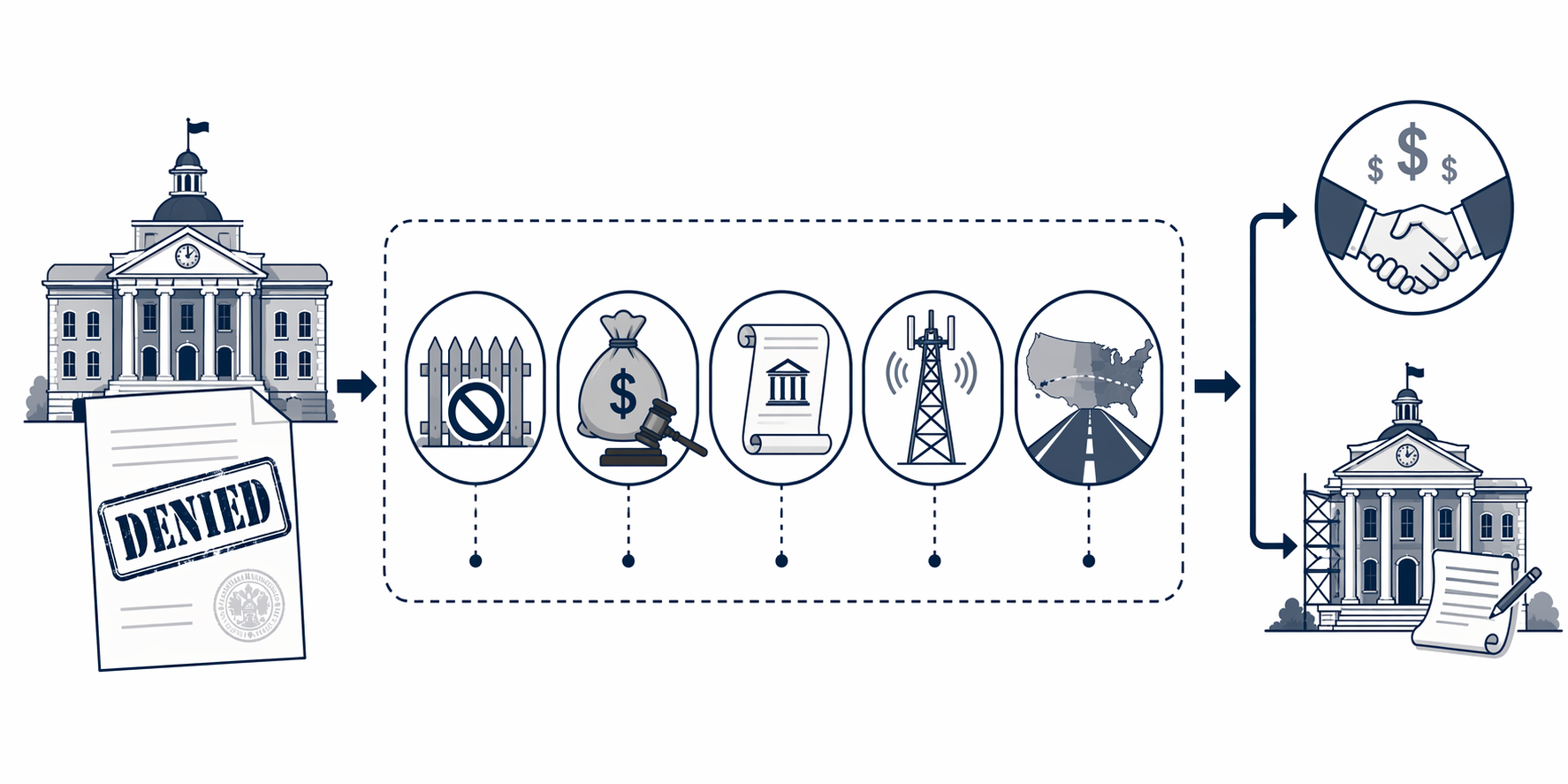
Related Digital v. Saline Township is the current template because it converted local resistance into an exclusionary-zoning challenge with a concrete settlement outcome. The dispute involved a proposed data center in Saline Township, Michigan, and settled with roughly $14 million in community benefits, according to Planet Detroit’s September 2025 account.[6] The number should not be treated as a universal price for resolving these fights. Its importance is doctrinal and strategic: the case showed that a developer could use state-law land-use principles to challenge a local posture that allegedly left no lawful place for the use.
That is a different animal from a routine permit appeal. An exclusionary-zoning theory asks whether the municipality has effectively barred a lawful land use rather than merely imposed conditions on one site. If the theory has a plausible statutory or constitutional home, the dispute can become less about whether a particular hearing was contentious and more about whether the ordinance structure can survive review.
Hill County, Texas supplies the second early signal. RCM Hill LLC filed federal litigation after the county adopted a blanket pause on data center construction, raising takings and related constitutional concerns; the county then repealed the pause and adopted new approval procedures instead.[7] K&L Gates described the pivot as part of a broader move away from categorical prohibitions and toward “process-driven regulatory layering.”[7] That phrase captures the practical consequence better than a win-loss label does. The case did not produce a mature appellate rule, but it changed municipal behavior.
Blanket pauses are attractive because they buy time. They are also easy targets because they can look like a denial without the discipline of a denial record. A county attorney defending a moratorium has to explain the source of authority, the duration, the relationship to a legitimate planning process, and the burden placed on pending applications. If the pause reaches projects that have already invested in land, interconnection, engineering, or permit sequencing, the damages and takings vocabulary arrives quickly.
| Case | Developer-side theory or posture | Early outcome to track |
|---|---|---|
| Related Digital v. Saline Township, Michigan | Exclusionary-zoning challenge | Settlement with roughly $14 million in community benefits |
| RCM Hill LLC v. Hill County, Texas | Challenge to blanket pause, including takings concerns | Pause repealed; county shifted to new approval procedures |
| Imperial Valley Computer Manufacturing v. City of Imperial, California | § 1983 civil rights allegations and coordinated-obstruction theory | Ongoing as of the April 2026 reporting |
| TenKey LandCo v. Simpson County, Kentucky | Ultra vires challenge to county land-use ordinance | Ongoing as of January 2026 reporting |
The Imperial Valley case pushes the category into federal civil rights territory. Imperial Valley Computer Manufacturing sued the City of Imperial, California, alleging coordinated obstruction of a proposed data center project; the case was reported in April 2026 as an ongoing civil rights lawsuit.[8] On the available public reporting, the case should not be overread as proof that local opposition commonly becomes actionable obstruction. Its value is narrower: it shows how a developer may try to translate a local approval breakdown into a § 1983 theory when it believes municipal actors moved beyond ordinary land-use discretion.
TenKey LandCo v. Simpson County, Kentucky gives the map a different state-law lever. TenKey sued Simpson County over a land-use ordinance, arguing that the county exceeded its authority; the dispute was reported in January 2026 as an ultra vires challenge.[9] Ultra vires claims are not glamorous, but they are often the first thing to check. If a county lacks authority to adopt the restriction it chose, the policy debate is secondary.
The remaining developer theories are not interchangeable. A Telecommunications Act § 253 theory depends on whether the local measure prohibits or has the effect of prohibiting telecommunications services. A Dormant Commerce Clause theory asks whether the locality has burdened interstate commerce in a constitutionally meaningful way. A Fifth Amendment takings claim requires attention to property interest, economic impact, duration, and ripeness. A § 1983 complaint needs a violated federal right, not merely a frustrating board meeting. Those are different doors, and a developer that walks through the wrong one only gives the municipality a cleaner dismissal.
Still, the direction of travel is visible. Saline and Hill County are not appellate landmarks, and neither should be cited as if it settled the legality of local data center restrictions nationwide. But they are early examples of developer-side litigation creating settlement value or ordinance revision before a fully developed merits ruling. That is why this category deserves more attention than another count of angry public hearings.
Environmental and nuisance claims use a different set of pressure points
Environmental and nuisance claims should not be treated as decorative add-ons to zoning disputes. They create different exposure because they can proceed even when a project has land-use approval, and they often focus on operations rather than entitlement. The pressure points are emissions classification, environmental review, emergency injunctive relief, and private nuisance damages.
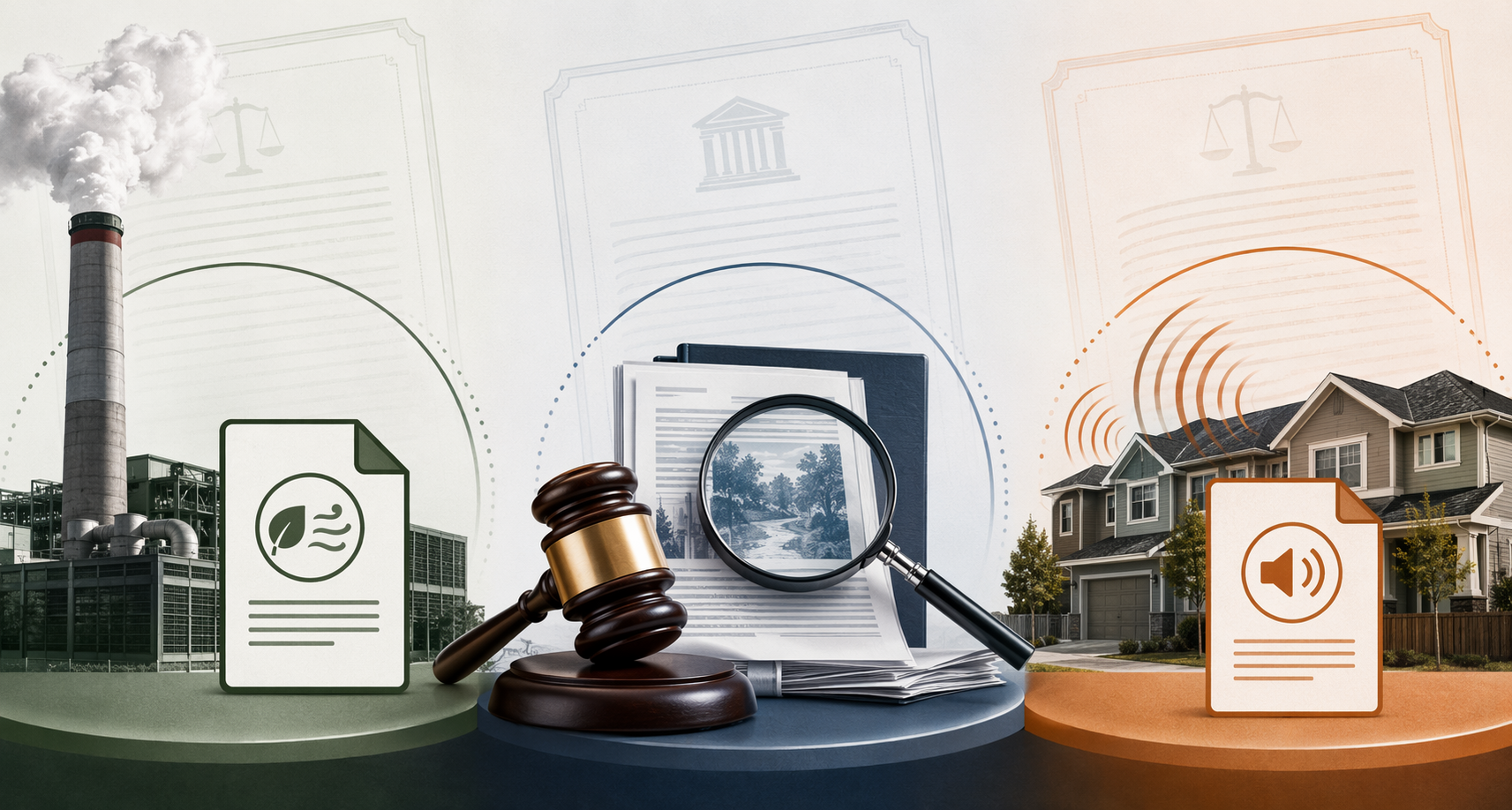
NAACP v. xAI is the key Clean Air Act test in the current materials. The case challenges emissions associated with gas turbines used to support xAI’s data center operations, with a live issue over whether the turbines fit the relevant mobile-source or stationary-source framework.[10] That classification question is not a side detail. It determines which regulatory pathway applies and whether the plaintiffs’ Clean Air Act theory has the statutory footing needed to support citizen-suit relief.
Permitting risk is broader than that one case. Hunton Andrews Kurth has warned that the rise of data centers brings environmental permitting challenges and litigation risk, especially where power generation, water use, construction impacts, or emissions controls intersect with project schedules.[11] The caution is general, but it points to a practical litigation sequence: entitlement counsel may win the zoning vote while environmental counsel is still defending the permit architecture that makes the facility operable.
MCEA v. Pine Island, Minnesota adds emergency relief to the tracker. The case involved a TRO halting a Google data center in May 2026, according to the infrastructure litigation materials.[2][3] A temporary restraining order is not a final judgment, but it has immediate commercial consequences. It can stop mobilization, interrupt construction sequencing, and force parties to litigate the sufficiency of environmental review on a compressed record.
The noise cases belong in the same family but should be handled with less drama unless their procedural posture develops. The research materials identify nuisance class actions in Mississippi, New Jersey, Michigan, and Texas.[2][3] Those suits are recurring exposure because neighbors can plead operational interference even after a facility is built. They are not, on the current materials, a single doctrinal wave with one leading rule. For counsel, the immediate use is risk screening: cooling systems, backup generation, setback choices, acoustic modeling, and complaint-response records may matter as much as the original zoning file.
Forum and remedy are doing more work than the label “opposition”
The same public controversy can generate more than one lawsuit. A community group may challenge a rezoning in state court. A developer may file a federal complaint over a moratorium. An environmental organization may pursue permitting or emissions claims. A nearby resident may bring nuisance claims after operations begin. The party with leverage changes as the project moves from entitlement to construction to operation.
- For community challengers, the early question is whether the approval record preserves a reviewable defect.
- For municipalities, the early question is whether a pause, ban, or denial has a statutory basis and a defensible record.
- For developers, the early question is whether local resistance is merely political delay or a legally cognizable injury.
- For environmental plaintiffs, the early question is whether the claim fits a permitting, emissions, review, or nuisance framework that can support meaningful relief.
That is also why state legislative activity does not displace the local litigation map. MultiState reported in 2026 on the collision between state data center legislation, local zoning battles, and federal AI infrastructure policy resistance.[12] State statutes may preempt, constrain, encourage, or complicate local authority, depending on their wording. They do not eliminate the need to ask whether the plaintiff has chosen the right forum and remedy for the specific municipal action at issue.
The most important near-term change is not that developers are destined to win. The record is too young, and several cited cases remained at early procedural stages as of mid-2026. The change is that developer countersuits have already made categorical bans and indefinite pauses more expensive to defend. Municipalities that still want control are moving toward layered approval procedures, technical standards, environmental conditions, and record-building instead of blunt prohibitions.
That shift will not end community challenges or nuisance suits. It will make the litigation more procedural, not less. The next useful tracker will not ask whether a town is for or against AI data centers. It will ask who has the statutory hook, which forum can grant relief, and whether the first ruling changed anyone’s behavior before the merits were ever reached.
References
- Data Center Watch Report, Data Center Watch
- Data Centers in Court: The Emerging Wave of Nuisance, Environmental, and Land-Use Litigation, WilmerHale, July 13, 2026
- AI Lawsuit Tracker Infrastructure, AI Lawsuit Tracker
- Judge allows lawsuit challenging Lansing AI data center to proceed, Tompkins Weekly
- Community groups, residents file lawsuit over Stokes County data center rezoning, Southern Coalition
- Saline Township data center lawsuit, Planet Detroit, September 2025
- Facing a Federal Lawsuit, Hill County Repeals Blanket Pause on Data Center Construction, Adopting New Approval Procedures Instead, K&L Gates, June 10, 2026
- California data center NIMBY Imperial County, inewsource, April 8, 2026
- Data center developer sues Simpson County government over land use ordinance, LPM/Kentucky Public Radio, January 28, 2026
- Environmental Lawsuits Present Roadblock for the AI Data Center Boom, TechPolicy.press
- The Rise of Data Centers Brings Environmental Permitting Challenges and Litigation Risk, Hunton Andrews Kurth
- State Data Center Legislation Faces Local Zoning Battles, MultiState, January 15, 2026; Federal AI Data Center Policy Meets Resistance From State Lawmakers, MultiState, April 14, 2026
Operationalizing workflow
No workflow has been explicitly linked to this obligation yet. See Workflows generally.
Illustrative cases
No illustrative case is currently tracked for this obligation. See Risk Digest for documented incidents generally.
← Back to RegulationReport a correction or tip
Spotted an outdated figure, a misstated fact, or a ruling this regulation entry should reflect? Public comments are disabled for this content given the professional cost of a misreported case outcome, penalty amount, or rule text — use the structured correction channel instead.
Report a correction or tip for this record →