
EU AI Act Compliance Deadlines for Legal AI Systems: What the Digital Omnibus Delay Means for Law Firms and In-House Counsel
On May 6, 2026, the European Council and Parliament reached a provisional political agreement—the Digital Omnibus—that would push back the compliance deadline for high-risk AI systems under Annex III from August 2, 2026 to December 2, 2027. The Council formally confirmed the deal on May 13, and formal adoption is expected before the original deadline takes effect. For legal professionals deploying AI tools in litigation, contract review, or e-discovery, the immediate question is straightforward: Which obligations actually moved, which did not, and what should your firm do today?
The May 2026 Omnibus Agreement: What Actually Changed
The Omnibus agreement does not rewrite the AI Act. It changes four key compliance dates while leaving the substantive obligations—conformity assessment, technical documentation, human oversight—intact. The most significant shift for legal AI is the deferral of Annex III high-risk obligations, but other deadlines remain fixed, and the overall regulatory architecture is unchanged.
- Annex III high-risk obligations: postponed from August 2, 2026 to December 2, 2027 (a 16-month deferral).
- Annex I embedded systems (e.g., medical devices, machinery): deferred to August 2, 2028.
- Article 50 transparency obligations: proceed as scheduled on August 2, 2026.
- Watermarking and disclosure obligations for existing AI systems: a grace period until December 2, 2026 (reported as either 3 or 4 months, depending on the source).
- A new ban on nudification and child sexual abuse material (CSAM) systems, with a transitional period until December 2, 2026.
The agreement also clarifies the AI Office's supervisory role, grants small and medium-sized enterprises (SMEs) access to regulatory sandbox relaxations, and postpones the national sandbox deadline to August 2, 2027. For law firms using AI systems that fall under Annex III point 8—administration of justice—the December 2027 deferral creates a longer runway, but only if they use it wisely.
Original vs. Revised Timeline: Which Deadlines Shifted and Which Didn't
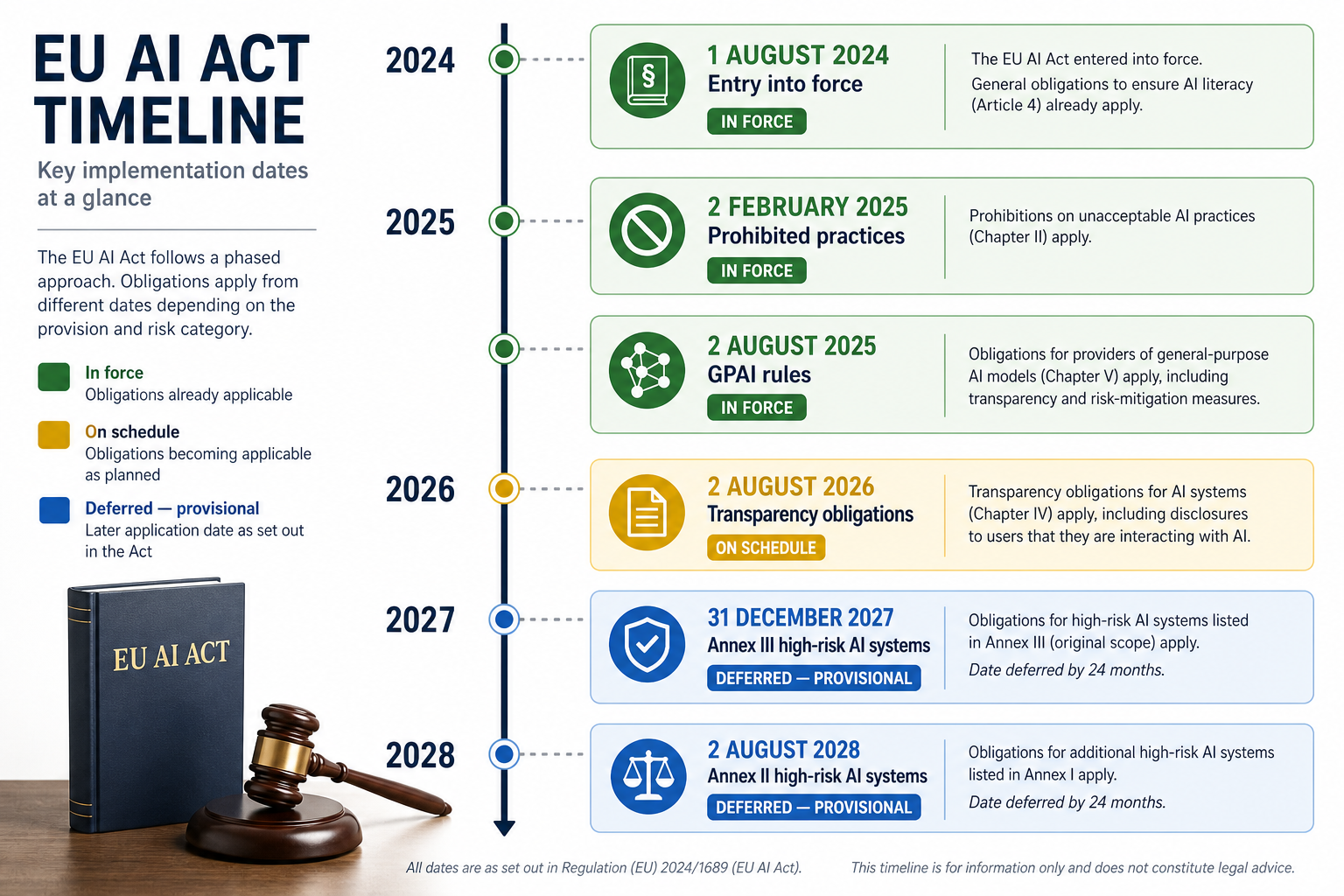
The table below compares the original AI Act timeline with the provisional revised dates. Note that the deadlines for prohibited practices (February 2, 2025) and GPAI rules (August 2, 2025) are already in force and unaffected by the Omnibus.
| Obligation | Original Date | Revised Date (Provisional) | Status |
|---|---|---|---|
| Prohibited AI practices | February 2, 2025 | No change | In force |
| GPAI rules | August 2, 2025 | No change | In force |
| Article 50 transparency (labeling & disclosure) | August 2, 2026 | No change | On schedule |
| Watermarking grace period for existing systems | N/A (new provision) | December 2, 2026 | Provisional |
| Annex III high-risk systems (incl. legal AI) | August 2, 2026 | December 2, 2027 | Deferred (provisional) |
| Annex I high-risk embedded systems | August 2, 2027 | August 2, 2028 | Deferred (provisional) |
| National AI regulatory sandboxes | August 2, 2026 | August 2, 2027 | Deferred (provisional) |
Article 50 Transparency Obligations: Still on Schedule for August 2026
Unlike the high-risk deadline, Article 50 transparency obligations are not deferred. Starting August 2, 2026, any organization deploying an AI system that generates or manipulates content (text, image, audio, video) must comply with two core requirements:
- AI-generated content labeling: Outputs such as legal memos, contract clauses, or case summaries produced by generative AI must be clearly marked as AI-generated, unless the content is substantially edited by a human or is incidental to the main product.
- AI interaction disclosure: When a user interacts with an AI system (e.g., a chatbot for legal research), the deployer must inform the user that they are interacting with AI, unless this is obvious from the context.
These rules apply to all providers and deployers of AI systems, including law firms using AI drafting tools, research platforms, or client-facing chatbots. The Omnibus agreement grants a limited grace period for watermarking existing systems that were placed on the market before August 2, 2026, allowing until December 2, 2026 to implement technical watermarking measures. But the obligation to label and disclose is immediate from August 2.
What Makes a Legal AI Tool High-Risk Under Annex III Point 8
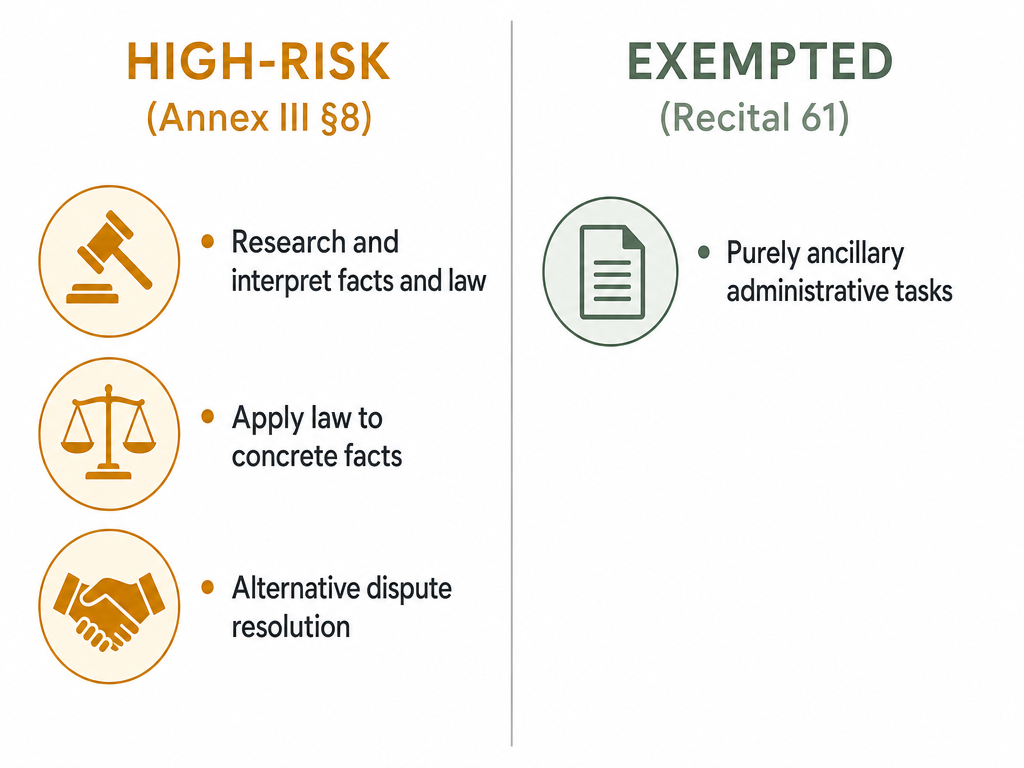
Annex III, point 8(a) of the AI Act lists as high-risk any AI system "intended to be used by a judicial authority or on their behalf to assist a judicial authority in researching and interpreting facts and the law and in applying the law to a concrete set of facts, or to be used in a similar way in alternative dispute resolution." This capture is broad. Any AI tool that a lawyer uses to analyze case law, draft legal arguments, predict outcomes, or review evidence may fall under this classification—if the tool is deployed in the context of judicial or quasi-judicial proceedings.
However, Article 6(3) provides four exemptions. An Annex III system is not high-risk if it meets any of these conditions:
- Narrow procedural task: The system performs only a minor procedural step (e.g., docketing, scheduling, document filing) without influencing the substantive outcome.
- Improving prior human activity: The system improves a task already completed by a human (e.g., grammar check on a drafted opinion), and the human remains fully responsible.
- Detecting decision patterns without replacement: The system identifies patterns in past rulings but does not replace or influence the decision-maker's judgment.
- Preparatory task: The system performs an ancillary activity (e.g., anonymization of documents, internal communication routing, administrative records management).
Crucially, Recital 61 explicitly states that "purely ancillary administrative activities" such as anonymisation, internal communications, and administrative management are not covered by the high-risk classification. But the profiling of natural persons—for example, an AI system that evaluates a litigant's likelihood of winning based on demographic data—is always high-risk, regardless of the exemptions.
Practical Implications for Law Firms and In-House Legal Departments
The December 2027 deferral gives legal organizations more time, but it does not reduce the complexity of the work required. The Cloud Security Alliance's March 2026 research note highlights significant enterprise readiness gaps: in a sample of 106 enterprise AI systems, 40% could not be clearly classified under the AI Act's risk categories. Over half of surveyed organizations lack systematic AI inventories. And the harmonized standards that underpin conformity assessment arrived 8 months late (prEN 18286 entered enquiry only in October 2025), compressing the original timeline.
For law firms and legal departments, these findings translate into concrete action items that should begin now, not in late 2027:
- Conduct an AI inventory: Document every AI system used in the organization, including third-party tools embedded in practice management software and custom-built models. Without an inventory, classification is impossible.
- Classify each system under the AI Act: Determine whether it is a high-risk Annex III system (including point 8 for legal AI), a limited-risk system (transparency only), or exempted under Article 6(3). Document the assessment.
- Begin technical documentation: For all high-risk systems, start building the records required by Articles 11–13 (technical documentation, logging, and record-keeping). Even with a 2027 deadline, these documents take months to prepare, especially if external conformity assessments are needed.
- Prepare for Article 50 transparency: By August 2, 2026, implement labeling and disclosure mechanisms for generative AI outputs. This may involve updating terms of service, adding watermarking to AI-generated content, and training staff on disclosure obligations.
- Appoint an authorized representative: For US-based law firms or legal tech providers that place AI systems on the EU market or whose outputs are used in the EU, Article 22 requires appointing an EU-based authorized representative regardless of the deferral.
The cost of compliance is substantial but not prohibitive. The same CSA research note estimates initial compliance costs for large enterprises at $8–15 million, with ongoing annual costs of $1–5 million. Mid-size organizations face $2–5 million upfront. These figures are directional but underscore that compliance is a resource-intensive, multi-year effort—not a checkbox exercise.
Risks of Treating the Delay as a Free Pass
The most dangerous response to the December 2027 deferral is to deprioritize AI compliance entirely. Three factors make this a costly miscalculation.
- The August 2026 transparency deadline is real. Law firms that delay implementing AI content labeling and disclosure obligations until 2027 will be non-compliant from day one of the new regime. Penalties for transparency violations under the AI Act's general provisions can still reach €15 million or 3% of global annual turnover.
- The harmonized standards are late, but they are coming. Once published, the clock starts on conformity assessment. Organizations that have not begun technical documentation will face a last-minute scramble that invites errors and oversight gaps.
- Incident reporting windows are tight. The AI Act requires deployers to report serious incidents within 15 days (2 days for critical infrastructure, 10 days for death). A compliance program built on a deferral mindset will not have the monitoring and escalation infrastructure in place to meet these deadlines.
Moreover, the December 2027 date is provisional. If the Omnibus agreement stalls or is modified during formal adoption, the original August 2026 deadline could snap back. Law firms that use the deferral as an excuse to defer compliance entirely will face the same penalties as if they had chosen to ignore the AI Act altogether.
Penalty Exposure and Enforcement Risk
The AI Act's penalty structure is designed to deter non-compliance at scale. The maximum fines are tiered by violation type and apply to both providers and deployers. For legal organizations, the headline figures are sobering.
| Violation Type | Maximum Fine | Additional Notes |
|---|---|---|
| Prohibited AI practices | €35M or 7% of global annual turnover | Already in force since February 2, 2025; includes social scoring, manipulation, real-time biometric ID in public spaces |
| High-risk system obligations (Annex III) | €15M or 3% of global annual turnover | Applies to legal AI tools that fall under Annex III point 8 or other high-risk categories |
| Transparency obligations (Art. 50) | €15M or 3% of global annual turnover | Applies to all generative AI systems regardless of risk classification; effective August 2, 2026 |
| Non-compliance with AI literacy requirements | Administrative fines (varies by member state) | AI literacy obligation took effect February 2, 2025; fines set by national law |
Beyond the AI Act's own penalties, member states are enacting additional national sanctions. Italy's Law 132/2025, for example, imposes fines up to €774,685 for AI-related violations and introduces criminal liability for deepfake dissemination (1–5 years imprisonment). Other member states are expected to follow with their own implementing legislation, creating a patchwork of national enforcement layers.
For US-based law firms and legal tech companies, the extraterritorial reach of the AI Act is a critical exposure. Under Article 2, providers that place AI systems on the EU market or whose system outputs are used in the EU are in scope regardless of where the provider is incorporated. Non-EU providers must appoint an authorized representative under Article 22. As Modulos notes, German courts can issue preliminary injunctions under unfair-competition law for missing CE marking, effectively blocking market access. While no such injunction has been publicly reported as of June 2026, the legal theory is established and enforcement is likely to increase once the compliance deadlines approach.
Operationalizing workflow
No workflow has been explicitly linked to this obligation yet. See Workflows generally.
Illustrative cases
No illustrative case is currently tracked for this obligation. See Risk Digest for documented incidents generally.
← Back to RegulationReport a correction or tip
Spotted an outdated figure, a misstated fact, or a ruling this regulation entry should reflect? Public comments are disabled for this content given the professional cost of a misreported case outcome, penalty amount, or rule text — use the structured correction channel instead.
Report a correction or tip for this record →