
The Legal Liability Gap in GM's 2026 Duramax Service Bulletin
The 2026 Silverado Duramax thrust-bearing defect is addressed by a Technical Service Bulletin, not a recall. This article explains why that distinction creates strong legal liability under lemon laws and warranty claims, and what owners can do.
- Jurisdiction
- US Federal
- Court
- Eastern District of Michigan
- Judge
- Terrence G. Berg
- AI tool named
- Not applicable (CP4 fuel pump case)
- Ruling date
- May 6, 2025
- Source document
- View primary court order ↗
- Last verified
- Jul 29, 2026
Lex Machina Review is an independent risk-tracking and reference resource. Nothing on this site is legal advice, and using it does not create an attorney-client relationship. Every record is reviewed against primary sources but may not reflect the most current status of a matter — always verify directly against the cited court order, rule text, or a licensed attorney before relying on it.
Companion explanation — secondary to the source document above
As of July 2026, the reported 2026 Silverado Duramax LZ0 thrust-bearing problem is not a NHTSA safety recall. That distinction matters. There are other recall issues around the 2026 Silverado platform, including matters involving drivetrain, fuel-pump, and owner's-manual compliance issues, but those should not be collapsed into a Duramax engine recall. For the LZ0 issue, the operative document is not a public recall campaign. It is GM Technical Service Bulletin 25-NA-307.
That does not make the problem legally small. A recall campaign number is one route into liability analysis, not the only one. A manufacturer service bulletin can be the more important paper trail when it identifies a known condition, gives dealers a diagnostic path, and tells them what repair is required.
The Document That Matters Is the TSB
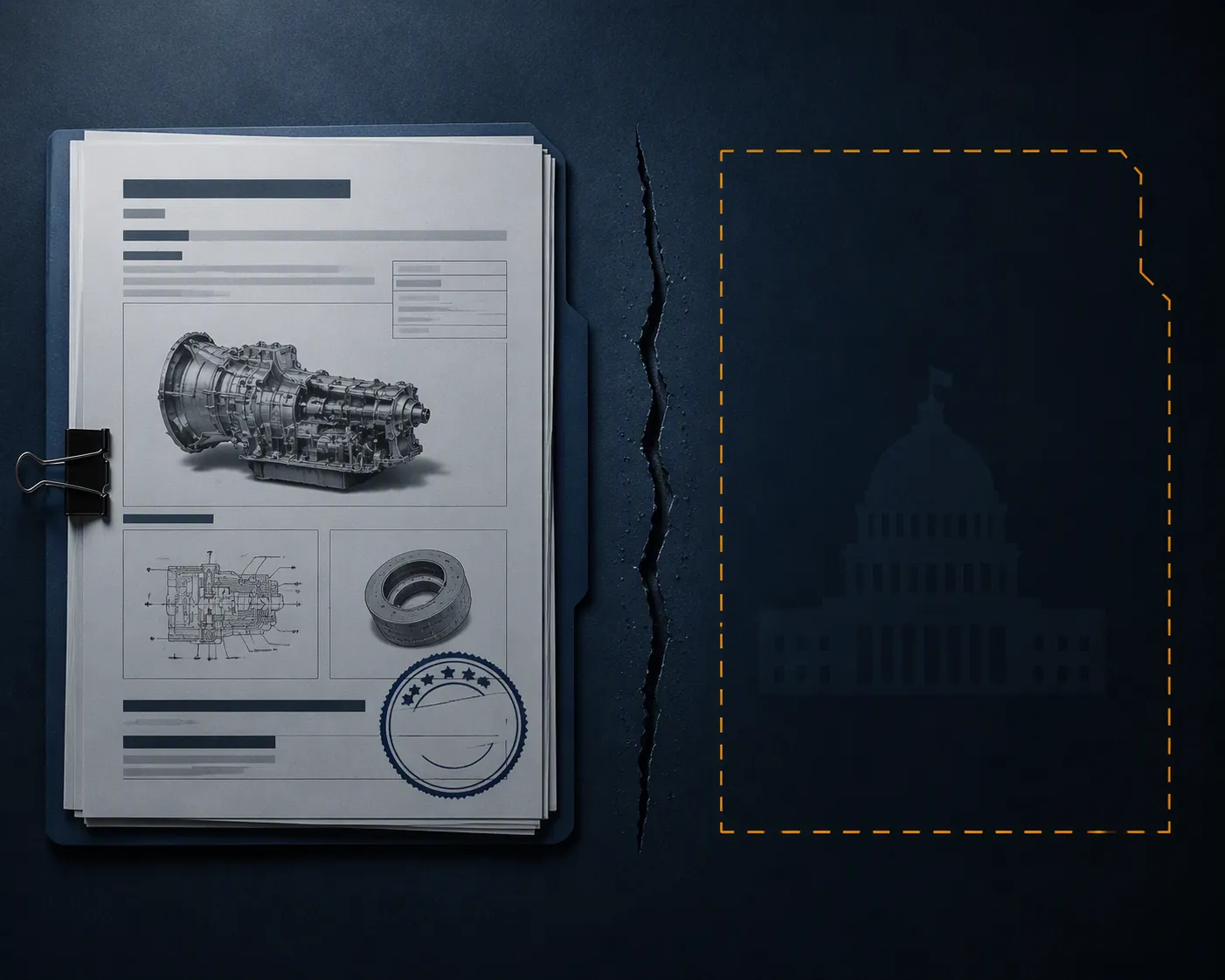
TSB 25-NA-307 is important because it does more than acknowledge owner complaints in general terms. According to Valero Law's discussion of the bulletin, GM identifies excessive crankshaft end play in 2025-2026 LZ0 3.0L Duramax engines, references an end-play specification of 0.084-0.316 mm, associates the condition with diagnostic trouble code P06DD, and directs replacement of the engine when the measured end play is outside specification.[1]
That sequence is legally useful because it connects four things that are often separated in defect disputes: the physical condition, the diagnostic code, the manufacturer's knowledge, and the remedy. An owner does not have to build the case solely from forum posts or a technician's offhand comment if the repair order reflects the bulletin, the measurement, and the replacement instruction.
The replacement instruction is the detail that changes the legal temperature. A bulletin that says to reflash software or inspect a connector may still matter, but it does not carry the same practical consequence as a bulletin leading to long-block replacement. When a late-model truck needs an engine under warranty, the dispute is no longer about annoyance. It is about substantial impairment, time out of service, diminished value, and whether the promised warranty remedy is actually being delivered.
Why “No Recall” Does Not Mean “No Claim”
Safety recalls and warranty claims answer different questions. A NHTSA safety recall focuses on whether a defect relates to motor-vehicle safety and triggers the federal recall process: reporting, owner notification, recall remedy, and completion tracking. Lemon-law and warranty claims ask a different set of questions: whether the vehicle conforms to warranty, whether the defect substantially impairs use, value, or safety, whether the manufacturer had a reasonable opportunity to repair, and whether the vehicle spent too long out of service.
That separation is why the LZ0 situation sits in a liability gap. Without a recall, there may be no recall notice in the mail, no public campaign number for a used-truck buyer to find, and no recall-completion metric that shows how many engines have been repaired. Yet the warranty problem can still be concrete: the dealer diagnoses excessive crankshaft end play, the TSB points to engine replacement, and the truck waits.
Most state lemon laws are built for that kind of practical failure. They commonly look to either repeated unsuccessful repair attempts or a cumulative out-of-service threshold. The exact rule is state-specific, and commercial fleet vehicles may be treated differently from consumer vehicles, but the recurring legal pattern is familiar: a serious defect plus extended downtime can trigger repurchase, replacement, damages, or fee-shifting remedies even when no safety recall exists.
For attorneys and fleet counsel, the useful question is not whether the owner can say “recall.” It is whether the file shows a warranted vehicle disabled by a manufacturer-recognized engine condition for long enough that the warranty remedy becomes unreasonable.
The Parts Backlog May Become the Claim
The reported parts delay is not a minor scheduling fact. Torque News reported on July 25, 2026, that replacement long-blocks were on national backorder, with a reported 10-16 week wait; that reporting is described as corroborated by Diesel Dudes Blog and BS Built LLC, but it is not a public GM admission of a specific backlog duration.[2]
That evidentiary label should stay attached to the number. A 10-16 week wait should not be pleaded or described as if GM publicly conceded it unless the owner has GM or dealer communications saying so. But as a reported market condition, it explains why these claims may develop quickly. A truck does not need four failed repairs if it is immobilized long enough to cross a statutory downtime threshold.
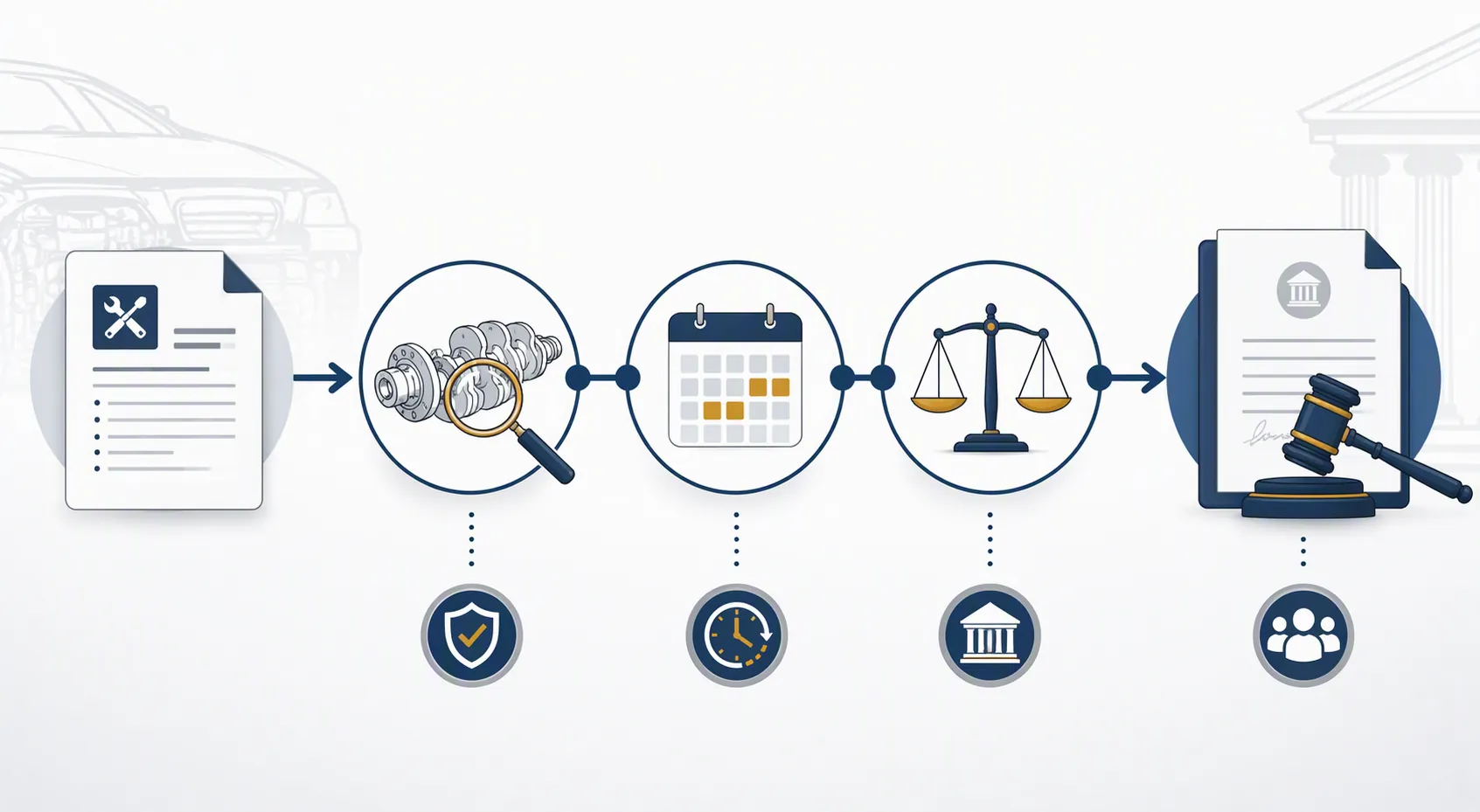
Downtime also creates economic pressure separate from the mechanical failure. The owner may still be making loan or lease payments. A fleet may be renting replacement capacity, delaying jobs, or reassigning vehicles. A dealer may provide a loaner in one case and not in another. Those facts matter because lemon-law and warranty damages are usually built from records, not from generalized frustration.
| Record | Why it matters |
|---|---|
| Repair order citing TSB 25-NA-307, P06DD, crankshaft end-play measurement, or engine replacement | Connects the vehicle to the manufacturer-recognized condition rather than a vague drivability complaint |
| Open and close dates for every repair order | Establishes cumulative days out of service and whether a statutory presumption may apply |
| Dealer or GM communications about engine availability | Shows whether delay came from parts supply, approval, diagnosis, or owner-caused scheduling |
| Loaner, rental, towing, payment, and insurance records | Documents consequential costs and the practical loss of use |
| Photographs, diagnostic printouts, and inspection notes | Preserves technical support before the engine is replaced or the truck is traded |
| Trade-in offers, appraisal notes, or resale disclosures | Helps evaluate diminished-value arguments where a known-but-not-recalled defect affects bargaining power |
The Repair Cost Sets the Stakes
Repair cost is not the same thing as legal liability, but it affects almost every negotiation around it. Diesel Dudes Blog reports that an out-of-warranty bearing-only repair may be about $2,000, while complete engine replacement has been estimated at $10,000-$18,000 in published dealer-estimate discussions.[3]
Those numbers should be used carefully. A quoted estimate for a complete replacement is not proof that every affected owner will pay that amount, especially if the vehicle is still under warranty. But the magnitude matters for three reasons. First, it makes delayed warranty performance more consequential. Second, it can influence resale and trade-in negotiations once a buyer or dealer learns the engine may be within the affected population. Third, it changes settlement posture; a case involving an engine replacement is not valued like a rattle, a warning light that clears, or a cosmetic defect.
The warranty context also cuts both ways. If GM replaces the engine promptly, pays for towing, and keeps the owner mobile, the damages picture may narrow. If the truck sits for weeks or months waiting for a long-block, the manufacturer may still argue that it offered the correct repair, but the owner can respond that a remedy unavailable for an extended period is not a meaningful warranty remedy.
Legal Theories That Fit the LZ0 Record
The strongest individual claims will likely begin with the vehicle's own paper trail: purchase or lease date, mileage, warranty status, repair orders, TSB-related diagnosis, and total days out of service. From there, several legal theories may become relevant depending on state law and the vehicle's use.
- State lemon law: a late-model truck with a substantial engine defect and extended repair downtime may meet a statutory presumption even without multiple failed repair attempts.
- Breach of express warranty: the core question is whether GM repaired the warranted defect within a reasonable time and in a manner that restored conformity.
- Magnuson-Moss Warranty Act: federal warranty claims may support fee-shifting and can pair with state-law warranty theories where the written warranty remedy allegedly failed.
- Implied warranty theories: depending on state law, plaintiffs may argue that an engine defect affecting use and reliability made the truck unfit for ordinary transportation or work purposes.
- Class theories: a known defect, common bulletin language, alleged disclosure omissions, and delayed or inadequate remedies can support aggregate litigation, though class scope depends heavily on VIN data, state law, warranty status, and proof of common defect manifestation.
There is a useful contrast with recall-centered cases. In a multi-recall situation, the claim may turn on repeated safety campaigns, recall adequacy, regulatory history, and whether a recall remedy itself failed. The LZ0 issue is narrower. It depends less on a public campaign record and more on whether GM's own service procedure, owner-specific downtime, and warranty performance show that the truck could not be repaired within a legally reasonable period. For readers comparing recall and non-recall remedy paths, the framework discussed in Legal Liability in Ford's Bronco Sport and Maverick Recalls is useful mainly as a contrast, not as a template.
What the CP4 Settlement Does—and Does Not—Show
The earlier Duramax CP4 fuel-pump litigation is worth mentioning because it shows how a component-defect case can proceed on knowledge and disclosure theories. It should not be treated as a damages forecast for the LZ0 thrust-bearing issue.
Class counsel described the CP4 matter as a $50 million settlement with final approval entered on May 6, 2025, by Judge Terrence G. Berg in the Eastern District of Michigan, including a $30 million repair fund and owner payments reported in the range of $400-$12,712 for a seven-state class covering California, Florida, Illinois, Iowa, New York, Pennsylvania, and Texas.[4] Road & Track separately reported the settlement as $35 million, illustrating that public descriptions of settlement value can vary depending on what is counted.[5]
The legally relevant comparison is not the dollar figure. It is the structure. CP4 plaintiffs pursued a theory that GM knew about a Duramax component defect and failed to adequately disclose it. LZ0 claimants may point to a different kind of record: a service bulletin that, if applicable to the vehicle, identifies the condition and the engine-replacement remedy. That may simplify part of the knowledge argument, but it does not solve the harder class questions: which VINs are affected, how many engines actually manifest the condition, what disclosures were made, and whether common issues predominate across states and warranty postures.
Law-Firm Investigations Are a Signal, Not Proof
Several law-firm pages and investigation notices have appeared around LZ0 Duramax claims. RockPoint Law, for example, maintains a recall-related page concerning a 2026 Chevrolet Silverado 3500 fuel-pump recall topic, and the broader legal marketplace includes pages from firms discussing LZ0 defect or lemon-law investigations.[6]
That activity is useful as a market signal. It shows that lawyers see potential claim value. It does not establish defect frequency, affected VIN range, causation, or class certification viability. Those still have to come from vehicle records, manufacturer documents, discovery, expert analysis, and admissible owner evidence.
The missing VIN range is especially important. The available materials do not provide a GM-published affected population for the LZ0 thrust-bearing issue. Without that, no one should state a precise defect rate or assume that every 2025-2026 LZ0 truck is affected. A careful claim starts by proving that the specific truck is within the diagnosed condition, not by treating the entire engine family as failed.
How Owners and Fleet Counsel Should Preserve the Claim
The first practical step is to get the diagnosis in writing. A repair order that says “engine concern” is weaker than one identifying P06DD, crankshaft end-play measurement, reference to TSB 25-NA-307, and the ordered remedy. If the dealer measured end play, the number should be preserved. If the dealer says the engine is on backorder, the owner should ask for that status in writing.
- Ask the dealer to include the TSB number, diagnostic trouble code, measurements, and repair authorization status on the repair order.
- Track every calendar day the truck is unavailable, including days waiting for diagnosis, parts approval, long-block delivery, and installation.
- Keep loan, lease, insurance, registration, rental, towing, and lost-use documentation in the same file.
- Save texts, emails, portal messages, voicemails, and service-advisor notes about parts availability or expected completion dates.
- Do not rely on a verbal “no recall, no remedy” statement; ask what warranty, goodwill, loaner, rental, or repurchase review process is available.
Fleet operators should add one more layer: utilization records. If a disabled truck caused a route change, substitute rental, missed job, or idle employee time, those records should be preserved while they are still routine business documents. A fleet claim often depends less on emotional inconvenience and more on showing how many days a revenue asset was unavailable and what replacement capacity cost.
Owners should also be careful at trade-in. If a dealer discounts the vehicle because of a pending engine replacement, an open repair history, or uncertainty around the LZ0 condition, that appraisal may become relevant to diminished value. If the truck is repaired with a replacement engine, the owner should keep the documentation showing what was replaced, when, and under what warranty.
The Liability Gap Is Real, But It Is Vehicle-Specific
The cleanest conclusion is also the narrowest one the evidence supports: the absence of a NHTSA safety recall does not close the liability door for 2026 Silverado Duramax LZ0 owners. TSB 25-NA-307, if tied to the vehicle's diagnosis, gives owners a manufacturer-document trail for the defect and remedy. Reported long-block delays may push individual vehicles past downtime thresholds. The repair-cost magnitude gives the dispute economic weight. Warranty, lemon-law, Magnuson-Moss, and class theories can all become relevant without a recall campaign number.
The weaker version of the claim is the overbroad one: every LZ0 is defective, the backlog is officially admitted, the CP4 settlement predicts the LZ0 settlement, and “recall” is just another word for “TSB.” Those shortcuts create unnecessary credibility problems. The stronger version starts with the truck, the bulletin, the measurement, the repair order, the wait, and the warranty promise.
Owners and fleet counsel should verify whether the specific vehicle has the TSB-related condition, preserve repair and downtime records, and evaluate state-specific lemon-law or warranty remedies with counsel rather than assuming that no recall means no claim.
References
- LZ0 3.0 Duramax Crankshaft End Play: GM Issues Bulletin 25-NA-307, Valero Law.
- GM's 3.0L Silverado Duramax Diesel Was Built to Last 300,000 Miles Until Its Crankshaft Snap Destroys, Torque News, July 25, 2026.
- GM 3.0L Duramax Thrust Bearing Failure: What to Know, Diesel Dudes Blog.
- Bosch CP4 Fuel Injection Class Action Lawsuit, Gibbs Law Group / ClassLawGroup.
- Chevrolet Silverado, GMC Sierra Duramax Diesel Truck Owners Settlement, Road & Track.
- Chevrolet Silverado 3500 Fuel Pump Recall 2026, RockPoint Law.
Related records
Tool profile
Browse tool evaluations →Governing regulation
Browse the obligations tracker →Preventive workflow
Browse verification workflows →
Report a correction or tip
Spotted an outdated figure, a misstated fact, or a ruling this case record should reflect? Public comments are disabled for this content given the professional cost of a misreported case outcome, penalty amount, or rule text — use the structured correction channel instead.
Report a correction or tip for this record →