
Legal Analysis of the 2027 Medicare Part D Premium Increase
This article examines the legal compliance changes for Part D plan sponsors following the end of the Premium Stabilization Demonstration and the CY 2027 Final Rule, focusing on new risk-corridor structures, beneficiary notice requirements, and bid-submission obligations.
- Jurisdiction
- US Federal
- Court
- Centers for Medicare & Medicaid Services
- AI tool named
- None
- Ruling date
- Jul 28, 2026
- Source document
- View primary court order ↗
- Last verified
- Jul 30, 2026
Lex Machina Review is an independent risk-tracking and reference resource. Nothing on this site is legal advice, and using it does not create an attorney-client relationship. Every record is reviewed against primary sources but may not reflect the most current status of a matter — always verify directly against the cited court order, rule text, or a licensed attorney before relying on it.
Companion explanation — secondary to the source document above
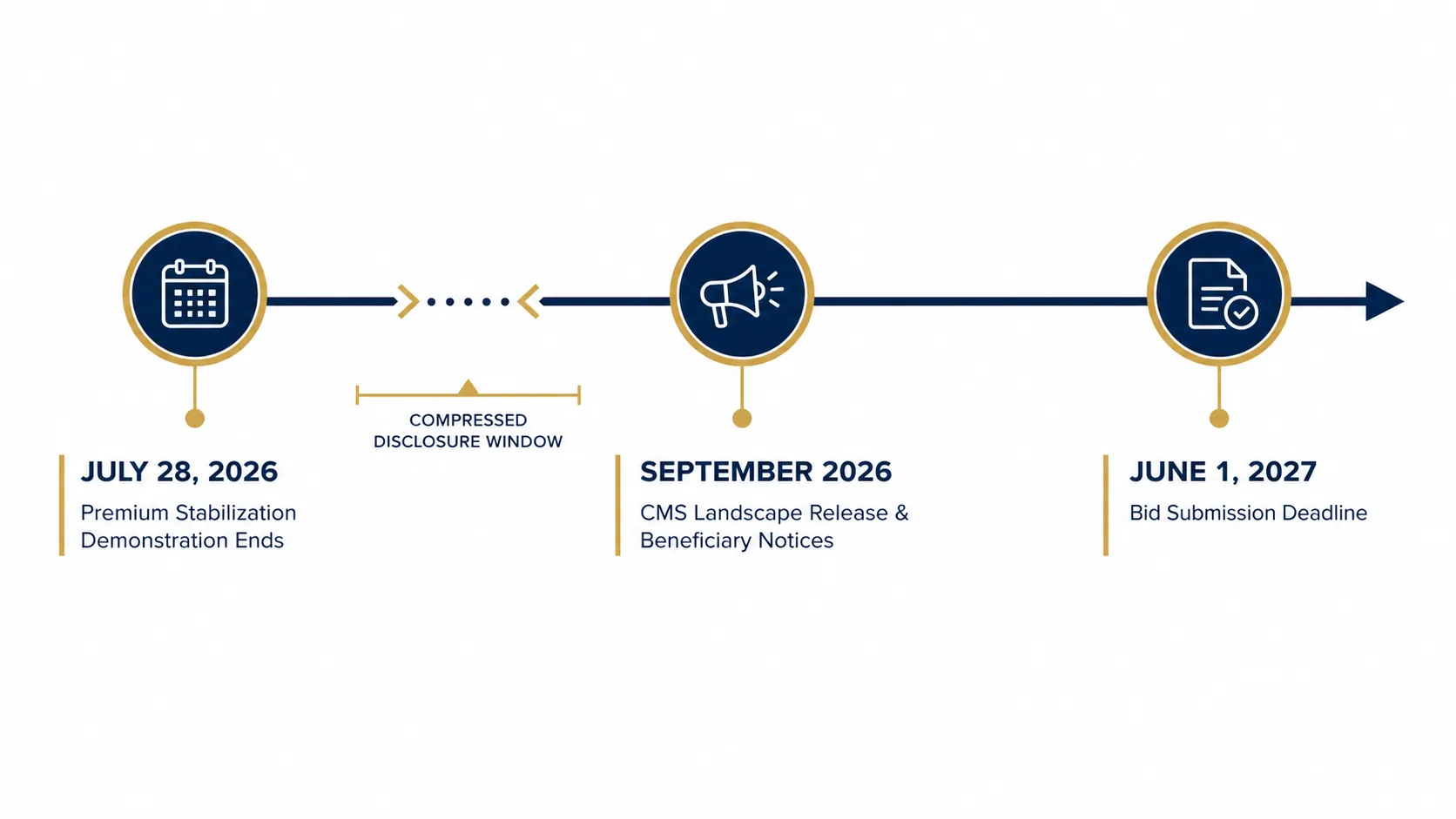
For 2027, a Part D sponsor can no longer treat the Premium Stabilization Demonstration as a bid-year backstop. CMS ended the demonstration on July 28, 2026, and the standard Social Security Act subsidy and risk-corridor framework resumes for the next contract year.[1] That is the legal center of the 2027 Medicare Part D premium increase analysis: not merely whether beneficiaries see higher premiums, but whether sponsors have documented bids, financial-risk assumptions, notices, scripts, and executive approvals on the assumption that the temporary federal cushion is gone.
The timing is uncomfortable because the 2027 Part D redesign obligations are no longer just statutory concepts waiting for operational translation. The CY 2027 Final Rule codifies Inflation Reduction Act Part D redesign requirements, including the out-of-pocket cap framework, elimination of the coverage gap, and Manufacturer Discount Program obligations described in contemporary rule analyses.[2][3] Those redesign requirements now sit beside the end of a temporary premium-stabilization structure that had softened plan-side exposure during the first years of implementation.

The Legal Change Is the Return to Ordinary Risk Sharing
The demonstration was not an informal premium policy. It rested on Section 402 demonstration authority, codified at 42 U.S.C. § 1395b-1, and GAO concluded in B-336645 that HHS could operate the Medicare Part D Premium Stabilization Demonstration under that authority.[4] That point matters because sponsors should not describe the 2025 and 2026 treatment as an unauthorized aberration. It was a temporary, legally analyzed demonstration. The compliance consequence in 2027 is that the temporary terms have ended.
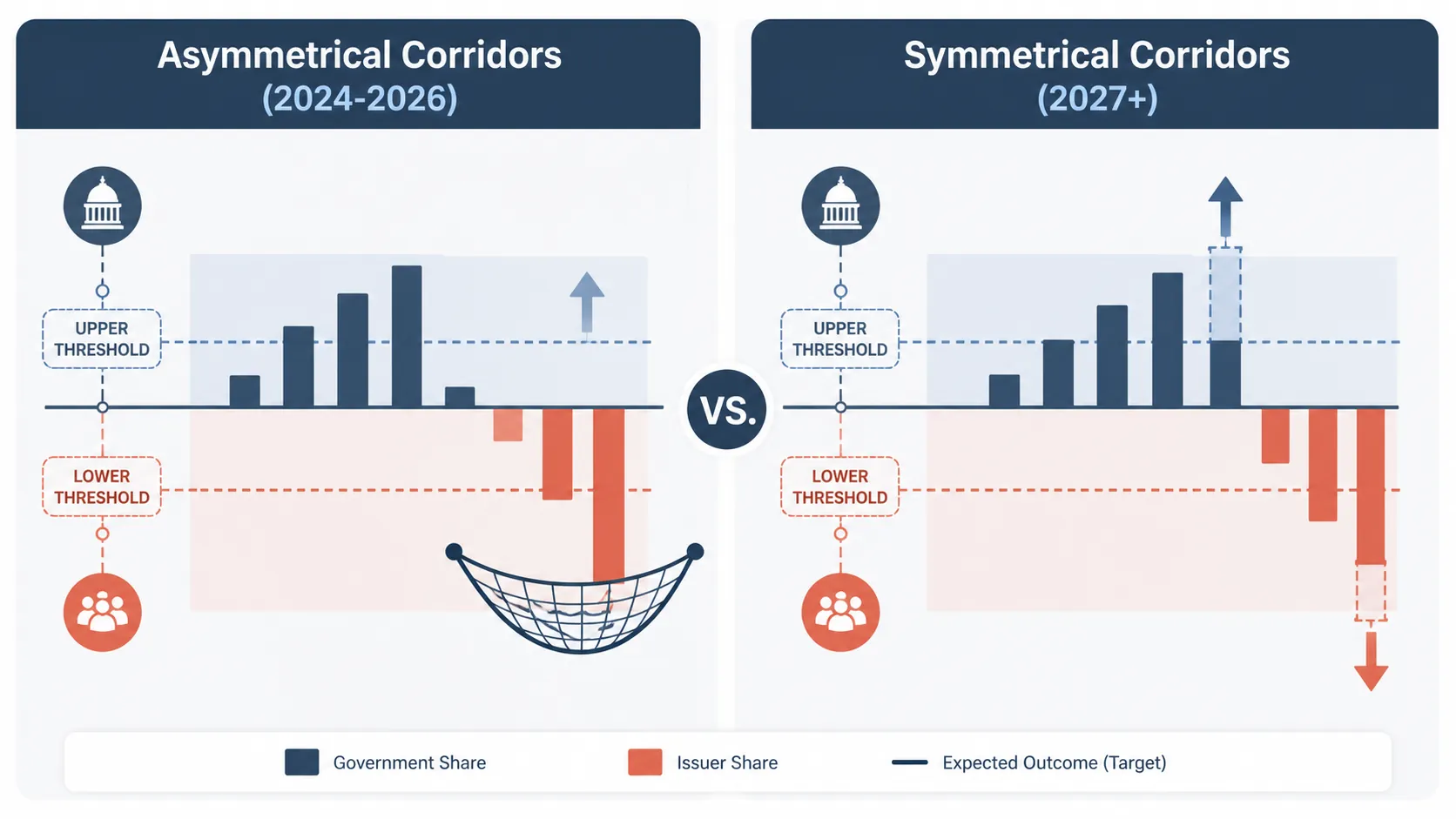
Under the demonstration, the risk corridors were asymmetrical. The government absorbed 50% of losses between 102.5% and 105% of the bid and 90% of losses beyond that range. For 2027, the structure returns to symmetrical corridors: 50% between 105% and 110%, and 80% beyond, for both gains and losses.[1] That shift is easy to understate if the issue is framed only as a premium story. For a sponsor, it changes the legal and financial significance of the bid file itself.
| Issue | Demonstration Structure | 2027 Standard Structure |
|---|---|---|
| Loss corridor trigger | Government risk sharing began at 102.5% of bid | Standard sharing begins at 105% of bid |
| Loss sharing above upper band | Government absorbed 90% beyond the demonstration threshold | Government shares 80% beyond the standard threshold |
| Symmetry | Designed with larger downside protection for plans | Applies to both gains and losses under the standard framework |
| Compliance implication | Bid error had a temporary federal cushion | Bid error flows more directly into plan financial exposure |
The corridor change does not make every 2027 premium increase unlawful or suspect. It does the opposite: it gives sponsors a clearer reason to document why their actuarial assumptions changed. If a committee sees a 2027 premium movement but the file does not separately identify the end of the demonstration, the return to symmetrical corridors, and the redesign-driven liability assumptions, the legal record will look thinner than the business decision actually was.
What the Bid File Must Now Carry
CMS reported a 2027 Base Beneficiary Premium of $41.33 and a National Average Monthly Bid Amount of $296.05.[1] Those numbers are not, by themselves, a sponsor’s premium-change explanation. They are the federal baseline against which the sponsor’s own bid assumptions, benefit design choices, formulary decisions, and risk-corridor exposure need to be reviewed.
The demonstration had also been subsidizing roughly $15 to $16 per member per month in 2025 and 2026, as MedPAC figures are described in KFF’s analysis of the CMS decision.[5] Once that subsidy lapses, the sponsor’s financial model should not simply add a line item called “premium pressure” and move on. The legal review should be able to trace where the removed subsidy appears in the bid narrative, the actuarial memorandum, the risk-corridor sensitivity analysis, and the materials provided to the board or delegated committee.
The June 1 bid-submission deadline was the operational date that gives the change its bite.[1] A rushed assumption in that file can become a finance issue if experience deteriorates, a compliance issue if the sponsor’s documentation cannot support what was submitted, and a member-communications issue if call-center scripts later describe the change in a way the bid record does not support.
- The actuarial memorandum should distinguish redesign-related liability from the separate effect of the demonstration ending.
- The executive approval package should state that 2027 risk corridors are symmetrical and that the prior demonstration loss protection is unavailable.
- The compliance sign-off should confirm which assumptions come from CMS primary materials and which come from outside legal or policy analysis.
- The finance review should test premium, utilization, and risk-corridor sensitivity without assuming a renewed federal stabilization payment.
CMS said its 2027 bid analysis showed sufficient plan-sponsor experience to return to traditional market conditions, which was part of the stated basis for ending the demonstration.[1] GAO separately noted that the evaluation framework for the demonstration was still being developed in GAO-26-107935.[6] Those two points can coexist. CMS has made the operative decision for 2027; sponsors still need to preserve a record that does not overclaim what has been independently evaluated.
The Final Rule Gives Certainty, Not Breathing Room
Law-firm analyses of the CY 2027 Final Rule describe CMS as finalizing Part D provisions that implement the IRA redesign, including the $2,100 out-of-pocket cap for 2026, indexed annually, the end of the coverage gap, and Manufacturer Discount Program requirements.[2][3] The Federal Register text was not directly available in the research set used here, so sponsor counsel should verify rule citations and effective-date language against the primary rule text before treating any outside summary as the controlling authority.
That verification step is not academic. A board memo that cites only a client alert may be adequate for early issue-spotting, but it is not enough for final implementation controls. The sponsor needs to know which obligations are codified, which are operational guidance, and which are analyst inferences about financial effect. The redesign may increase plan liability, but the legal file should avoid collapsing statutory design, regulatory codification, and premium projection into one unsupported sentence.
Beneficiary Notice Risk Begins Before the Mailing
About 25 million beneficiaries in standalone prescription drug plans are expected to receive 2027 premium information through the September 2026 CMS landscape release.[5] That September marker is not just a public information event. It starts a short internal runway for reconciling what CMS displays, what sponsors say in required materials, and what customer-facing teams are permitted to explain.
The immediate risk is not that every beneficiary communication must contain a full legal explanation of risk corridors. It should not. The risk is that communications become inaccurate by simplifying the change too far. A notice or script that attributes the entire premium change to the IRA redesign, to CMS, to drug manufacturer discounts, or to the end of the demonstration may create a separate compliance problem if the sponsor’s actual bid record reflects multiple drivers.
The better review sequence starts before final beneficiary-facing language is locked. Legal and compliance should compare the bid explanation, actuarial support, CMS landscape data, model or required notices, enrollment materials, broker talking points, and call-center scripts. The review should ask whether each document says less than the sponsor can prove, not more. Beneficiaries do not need a corridor table; they do need premium information that is timely, accurate, and consistent with the approved record.
- Premium-change language should identify the sponsor’s plan-specific change without implying that CMS set the plan’s final premium.
- Scripts should give customer-service representatives a narrow explanation they can repeat without improvising legal conclusions.
- Broker and sales materials should be checked against the same approved explanation used in member notices.
- Escalation paths should be ready for beneficiaries who challenge whether a premium increase was properly disclosed.
What Should Not Be Overstated Yet
As of July 30, 2026, the CMS announcement ending the demonstration is only two days old. The current research record does not identify any filed or threatened litigation by beneficiaries, plans, states, or advocacy organizations. A sponsor may reasonably monitor for Administrative Procedure Act theories, beneficiary-affordability challenges, or congressional oversight pressure, but those possibilities should not be written into compliance materials as pending legal exposure without support.
The same caution applies to state-level risk. Part D is a federal program, and the materials reviewed here do not provide a developed analysis of state insurance commissioner authority in this setting. If a sponsor operates through entities with state-regulated products, state communications and unfair-practice rules may still be worth separate review, but the present record does not support a broad claim that state regulators have a defined enforcement role in the 2027 Part D premium change.
Q3 2026 Work for Sponsors
The practical work now is narrow and immediate. Sponsors should revise 2027 bid and financial-risk assumptions for the absent demonstration safety net, document the return to symmetrical risk corridors, and verify CY 2027 Final Rule implementation against primary regulatory text when available. Outside analyses are useful issue-spotters, but they should not substitute for the rule text in final compliance approvals.
The beneficiary-facing work should move on the same calendar. September 2026 landscape information, required notices, and sponsor communications will arrive quickly after the July 28 decision. Legal review should be finished before language reaches members, brokers, or call centers, because a defensible premium calculation can still be undermined by an inaccurate explanation of why the member is paying more.
References
- Medicare Part D 2027 National Average Monthly Bid Amount Information, CMS, July 28, 2026.
- CMS Finalizes CY 2027 Medicare Advantage and Part D Rule, Holland & Knight, April 2026.
- The final course for 2027 Medicare Advantage and Part D policies, McDermott+.
- Department of Health and Human Services—Medicare Part D Premium Stabilization Demonstration, GAO.
- CMS's Decision to End Temporary Subsidies to Medicare's Stand-Alone Drug Plans, KFF.
- Medicare Part D: Implementation of Beneficiary Premium Stabilization Demonstration, GAO.
Related records
Tool profile
Browse tool evaluations →Governing regulation
Browse the obligations tracker →Preventive workflow
Browse verification workflows →
Report a correction or tip
Spotted an outdated figure, a misstated fact, or a ruling this case record should reflect? Public comments are disabled for this content given the professional cost of a misreported case outcome, penalty amount, or rule text — use the structured correction channel instead.
Report a correction or tip for this record →