
What Will the 2027 Social Security COLA Be?
As of early August 2026, the 2027 Social Security COLA is projected between 3.6% and 3.8%, roughly a point above 2026's 2.8%. The official number will not exist until Q3 CPI-W data closes in September, so the range is the right planning input until SSA announces the figure on Oct 14, 2026, with the increase landing in January 2027 payments.
- Jurisdiction
- US-federal
- Court
- Social Security Administration
- AI tool named
- None
- Ruling date
- Oct 14, 2026
- Source document
- View primary court order ↗
- Last verified
- Aug 4, 2026
Lex Machina Review is an independent risk-tracking and reference resource. Nothing on this site is legal advice, and using it does not create an attorney-client relationship. Every record is reviewed against primary sources but may not reflect the most current status of a matter — always verify directly against the cited court order, rule text, or a licensed attorney before relying on it.
Companion explanation — secondary to the source document above
Current answer: a 3.6%–3.8% planning range, not an official COLA
As of Aug. 4, 2026, the defensible planning range for the 2027 Social Security cost-of-living adjustment is 3.6% to 3.8%. The Senior Citizens League is holding at 3.8%, AARP has published a 3.6% estimate, and independent analyst Mary Johnson is at 3.7% after cutting her prior 4.7% estimate following cooler June inflation data.[1][2][3]
That range is roughly a full percentage point above the 2026 COLA of 2.8%, but it is still only a forecast. SSA has not set the 2027 COLA. The official number is scheduled to be announced on Oct. 14, 2026, after the September CPI data closes the third-quarter measurement period.[4][5]
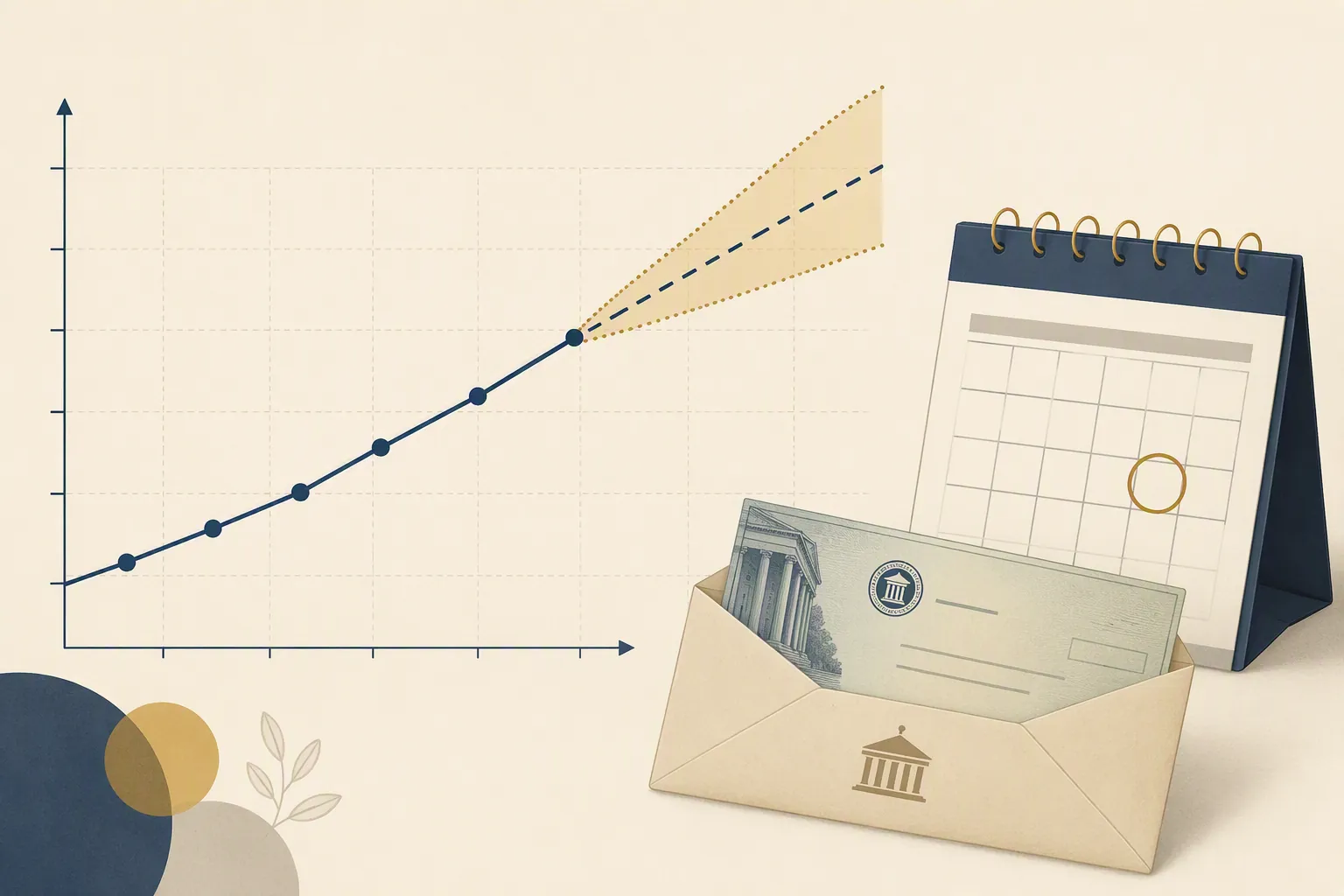
For budgeting purposes, the clean answer is this: use 3.6%–3.8% for now, do not treat any single dollar example as your promised increase, and expect the increase to apply to January 2027 Social Security payments once SSA issues the final COLA.
Why the forecast cluster is useful, and why it is not final
A tight forecast cluster is worth more than a lone headline number. TSCL, AARP, and Johnson are not publishing the same figure, but their estimates are close enough to give beneficiaries a working bracket before the government number exists.
| Source | Current 2027 COLA estimate | What the estimate is based on or how it is framed | Why it matters |
|---|---|---|---|
| The Senior Citizens League | 3.8% | Published July 14, 2026, and described as holding at 3.8%.[1] | This is the high end of the current narrow range and includes a specific average-benefit dollar example. |
| AARP | 3.6% | AARP called the estimate “our best guess” and described it as its first pre-Q3 COLA forecast, using CPI-W data from October 2025 through June 2026 plus Cleveland Fed nowcasts.[2] | This is the low end of the current range and includes separate examples for retired-worker, surviving-spouse, and SSDI benefits. |
| Mary Johnson | 3.7% | Johnson lowered her projection from 4.7% to 3.7% after June inflation cooled.[3] | This sits between TSCL and AARP and shows how quickly the estimate can move when new inflation data lands. |
The temptation is to pick the middle number and move on. That is neat, but Social Security does not average private forecasts. The statute points to a specific inflation measure over a specific time window, and that window is not closed yet.
The legal fixing mechanism is still Q3 CPI-W
The Social Security COLA is tied to the Consumer Price Index for Urban Wage Earners and Clerical Workers, or CPI-W. SSA calculates the percentage increase in the average CPI-W for the third quarter of the current year over the average CPI-W for the third quarter of the last year in which a COLA was determined.[5]
For the 2027 COLA, that means the decisive months are July, August, and September 2026. June can shape forecasts, and it has. It cannot finish the calculation. September has to be reported before SSA can announce the legal figure.
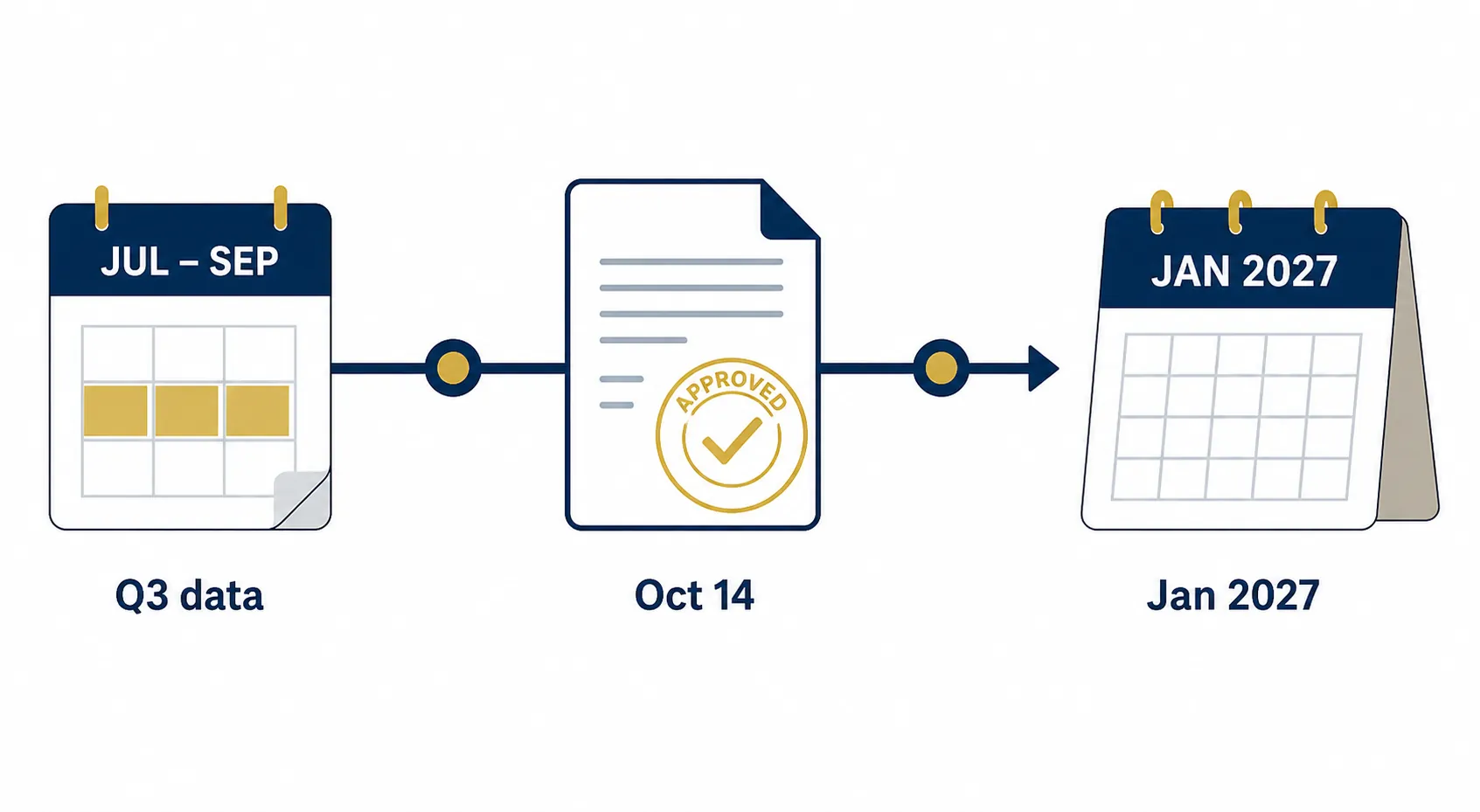
That is the practical distinction beneficiaries and advisors need to keep intact. A projection can be a reasonable planning input. It is not a benefit determination. For the SSI-specific statutory version of the same timing issue, see How the 2027 SSI COLA Increase Is Legally Fixed.
The inflation inputs still open
June explains why the current estimates moved, but it does not settle the year. BLS reported June CPI-W up 3.5% year over year, while energy prices were up 15.7% year over year.[6] Forecast coverage has also pointed to a May CPI-U reading of 4.2% and tariff pressure as reasons the third-quarter path may not be smooth.[1][2]
Those figures matter because CPI-W is the index that fixes the COLA, and energy can move household inflation quickly. They still do not support a precise check increase today. July, August, and September have to be measured as a quarter, not guessed from one month’s report.
What the range means in monthly dollars
The dollar examples in circulation are not interchangeable. They start from different baseline benefit amounts. That is not a scandal; it is arithmetic. It does mean a person should not read a $59, $70, $75, or $77 example as though all of those figures were calculated on the same average check.
| Source | Projection used | Baseline benefit used by that source | Illustrated monthly result |
|---|---|---|---|
| The Senior Citizens League | 3.8% | $1,937.53 average benefit | $2,011.15 after the projected COLA, an increase of $73.62.[1] |
| CNBC Select | 3.8% estimate illustration | $2,026 baseline | About $2,103 after the increase, or roughly $77 more per month.[7] |
| AARP retired-worker example | 3.6% | About $2,084 average retired-worker benefit | Roughly $75 more per month.[2] |
| AARP surviving-spouse example | 3.6% | About $1,931 average surviving-spouse benefit | Roughly $70 more per month.[2] |
| AARP SSDI example | 3.6% | About $1,635 average SSDI benefit | Roughly $59 more per month.[2] |
For an individual check, the better estimate is percentage-based: take the gross monthly benefit amount and apply the forecast range. A 3.6% increase and a 3.8% increase are close, but on a fixed income the difference is not imaginary. Rent, groceries, caregiver hours, and medical bills are paid in dollars, not in percentage points.
When the increase would show up
SSA’s official COLA announcement is scheduled for Oct. 14, 2026. The increase applies to benefits payable for January 2027.[4]
- Social Security payment dates for January 2027 are Jan. 3, Jan. 13, Jan. 20, and Jan. 27, depending on the beneficiary’s payment schedule.[4]
- SSI recipients are scheduled to receive the January 2027 payment on Dec. 31, 2026, because Jan. 1 is a federal holiday.[4]
The timing point is easy to miss in household budgeting. The COLA is announced in October, but the benefit increase belongs to January payments. A forecast in August does not change a September or October check.
Where the Social Security 2100 Act fits
The Social Security 2100 Act belongs in the 2027 COLA conversation only as legislative context unless and until it is enacted and applicable. H.R. 9519 was introduced on June 29, 2026.[8] The introduced text includes a temporary rule for COLA determinations from 2027 through 2036 that would use the higher of CPI-W or CPI-E.[9]
That would be a different rule from the one SSA normally applies. Available estimates suggest CPI-E would generally lift COLAs modestly: SSA’s Office of the Chief Actuary has estimated a CPI-E provision at about 0.15 percentage point higher on average, and the National Committee to Preserve Social Security and Medicare reported that from 1982 through 2014 CPI-E averaged 2.9% while CPI-W averaged 2.7%.[10][11]
Those estimates do not make the 2027 COLA a CPI-E COLA today. The current forecast range of 3.6%–3.8% is based on the existing CPI-W process. A “Social Security 2100 Act COLA projection 2027” headline that skips that distinction is treating a bill as though it were already the operative benefit formula.
Planning status as of Aug. 4, 2026
Use 3.6%–3.8% as the current planning range. Keep each dollar example attached to the source and baseline benefit that produced it. Do not treat the Social Security 2100 Act as controlling the 2027 adjustment unless the legislative status changes.
This is a living forecast record, last verified Aug. 4, 2026. It needs updating when Q3 CPI-W data closes in September and again when SSA issues the official COLA on Oct. 14, 2026.
References
- Congress Reintroduces Social Security 2100 Act as This Year's COLA Projection Holds at 3.8%, The Senior Citizens League, July 14, 2026.
- Social Security COLA Preview: Will 2027 Benefits Go Up?, AARP.
- New Social Security COLA projections released for 2027 adjustment, The Hill.
- Cost-of-Living Adjustment (COLA) Information, Social Security Administration.
- Cost-Of-Living Adjustment (COLA), Social Security Administration Office of the Chief Actuary.
- Consumer Price Index Summary, June 2026, U.S. Bureau of Labor Statistics.
- How Much Will the Social Security 2027 COLA Be? Latest Estimates & Predictions, CNBC Select.
- H.R.9519 - All Actions, Congress.gov.
- Social Security 2100 Act, H.R. 9519, Introduced in House, GovTrack.
- Summary Measures and Graphs: Cost-of-Living Adjustment Provisions, Social Security Administration Office of the Chief Actuary.
- The CPI-E: A Better Option for Calculating Social Security COLAs, National Committee to Preserve Social Security and Medicare.
Related records
Tool profile
Browse tool evaluations →Governing regulation
Browse the obligations tracker →Preventive workflow
Browse verification workflows →
Report a correction or tip
Spotted an outdated figure, a misstated fact, or a ruling this case record should reflect? Public comments are disabled for this content given the professional cost of a misreported case outcome, penalty amount, or rule text — use the structured correction channel instead.
Report a correction or tip for this record →