
Is the FCC Actually Revoking ABC's Licenses?
ABC's broadcast licenses are not being revoked — the network is suing the FCC over a rare early-renewal order it calls First Amendment retaliation. The near-term outcome turns on procedure, not the merits: whether a federal court can hear the single retaliation claim before the FCC's administrative process concludes.
- Jurisdiction
- US federal
- Court
- U.S. District Court for the District of Columbia
- Judge
- Loren L. AliKhan
- AI tool named
- None
- Ruling date
- Apr 28, 2026
- Source document
- View primary court order ↗
- Last verified
- Aug 26, 2026
Lex Machina Review is an independent risk-tracking and reference resource. Nothing on this site is legal advice, and using it does not create an attorney-client relationship. Every record is reviewed against primary sources but may not reflect the most current status of a matter — always verify directly against the cited court order, rule text, or a licensed attorney before relying on it.
Companion explanation — secondary to the source document above
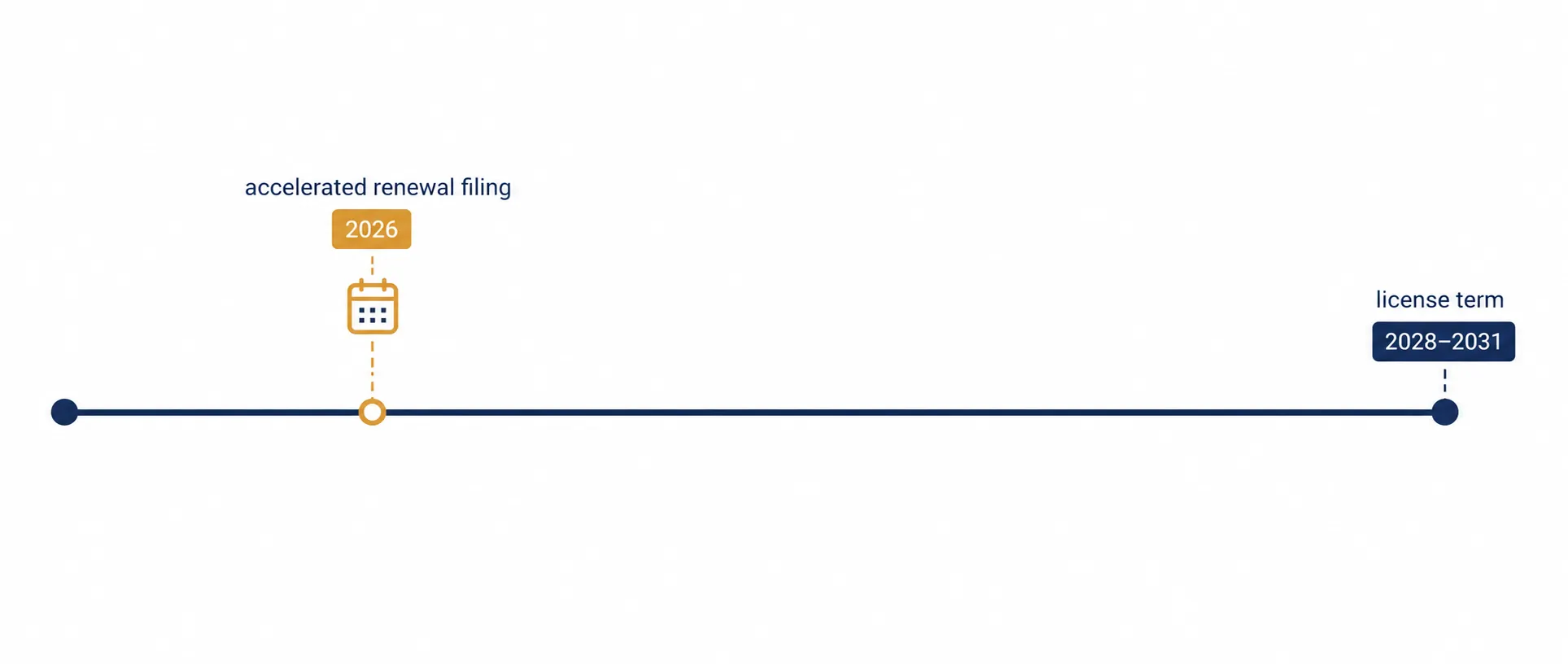
ABC’s broadcast licenses are not being revoked today. The operative FCC act is an early-renewal order: Media Bureau Order DA-26-416, released Apr. 28, 2026, which required eight ABC owned-and-operated stations to file renewal applications early, by May 28, 2026, even though their license terms otherwise run into 2028–2031.[1] Disney, ABC, and the affected stations responded with a federal lawsuit filed Aug. 18, 2026, pleading a single First Amendment retaliation claim and seeking emergency relief before the renewal process advances further.[2]
| Record item | Current posture |
|---|---|
| Agency action challenged | FCC Media Bureau Order DA-26-416, an early-renewal order for eight ABC owned-and-operated stations; it is not a revocation order.[1] |
| What the order required | The stations were ordered to file renewal applications by May 28, 2026, years before ordinary license expirations in 2028–2031.[1] |
| Plaintiffs | Disney, ABC, and the eight affected owned-and-operated station licensees.[2] |
| Filing date | Aug. 18, 2026.[2] |
| Claim pleaded | One cause of action: First Amendment retaliation.[2] |
| Emergency relief sought | Temporary restraining order and preliminary injunction against the challenged early-renewal process.[2] |
| Near-term court schedule | Reported briefing dates are Sept. 3, Sept. 17, and Sept. 24, with a TRO/preliminary-injunction hearing expected during the week of Oct. 5, 2026; if the FCC issues a hearing designation order, an expedited hearing is reported for the next business day.[3] |
| Last checked for this article | Aug. 26, 2026. Before relying on this posture in a client memo, recheck the D.D.C. docket and any FCC filings after that date. |
What the FCC actually required
The order that set off the lawsuit does one concrete thing: it accelerates the license-renewal filings for eight ABC owned-and-operated stations. It does not say the licenses are revoked. It does not make a final finding that any station failed the renewal standard. It does not itself remove a station from the air.
That distinction is not a technicality. An early renewal filing changes the station’s legal workload and risk calendar. It forces the licensee to enter a renewal posture now, respond to objections now, and litigate the regulatory implications of the FCC’s order before the ordinary end of the license term. For station counsel, that is a live burden. For anyone describing the case externally, it is still not the same thing as an adjudicated license loss.
Actual revocation would travel under a different statutory path. Section 312 of the Communications Act lists grounds for revocation and provides that a station license may not be revoked except after an order to show cause and an opportunity for hearing.[4] Renewal, meanwhile, is evaluated under the renewal framework Congress left in place after eliminating comparative renewal in 1996: the Commission looks to whether the station has served the public interest, whether there have been serious violations, and whether there is a pattern of abuse.[5]
The order therefore sits in an uncomfortable middle ground. It is not the penalty that some headlines imply, but it is also not a harmless letter. It opens a proceeding earlier than ABC says the law permits and earlier than the station license terms required. The practical question is whether that acceleration is a lawful administrative move or, as ABC alleges, the penalty mechanism itself.
The historical baseline is one reason the order drew attention. Reporting on the dispute has described forced early renewal as rare, identifying the 1972 Leflore Broadcasting matter as the last comparable forced early renewal, and has emphasized that content-based broadcast-license revocation has not been a routine modern FCC tool.[6] That history does not decide ABC’s claim. It does explain why an early-renewal order, even without revocation, is being treated as a serious legal event.
The order and the complaint are doing different legal work
DA-26-416 is the agency action. ABC’s complaint is the retaliation narrative wrapped around that action. Keeping those documents separate avoids the two common errors in this dispute: treating the FCC order as if it already revoked licenses, or treating ABC’s allegations of motive as if a court has already found them true.
| Issue | FCC order | ABC’s complaint |
|---|---|---|
| Present legal effect | Accelerates renewal filings for eight owned-and-operated stations.[1] | Says that acceleration is retaliatory and should be enjoined before the administrative process imposes further harm.[2] |
| License status | Does not revoke the licenses and does not itself make a final nonrenewal decision.[1] | Alleges the order places ABC under threat of losing valuable broadcast licenses if it continues exercising independent editorial judgment.[2] |
| Core legal theory | Administrative processing of license renewals. | Single First Amendment retaliation claim, framed in part through the Supreme Court’s recent government-coercion doctrine.[2] |
| Near-term consequence | Station renewal filings and related FCC process move earlier than the ordinary expiration schedule.[1] | ABC asks the district court to stop the process before the FCC completes it.[2] |
ABC’s complaint calls the order an “existential threat” and describes the alleged injury as forcing a choice between “exercising independent editorial judgment” and “risking the loss of valuable broadcast licenses.”[2] Those are ABC’s words and ABC’s theory. They matter because the First Amendment claim depends on motive and coercive effect, not merely on the formal label attached to the order.
That is also where the political backstory enters the case, but only as pleaded evidence of retaliation. ABC points to disputes involving Jimmy Kimmel jokes, guests and comments on The View, and the network’s decision not to air the president’s July primetime speech.[2] The lawsuit does not ask the district court to decide whether those programming choices were wise, fair, or newsworthy. It asks whether the government used broadcast licensing pressure because of them.
The FCC side has not accepted that framing. FCC Chair Brendan Carr has publicly characterized ABC’s lawsuit as “meritless,” according to contemporaneous coverage.[7] That denial should be treated as a litigating and public-position statement, not as a finding that resolves the retaliation issue.
One more boundary matters for anyone tracking the docket: this renewal fight should not be merged with other ABC/FCC disputes. The View equal-time matter is a separate proceeding, and comment-count figures or public-submission totals from that docket do not establish the record in the early-renewal case.[8]
Former FCC officials have also appeared in the broader renewal fight, urging the Commission to reject petitions to deny and warning against using licensing authority as leverage over editorial choices.[9] Those filings are context, not a substitute for the pleadings. They help show why experienced communications lawyers view the order as unusual; they do not prove ABC’s retaliation claim.
The immediate fight is jurisdiction, not who wins the First Amendment merits
The next meaningful decision is likely to turn on whether the district court can hear the case now. Reported scheduling places the dispute before Judge Loren L. AliKhan in the U.S. District Court for the District of Columbia, with the FCC expected to press ripeness and exhaustion arguments and ABC expected to rely on Axon Enterprise v. FTC to argue that its constitutional retaliation claim can be heard before the agency process ends.[3]
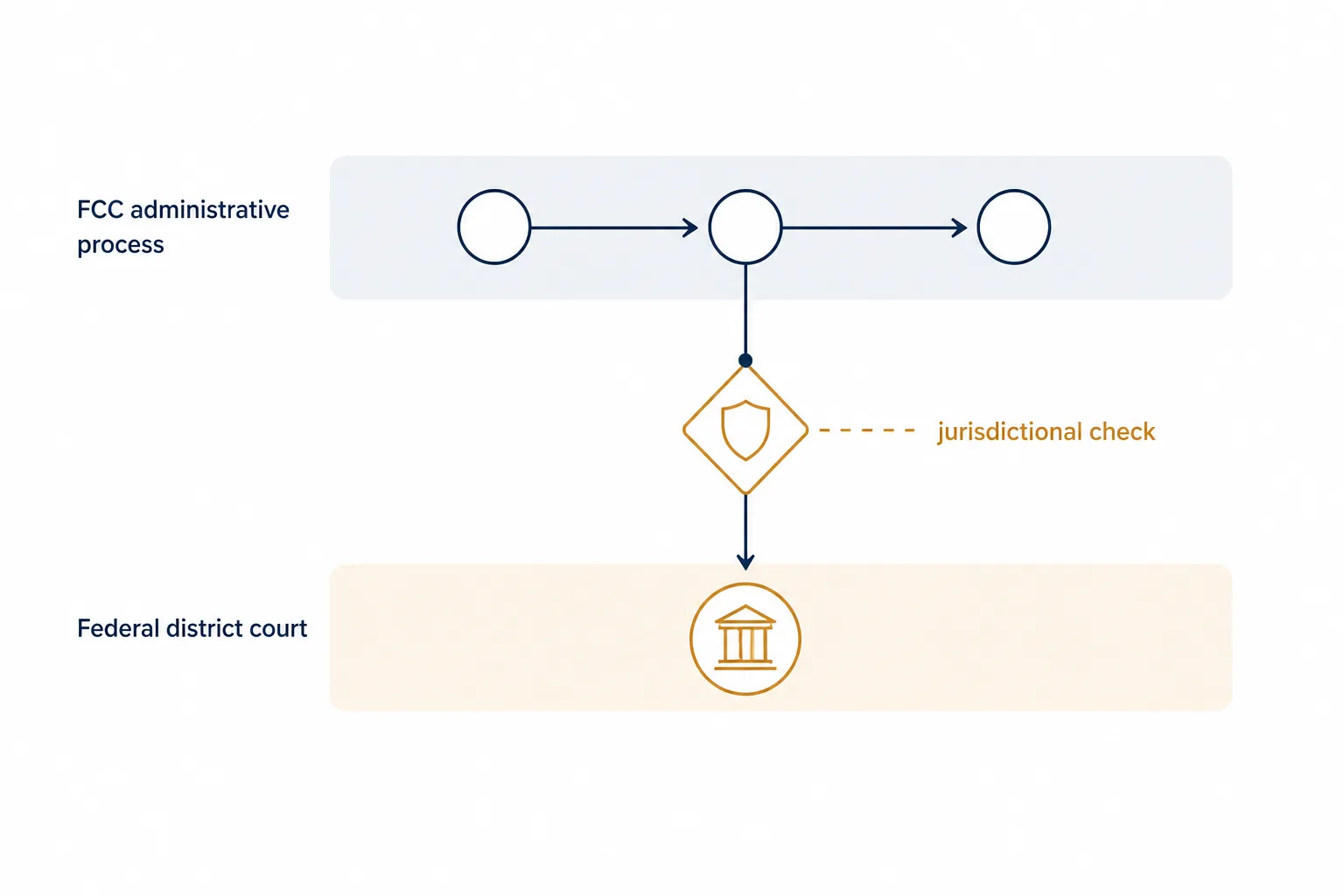
The government’s likely path is familiar in administrative-law litigation: the FCC process exists, Congress created review channels, and the regulated party should not be able to bypass that structure before the agency acts finally. In that frame, Thunder Basin-style channeling, ripeness, and exhaustion are not side issues. They are the door to the courthouse.
ABC’s likely response is that the injury is happening now because the allegedly retaliatory process itself chills or penalizes editorial choice. Axon matters to that argument because it recognized that some constitutional challenges to agency structure or process may be heard in district court without waiting for the administrative proceeding to conclude.[3] Whether this case fits that lane is the question; the complaint’s speech-retaliation theory does not automatically answer it.
The reported schedule gives the parties little room to let the issue drift. Briefing is set for Sept. 3, Sept. 17, and Sept. 24, with a TRO/preliminary-injunction hearing during the week of Oct. 5, 2026. If the FCC issues a hearing designation order, the court schedule reportedly provides for an expedited hearing the next business day.[3]
If the court dismisses or stays the case on justiciability grounds, that would not be a ruling that ABC’s First Amendment theory is wrong. It would mean the court concluded that the claim must wait, or that the statutory review scheme channels the dispute elsewhere for now. If the court reaches the emergency-relief request, it still may decide only whether ABC has met the temporary-injunction standard, not the final legality of the FCC’s renewal authority.
What to recheck before relying on the case posture
As of Aug. 26, 2026, the safe description is this: the FCC has not revoked ABC’s licenses; the Media Bureau ordered early renewal filings; ABC and Disney sued to block that order as First Amendment retaliation; and the near-term fight is whether the D.D.C. can hear the claim before the FCC process concludes.
- Check the D.D.C. docket for any motion to dismiss, opposition, reply, or order modifying the Sept. 3, Sept. 17, Sept. 24, and week-of-Oct. 5 schedule.
- Check whether the FCC has issued any hearing designation order; under the reported schedule, that could trigger an expedited court hearing the next business day.
- Check the FCC docket for amendments, petitions, oppositions, or staff action after DA-26-416.
- Do not import facts, comment counts, or arguments from separate ABC/FCC proceedings unless the filing is actually in this renewal record.
- When quoting disputed language, keep it attributed: ABC alleges retaliation and an existential threat; Carr calls the suit meritless; neither characterization is yet an adjudicated finding.
References
- Walt Disney Company, ABC, and TV Subsidiaries — Federal Communications Commission, Apr. 28, 2026.
- ABC, Inc. et al. v. Federal Communications Commission et al., Redacted Complaint — Deadline-hosted court filing, Aug. 18, 2026.
- ABC Trump FCC Lawsuit Hearing — Deadline, Aug. 2026.
- 47 U.S. Code § 312 — Administrative sanctions — Cornell Legal Information Institute.
- The FCC Lacks Authority to Punish Broadcasters for Their Viewpoints — Yale Journal on Regulation.
- ABC Stations’ License Renewal and the FCC — Freedom Forum.
- ABC, Disney sue FCC over license lawsuit Carr — Politico, Aug. 18, 2026.
- ABC battles FCC regulators in dispute over The View equal-time rules — Associated Press via The Free Speech Center at Middle Tennessee State University.
- Former FCC officials oppose early review of Disney-owned ABC licenses — The Guardian, July 28, 2026.
Related records
Tool profile
Browse tool evaluations →Governing regulation
Browse the obligations tracker →Preventive workflow
Browse verification workflows →
Report a correction or tip
Spotted an outdated figure, a misstated fact, or a ruling this case record should reflect? Public comments are disabled for this content given the professional cost of a misreported case outcome, penalty amount, or rule text — use the structured correction channel instead.
Report a correction or tip for this record →