
Why Abdul Ballout's Early Release Echoed a Known Failure
Within four months, convicted ISIS supporters Abdul Ballout and Mohamed Bailor Jalloh were granted early release after courts accepted their claimed disengagement at face value, leading to deadly attacks. This case comparison exposes a structural blind spot in verifying deradicalization claims that parallels the AI hallucination verification problem tracked on this site.
- Jurisdiction
- Germany
- Court
- Berlin Juvenile Court
- AI tool named
- None
- Ruling date
- May 1, 2026
- Source document
- View primary court order ↗
- Last verified
- Jul 28, 2026
Lex Machina Review is an independent risk-tracking and reference resource. Nothing on this site is legal advice, and using it does not create an attorney-client relationship. Every record is reviewed against primary sources but may not reflect the most current status of a matter — always verify directly against the cited court order, rule text, or a licensed attorney before relying on it.
Companion explanation — secondary to the source document above
The Ballout release record is the place to start
The Abdul Ballout early release terrorism case turns on a short sequence of procedural facts, not on any need to replay the violence at Berlin Pride. In May 2026, Ballout was sentenced in Germany to 22 months of youth custody, fully suspended with probation. The court credited roughly nine months of pretrial detention and accepted his claimed distancing from ISIS as a mitigating signal. Prosecutors had asked for a longer, non-probationary sentence and for continuation of the arrest warrant, but the court overruled them. As a probation condition, Ballout was directed into a 26-session deradicalization program. He attended two sessions, on June 15 and July 9, before the July 25 attack. A third session had been scheduled for July 27, after the attack and after he had reportedly been killed by police. Some German records may identify him as “Abdul B.” because of German privacy practice. [1]
That is the record that matters. The court did not merely note a defendant’s statement of regret and move on; it allowed a claimed break with ISIS to help convert a custodial term into a suspended youth sentence. The operational consequence was immediate. Probation and deradicalization staff inherited a risk judgment that had already been treated as sufficiently resolved for release.
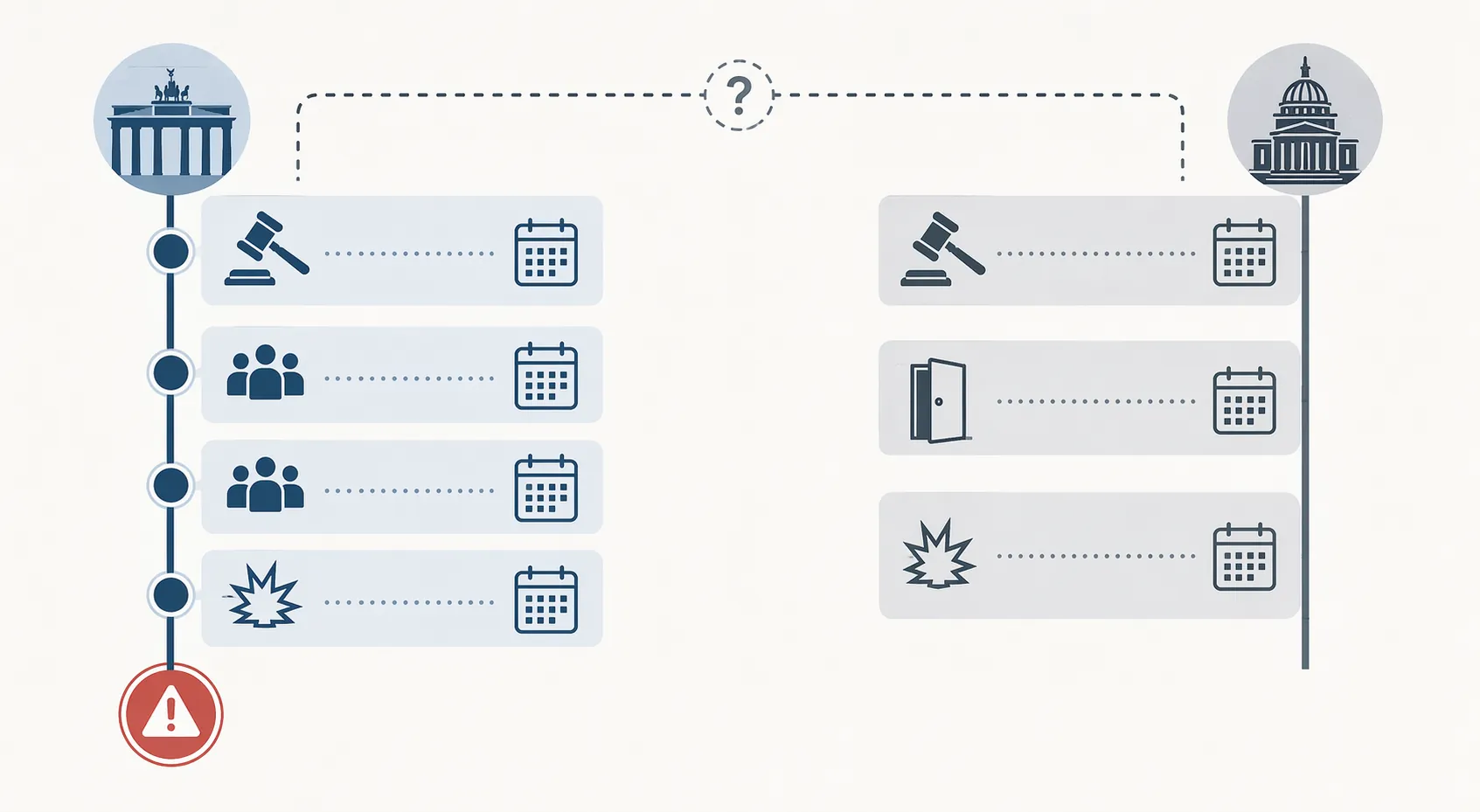
The attack itself should be handled with some restraint because the case was still only three days old as of July 28, 2026. Available reporting put the number of injured people in a range of roughly 25 to 29, depending on the outlet and update. [2] That range is enough to understand the gravity of the event without pretending that every figure had already stabilized.
There was also a July 3 police search at Ballout’s home in connection with a weapons matter. Police reportedly found only a toy gun, and the case was dismissed. [1] It is tempting to turn that search into a dramatic missed-warning centerpiece. The narrower point is more useful: one check closed one question, but it did not amount to a structured recidivism-risk verification process or independently verify the larger premise on which release depended — that Ballout had actually disengaged from the ideology and networks that made his prior conviction significant.
Why the suspended sentence mattered
A suspended sentence is not just a softer punishment. In a terrorism case, it moves the most important assumption from the courtroom into the community: that supervision, program attendance, and the defendant’s asserted change are adequate to manage the remaining risk. When prosecutors ask for a non-probationary sentence and continuation of an arrest warrant, they are not merely asking for symbolic severity. They are asking the court not to let an unresolved risk question become an operational fact.
The deradicalization condition shows the same problem in a different form. A 26-session program can be a meaningful supervisory tool only if the system is clear about what it is doing. Is the program a condition imposed after the court has already found risk manageable? Is it the main mechanism for testing whether disengagement is real? Or is it being treated as both at once? In Ballout’s case, the court had already allowed release, and the program had barely begun. Two attended sessions are not the same thing as a completed intervention, much less an independent risk assessment. [1]
This distinction matters because release decisions often turn on the appearance of a process. A program order can make a file look supervised. A scheduled session can make a risk look managed. A defendant’s verbal distancing can make a sentencing record look rehabilitative. None of those are useless. But none of them is the same as corroborated verification of the claim that produced the release pathway.
Jalloh is the comparator, not the same case in another country
Mohamed Bailor Jalloh’s case belongs beside Ballout’s, but not because the legal mechanisms were identical. They were not. Jalloh was sentenced in 2017 in the United States to 11 years in federal prison for providing material support to ISIS. He was released on December 23, 2024, after roughly seven and a half years, through a drug-treatment program pathway even though terrorism inmates are typically treated as ineligible for that form of release. He remained on supervised release until 2029. On March 12, 2026, he attacked people at Old Dominion University, killing one and wounding two. [3]
The comparison should be kept disciplined. Ballout’s release followed a German juvenile-court sentencing decision that suspended youth custody. Jalloh’s release came through a U.S. federal drug-treatment program pathway after years in custody. Treating those as doctrinal equivalents would blur the very thing that needs attention: different systems can produce the same verification blind spot through different routes.
The common feature is narrower and more troubling. Both men were convicted ISIS supporters. In both records, confession, cooperation, or claimed disavowal operated as a mitigating signal. And in the available reporting on both cases, there is no indication that a structured risk-assessment instrument — AI-powered or otherwise — independently tested the recidivism risk before release. [1][3]
| Case | Release mechanism | Mitigating signal | Verification gap |
|---|---|---|---|
| Abdul Ballout | German youth-custody sentence fully suspended with probation in May 2026 | Claimed distancing from ISIS, credited alongside pretrial detention | Deradicalization program ordered, but only two of 26 sessions attended before the attack; no structured risk-assessment instrument identified in available reporting |
| Mohamed Bailor Jalloh | U.S. federal release through a drug-treatment program pathway on December 23, 2024 | Confession or asserted disavowal treated as a mitigating signal in the broader record | Release occurred despite terrorism-inmate eligibility concerns; no structured risk-assessment instrument identified in available reporting |
That table should not be read as proof that either attack was predictable in the strong sense. Retrospective certainty is cheap and usually misleading. The better question is what the decision-maker could verify at the time. A later attack does not automatically prove that every earlier release decision was indefensible. It does, however, expose whether the record had a way to test the representation on which the decision relied.
The blind spot is not belief in rehabilitation
There is a poor version of this argument that says courts should never credit change, never use deradicalization programs, and never release terrorism offenders before the outer edge of a sentence. The available materials do not support that broad claim. They support something more specific: when claimed disengagement becomes important to release, the claim needs a verification method strong enough for the stakes attached to it.
Self-report has a place in sentencing and supervision. Defendants can provide information that no instrument can supply. Admissions can matter. Cooperation can matter. Program participation can matter. But a self-reported break with a violent organization is not a neutral fact like a date of birth or a certified custody credit. It is an assertion about internal commitment, future conduct, and continuing affiliation risk. Those are exactly the kinds of assertions that require corroboration before they are allowed to change custody status.
A structured process would not have to mean a single mandatory score. It could mean a documented method for separating what is known, what is claimed, what has been externally corroborated, and what remains unresolved. It could require the court to identify whether a program is being used as treatment, as monitoring, as evidence of changed risk, or merely as a condition after release. It could require prosecutors’ objections to be answered on the same evidentiary plane, rather than being displaced by a generalized impression that the defendant has moved away from extremism.
The Ballout file is especially stark on that point because the deradicalization record was not mature. Two sessions attended before the attack did not provide much behavioral history. A third session scheduled after the attack could not verify anything in time. The 26-session order may have been a reasonable supervisory requirement, but it was not, at that stage, evidence that the claimed distancing had held under observation. [1]
Where the AI-risk analogy actually fits
No AI tool is reported to have been involved in either release decision. The analogy is structural, not causal. The resemblance is to a familiar legal-AI failure pattern: a fluent, plausible, useful-looking representation enters a professional process; someone fails to verify it independently; and the system treats it as reliable because it has already been written into an authoritative document.
In AI-generated briefing, the danger is that an invented case citation, a distorted quotation, or an unsupported legal proposition becomes part of a filing because it looks like the kind of thing a lawyer expected to see. The professional failure is not that the lawyer encountered a plausible assertion. The failure is that plausibility was allowed to substitute for verification.
The release records raise the same class of problem in a different domain. A defendant’s claimed disengagement may sound coherent. It may align with incentives the system wants to encourage. It may be accompanied by a confession, custody credit, or a program condition. But once that claim changes custody status, it is no longer just narrative material. It has become an operational fact. Prosecutors, probation officers, program staff, universities, parade attendees, and later victims bear the consequences if the assertion was thinner than the court record made it appear.
That is why the comparison between Ballout and Jalloh should not be reduced to a slogan about early release. The more precise lesson is about verification architecture. What did the court or release authority require before accepting disengagement as meaningful? Was there a structured instrument or documented methodology? Were contrary prosecutorial concerns resolved with evidence, or simply outweighed? Did later supervision test a premise that had already done its work at sentencing or release?
A restrained conclusion from two hard records
Ballout and Jalloh do not prove that any particular risk-assessment instrument would have prevented either attack. The record does not support that level of confidence. Instruments can be wrong, incomplete, biased, or poorly administered. A structured process is not a guarantee against violence.
The records do show something narrower: in two different legal systems, convicted ISIS supporters reached release after claimed disengagement or disavowal helped mitigate the risk picture, and the available reporting identifies no structured risk-assessment instrument independently testing that premise. In Ballout’s case, the mismatch is especially visible because the court accepted the distancing claim, prosecutors sought more restraint, and the deradicalization program had barely begun before the attack. In Jalloh’s case, the release pathway was different, but the same verification question remained unresolved.
Legal systems already know that unverified AI output cannot be treated as reliable merely because it is plausible, polished, or useful to the next procedural step. The same discipline is needed when a high-stakes self-report is used to justify release. These cases do not establish that verification would have saved every victim. They do show the cost of letting an untested representation become an operational fact.
References
- Berlin Public Prosecutor’s Office data reported by CBS News, BBC, Reuters, AP, ANSA and Die Welt
- Berlin Pride attack casualty reporting by BBC, Reuters, AP, CBS News, ANSA and Die Welt
- Mohamed Bailor Jalloh release and Old Dominion University attack reporting by PBS News/AP, NBC News and New York Post
Related records
Tool profile
Browse tool evaluations →Governing regulation
Browse the obligations tracker →Preventive workflow
Browse verification workflows →
Report a correction or tip
Spotted an outdated figure, a misstated fact, or a ruling this case record should reflect? Public comments are disabled for this content given the professional cost of a misreported case outcome, penalty amount, or rule text — use the structured correction channel instead.
Report a correction or tip for this record →