
Actual Knowledge Is the Key to Student Suicide Liability
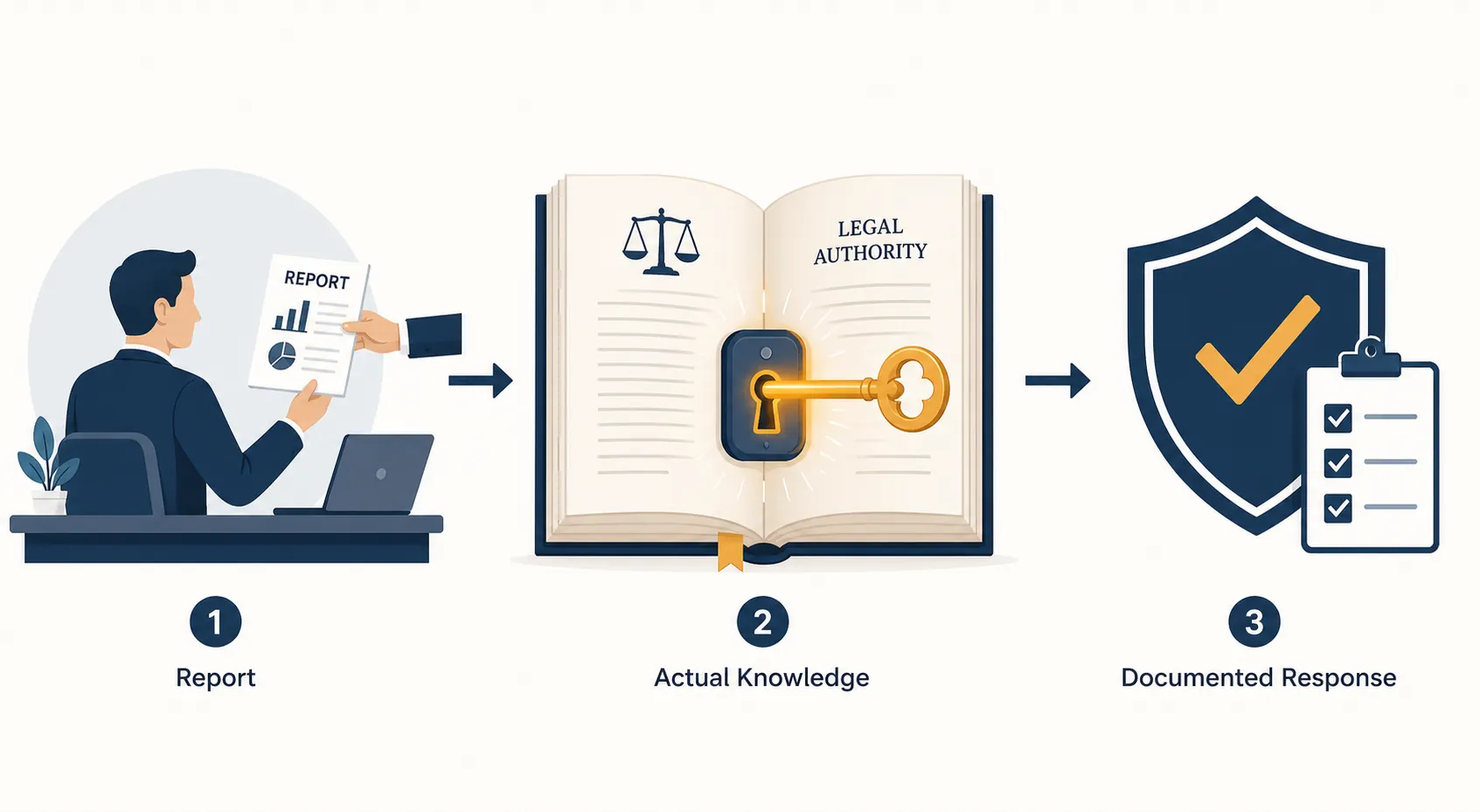
State and federal courts are converging on a narrow duty trigger for student-suicide liability: actual knowledge of a prior attempt or stated intent, followed by proof of a documented response protocol. This record maps that standard across the governing Massachusetts, Maryland, and California opinions and explains what evidence clears the hurdle.
- Jurisdiction
- Massachusetts
- Court
- Massachusetts Supreme Judicial Court
- AI tool named
- No AI tool implicated
- Ruling date
- Jul 24, 2018
- Source document
- View primary court order ↗
- Last verified
- Aug 3, 2026
Lex Machina Review is an independent risk-tracking and reference resource. Nothing on this site is legal advice, and using it does not create an attorney-client relationship. Every record is reviewed against primary sources but may not reflect the most current status of a matter — always verify directly against the cited court order, rule text, or a licensed attorney before relying on it.
Companion explanation — secondary to the source document above
Last verified Aug. 3, 2026. This Risk Digest record is a doctrine map, not legal advice on any individual death, claim, district, or campus. In student-suicide liability cases involving alleged mental-health gaps, the threshold question is narrower than most public discussion suggests: what did the school actually know about this student’s suicide risk, when did it know it, and what documented response followed?
The cases that matter most do not treat every mental-health concern as a legal duty to prevent suicide. They look for a sharper trigger: actual knowledge of a prior suicide attempt, or of stated suicidal plans or intent. After that, the inquiry changes. The institution’s file must show whether someone initiated reasonable measures, not merely whether the counseling that followed looks clinically ideal in hindsight.
Record map: the duty sources that control the analysis
| Source | Court, date, and posture | Duty rule | Why it matters |
|---|---|---|---|
| Nguyen v. MIT | Massachusetts Supreme Judicial Court, 2018; certified questions in a university student-suicide case | A university may owe a limited duty to take reasonable measures to prevent suicide when it has actual knowledge of a student’s prior suicide attempt while enrolled or shortly before matriculation, or actual knowledge of stated suicidal plans or intentions. [1] | This is the load-bearing rule: actual knowledge first, reasonable measures second. |
| Boston Bar Journal analysis of Nguyen | Post-opinion legal analysis | Explains the SJC’s practical reasonable-measures framework: suicide-prevention protocol, trained clinical care, emergency-contact notification if care is refused, and emergency personnel in urgent circumstances. [2] | Useful for translating the duty into the records risk managers and counsel actually audit. |
| Doe v. City of Northampton | U.S. District Court for the District of Massachusetts, No. 23-10358-MGM, July 1, 2024; pleading-stage duty ruling | The court allowed a public-school student-suicide claim to proceed where the pleaded facts allegedly made the student’s suicide risk foreseeable to school personnel. [3] | It tests Nguyen-style knowledge and foreseeability in the K-12 public-school setting; it is not a final liability finding. |
| Eisel v. Board of Education of Montgomery County | Maryland Court of Appeals, 1991 | School counselors may have a duty to use reasonable means to attempt to prevent suicide when they are on notice of a student’s suicidal intent. [4] | It remains an older K-12 counselor-duty anchor, especially where suicidal statements reached school personnel. |
| Regents of University of California v. Superior Court | California Supreme Court, 2018 | Recognized a university duty in a bounded student-safety setting tied to curricular activities, as discussed in the Nguyen analysis. [2] | It is most useful as a boundary case: a school relationship can matter, but the duty still needs a defined context and trigger. |
| Zirkel empirical study | Empirical analysis of K-12 student-suicide case law, covering 44 cases and 79 rulings from 2005–2019 | Reports historical patterns in student-suicide litigation outcomes and rulings. [5] | It supplies systematic background, but it predates Doe and other 2024–2026 developments. |
Nguyen supplies the clean hinge: actual knowledge before reasonable measures
Nguyen is careful in a way that is easy to lose when the facts involve a young person’s death. The Massachusetts Supreme Judicial Court did not say that a university becomes a general insurer against suicide because students are under stress, because counseling services exist, or because the institution knows that suicide is a serious campus risk. The duty arose only in limited circumstances where university personnel had actual knowledge of a student’s prior suicide attempt while enrolled or shortly before matriculation, or actual knowledge that the student had stated plans or intentions to commit suicide. [1]
That trigger matters because it preserves a legal difference between concern and notice. A student may be isolated, failing courses, grieving, bullied, volatile, or refusing help. Those facts may be grave. They may require care, discipline, disability-process review, or ordinary safety intervention. But under Nguyen, the suicide-prevention duty depends on whether the institution actually knew about a prior attempt or stated suicidal plans or intent, not whether it should have understood the student’s life as dangerous in a broader moral sense. [1]
Once actual knowledge exists, Nguyen does not ask a court to grade therapy. It asks whether the university took reasonable measures. The practical measures identified in the post-opinion analysis are concrete: initiate the school’s suicide-prevention protocol; contact appropriate officials trained to handle the matter; arrange for clinical care by trained professionals; if the student refuses care, alert the emergency contact; and, in urgent circumstances, contact police, fire, or emergency medical personnel. [2]
That is the doctrinal center of the record. The legal failure is not simply that a counseling program was understaffed, that a dean sounded too calm, or that an appointment was not as effective as the family later believes it should have been. The actionable gap is more specific: after actual knowledge, the institution cannot trace a reasonable response.
What transforms concern into actual knowledge
The evidence that clears the duty threshold usually has a different texture from ordinary student-support material. It is not a vague impression that a student was “struggling.” It is a dated report of a prior attempt, a statement that the student intended to kill himself or herself, a message naming a plan, a referral documenting suicidal intent, a friend’s report passed to a counselor, or a prior emergency intervention known to the school.
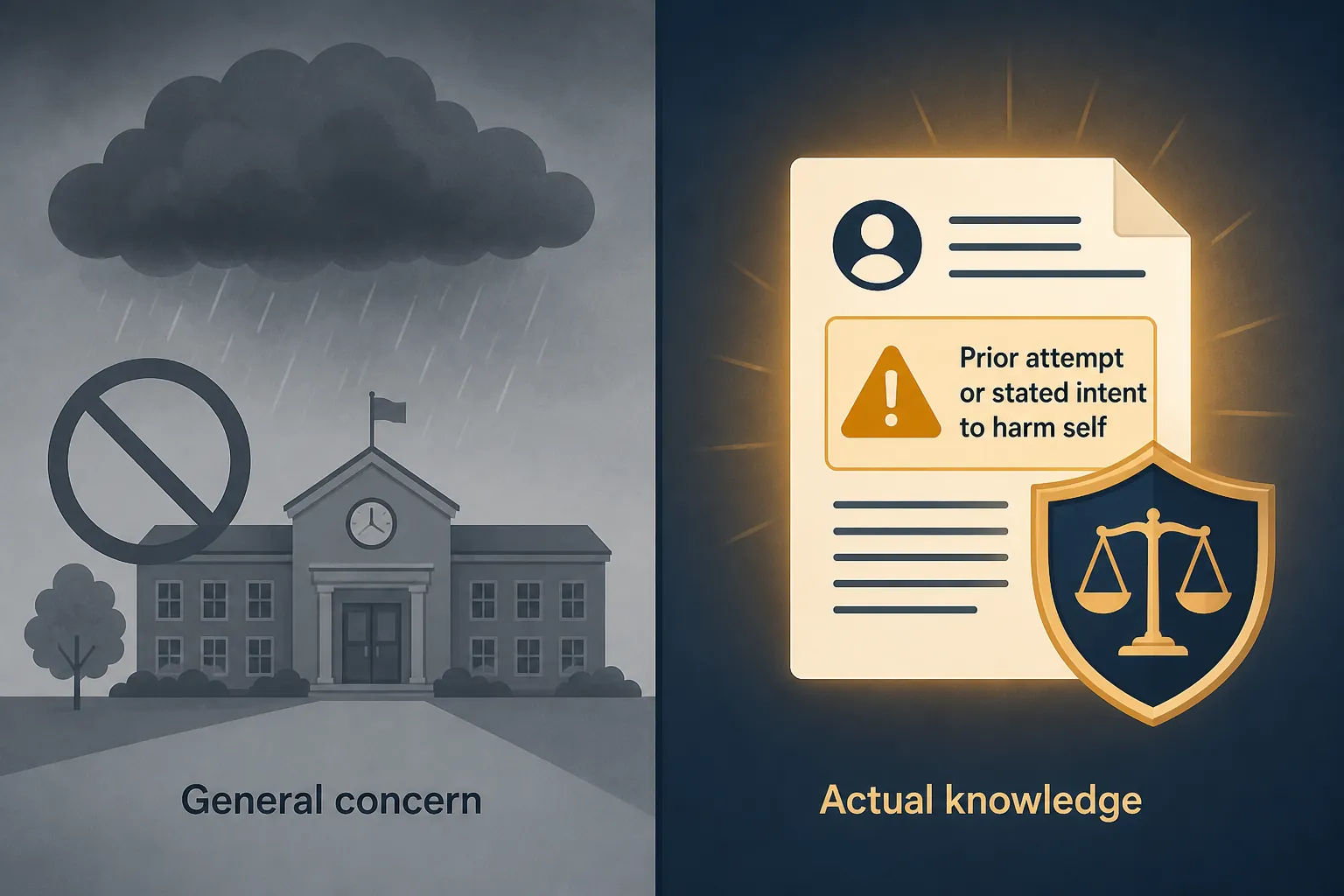
Generalized distress does not become actual knowledge merely because the distress is serious. Bullying complaints, academic pressure, disciplinary conflict, disability accommodations, social isolation, and family concerns can all be important. They may also be part of a chronology that explains why a later warning should have been understood. But the duty cases turn on the more pointed question: did the school receive information that this student had attempted suicide or had stated suicidal plans or intent?
The difference can be harsh, but it is not artificial. A counselor who receives a report that a student said she plans to kill herself is holding a different file from a counselor who knows only that the student has been crying, missing class, and arguing with peers. Both files may deserve attention. Only the first one is likely to satisfy the actual-knowledge trigger without additional facts.
Doe brings the knowledge question into the K-12 public-school setting
Doe v. City of Northampton is important because it moves the same kind of foreseeability analysis into a public-school case and does so at the pleading stage. The federal district court, applying Massachusetts law, allowed the claim to proceed where the complaint alleged that school personnel knew enough about the student’s suicide risk to make the harm foreseeable. [3]
That posture should not be softened or overstated. A pleading-stage ruling means the plaintiff alleged enough to survive dismissal; it does not mean the plaintiff proved breach, causation, or damages. For counsel reading a newly filed complaint, though, Doe is still a serious marker. It shows that, in the K-12 context, alleged institutional knowledge of suicide risk can be enough to get past the first gate when the facts are tied to foreseeability rather than to a generalized claim that the district should have had better mental-health services. [3]
For district-side readers, the practical comparison is close to other duty-of-care files: who had the warning, what authority did that person have, what protocol applied, and where does the paper trail go cold? A similar foreseeability discipline appears in this site’s school-duty discussion of how the Sunshine Protection Act could expose schools to liability, although student-suicide claims require their own tighter record because the duty trigger is knowledge of suicidal intent or attempt, not merely a foreseeable operational hazard.
After actual knowledge, the file has to show a response
The response side is where “mental health gaps” becomes a legally useful phrase. A plaintiff does not need to prove that the school could have cured the student’s illness. The more focused question is whether, after actual knowledge, the institution failed to initiate and document reasonable suicide-prevention measures.
| Record question | Why it matters after actual knowledge |
|---|---|
| Was a suicide-prevention protocol initiated? | A written policy is not enough if no one can show that the protocol was actually triggered for this student. |
| Who received the report, and when? | The duty analysis depends on actual institutional knowledge, so dates, recipients, and handoffs matter. |
| Was the student referred or connected to trained clinical care? | Nguyen’s reasonable-measures framework looks to arrangement for clinical care by trained professionals, not informal reassurance alone. |
| If the student refused care, was an emergency contact notified? | Refusal does not necessarily end the institution’s response obligation when the actual-knowledge trigger has been met. |
| Were emergency personnel contacted in urgent circumstances? | A stated imminent plan or crisis presentation changes the response record from routine referral to urgent safety intervention. |
| Can the institution trace the sequence? | The later legal file needs more than memory: notes, referrals, calls, emails, and incident reports become the evidence of reasonable measures. |
A protocol is not magic. Courts and litigants will still ask whether the people who received the information used it. A binder policy that was never opened does little work. A checklist completed after the fact may raise its own questions. The stronger record is usually contemporaneous: report received, risk escalated, trained personnel involved, student contacted, care arranged, emergency contact notified if care was refused, emergency services called if the situation was urgent.
There is a human reason to insist on that sequence. In a student-suicide file, the people who later read the record are often trying to reconstruct a few hours or days when a decision mattered. The school counselor receiving a peer report, the dean deciding whether to call a parent, the administrator asking whether a privacy rule permits disclosure, and the district lawyer reviewing the file months later all need the same thing: a traceable response to known suicidal risk.
Eisel remains the K-12 counselor-duty anchor
Eisel v. Board of Education of Montgomery County is older, but it still explains why K-12 counselor cases cannot be dismissed as ordinary nonfeasance disputes. The Maryland Court of Appeals recognized that school counselors may have a duty to use reasonable means to attempt to prevent a student’s suicide when they are on notice of suicidal intent. [4]
Eisel’s continuing value is not that every school employee becomes liable whenever a student is emotionally distressed. Its value is that it treats notice of suicidal intent as legally different from general welfare concern. That is the same line Nguyen later sharpens in the university setting: actual knowledge of a suicide attempt or stated suicidal plans or intent is the event that changes the institution’s legal position. [1][4]
Regents is a boundary, not a shortcut
Regents of University of California v. Superior Court can be tempting to cite as a broad university-duty case. It should be used more carefully. The California Supreme Court recognized a university duty in a bounded student-safety context tied to curricular activities, and the Nguyen commentary treats Regents as part of the broader movement away from blanket no-duty rules for universities. [2]
For student-suicide claims, Regents is most useful as a guardrail. It supports the idea that the student-institution relationship may carry legal duties in defined settings. It does not replace the suicide-specific knowledge inquiry. A university’s general relationship with students still has to be connected to the particular risk and the particular information the institution actually had.
Zirkel supplies history, not a 2026 answer
Perry Zirkel’s empirical study is useful because it is systematic. It examined 44 student-suicide cases and 79 rulings in the K-12 setting from 2005 through 2019. [5] That is a better backdrop than anecdotal settlement talk or recycled statements about school mental-health duties.
The date range is also its limit. The study does not account for Doe, for later 2024–2026 rulings, or for any unresolved appellate developments outside the study period. This record therefore uses Zirkel for historical patterning, not for the current Massachusetts duty rule or for the present posture of newer cases.
The same restraint applies to settlement figures. Older student-suicide settlements, and adjacent fatal-bullying or assault settlements, may signal that exposure can be severe in the right record. They do not price the duty question. A large payment in one file cannot supply actual knowledge in another.
The proof fight is usually narrower than the grief
A plaintiff trying to clear the duty hurdle will usually need to identify the warning with care: the prior attempt, the stated plan, the communication, the recipient, the date, and the institutional handoff. A defendant will usually try to separate documented concern from actual knowledge and, if actual knowledge is present, show the reasonable measures that followed.
This is also why unverified procedural claims should stay out of a risk record. The current Ohio Supreme Court appeal status in Soler v. Cleveland Metropolitan School District, 2025-Ohio-2151, is not asserted here as of Aug. 3, 2026. If a file depends on that case, its docket status should be verified directly before anyone treats it as authority.
The duty hurdle is not a referendum on whether a school’s mental-health system was humane enough. It is colder and more specific: did the school have actual knowledge of a prior attempt or stated suicidal intent, and, if so, can it trace a reasonable documented response?
References
- Nguyen v. Massachusetts Institute of Technology, Justia, 2018
- The Supreme Judicial Court Steps Into the Complicated World of Student Mental Health, Boston Bar Association
- Massachusetts Federal District Court Weighs in on the Existence of a Duty of Reasonable Care Between a Public School and a Student at Foreseeable Risk of Suicide, VDH Boston
- Student Suicide: Legal and Ethical Implications, American School Counselor Association
- Liability for Student Suicide: An Updated Empirical Analysis of the Case Law, ERIC
Related records
Tool profile
How Meta's AI Spending Reshapes Law Firm ProfitabilityGoverning regulation
Browse the obligations tracker →Preventive workflow
Browse verification workflows →
Report a correction or tip
Spotted an outdated figure, a misstated fact, or a ruling this case record should reflect? Public comments are disabled for this content given the professional cost of a misreported case outcome, penalty amount, or rule text — use the structured correction channel instead.
Report a correction or tip for this record →