
The Legal Investigation Into the Aeon Mall Kumamoto Explosion
The July 2026 Aeon Mall Kumamoto explosion, which killed five and injured dozens, has triggered a multi-agency investigation into whether the automated LPG shut-off system failed. This article examines the liability questions under Japan's High Pressure Gas Safety Act and what legal professionals should watch as the probe unfolds.
- Jurisdiction
- Japan
- Court
- Kumamoto District Court
- AI tool named
- Automated LPG shut-off system
- Ruling date
- Jul 28, 2026
- Source document
- View primary court order ↗
- Last verified
- Jul 30, 2026
Lex Machina Review is an independent risk-tracking and reference resource. Nothing on this site is legal advice, and using it does not create an attorney-client relationship. Every record is reviewed against primary sources but may not reflect the most current status of a matter — always verify directly against the cited court order, rule text, or a licensed attorney before relying on it.
Companion explanation — secondary to the source document above
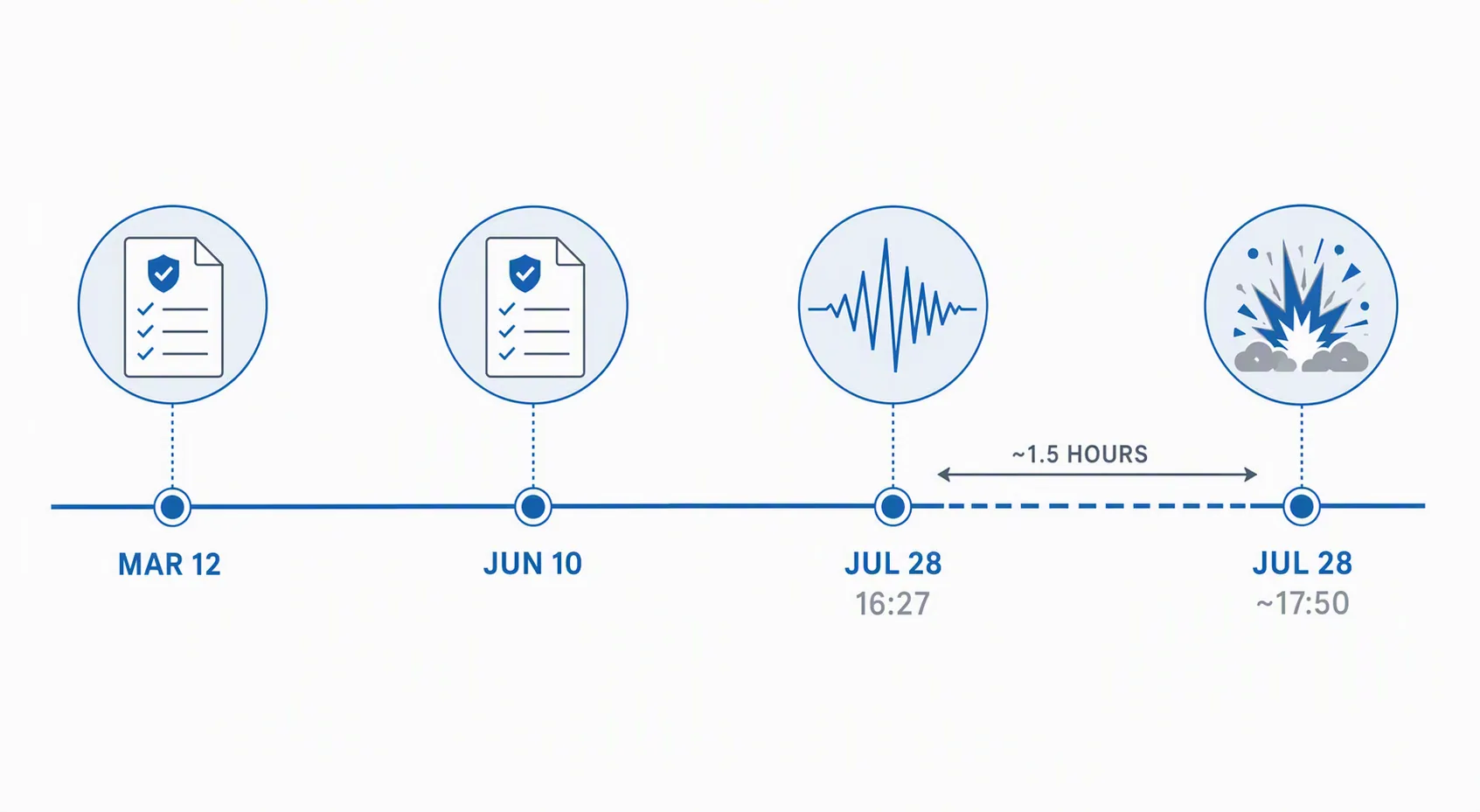
The legal investigation into the Aeon Mall Kumamoto explosion begins in an 80-minute gap. Reuters reports that the magnitude 7.1 earthquake struck at 16:27 on July 28, 2026; customer evacuation was completed around 17:00; and the gas explosion occurred around 17:50, after the mall had already been cleared of shoppers but while employees and responders were still exposed to the building’s condition.[1]
That timing matters more than the usual disaster headline. If an automated LPG safety system was designed to respond to major seismic activity, leaks, or pressure abnormalities, the question is not simply whether gas was present. It is whether the system detected the event and failed to execute, or whether it never detected the relevant condition at all. Aeon President Akio Yoshida has said the gas-leak hypothesis is “very high,” but Reuters reported on July 29 that Aeon had not confirmed whether the microcomputer-controlled shut-off valve activated.[1]
This Risk Digest analysis is current as of July 30, 2026. The public record is still thin: no court filings, charges, or formal liability determinations have been reported in English-language sources. AP, citing Japanese authorities, reported broader quake death tolls that differed by counting method: 23 dead in the prefectural tally and 28 in a police tally that included cases still under investigation.[2] NHK reported the explosion at the Kumamoto mall on July 28 as an emergency incident, before later reporting and press briefings began to narrow the technical questions.[3]
The Inspection Record Is Now Evidence, Not Reassurance
The most legally important pre-explosion fact may be that the LPG system did not enter July with a known public defect. Reuters reported that Aeon’s system passed a voluntary inspection on March 12, 2026 and a statutory inspection on June 10, 2026, both with “no abnormalities.”[1] Those dates will be attractive to every party that wants to show diligence. They will also be the starting point for any party that wants to show the inspection protocol was too narrow.
A clean inspection record can answer one set of questions while leaving the decisive one untouched. It may show that required checks were performed, that visible components were in acceptable condition, or that ordinary operating thresholds were not showing faults. It does not, by itself, prove that the system would respond correctly to a Shindo-7 seismic event followed by power disruption, pressure changes, possible underground-piping damage, emergency valve operation, and enclosed-building gas accumulation.
That distinction is central for counsel assessing premises-liability, product-liability, and regulatory risk. If the inspections tested only routine conditions, the fact that they were passed may reduce one category of negligence allegation but intensify another: whether the regulated inspection baseline matched the known catastrophic use case of the equipment. If the inspections did include seismic shut-off verification, investigators will need to know whether they tested the actual installed configuration rather than a generic device capability.
| Record fact | Legal significance | Question still open |
|---|---|---|
| March 12 voluntary inspection found no abnormalities | Supports a diligence narrative before the statutory check | What failure modes were actually tested? |
| June 10 statutory inspection found no abnormalities | Places the case inside the regular compliance framework | Did the statutory protocol test seismic shut-off logic under realistic conditions? |
| Earthquake at 16:27; explosion around 17:50 | Creates a time window for automated or remote intervention analysis | Was the system silent, disabled, delayed, overridden, or unable to sense the hazard? |
| Aeon had not confirmed shut-off activation as of July 29 | Prevents any responsible analysis from treating device failure as proven | Did the device receive a triggering input, and what did its logs show? |
What the Automated LPG System Was Supposed to Do
The device at the center of the inquiry is not merely a passive pipe fitting. A Japan LPG Sales Association official told Reuters that microcomputer-controlled meters automatically shut off supply if they detect abnormalities such as leaks or pressure fluctuations, and that they are designed to cut supply during major seismic activity. Reuters also reported that the system had a radio-based remote shut-off capability.[1]
That design language creates a traceability problem. Automated safety systems distribute responsibility across hardware, software logic, sensors, communications, power supply, installation design, inspection scope, and operator response. A fractured pipe can be photographed. A control decision has to be reconstructed from logs, thresholds, electrical state, sensor input, valve position, communications records, and human actions taken after alarms or after silence.
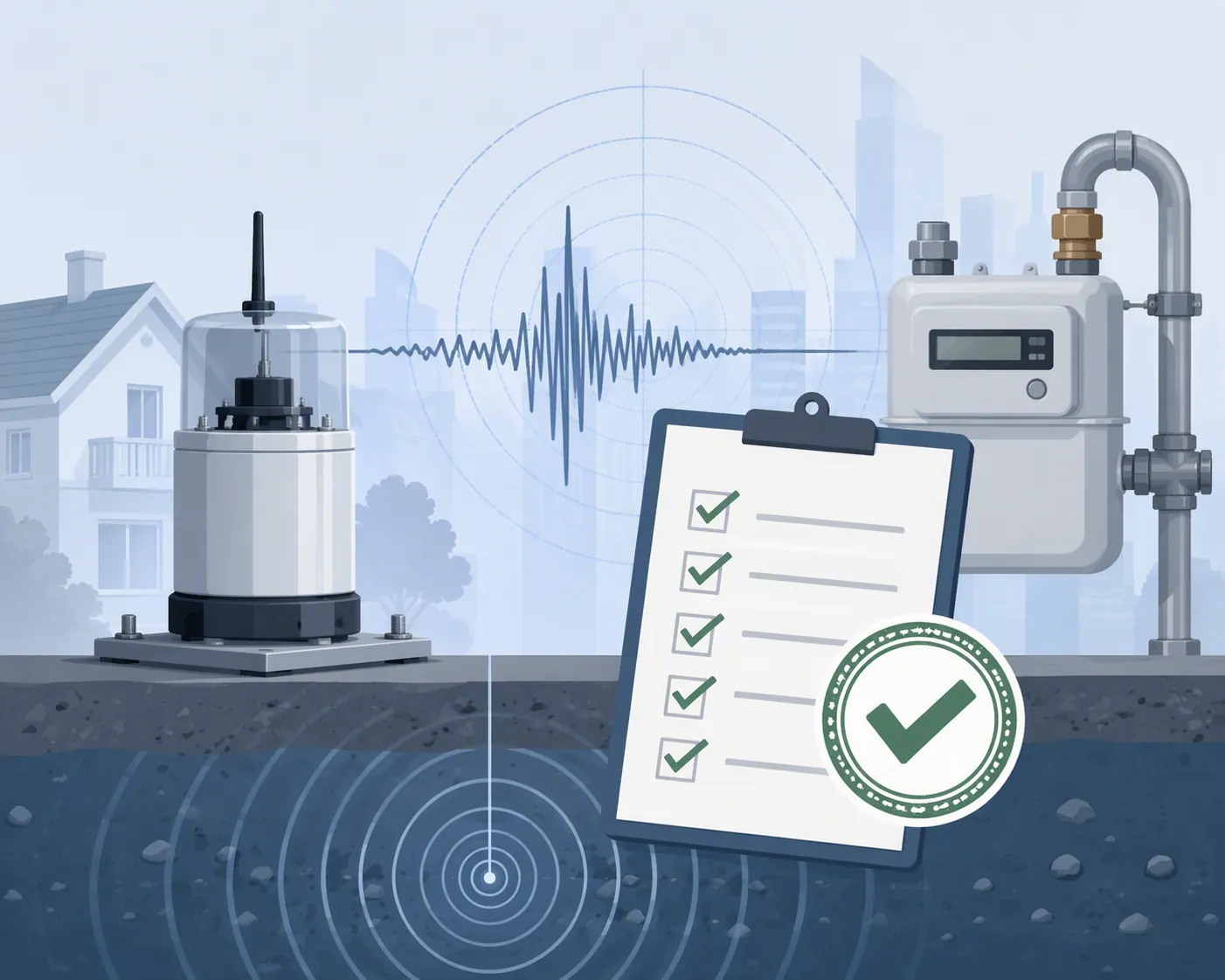
For legal professionals, the difference between “the gas system was inspected” and “the automated shut-off logic was validated for the relevant event sequence” is not semantic. It affects who should preserve evidence, who may have design knowledge, who can explain threshold settings, and who had the duty to recognize that a nominally compliant system might still fail under an extreme but foreseeable earthquake scenario.
Industry materials from the Japan LP Gas Association describe safety and supply-recovery systems for LP gas, including disaster-oriented arrangements and recovery measures.[4] Those materials are useful background, but they do not answer what happened at this mall. The litigation-relevant question is site-specific: what was installed, how it was integrated, how it was inspected, and what it recorded between 16:27 and 17:50.
The Investigation Appears to Be Moving Away From the Tank
An unofficial July 29 press-conference analysis by a facilities and infrastructure commentator on note.com stated that the outdoor LPG storage tank was intact after the blast, shifting technical attention toward underground piping and the gas cogeneration system rather than the storage tank itself.[5] That account is not an official investigative finding, and it should not be treated as one. It is still useful as a map of the systems investigators may need to isolate.
The same commentator described the Aeon Mall Kumamoto facility’s gas cogeneration system, or CGS, as a sophisticated arrangement that combines ordinary energy conservation with independent power during disasters. In that account, a seismic event with grid-power outage can trigger emergency shut-off valve operation while the CGS switches to independent operation mode.[5] If accurate for the installed system, that is a materially different problem from asking whether a single meter worked.
The legal reason to care about the CGS is not that it proves fault. It is that interactions between independently reasonable safety behaviors can create a combined failure mode: a valve may close, a generator may change operating mode, remote control may depend on communications or power availability, and gas may continue to migrate through a damaged or isolated segment. The current record does not establish that this happened. It establishes that the system architecture is complex enough that a simple “inspected and cleared” conclusion would be premature.
News On Japan reported on July 30 that the mall-specific death toll had risen to five and cited an explosion expert who said the blast scale suggested “an exceptionally powerful combustion event in which a pressure wave traveled faster than the speed of sound.” The report also described a theory that leaked gas may have accumulated because the air-conditioned building was relatively enclosed after evacuation.[6] That theory, if borne out, would make the 80-minute interval even more important: the danger may have been developing after the human evacuation was largely complete.
Compliance May Not End the Inquiry
The High Pressure Gas Safety Act and related LPG safety rules matter here because the system had just passed a statutory inspection. But the available English-language sources do not yet support a confident claim about the precise statutory breach, if any. The better current question is narrower: can a party show statutory compliance while still facing liability exposure because the inspection regime did not test a foreseeable automated-system failure mode?
An ASME paper on the development of seismic design code for high-pressure gas facilities in Japan describes the evolution of seismic design standards and the treatment of Level 2 earthquakes in the high-pressure gas context.[7] The Kumamoto quake registered Shindo 7, the highest intensity on Japan’s scale, according to Reuters.[1] The legal significance is not that the ASME paper decides this case. It is that Japan’s gas-safety framework already contemplates severe seismic conditions, making it harder to treat earthquake-triggered system behavior as an unforeseeable category in the abstract.
That does not mean every regulated actor is exposed in the same way. The facility operator’s questions will start with maintenance, emergency response, vendor oversight, evidence preservation, and whether internal risk assessments accounted for gas accumulation after evacuation. The inspection provider’s questions will turn on the scope of work, testing method, statutory requirements, and any representations made after the March and June checks. The system designer or manufacturer will face a different record: sensing thresholds, fail-safe behavior, valve actuation, remote shut-off reliability, power-loss assumptions, warnings, and installation instructions.
Integration vendors, maintenance contractors, and energy-system specialists may sit between those categories. Automated safety equipment often fails legally in the seams: a component performs as designed, but the installed system behaves in a way no single manual describes clearly; a remote capability exists, but no one can show who had authority or practical ability to use it during a communications or power disruption; a statutory inspection certifies the ordinary condition, but the catastrophic sequence depends on interactions outside the inspection checklist.
The Branching Questions Counsel Should Track
At this stage, the responsible analysis is a branching map, not a liability conclusion. The first branch is factual and should be answered from records, not press phrasing: did the microcomputer-controlled shut-off system register the earthquake, pressure abnormality, or leak condition? If it did, investigators need the execution path. If it did not, they need the sensing and threshold path.
- Detection: whether the seismic sensor, pressure sensor, or leak-detection logic received a triggering input during or after the quake.
- Execution: whether the shut-off command was issued, whether the valve moved, and whether any downstream segment remained pressurized.
- Power and communications: whether grid outage, independent-power mode, radio remote shut-off, or emergency controls changed the system’s behavior.
- Inspection scope: whether the March and June inspections tested only component condition or also the integrated seismic failure sequence.
- Human response: whether mall personnel, contractors, emergency responders, or remote operators had warnings, authority, and practical means to intervene before 17:50.
The second branch is regulatory. If official findings show that the statutory inspection protocol was followed exactly, the inquiry does not disappear; it moves to adequacy, interpretation, and foreseeable-risk management. A compliance defense is strongest when the regulated standard is specific to the failure mode that occurred. It is weaker when the standard confirms general maintenance status while the loss arises from automated decision logic under a combined seismic, power, pressure, and building-envelope scenario.
The third branch is evidence preservation. Legal teams should expect the critical record to include inspection reports, maintenance logs, sensor logs, valve-position data, CGS control records, power-transfer records, remote-command records, alarm histories, evacuation communications, vendor manuals, commissioning documents, and any post-event testing. If the system retained data locally and power was disrupted, chain-of-custody questions will matter almost as much as the logs themselves.
Why This Case Reaches Beyond One Mall
The Aeon Mall Kumamoto explosion is not an artificial-intelligence case in the ordinary sense. There is no public indication that a machine-learning model made a discretionary decision. The connection for technology-risk lawyers is more basic and more durable: automated safety systems are often trusted because they are instrumented, inspected, and described as fail-safe. When the record after a catastrophic event cannot immediately show whether the system detected the hazard or acted on it, the legal problem resembles other tool-reliability disputes. The object of trust becomes the object of proof.
This is also why the distinction between adoption and effectiveness matters. Japan’s engineering discipline and LP gas safety infrastructure may be substantial. Microcomputer-controlled meters may be widely used and designed for seismic shut-off. None of that establishes that the particular installation at Aeon Mall Kumamoto performed correctly on July 28, or that the applicable inspection regime validated the combined failure mode now under scrutiny.
The formal investigation may ultimately identify damaged underground piping, a control-system failure, a power-mode interaction, a maintenance error, an inspection gap, some combination of those factors, or a narrower cause not yet visible in public reporting. Until then, the legally useful conclusion is restrained. The Aeon Mall Kumamoto explosion is an early test of whether Japan’s high-pressure gas safety framework can absorb automated safety-system failures that appear compliant in routine inspection but fail under catastrophic seismic conditions.
The market has already reacted as if the regular baseline is not enough. Reuters reported that Aeon announced emergency inspections at all Aeon Mall locations nationwide, separate from regular statutory inspections.[1] That move should not be read as an admission of legal fault. It is, however, a practical signal: when an automated safety system passes recent inspections and a fatal explosion follows a severe earthquake, operators do not wait for a final statutory interpretation before rechecking comparable assets.
References
- After the quake came the blast: Inside Japan's shopping mall disaster, Reuters, July 29, 2026.
- Death toll from southwestern Japan quake climbs to 23, AP News, July 29, 2026.
- Aeon: Explosion reported at Kumamoto mall, NHK, July 28, 2026.
- Safety and Supply Recovery Systems, Japan LP Gas Association.
- Press conference summary with facilities analysis, note.com, July 29, 2026.
- Five Dead as Search Continues at Aeon Mall, News On Japan, July 30, 2026.
- Development of Seismic Design Code for High Pressure Gas Facilities in Japan, ASME Digital Collection.
Related records
Tool profile
Browse tool evaluations →Governing regulation
Browse the obligations tracker →Preventive workflow
Browse verification workflows →
Report a correction or tip
Spotted an outdated figure, a misstated fact, or a ruling this case record should reflect? Public comments are disabled for this content given the professional cost of a misreported case outcome, penalty amount, or rule text — use the structured correction channel instead.
Report a correction or tip for this record →