
Japan's obligation of safety consideration after the Aeon Mall explosion
The Aeon Mall Kumamoto explosion raises a novel question in Japanese employment law: whether the facility operator's obligation of safety consideration extends to tenant workers who died after customers were evacuated. This analysis examines the legal framework, Aeon's admissions, and the foreseeable liability boundaries under Civil Code Article 415 and the Industrial Safety and Health Act.
- Jurisdiction
- Japan
- Court
- None
- AI tool named
- None
- Source document
- View primary court order ↗
- Last verified
- Jul 30, 2026
Lex Machina Review is an independent risk-tracking and reference resource. Nothing on this site is legal advice, and using it does not create an attorney-client relationship. Every record is reviewed against primary sources but may not reflect the most current status of a matter — always verify directly against the cited court order, rule text, or a licensed attorney before relying on it.
Companion explanation — secondary to the source document above
The timeline that creates the legal problem
The legal question at Aeon Mall Kumamoto begins with the clock. A magnitude 7.1 earthquake struck at about 16:27. Roughly 3,000 customers were evacuated within about 30 minutes, putting the public-facing evacuation at around 16:57. The explosion came at about 17:50. In the reporting record available on July 29, all four confirmed mall-site victims were workers, and three people remained missing.[1][2]
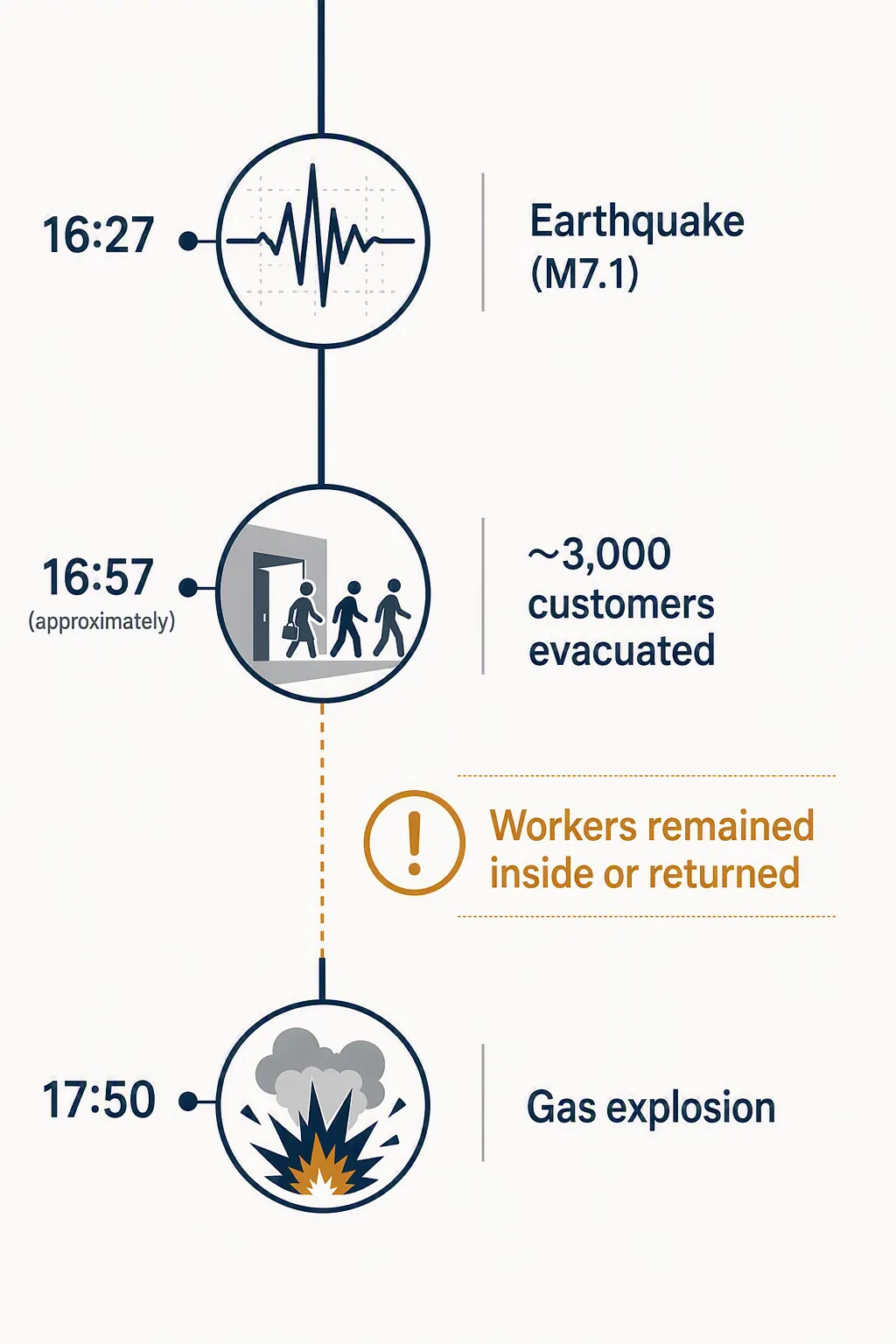
That sequence matters more than the size of the earthquake by itself. If the public was moved out, but workers were not reliably counted before the secondary explosion, the issue is not simply whether a disaster happened. It is whether the party controlling the evacuation discharged its safety obligations toward the people still working inside the facility after customers had gone.
Aeon’s own account sharpens that issue. President Akio Yoshida said the company “had not fully anticipated that an explosion of this kind could occur” and that “we believed that employees had also evacuated, but it later emerged that some people had remained inside, or returned for whatever reason.”[3] For liability analysis, the second sentence is the colder one. It identifies the gap between assuming evacuation had covered workers and knowing whether it had.
The facility was not a small single-employer workplace. The mall had 204 tenant shops and about 2,700 tenant employees alongside Aeon’s own staff.[4] That is why the phrase “employees had also evacuated” cannot be read as a tidy employment-law category. In a mall-wide emergency, tenant staff may be employees of separate shop operators, but they may still depend on the mall operator’s alarms, announcements, routes, security staff, facility decisions, and permission to re-enter or remain.
Why worker accounting is different from customer evacuation
A successful customer evacuation does not answer the worker question. Customers are transient occupants. Workers are assigned to storefronts, stockrooms, service corridors, loading areas, kitchens, and back-of-house spaces. Some may have duties that make them hesitate: closing registers, checking storage areas, assisting customers, securing shop property, or waiting for instructions from a tenant manager. Those details do not prove fault by themselves, but they explain why a headcount failure is not a clerical afterthought.
The available facts suggest a clean separation between two operational achievements. Aeon could move thousands of shoppers out quickly. Aeon could not, at least on the facts reported so far, reliably confirm that workers were out before the explosion. The legal implications sit in that separation.
Japanese law’s obligation of safety consideration, usually referred to as anzen hairi gimu, is commonly analyzed through Civil Code Article 415, which concerns liability for non-performance of obligations.[5] In employment and workplace-safety disputes, the doctrine asks whether the party owing the duty took reasonable measures to protect workers’ lives and health against foreseeable risks. It is not a strict-liability rule for every injury after an earthquake. It is also not defeated merely because the immediate trigger was a natural disaster.
The difficult point is privity. Aeon was not necessarily the direct employer of the tenant workers who died. A narrow view would stop there and say each tenant employer bore the safety duty to its own staff. That view becomes less stable if Aeon centrally controlled evacuation decisions for the whole premises. Control is not a formal payroll test. In a multi-tenant mall, the operator may be the only actor able to coordinate building-wide evacuation orders, restrict re-entry, shut down facility systems, account for areas cleared, and communicate whether the premises remain dangerous.
That does not make Aeon the legal employer of every tenant worker. It does make the operator a plausible duty-holder for the specific risk created by mall-wide emergency management. If a tenant cashier, restaurant worker, cleaner, or stockroom employee is told to follow facility-wide evacuation instructions, the question becomes whether the facility operator assumed a safety function broad enough to include that worker in the operational class being protected.
The statutory baseline is not the whole case
The Industrial Safety and Health Act supplies a baseline expectation: employers must take necessary measures to prevent dangers, including dangers connected to buildings, facilities, and work methods, and workplace accidents must be reported under the statutory framework.[6] For direct employers inside the mall, that obligation is obvious. For Aeon as facility operator, the statute is not a complete shortcut to liability for every tenant employee, but it helps frame what Japanese workplace law treats as ordinary rather than extraordinary: danger prevention must be organized before the accident, not reconstructed afterward from assumptions.
A civil claim would still have to work through duty, breach, causation, and damages. The cleanest theory is not that a major earthquake should have been prevented. It is that, once the earthquake occurred, a foreseeable secondary facility risk required more than customer evacuation. The plaintiff-side argument would likely focus on whether Aeon had a worker headcount system, whether evacuation coverage included tenant back rooms and service spaces, whether re-entry was controlled, and whether employees who remained or returned were left outside the operator’s accounting.
The phrase “for whatever reason” in Aeon’s statement would be contested hard. It may describe uncertainty. It may also invite a defense that workers acted independently after instructions were given. But at the pleading and evidence-development stage, it does not resolve who controlled the relevant premises, who had authority to stop re-entry, who confirmed evacuation, or whether tenant workers were ever integrated into the mall’s emergency procedures.
Foreseeability after a reopened, retrofitted mall
The mall had reopened on June 13, 2026 after a multi-year seismic retrofit that was described as including seismically reinforced ceilings.[3] That fact should not be inflated into proof that Aeon anticipated a gas explosion. A retrofit is not a confession that every post-quake hazard was foreseen in detail. But it does matter to reasonable reliance and emergency planning. A facility recently presented as strengthened against seismic risk cannot treat post-earthquake safety as an unknowable abstraction.
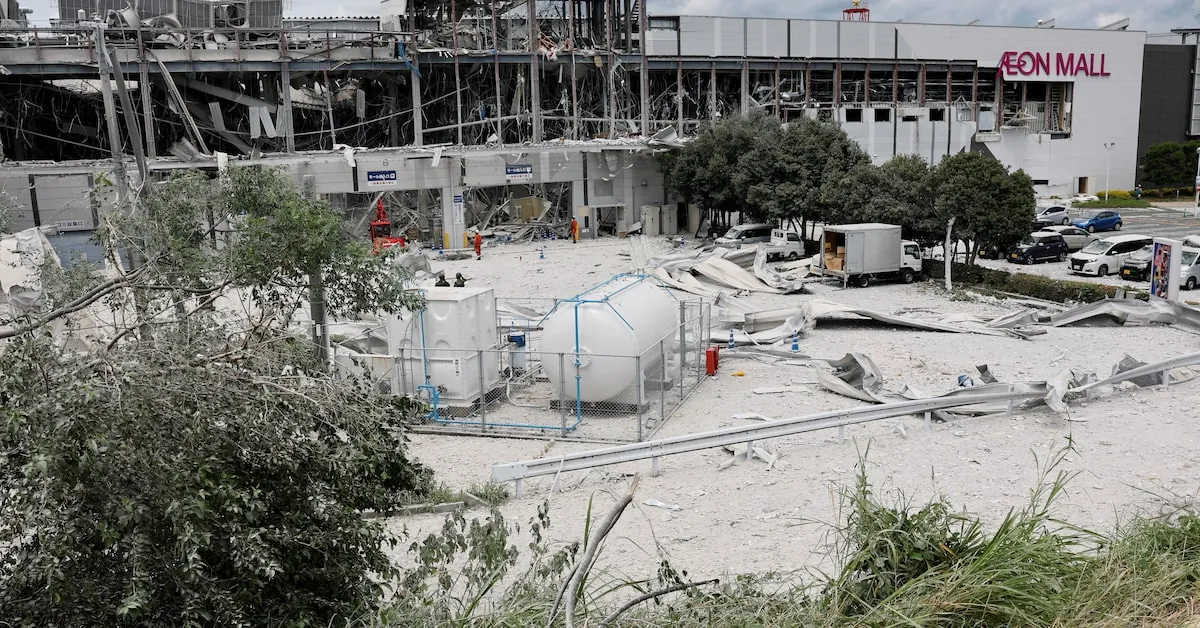
Foreseeability in this setting should be kept at the right level of generality. Aeon’s president said the company had not fully anticipated this kind of explosion.[3] That admission may help the company against an argument that the precise mechanism was known. It does less work against the broader argument that a structurally affected, multi-tenant commercial facility after a major earthquake presented serious secondary risks requiring strict control over who remained inside.
The legal distinction is familiar but often blurred after disasters. If the alleged duty is “predict this exact explosion,” the theory is vulnerable. If the alleged duty is “after a major earthquake, do not treat evacuation as complete until workers inside the facility are accounted for and re-entry is controlled,” the theory is stronger. The reported interval between completion of the customer evacuation and the explosion gives that second theory room to breathe.[1]
Where the defenses begin
The liability case is serious, but it is not settled. No directly on-point Japanese Supreme Court precedent has been identified at this scale for extending anzen hairi gimu from a mall operator to tenant workers in a mass disaster at a multi-tenant facility. As of the July 29-30 reporting window, no lawsuits had been filed in the public record described by the available reports. The casualty figures were also preliminary, with three people still listed as missing in the July 29 reporting.[2]
Aeon’s likely defenses would not need to deny tragedy. They would likely separate categories of control. The company could argue that tenant employers retained responsibility for their own staff, that evacuation instructions were given, that workers who remained or returned did so outside Aeon’s direction, and that the gas explosion was an extraordinary consequence of a major earthquake rather than a preventable workplace hazard.
Comparative negligence is the most concrete doctrinal pressure point. Civil Code Article 722 allows damages to be reduced where the injured party’s negligence contributed to the loss.[5] If evidence shows that particular workers ignored clear evacuation orders, re-entered restricted areas, or stayed for reasons unrelated to any instruction or expectation created by Aeon or the tenant employer, a court could reduce the operator’s share even if some duty and breach were found.
That defense, however, depends on facts not yet established. “Remained inside” and “returned” are not legally identical. A worker who never received a clear order, a worker told to assist with closing procedures, a worker blocked by damaged routes, and a worker who independently went back for personal property would present different causation and fault questions. Treating those possibilities as one category would do the work of comparative negligence before the evidence exists.
Damages would be compensatory, not punitive
If the deaths are treated as workplace accidents, statutory workers’ compensation benefits may be available, including death benefits such as lump-sum payments and survivor pensions under Japan’s industrial accident compensation system. Parallel civil claims may still proceed if negligence is proven. Japanese law does not provide punitive damages, and bodily injury or death damages are not capped in the way some U.S. readers might assume from other compensation systems.[7]
The practical consequence is that civil litigation, if filed, would not be about punishing Aeon through exemplary damages. It would be about compensatory recovery and allocation of responsibility among the mall operator, tenant employers, possibly other facility-related actors, and the deceased workers themselves if comparative negligence is argued. The central evidence would likely be operational rather than rhetorical: evacuation manuals, tenant instructions, alarm logs, security communications, re-entry controls, gas shutoff procedures, headcount records, and incident reports.
The liability boundary
On the present record, Aeon faces a plausible and serious civil-liability theory. The theory is not that the earthquake itself creates liability. It is that Aeon centrally managed evacuation in a multi-tenant facility, succeeded in moving roughly 3,000 customers out, but did not reliably account for workers before a secondary explosion killed confirmed victims who were workers.[1][2]
That theory fits the logic of Japan’s obligation of safety consideration: the party with practical control over a dangerous workplace condition may have to take reasonable measures to protect the workers exposed to it, even where the formal employment relationship is more complicated. Tenant status should matter to the analysis, but it should not end it if the mall operator controlled the evacuation system on which those workers depended.
The outcome remains uncertain until claims are filed and a court decides how far the duty extends in a multi-tenant disaster setting. Customer evacuation success does not necessarily discharge workplace safety obligations when workers remain inside a facility the operator controlled.
References
- Japan earthquake: Rescuers search, AP News, July 29, 2026.
- After the quake came the blast, Reuters, July 29, 2026.
- Destroyed Aeon mall had just reopened, Reuters, July 28, 2026.
- Aeon Apologizes, Nippon.com, July 29, 2026.
- Civil Code, Japanese Law Translation.
- Industrial Safety and Health Act, Japanese Law Translation.
- Product Liability Laws and Regulations Japan 2026, ICLG.
Related records
Tool profile
Browse tool evaluations →Governing regulation
Browse the obligations tracker →Preventive workflow
Browse verification workflows →
Report a correction or tip
Spotted an outdated figure, a misstated fact, or a ruling this case record should reflect? Public comments are disabled for this content given the professional cost of a misreported case outcome, penalty amount, or rule text — use the structured correction channel instead.
Report a correction or tip for this record →