
Affray Charge Definition in UK Criminal Law
A reference record for criminal practitioners covering the statutory definition of affray under Section 3 of the Public Order Act 1986, including the three-element test, mens rea threshold, sentencing exposure, and key case law.
- Jurisdiction
- United Kingdom
- Court
- General
- AI tool named
- Not applicable
- Ruling date
- Jul 25, 2026
- Source document
- View primary court order ↗
- Last verified
- Jul 25, 2026
Lex Machina Review is an independent risk-tracking and reference resource. Nothing on this site is legal advice, and using it does not create an attorney-client relationship. Every record is reviewed against primary sources but may not reflect the most current status of a matter — always verify directly against the cited court order, rule text, or a licensed attorney before relying on it.
Companion explanation — secondary to the source document above
Category: risk-digest. Scope: UK criminal law. This is a reference record, not legal advice. Primary sources checked against the Public Order Act 1986, CPS charging guidance, and Sentencing Council materials. Last verified: 25 July 2026.
An affray charge in UK criminal law is defined by Section 3 of the Public Order Act 1986. A person is guilty of affray if they use or threaten unlawful violence towards another, and their conduct is such as would cause a person of reasonable firmness present at the scene to fear for their personal safety. If two or more people use or threaten unlawful violence, their conduct is taken together for that purpose. A threat cannot be made by words alone, and no person of reasonable firmness need actually be, or be likely to be, present at the scene.[1]
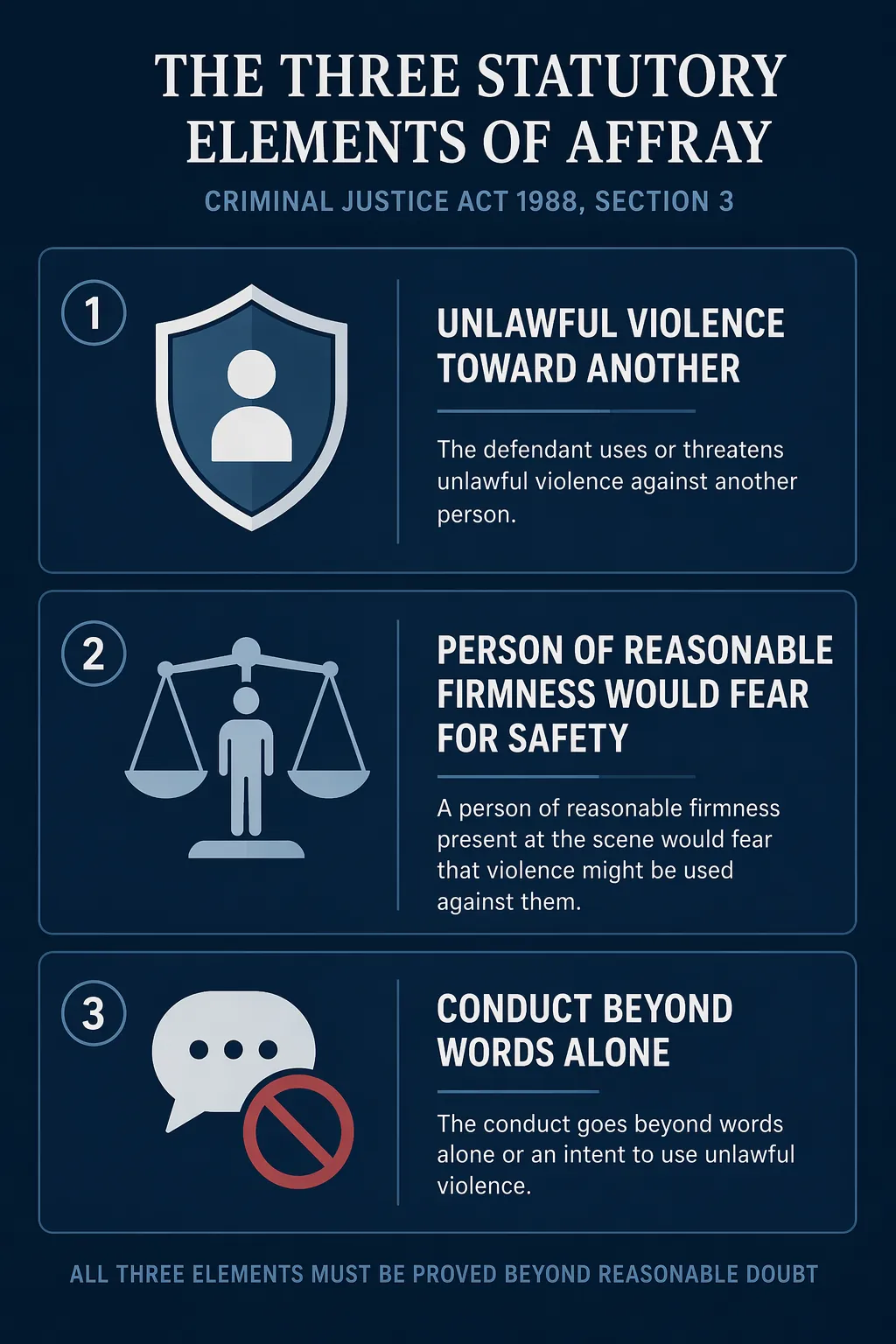
The statutory test
The definition does more work than the common shorthand “fighting in public.” Affray can occur in public or private, but it still requires the prosecution to prove the statutory components. The charge is not made out merely because an incident was frightening, disorderly, noisy, or dangerous.
| Element | What must be proved | What does not suffice |
|---|---|---|
| Unlawful violence used or threatened towards another | The defendant used or threatened unlawful violence directed at another person. | Mere possession of a dangerous item, or violence against property with no person-directed violence. |
| Reasonable-firmness fear test | The conduct would cause a hypothetical person of reasonable firmness present at the scene to fear for personal safety. | A scene that is disorderly but would not make that hypothetical person fear for personal safety. |
| Threat cannot be words alone | Where the allegation is a threat, there must be conduct beyond words. | Insults, abuse, or verbal threats alone. |
The first element is often where loose charging language causes trouble. Section 3 requires unlawful violence “towards another.” Section 8 of the same Act confirms that, for affray, “violence” includes violent conduct towards property as well as persons, but it also preserves the need for the conduct to be capable of falling within the offence charged. Damage or threatened damage is not automatically affray unless the statutory requirement of violence used or threatened towards another is met.[1]
The second element is objective. The question is not whether a particular passer-by, complainant, police officer, or household member was in fact afraid. The question is whether a person of reasonable firmness, if present at the scene, would fear for personal safety. Section 3 expressly removes the need for such a person actually to be present, or even likely to be present.[1]
The third element narrows threatening cases. Section 3 says a threat cannot be made by the use of words alone. Words may explain or colour conduct, but they cannot by themselves satisfy the threat requirement for affray. That matters in plea advice: an abusive confrontation may fit another public order offence, but it does not become affray simply because the words are aggressive.[1]
Mens rea: intention or awareness
Section 6 supplies the mental element. For affray, the defendant must intend to use or threaten violence, or be aware that their conduct may be violent or may threaten violence. The same section also provides that a person is not guilty if they were not aware, and had no reason to suspect, that their conduct might be violent or threaten violence.[1]
That mental element should be kept separate from the reasonable-firmness test. The hypothetical bystander test asks about the quality of the conduct. Section 6 asks what the defendant intended or was aware of. A charge can become blurred if those questions are collapsed into a general allegation that the defendant “caused alarm” or was “involved in disorder.”
How CPS guidance applies the line
The CPS guidance, updated on 1 April 2026, treats affray as available for serious incidents of unlawful violence or threatened violence, while preserving the statutory distinctions between affray, violent disorder, and lower public order offences. It also reflects the statutory point that affray may occur in private as well as public, and that words alone are not enough for the threat limb.[2]
The practical charging question is therefore not “was this a public fight?” It is narrower: what conduct is alleged, towards whom was the violence used or threatened, would the reasonable-firmness test be met, and is the evidence capable of proving intention or awareness? If any one of those questions is answered against the prosecution, affray is the wrong label even if the facts still disclose another public order offence.
Section 7(3) is also worth keeping in view. On a trial on indictment for affray, if the jury is not satisfied of affray but is satisfied of an offence under Section 4, it may convict of that alternative. That statutory alternative matters where the evidence supports threatening, abusive, or insulting behaviour but not the full affray test.[1]
The boundary cases
I v DPP is the case that most sharply resists overextension. The House of Lords quashed affray convictions involving youths who had petrol bombs, because there had been no face-to-face confrontation and no person towards whom violence was directed. Dangerous possession, without the statutory person-directed element, was not enough.[3]
That distinction is not technical hair-splitting. It prevents affray from becoming a fallback charge whenever the facts look alarming. Section 3 is aimed at violence used or threatened towards another, judged by the reasonable-firmness test. If the conduct has not crossed that line, the prosecution must look elsewhere.
R v Sanchez and Leeson v DPP show the bystander limb doing independent work. CPS guidance records Sanchez as a case where the test failed because bystanders had space to distance themselves from the knife attack. It records Leeson as a case where the violence was focused solely on the victim, with no risk to bystanders, so the reasonable-firmness test failed.[2]
Those cases do not mean that an actual bystander must be endangered. Section 3 says the opposite. They do mean that the statutory fiction is not empty. The court still asks whether the conduct, viewed at the scene, would cause a person of reasonable firmness to fear for personal safety.
R v NW belongs mainly on the other side of the fence. It is cited in CPS materials on the “present together” requirement for violent disorder. Affray does not require that same group structure, but the distinction helps explain why prosecutors should not treat the public order offences as interchangeable labels for the same incident.[2]
Public or private, but not common law
Affray is often described as a public order offence, but Section 3 expressly states that no person of reasonable firmness need actually be present. The offence is not confined to a street, pub, station, or public event. A private setting can still fall within Section 3 if the elements are proved.[1]
Nor is there a surviving common-law affray charge alongside it. Section 9 of the Public Order Act 1986 abolished common-law affray, riot, rout, and unlawful assembly from 1 April 1987.[1]
Sentence exposure
Affray is triable either way. On conviction on indictment, the maximum sentence is 3 years’ imprisonment, a fine, or both. On summary conviction, the maximum is 6 months’ imprisonment, a fine, or both.[1]
The Sentencing Council definitive guideline for affray has been effective since 1 January 2020. It uses culpability and harm categories, with a guideline range running from a Band C fine to 2 years 9 months’ custody. The category assessment turns on factors such as use of weapons, group activity, vulnerability, location, sustained conduct, and the extent of fear or injury, rather than on the label “affray” alone.[4]
Practitioners should verify the current Sentencing Council page before advising on outcome. The guideline refers to a 2026 presumption of suspension for custodial terms of 12 months or less for convictions on or after 22 March 2026, but current commencement and application should be checked at the point of advice.[4]
What must be checked before treating affray as proved
- Was unlawful violence used or threatened towards another person?
- If the allegation is a threat, is there conduct beyond words alone?
- Would a person of reasonable firmness present at the scene fear for personal safety?
- Is the prosecution relying on an actual bystander when the statute only requires the hypothetical test, or missing the test because no actual bystander was present?
- Can intention or awareness be proved under Section 6?
- If affray is not made out, is a lesser public order alternative, including Section 4, the proper route?
Affray is neither a catch-all for disorder nor a charge limited to public brawls. It is a defined statutory offence whose proof depends on person-directed unlawful violence, the reasonable-firmness fear test, conduct beyond words alone where a threat is alleged, and intention or awareness under Section 6. Sentencing exposure should then be checked against the current guideline and any operative suspended-sentence provisions before advice is given.
References
- Public Order Act 1986, legislation.gov.uk, https://www.legislation.gov.uk/ukpga/1986/64/contents
- Public Order Offences incorporating the Charging Standard, Crown Prosecution Service, updated 1 April 2026, https://www.cps.gov.uk/legal-guidance/public-order-offences-incorporating-charging-standard
- I v DPP [2001] UKHL 10, BAILII, https://www.bailii.org/uk/cases/UKHL/2001/10.html
- Affray: Definitive Guideline, Sentencing Council, effective 1 January 2020, https://www.sentencingcouncil.org.uk/offences/magistrates-court/item/affray/
Related records
Tool profile
Browse tool evaluations →Governing regulation
Browse the obligations tracker →Preventive workflow
Browse verification workflows →
Report a correction or tip
Spotted an outdated figure, a misstated fact, or a ruling this case record should reflect? Public comments are disabled for this content given the professional cost of a misreported case outcome, penalty amount, or rule text — use the structured correction channel instead.
Report a correction or tip for this record →