
Unlabeled AI Animal Videos Face Growing FTC Risk
Unlabeled AI-generated animal videos depicting unrealistic wildlife behavior or fraudulent lost-pet images face escalating FTC scrutiny under Section 5 of the FTC Act. This analysis examines the enforcement risk for platforms, brands, and creators in light of the agency's July 2026 proposed policy statement and documented consumer harms.
- Jurisdiction
- US Federal
- Court
- Federal Trade Commission
- AI tool named
- AI image generation
- Ruling date
- Jul 25, 2026
- Source document
- View primary court order ↗
- Last verified
- Jul 25, 2026
Lex Machina Review is an independent risk-tracking and reference resource. Nothing on this site is legal advice, and using it does not create an attorney-client relationship. Every record is reviewed against primary sources but may not reflect the most current status of a matter — always verify directly against the cited court order, rule text, or a licensed attorney before relying on it.
Companion explanation — secondary to the source document above
As of July 25, 2026, the legal issue is not whether every unlabeled AI animal clip is unlawful. It is narrower and more useful: when does a synthetic animal video make viewers believe something consequential enough that the Federal Trade Commission could treat the omission of an AI label as deceptive?
The live pressure point is the FTC’s July 2026 proposed policy statement on AI accuracy, which is still open for public comment until July 31, 2026. The proposal frames AI outputs that distort consumer expectations as potential Section 5 deception problems, not just as quality-control failures or platform trust issues.[1] There is still no published U.S. court ruling squarely holding that an unlabeled AI-generated animal video violates Section 5. But the agency has already been moving AI claims through enforcement channels under Operation AI Comply, which makes the proposal harder to dismiss as a policy memo with no machinery behind it.[2]

For counsel assessing the legal risks of AI-generated animal videos, the question should start with materiality. A fantasy tiger dancing in a visibly surreal animation is a weak deception case. A realistic clip suggesting that a wild predator safely approaches children, that a stranded animal was actually rescued, that a missing dog has been found, or that a brand captured a real animal encounter is in a different risk category. The legal concern is not synthetic pixels by themselves. It is synthetic evidence presented as reality in a setting where viewers may change their behavior, spend money, trust a platform, or credit a commercial message.
The FTC Theory Runs Through Deception, Not Aesthetic Discomfort
Section 5 deception analysis usually turns on whether a representation, omission, or practice is likely to mislead consumers acting reasonably under the circumstances, and whether the point is material. In the AI animal-video setting, the omission is the absence of a label or other clear disclosure. The representation is often visual: this animal behaved this way, this rescue happened, this person encountered this wildlife, this image documents a real missing pet.
That distinction matters because many synthetic animal videos are silly without being legally important. A viewer who sees a cartoonish raccoon cooking dinner may be entertained, confused, or annoyed, but the legal stakes are modest if the clip does not induce reliance. The risk changes when realism is used to make the viewer believe a factual claim about animal behavior, animal identity, rescue evidence, or a brand’s real-world conduct.
The FTC’s July 2026 proposal gives that distinction a regulatory vocabulary. It does not finalize a new animal-video rule, and it should not be described as one. But by tying AI accuracy and distorted consumer expectations to deception analysis, the agency is signaling that synthetic media can become actionable when the output supplies a false factual premise that matters to the viewer’s decision.[1]
Operation AI Comply supplies the enforcement context. The agency has already used named AI-related enforcement actions to test claims about what AI tools do, how they perform, and what consumers are led to expect.[2] That does not mean animal videos are next on a public docket. It does mean that a platform, brand, or creator should be careful about assuming that “it was only content” ends the Section 5 analysis.
Where An Animal Clip Starts To Look Materially Misleading
The highest-risk videos are not defined by species or by whether the clip is cute. They are defined by the factual belief the clip asks a viewer to adopt. Five recurring fact patterns deserve separate treatment because they create different kinds of reliance.
| Fact pattern | Why the omission of an AI label matters |
|---|---|
| Impossible wildlife behavior | The video may teach viewers that dangerous or implausible animal conduct is normal, safe, or documented. |
| Fabricated human-animal encounters | The clip may make a brand, influencer, shelter, or tourist operator appear to have witnessed or enabled a real event. |
| Rescue imagery | Viewers may believe a real animal was found, harmed, saved, adopted, or in need of donations. |
| Lost-pet images | Pet owners may pay, travel, disclose information, or stop searching based on synthetic evidence. |
| Monetized creator or brand posts | The synthetic scene may support a commercial claim, sponsorship, audience-growth strategy, or product association. |
Impossible wildlife behavior is the cleanest bridge between public confusion and consumer deception, but it still needs careful phrasing. A 2025 Conservation Biology study reported that AI-generated wildlife videos showing impossible interspecies interactions and anthropomorphized behavior can distort public understanding of animal behavior, conservation status, and safety.[3] That study is not a legal holding. It does not prove that every viewer is deceived, or that every synthetic wildlife clip causes compensable injury. Its value is narrower: it supplies evidence that realistic AI wildlife media can alter what viewers think animals do and what risks those animals present.
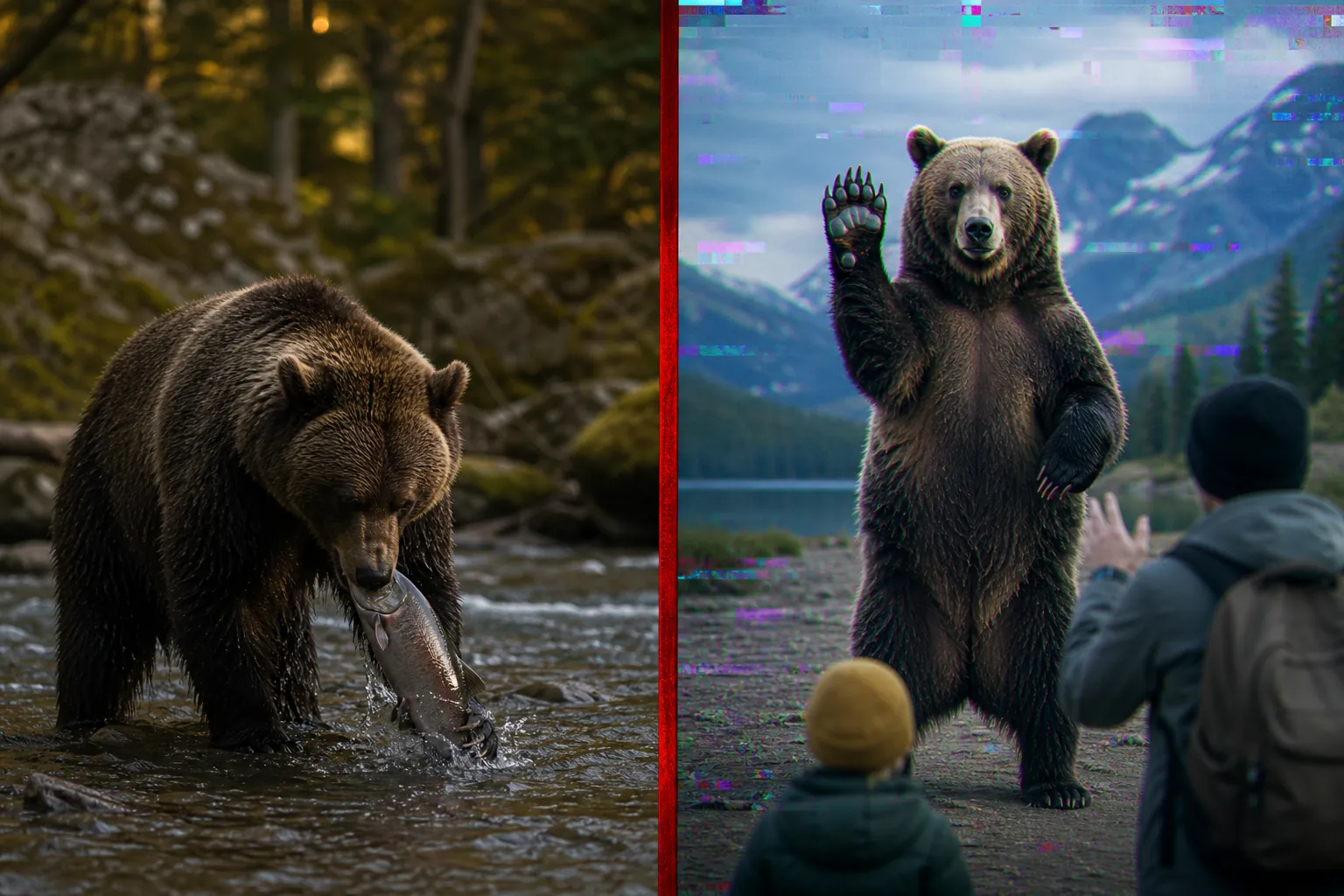
That matters most when the video depicts conduct with safety implications: a wild animal cuddling with a child, a predator calmly entering a home, a venomous animal handled as if harmless, or a rescue worker approaching wildlife without risk. The deception issue is not that the animal is synthetic. It is that the clip may operate as fake evidence of real-world safety.
Rescue and lost-pet content is sharper because the consumer injury is easier to see. PopSci reported in March 2026 on AI dog-photo scams involving people who used synthetic pet images to extract money from owners searching for missing animals, with reported losses of more than $1,900 in an incident.[4] That is a different evidentiary posture from general public confusion about wildlife. It involves an identifiable victim, a concrete payment, and a synthetic image used as supposed proof.
For FTC purposes, that kind of use is closer to ordinary fraud-adjacent deception than to a dispute about online aesthetics. If a synthetic animal image makes a grieving or anxious pet owner believe that a specific animal has been located, the missing disclosure is not a courtesy label. It is part of the factual machinery of the demand.
Public Confusion Is Context, Not The Whole Liability Case
The broader media environment helps explain why this risk is rising. BBC Future described the spread of AI animal videos and the resulting difficulty viewers face in separating real animal footage from synthetic scenes.[5] That is relevant background for platforms and brands because consumer expectations are formed in feeds, not in legal memos.
But public confusion alone is not a full Section 5 case. A regulator still has to care about what the viewer was led to believe and why it mattered. A realistic fake video of a bear rescuing a child may distort beliefs about animal behavior. A realistic fake video of a shelter rescuing a dog may also affect donations, adoption interest, brand goodwill, or accusations against another party. A realistic fake image of a missing pet may directly trigger payment. Those are not the same risk positions.
That is why blanket claims that AI has “ruined” animal videos do not do much legal work. The better question is whether the synthetic content supplies a fact the viewer is expected to rely on. If the answer is yes, the absence of a label becomes much harder to defend as harmless.
Platforms, Brands, And Creators Do Not Carry The Same Exposure
A creator who uploads an unlabeled AI animal clip, a brand that uses one in a campaign, and a platform that recommends it to millions of viewers may all be involved in distribution. Their legal risks are not identical.
Creators
For creators, the practical risk rises with realism, monetization, and factual framing. A caption such as “AI-generated scene” placed where ordinary viewers will see it is materially different from burying a disclosure behind ambiguous hashtags. The harder case is a creator who knows that a clip is synthetic but titles it as breaking rescue footage, authentic wildlife behavior, or proof that a lost animal has been found.
Monetization also matters. If a synthetic animal video drives subscriptions, donations, merchandise sales, sponsorship value, or paid traffic, the content is doing more than amusing an audience. It is supporting an economic transaction. That does not automatically make the post unlawful, but it strengthens the argument that the undisclosed synthetic nature of the clip was material.
Brands
Brands have less room to treat disclosure as optional. A heartwarming animal encounter in an advertisement implies something about the brand’s relationship to the event: that the company saw it, sponsored it, caused it, documented it, or responded to it. If the encounter is synthetic, that fact can matter to consumers evaluating authenticity, animal welfare, safety, or corporate conduct.
The same analysis applies to influencer campaigns. A brand cannot safely outsource the factual impression to a creator and then treat the resulting video as merely user-generated charm. If the post is part of a paid campaign, the brand should assume that the AI label, endorsement disclosure, caption, and surrounding copy will be read together.
Platforms
Platforms face a different problem: scale and control. TikTok, Meta, and YouTube have AI-labeling policies that function as operational baselines for creators and advertisers, even where they are not the source of U.S. statutory liability. For a platform, weak enforcement of its own labeling system can become evidence of foreseeable confusion, especially if the platform’s recommendation system repeatedly amplifies realistic synthetic rescue, wildlife, or lost-pet content.
The unresolved Section 230 question is whether a platform remains shielded when third-party AI animal content is created or modified through the platform’s own AI tools. Academic and policy commentary has increasingly questioned whether traditional Section 230 assumptions fit AI-driven platform functions, but no court has supplied a definitive answer for this animal-video fact pattern.[8][9] Counsel should treat the issue as unsettled, not as a solved defense or a collapsed shield.
EU And State Rules Add Pressure, But They Do Not Replace The U.S. Analysis
The EU AI Act supplies a separate compliance baseline. Article 50 labeling obligations for realistic AI-generated content are scheduled to take effect on August 2, 2026, requiring visible disclosure in circumstances where synthetic content could be mistaken for real media.[6] For a global platform or brand, that date matters even if the U.S. question remains framed through Section 5 rather than an AI-specific federal labeling statute.
State law adds another overlay. MultiState reported in February 2026 that AI-generated content laws were changing across more than 46 states, including deepfake-related measures.[7] Many of those laws are not written for animal videos as such, and a state-by-state survey would overstate the precision available here. The safer point is that deceptive synthetic media is no longer only a federal-platform-policy issue; state statutes may create additional obligations depending on the video’s use, target, and commercial context.
The international and state developments are also useful evidence of compliance expectations. A company that can label realistic AI animal content for EU users, or under its own platform rules, will have a harder time explaining why U.S. viewers could be left without a clear disclosure when the same clip is used to support a commercial or factual claim.
FTC Enforcement Capacity Is A Moving Target
The FTC’s institutional posture is itself in flux. The June 29, 2026 Humphrey’s Executor / Slaughter ruling has changed the conversation around FTC independence and removal protections, which may affect enforcement priorities and agency predictability. For readers tracking that structural issue, Lex Machina Review’s analysis of the Humphrey’s Executor case is the more direct place to assess the constitutional and administrative-law implications.
For AI animal videos, the immediate takeaway is more practical. A proposed policy statement can change before it is finalized. Enforcement priorities can shift. Litigation may narrow or test the agency’s theory. None of that makes the current risk imaginary. It means counsel should avoid treating the July 2026 proposal as final law while still taking seriously the direction of travel.
A Workable Disclosure Line
A defensible compliance approach does not require labeling every stylized animal animation as if it were evidence in a fraud file. It does require a clear rule for realistic synthetic content that could be mistaken for real-world animal behavior, rescue evidence, pet-location evidence, or brand documentation.
- Label realistic AI-generated animal content before the viewer is asked to rely on it.
- Treat rescue, shelter, donation, adoption, and lost-pet content as high-risk by default.
- Do not use synthetic wildlife behavior to imply that dangerous animal interactions are safe or documented.
- Review brand and influencer captions, thumbnails, hashtags, and paid-placement copy together.
- Preserve records showing when an AI tool was used, what disclosure was applied, and who approved the post.
The placement of the label matters. A disclosure that appears only after the viewer has watched, shared, donated, clicked, or messaged a supposed rescuer may not cure the initial deception. Nor is “AI” always enough if the surrounding copy still says or implies that the depicted event occurred. A useful disclosure tells the viewer what matters: the animal scene is synthetic, the rescue is dramatized, the image is not proof of a found pet, or the brand encounter was generated rather than captured.
Until courts or a finalized FTC statement say more, unlabeled AI animal videos should not be treated as unlawful as a class. The credible Section 5 risk sits with a narrower group: realistic synthetic videos that make animal behavior, rescue evidence, lost-pet imagery, or brand encounters look real in a way that affects consumer belief, payment, safety expectations, or platform trust. For those videos, disclosure is no longer just reputational hygiene. It is a risk control.
References
- FTC Seeks Public Comment on Policy Statement Addressing AI Accuracy, Federal Trade Commission, July 2026
- FTC enters new chapter in its approach to artificial intelligence enforcement, Reuters, February 4, 2026
- AI-generated videos can alter perceptions of wildlife, Conservation Biology, 2025
- AI dog photos are being used to scam grieving pet owners, Popular Science, March 2026
- AI has ruined cute animal videos, BBC Future, July 2026
- Labeling AI-Generated Content: What the New Rules Require, Pandectes
- How AI-Generated Content Laws Are Changing Across the Country, MultiState, February 12, 2026
- Beyond Section 230: Principles for AI Governance, Harvard Law Review
- Section 230 and AI-Driven Platforms, The Regulatory Review, January 17, 2026
Related records
Tool profile
How Meta's AI Spending Reshapes Law Firm ProfitabilityGoverning regulation
Browse the obligations tracker →Preventive workflow
Browse verification workflows →
Report a correction or tip
Spotted an outdated figure, a misstated fact, or a ruling this case record should reflect? Public comments are disabled for this content given the professional cost of a misreported case outcome, penalty amount, or rule text — use the structured correction channel instead.
Report a correction or tip for this record →