
Three Legal Risks for Investors From an AI Bubble Correction
Investors in AI-linked securities face three active legal liability pathways as the market corrects: securities class actions following AI IPO collapses, criminal AI-washing enforcement, and D&O disclosure failures. This analysis maps the live H1 2026 cases so counsel can assess exposure.
- Jurisdiction
- US Federal
- Court
- U.S. District Court
- AI tool named
- Fermi
- Ruling date
- Jan 5, 2026
- Source document
- View primary court order ↗
- Last verified
- Jul 29, 2026
Lex Machina Review is an independent risk-tracking and reference resource. Nothing on this site is legal advice, and using it does not create an attorney-client relationship. Every record is reviewed against primary sources but may not reflect the most current status of a matter — always verify directly against the cited court order, rule text, or a licensed attorney before relying on it.
Companion explanation — secondary to the source document above
AI bubble fears become legal risks for investors in a more immediate way once the correction produces a docket number. By mid-2026, that line has already been crossed. NERA counted 18 AI-related securities class actions in the first half of 2026, while its broader H1 update counted 118 federal securities class actions overall, a pace of 236 for the full year if filings continued at the same rate.[1] Alston & Bird likewise described AI-related securities filings as surging in July 2026, reinforcing that this is no longer a theoretical risk category waiting for the market to decide whether “bubble” is the right label.[2]
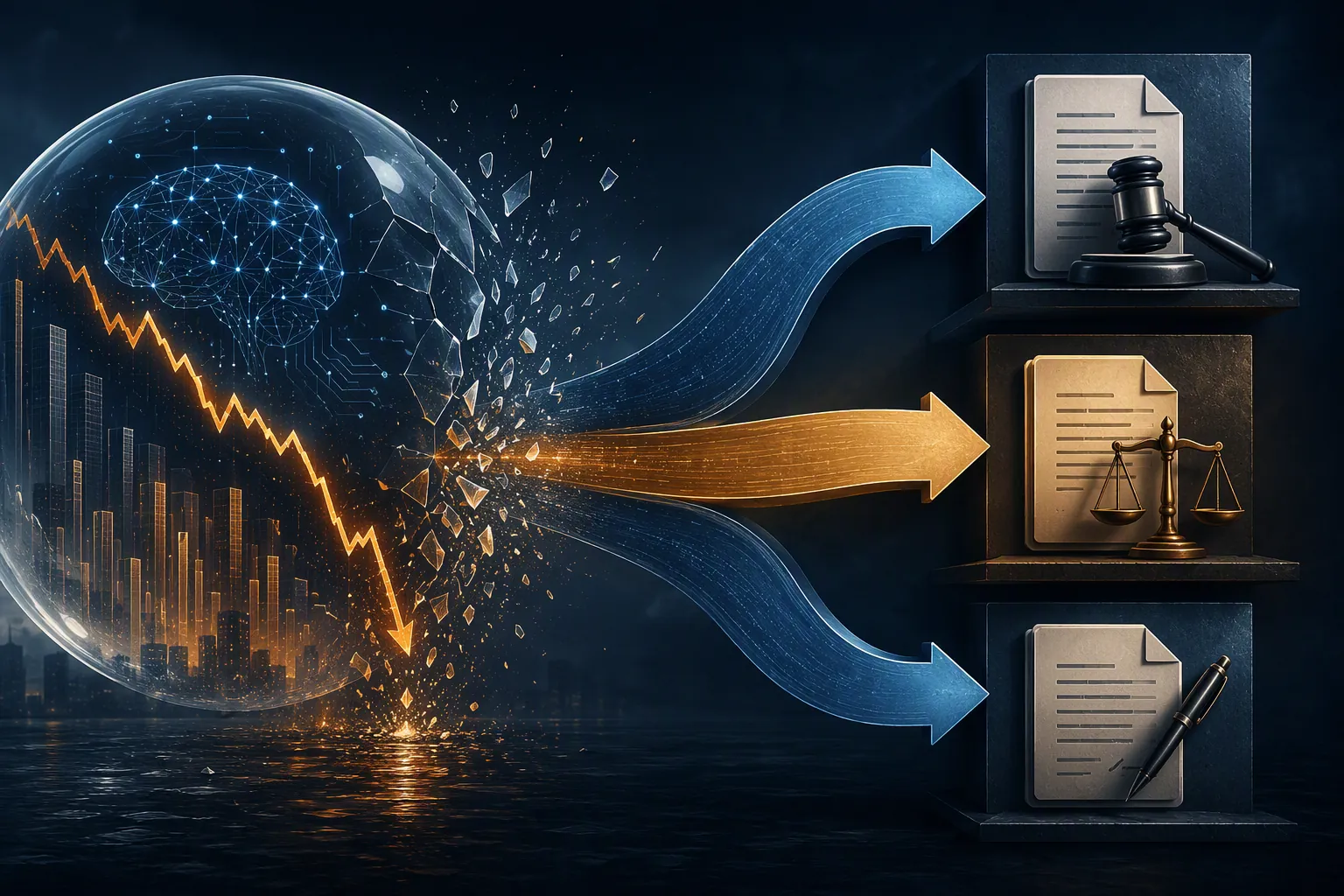
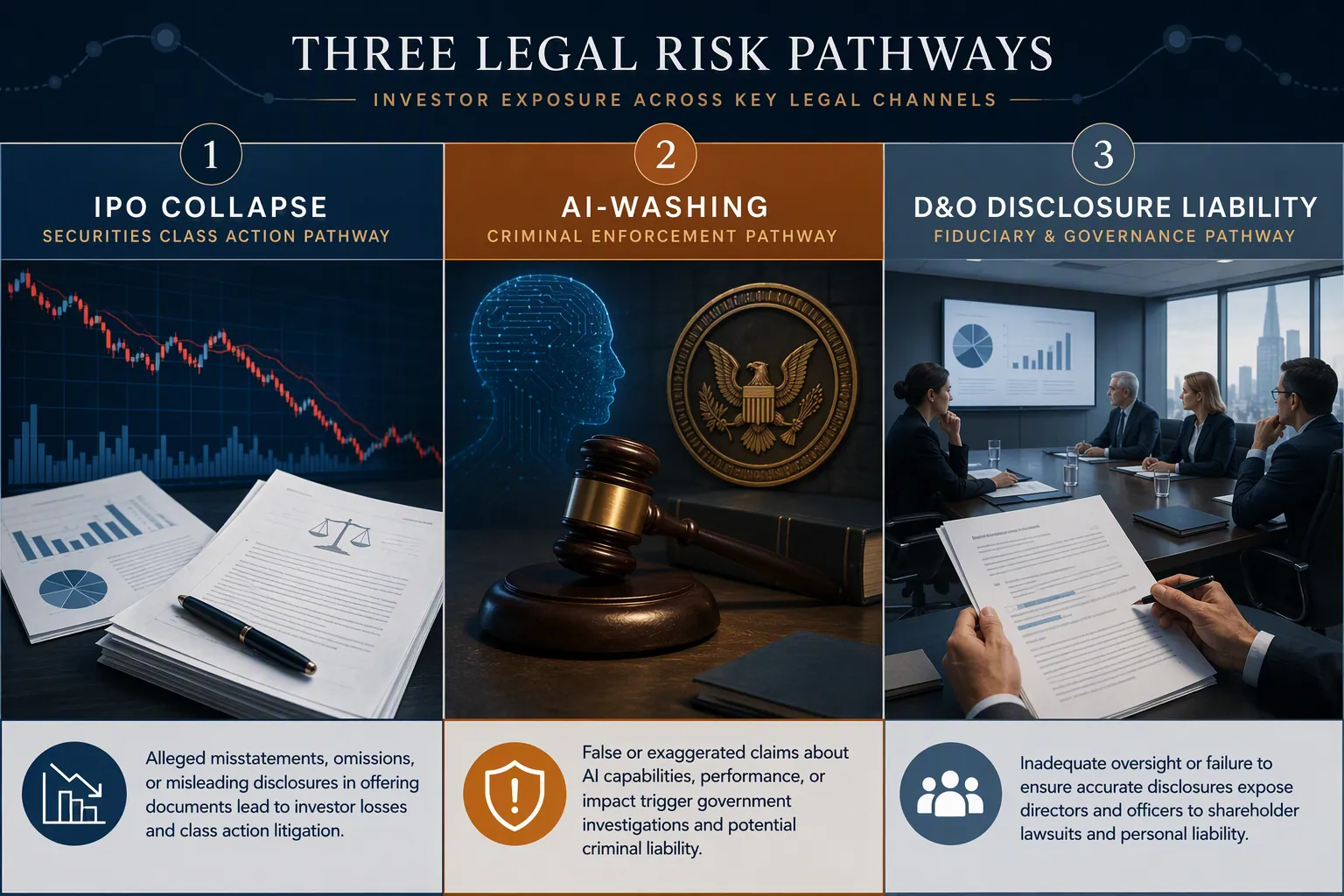
The useful question is narrower: when an AI-linked position breaks, which legal channel is likely to open first? The current record points to three. One is the familiar post-correction securities class action, now appearing in AI-linked IPO and public-company fact patterns. A second is AI-washing enforcement, including civil SEC cases and, in one live criminal matter, DOJ escalation. A third is D&O disclosure litigation over AI rollout, guidance, margins, and operational execution.
The filing count is already large enough to change intake questions
A filing count does not prove claim quality. It does, however, change the checklist for counsel reviewing AI-exposed securities. The first pass can no longer stop at valuation, customer concentration, or whether management used overheated language. It has to ask whether the company has already supplied the elements plaintiffs need: a public AI narrative, a sharp market correction, a corrective event, identifiable statements, and a purchaser class.
The broader securities-litigation environment matters here because plaintiffs are filing into an active market, not a quiet one. NERA reported average settlements of $54 million in H1 2026, a 32% year-over-year increase.[1] That figure should not be treated as a forecast for AI cases specifically. It is a temperature reading: securities claims are being filed and resolved in a market where defense costs, mediation posture, D&O retention pressure, and settlement expectations are already material.
| Pathway | Typical trigger | Primary defendants or targets | Evidence counsel should look for |
|---|---|---|---|
| Post-correction securities class action | IPO, SPAC, or public-market drop after an AI-linked business event | Issuer, officers, directors, underwriters, controlling persons | Offering documents, earnings-call statements, customer termination notices, corrective disclosures |
| AI-washing enforcement | Claims that AI automation, model capability, or investment process was overstated | Company, founders, executives, advisers, portfolio companies | Marketing materials, investor decks, diligence files, technical validation, internal emails |
| D&O disclosure liability | AI rollout or execution problem followed by guidance cut, margin pressure, or share-price decline | Public-company directors and officers | Risk factors, MD&A, board materials, rollout metrics, analyst-call representations |
Fermi shows the post-correction template plaintiffs want
The Fermi lawsuit is the cleanest current example because it does not require a long theory of market psychology. The company completed a $757.7 million IPO, its share price allegedly fell 59%, a single-tenant termination supplied a concrete business event, and plaintiffs filed Securities Act and Exchange Act claims on January 5, 2026.[3] That is the anatomy of an intake memo: offering proceeds, decline, event, defendants, statutes.
The complaint, as described by The D&O Diary, asserts claims under Sections 11 and 15 of the Securities Act and Sections 10(b) and 20(a) of the Exchange Act.[3] That combination matters. Section 11 gives plaintiffs an offering-document pathway, where the pleading fight centers on alleged misstatements or omissions in registration materials. Section 10(b) adds the harder fraud channel, including scienter, reliance, loss causation, and a corrective-disclosure theory. Section 15 and Section 20(a) then follow the control-person route.
For an investor or fund holding AI-linked names, Fermi’s value is not that it proves liability. It does not. It is still at the pleading stage. Its value is that it shows how quickly an AI infrastructure or AI-adjacent growth story can be converted into a securities complaint once a specific customer event and a post-offering price decline appear in the same file.
That is also where AI CapEx disclosures become adjacent, not interchangeable. A company can face exposure because its AI spending story allegedly overstated demand visibility, capacity utilization, customer commitments, or timing. Those Rule 10b-5 theories are developed separately in How AI CapEx Is Creating a New Securities Litigation Wave. The overlap with Fermi is practical: plaintiffs need a bridge between the AI growth story and the price move, and the bridge is often a disclosure record before the market correction.
What the Fermi pathway asks counsel to collect
- The registration statement and any roadshow or offering materials that described AI demand, customers, capacity, or revenue visibility.
- The first corrective event that turned the growth story into a measurable loss event, including customer termination, delayed rollout, utilization shortfall, or guidance cut.
- Trading records by purchase window, because Securities Act and Exchange Act exposure may involve different class periods and reliance theories.
- D&O program structure, including IPO tower, Side A coverage, retentions, exclusions, and notice timing.
D&O exposure is developing around execution, not only promotion
The second pathway is not just “AI company disappoints investors.” That description is too loose to help anyone reserving a claim or preparing a renewal call. The more useful category is D&O disclosure liability where management allegedly spoke about AI rollout, platform transition, margins, or demand in a way that the later operating result made litigable.
The Trade Desk, Elastic, and Telus International illustrate the difference. The D&O Diary’s July 2026 review reported that The Trade Desk’s shares fell 32% in a case tied to an AI rollout theory; Elastic dropped 26% after a guidance cut; and Telus International saw cumulative declines of about 76% on AI margin issues.[4] Those are not the same case. They point to different pleading routes.
The Trade Desk fact pattern, as summarized, places pressure on rollout representations: what the company said about the AI-related product transition, how investors understood that transition, and whether later disclosures made earlier optimism look misleading. Elastic is more obviously a guidance case: the legal question moves toward whether management adequately disclosed demand, sales-cycle, or execution risks before the cut. Telus International belongs closer to the margin and business-model lane: when AI is supposed to improve efficiency, margin deterioration can become the corrective event plaintiffs use to revisit prior statements.
For D&O carriers, the distinction affects underwriting and claim handling. A rollout case asks about product readiness, migration friction, sales enablement, and customer adoption. A guidance-cut case asks what management knew about pipeline quality and timing. A margin case asks whether AI was being sold to investors as a cost reducer while internal data showed a more expensive transition. The complaint may use the same AI vocabulary in all three, but the documents needed to defend them are not the same.
The board record becomes part of the securities record
AI disclosure litigation tends to pull two records together. The external record is what investors heard: earnings calls, investor presentations, risk factors, MD&A, and press releases. The internal record is what directors and officers reviewed: rollout dashboards, customer feedback, margin analyses, model-performance limits, incident reports, and revised forecasts. Once the stock drop occurs, the gap between those two records becomes the litigation surface.
That does not mean every failed AI initiative creates securities liability. Product transitions miss, customers wait, and margins compress for reasons that are not fraud. The legal risk rises when the company has already trained the market to treat the AI initiative as a driver of growth, efficiency, or competitive advantage, then later attributes a material disappointment to the same initiative or its rollout.
AI-washing enforcement creates a different investor problem
The enforcement pathway is narrower than the class-action pathway, but it can be more damaging to diligence narratives. AI-washing cases are not mainly about whether a company overestimated market demand. They are about whether the company claimed to use AI, automation, predictive models, or algorithmic decision-making in a way that regulators allege was false or materially misleading.
The Saniger/Nate matter shows the escalation risk. Holland & Knight reported in July 2025 that prosecutors alleged Nate raised $42 million based on fake AI automation claims, and that DOJ was seeking 20-year sentences.[5] Those are allegations in a criminal case, not findings after verdict. For investors, the point is not to treat the allegations as proven; it is to recognize how a portfolio-company AI representation can move from diligence issue to criminal-enforcement exposure.
The civil baseline arrived earlier. In March 2024, the SEC announced settled charges against Delphia and Global Predictions over allegedly false and misleading statements about their use of AI, with the firms agreeing to pay $400,000 in total civil penalties.[6] The SEC’s theory was not that AI investing is risky. It was that firms cannot market AI capabilities they do not actually use in the way represented.
That distinction should shape investor diligence. An AI-washing review should not stop at asking whether the company “has AI.” It should test whether the claimed AI capability performs the function being sold to investors, customers, or limited partners. If a deck says manual review has been replaced, counsel should ask what percentage of decisions still require human handling. If an adviser says models generate investment recommendations, counsel should ask how the models are used, who overrides them, and whether compliance has approved the description.
The diligence file can later become the defense file
Investors often treat AI diligence as a technology review. In enforcement-sensitive situations, it is also a representations review. The key documents are the pitch deck, subscription materials, side letters, technical diligence notes, customer contracts, marketing approvals, and any internal memo that explains what the AI system actually does. Those documents can either show that the investor reasonably tested the claim or show that a promotional statement passed through untouched because everyone wanted the AI story to be true.
The three pathways do not trigger the same insurance or defense response
Grouping these cases under “AI bubble litigation” is convenient, but it hides the decisions risk managers have to make after the price move. A Securities Act claim after an IPO drop raises offering-document, underwriter, and tower-allocation issues. A Rule 10b-5 disclosure case after an earnings call puts scienter, loss causation, and class-period trading at the center. An SEC or DOJ AI-washing inquiry may require parallel civil, criminal, indemnification, and privilege planning before any shareholder complaint arrives.
| Question | Post-correction class action | AI-washing enforcement | D&O disclosure case |
|---|---|---|---|
| What starts the matter? | A stock drop tied to an offering, customer event, or corrective disclosure | A regulator or prosecutor challenges AI capability claims | A rollout failure, guidance cut, or margin issue follows prior AI statements |
| Who reviews first? | Securities litigation counsel and D&O claims team | Enforcement counsel, white-collar counsel, compliance, and privilege lead | Securities litigation counsel, board counsel, carrier, and disclosure committee |
| What evidence matters most? | Offering documents, public statements, trading window, loss event | Marketing claims, technical validation, investor communications, internal knowledge | Board materials, forecasts, risk factors, earnings-call scripts, operational metrics |
| What is the main boundary? | Pleading-stage allegations may not survive motion practice | Allegations are not verdicts or admissions unless resolved as such | Operational disappointment alone is not securities fraud |
The Fermi pattern is the one most likely to look familiar to securities litigators because it resembles prior post-offering cases with a new AI wrapper. The D&O disclosure cases are more fact-sensitive because the disputed representation may be about rollout progress, margin effects, or guidance discipline rather than the existence of AI itself. The enforcement matters are different again because the alleged misconduct can sit inside investor marketing or technical claims long before a public-company stock drop.
That separation matters for investors with mixed exposure. A public-equity manager holding AI infrastructure names is not reviewing the same risk as a private fund that backed an automation company based on founder representations. A D&O carrier renewing a software company with a high-profile AI transition is not underwriting the same exposure as a Side A excess layer sitting above an IPO tower. The word AI is common to all of them; the legal mechanics are not.
An exposure map for AI-linked holdings
Counsel reviewing AI-exposed holdings in Q3 2026 can make the exercise more useful by classifying each position by trigger rather than by sector label. A company is not a securities-litigation risk because it says “AI” often. It becomes a more concrete risk when an identifiable representation, transaction, operating metric, or corrective event can be matched to a loss.
- Put IPO, de-SPAC, and recent-offering names in the post-correction class-action lane if the AI story was material to the offering or early trading.
- Put companies with strong automation, model-performance, or “AI-native” claims in the AI-washing lane if diligence depends on whether the technology actually performs as represented.
- Put public companies with AI rollouts, margin promises, or AI-driven guidance assumptions in the D&O disclosure lane.
- Flag any holding that sits in more than one lane, especially a recent issuer that also makes aggressive automation claims or has tied guidance to AI execution.
The boundaries remain important. Fermi is a pleading-stage lawsuit, not an adjudicated finding. Saniger/Nate has not reached verdict. The 18 AI-related securities class actions counted for H1 2026 are current as of the July 2026 sources cited here and will need to be updated after H2 filings develop.[1][2][3][5]
Even with those limits, the litigation record is already specific enough to use. If the AI correction deepens, investors are not facing one generic bubble-litigation risk. They are facing separate legal channels with different triggers, defendants, documents, pleading burdens, enforcement consequences, and insurance implications. The useful work now is to sort the holdings before the next corrective disclosure does it for everyone.
References
- Recent Trends in Securities Class Action Litigation: H1 2026 Update, NERA, 2026.
- Securities Class Action Filings Surge AI, Alston & Bird, July 2026.
- Worried About a Possible AI Bubble Burst?, The D&O Diary, January 2026.
- AI-Related Securities Litigation Continues to Evolve, The D&O Diary, July 2026.
- SEC and DOJ Warm Up to Enforcement Over AI Washing, Holland & Knight, July 2025.
- SEC Charges Two Investment Advisers with Making False and Misleading Statements About Their Use of Artificial Intelligence, U.S. Securities and Exchange Commission, March 18, 2024.
Related records
Tool profile
Browse tool evaluations →Governing regulation
Browse the obligations tracker →Preventive workflow
Browse verification workflows →
Report a correction or tip
Spotted an outdated figure, a misstated fact, or a ruling this case record should reflect? Public comments are disabled for this content given the professional cost of a misreported case outcome, penalty amount, or rule text — use the structured correction channel instead.
Report a correction or tip for this record →