
How FDA Handles AI-Designed Coronavirus Vaccine Approval
Explains the statutory classification of an AI-designed coronavirus vaccine as a biologic under existing PHS Act authority, the potential device regulation of the AI design tool, and the untested evidentiary standard for AI-generated design data that regulatory counsel must prepare for.
- Jurisdiction
- US-Federal
- Court
- FDA - CBER
- AI tool named
- Unspecified AI antigen design system
- Ruling date
- Jun 5, 2026
- Source document
- View primary court order ↗
- Last verified
- Jul 30, 2026
Lex Machina Review is an independent risk-tracking and reference resource. Nothing on this site is legal advice, and using it does not create an attorney-client relationship. Every record is reviewed against primary sources but may not reflect the most current status of a matter — always verify directly against the cited court order, rule text, or a licensed attorney before relying on it.
Companion explanation — secondary to the source document above
The first legal mistake in an AI designed coronavirus vaccine approval memo is to let the word “AI-designed” do the classification work. It should not. If the product being administered is a vaccine antigen intended to induce an immune response against a coronavirus, the starting point is still the biologics framework: vaccines fall within the statutory definition of a biological product under 42 U.S.C. §262(i), and licensure proceeds under Section 351 of the Public Health Service Act rather than through a newly invented AI-vaccine category.[1]
That answer is not the end of the analysis, but it is the anchor. The antigen’s computational origin does not convert the vaccine into a device, a drug under CDER’s ordinary small-molecule pathway, or an unclassified digital product. For a preventive vaccine, CBER remains the relevant FDA center, and the BLA question remains whether the sponsor has supplied the evidence FDA expects for safety, purity, and potency under the biologics regime.

The Vaccine Is the Biologic; the Model Is a Separate Problem
A clean regulatory memo should separate two objects that marketing language tends to merge. One object is the final vaccine candidate: the antigen, formulation, manufacturing process, controls, nonclinical package, clinical protocol, and ultimately the biologics license application. The other object is the AI system that generated, ranked, or optimized the antigen design.
The first object fits the familiar legal box. It is a biological product. The second object may raise a different set of questions: whether the software is merely an internal research tool, whether it produces data submitted to FDA, whether it influences regulatory decision-making, and whether it has characteristics that could bring it within device or software-as-a-medical-device analysis.
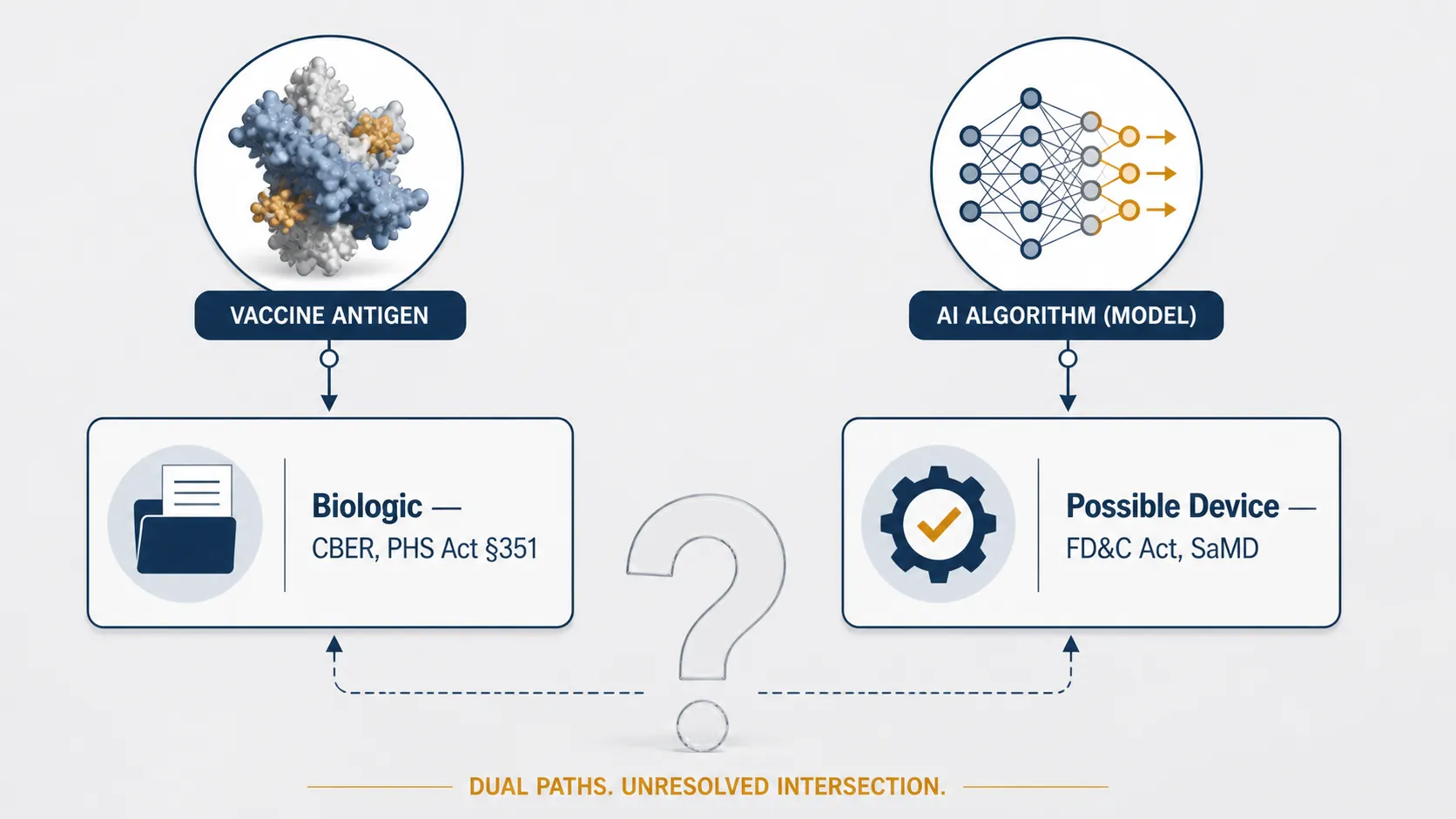
The distinction matters because counsel can be right about the vaccine pathway and still underprepare the AI file. A BLA strategy that says only “CBER regulates vaccines” answers the jurisdictional question for the product. It does not answer how FDA will evaluate the model-derived design rationale, how much transparency the agency may expect, or whether the AI system itself creates parallel compliance obligations.
Why the Statutory Classification Is the Easy Part
The PHS Act does not ask whether a vaccine antigen was conceived by a human immunologist, screened by a conventional bioinformatics workflow, or proposed by a machine-learning model. It asks whether the product falls within the biological-product category. Vaccines do. That is why the phrase “AI-designed coronavirus vaccine” should be treated as a description of development history, not a legal product class.
This is also where analogies to AI-discovered small molecules can mislead. They are useful evidence that FDA has already encountered AI in drug development. They do not decide CBER’s treatment of a vaccine antigen. A small molecule developed for a therapeutic indication and reviewed through CDER is not the same regulatory object as a preventive biologic vaccine reviewed through CBER.
The right conclusion is narrow but important: AI design does not displace the biologics pathway. It also does not lower the evidentiary burden. If anything, the sponsor may need to do more explanatory work because part of the design rationale came from a system whose operation, training data, validation boundaries, and error modes may not be apparent from ordinary vaccine-development documents.
The January 2025 FDA Draft Guidance Gives Counsel a Vocabulary, Not a Safe Harbor
FDA’s January 2025 draft guidance, “Considerations for the Use of Artificial Intelligence to Support Regulatory Decision-Making for Drug and Biological Products,” is the most practical document now available for thinking about AI-generated design evidence in a biologics submission. It is not final guidance, and it is not binding law. It does, however, show how the agency is organizing the credibility question when AI is used to support regulatory decision-making for drugs and biological products.[2]
The draft guidance frames the issue around a risk-based credibility assessment. For an AI-designed antigen, the useful point is not to recite all seven steps as a checklist. The useful point is to ask what role the model output plays in the submission.
| Draft-guidance concept | Question for an AI-designed vaccine file |
|---|---|
| Context of use | Was the model used to generate a candidate antigen, rank candidates, predict immune response, support nonclinical decisions, or justify clinical advancement? |
| Model risk | Could an erroneous model output affect antigen selection, trial design, dose selection, or the interpretation of immune-response data? |
| Credibility goals | What level of confidence is needed for the specific regulatory use being claimed? |
| Evidence generation | What validation, benchmarking, sensitivity analysis, or experimental confirmation supports the model’s output? |
| Documentation and assessment | Can the sponsor explain the model, data provenance, limitations, and decision trail well enough for FDA review? |
That framing keeps the submission from drifting into a vague assertion that “AI found the antigen.” FDA will not license a vaccine because the design story is novel. The agency will review the submitted evidence. The model’s importance depends on whether the sponsor asks FDA to rely on model output for a regulatory conclusion, or whether the model is merely part of the discovery history later confirmed through ordinary nonclinical and clinical evidence.
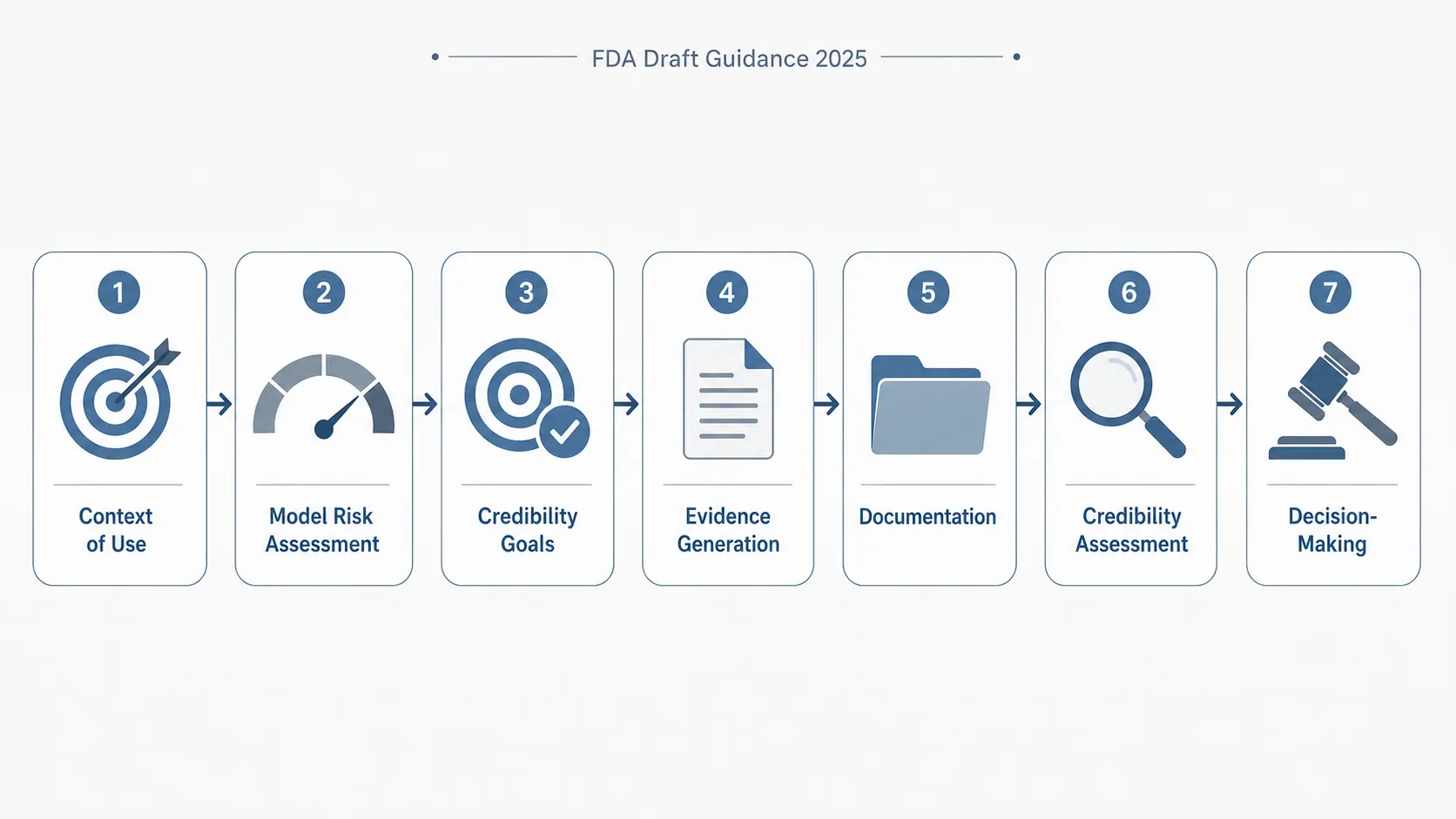
This is the point at which a cautious lawyer should circle every sentence that says “FDA will accept” and revise it to “FDA may evaluate.” The draft guidance provides a vocabulary for credibility assessment. It does not establish an approval precedent for an AI-designed vaccine antigen.
When the AI Tool Starts Looking Like a Regulated Device
The harder classification question is not whether the vaccine is a biologic. It is whether the AI system used to design or select the antigen is itself regulated. Legal analysis by Zúñiga and coauthors argues that an AI tool may raise device-law questions under the FD&C Act if it produces data used in regulatory submissions, potentially implicating quality-system and validation expectations associated with 21 CFR Part 820.[3]
That analysis should be used carefully. It is not an FDA determination, an enforcement action, or a court ruling. It does, however, identify the problem counsel cannot ignore: a software system that remains upstream of the patient may still become regulatory material if the sponsor asks FDA to rely on its outputs.
The device question will likely turn on function and use, not branding. A model that only helps a research team brainstorm antigen candidates sits in a different posture from a validated platform whose predictions are submitted as evidence supporting antigen selection, immune-response expectations, or clinical-trial advancement. The more the sponsor relies on the model as proof, the more the model’s own controls become part of the regulatory conversation.
Zúñiga and coauthors also point to the transparency problem: AI systems can produce useful immunological hypotheses while making their internal rationale difficult to inspect, creating tension with regulatory review’s demand for explainable, testable evidence.[3] In a vaccine file, that tension is not solved by saying that human scientists reviewed the output. The reviewer will still want to know what data trained the system, what assumptions shaped the output, what failure modes were assessed, and where experimental evidence replaced model inference.
DIOSynVax Shows the Question Without Settling It
The DIOSynVax and Cambridge example is useful because it is concrete and limited. Reports in June 2026 described the candidate as the world’s first entirely AI-designed vaccine antigen to complete a Phase 1 trial; the trial involved 39 volunteers and produced modest immune responses.[4][5]
Those facts are enough to make the candidate legally interesting. They are not enough to infer FDA’s position. No public FDA filing has been identified for the product, and there has been no FDA approval, emergency use authorization, enforcement action, or judicial decision testing how the agency would handle the AI-designed-antigen issue.
The modest immune-response result also matters. A hyped version of this story would treat the first AI-designed antigen as proof that the regulatory system has to change. The actual record is more restrained: an early clinical result, a small Phase 1 population, and an unresolved regulatory path. For counsel, that restraint is useful. It forces the analysis back to ordinary questions of evidence rather than novelty.
If a sponsor with a similar candidate sought an IND meeting or later a BLA strategy discussion, the memo should not ask FDA to bless “AI vaccine approval” as a concept. It should identify the vaccine as a CBER biologic, describe precisely how the AI system was used, and separate evidence generated by wet-lab, animal, manufacturing, and clinical work from claims that depend on model output.
FDA Has AI Infrastructure, but Not This Precedent
FDA is not encountering AI for the first time. CDER established an AI Council in 2024, and FDA and EMA published “10 Guiding Principles for Good AI Practice in Drug Development” in January 2026.[6] CDER has also reported receiving more than 500 drug and biological product applications with AI components between 2016 and 2023.[6]
Those facts show institutional movement. They do not create a settled approval pathway for an AI-designed coronavirus vaccine antigen. Many AI-related submissions involve uses such as trial operations, endpoint assessment, manufacturing analytics, or modeling support. That is different from asking FDA to evaluate an antigen whose design rationale depends materially on an AI system.
The same caution applies to AI-discovered small-molecule drug examples. They help show that FDA has seen AI-derived development programs. They do not answer whether CBER will expect additional validation when the active biologic ingredient in a vaccine was generated by a model, nor do they determine whether the model itself will be treated as regulated software.
What Counsel Should Be Ready to Prove
The approval file still has to carry the ordinary vaccine burden. AI does not substitute for manufacturing controls, assay validation, nonclinical evidence, clinical safety, immunogenicity, or efficacy evidence where required. The AI issue sits on top of that burden, mainly as a credibility and reliance problem.
- Classify the administered product as a biological product and plan for CBER review under the PHS Act.
- Describe the AI system’s context of use with enough precision to show whether FDA is being asked to rely on the model output.
- Document training data, data provenance, model versioning, validation methods, performance limits, and human review.
- Separate experimentally confirmed evidence from predictions, rankings, or hypotheses generated by the model.
- Assess whether the AI system’s function creates a separate device or software compliance issue.
- Avoid representing draft FDA guidance, legal commentary, or adjacent CDER experience as binding precedent for CBER vaccine review.
That last point is not stylistic caution. It is litigation-proofing. If the application is challenged, delayed, or narrowed, the record should show that the sponsor understood the difference between product classification, model credibility, and device status. A confident classification of the vaccine does not justify an overconfident prediction about the AI evidence standard.
The Practical Regulatory Answer
For an AI-designed coronavirus vaccine, the defensible starting position is straightforward: the vaccine is a biologic, CBER is the expected reviewing center, and Section 351 of the PHS Act supplies the licensing framework. The AI origin of the antigen does not create a new statutory product category.
The unresolved risk sits elsewhere. FDA may scrutinize the AI system as a source of regulatory evidence under the January 2025 draft guidance, and the system may raise separate device-law questions depending on its function and the sponsor’s reliance on its outputs. No public FDA approval, EUA, enforcement action, or court ruling has yet tested that combined fact pattern for an AI-designed coronavirus vaccine antigen.
References
- 42 U.S.C. §262 - Regulation of biological products, Legal Information Institute, https://www.law.cornell.edu/uscode/text/42/262
- Considerations for the Use of Artificial Intelligence to Support Regulatory Decision-Making for Drug and Biological Products, FDA, January 2025, https://www.fda.gov/regulatory-information/search-fda-guidance-documents/considerations-use-artificial-intelligence-support-regulatory-decision-making-drug-and-biological
- Legal questions of AI-generated immunological products for infectious diseases, Taylor & Francis, 2025, https://www.tandfonline.com/doi/full/10.1080/21645515.2025.2570962
- World-first AI-designed vaccine shows promise in clinical trial, ScienceDaily, June 2026, https://www.sciencedaily.com/releases/2026/06/260605023357.htm
- AI-designed vaccine tested in humans for first time, BBC News, https://www.bbc.com/news/articles/crrpggegwe0o
- Artificial Intelligence in Drug Development, FDA CDER, https://www.fda.gov/about-fda/center-drug-evaluation-and-research-cder/artificial-intelligence-drug-development
Related records
Tool profile
How Meta's AI Spending Reshapes Law Firm ProfitabilityGoverning regulation
Browse the obligations tracker →Preventive workflow
Browse verification workflows →
Report a correction or tip
Spotted an outdated figure, a misstated fact, or a ruling this case record should reflect? Public comments are disabled for this content given the professional cost of a misreported case outcome, penalty amount, or rule text — use the structured correction channel instead.
Report a correction or tip for this record →