
How AI-Enabled Breaches Create a Hidden Litigation Cost Multiplier
The IBM 2026 Cost of a Data Breach Report shows AI-enabled breaches cost $6M on average, but the larger threat may be the litigation cost multiplier—from narrowed breach-to-lawsuit windows to mass arbitration fees exceeding $10M—that most legal teams underestimate in pre-breach planning.
- Jurisdiction
- US federal
- Court
- Federal courts
- AI tool named
- AI-enabled breach
- Ruling date
- Jul 29, 2026
- Source document
- View primary court order ↗
- Last verified
- Jul 30, 2026
Lex Machina Review is an independent risk-tracking and reference resource. Nothing on this site is legal advice, and using it does not create an attorney-client relationship. Every record is reviewed against primary sources but may not reflect the most current status of a matter — always verify directly against the cited court order, rule text, or a licensed attorney before relying on it.
Companion explanation — secondary to the source document above
The first lawsuit can now arrive while the breach team is still arguing over the timeline. That is the legal problem hidden inside the current wave of AI-enabled cyberattacks: not simply that the initial incident costs more, but that the company may lose procedural room before it knows enough to speak with confidence.
IBM’s 2026 Cost of a Data Breach findings put a useful number on the visible layer. The company reported that AI-enabled malicious breaches cost organizations $6 million on average, compared with a $4.99 million overall global average; it also reported that one in four malicious breaches is now AI-enabled.[1] Those figures matter because they reset the baseline for incident budgets. They do not, however, tell legal teams what happens after notification language is drafted, the first complaint is filed, the arbitration clause is tested, and the insurer starts reading exclusions more closely than anyone read the procurement file.

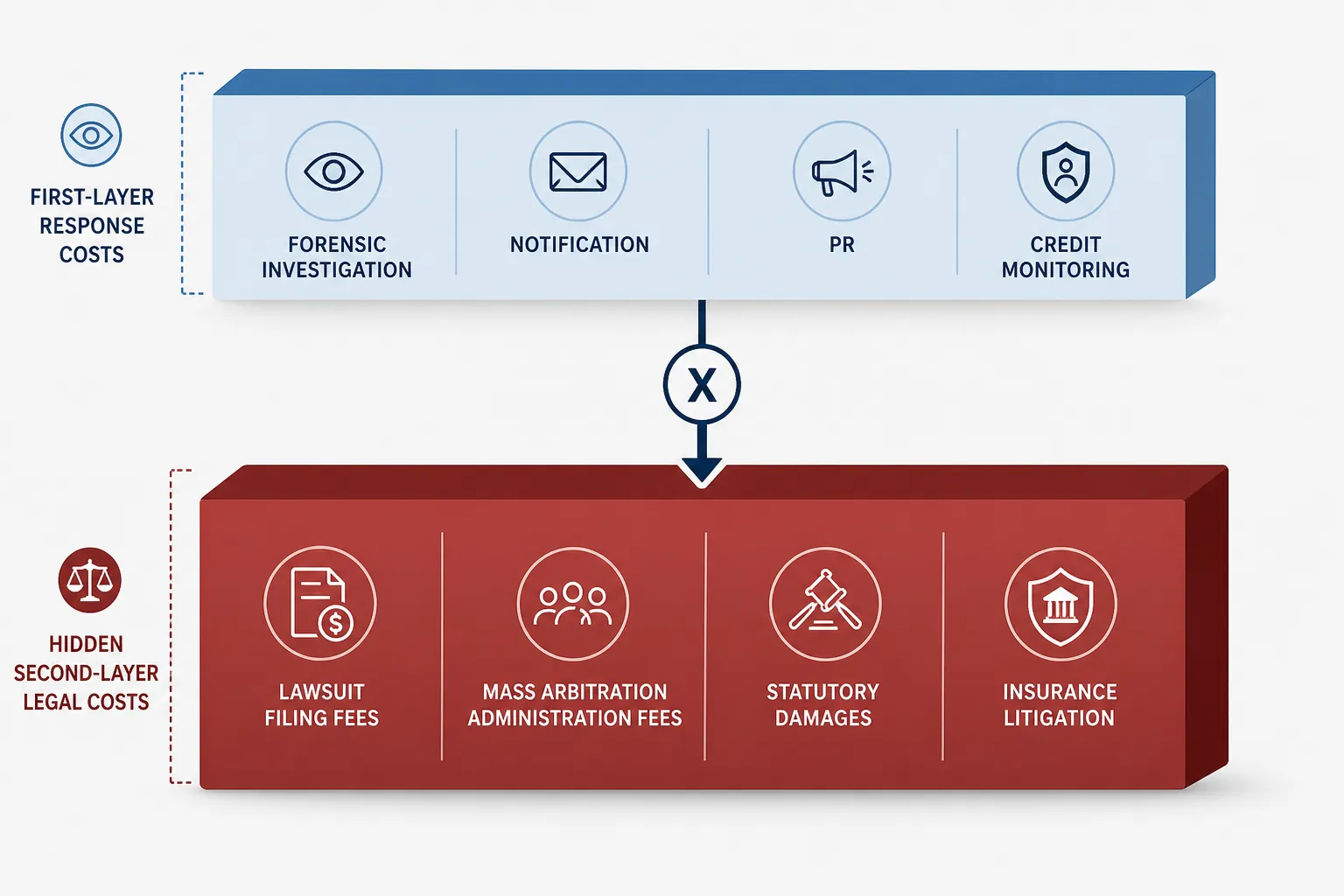
For counsel, AI-enabled breach planning should not lead only to a larger forensic reserve. The more useful question is whether the legal department has modeled a compound cost structure: first-party response expenses on one side, and second-order litigation, arbitration, statutory, regulatory, and insurance friction on the other.
The $6 Million Average Is a Floor for Legal Planning, Not a Ceiling
A breach budget usually starts with the familiar first-party line items: forensic investigation, outside breach counsel, notification vendors, call center support, public relations, credit monitoring, and remediation. Those costs are painful, but they are at least the costs most teams expect to see. They are also the costs that tend to dominate early executive updates because they are easier to invoice, estimate, and approve.
Litigation costs are less obedient. They depend on who files first, which statutory theory they choose, whether arbitration terms turn into leverage, whether parallel regulatory inquiries emerge, and whether the carrier agrees that the event sits inside the policy the way the insured assumed it did. That is why the IBM number is best read as the operational baseline, not as the total expected loss.
| Cost Layer | Typical Items | Why AI-Enabled Breaches Change the Planning Problem |
|---|---|---|
| First-party response | Forensics, breach counsel, notification, PR, monitoring, remediation | The baseline is higher when AI-enabled malicious breaches average $6 million, but these are still the costs most companies already know to budget for. |
| Second-order legal exposure | Class actions, mass arbitration fees, statutory claims, insurance disputes, regulatory penalties | The timing and leverage can shift before the facts are stable, and some costs can arise before merits are tested. |
There is a caveat worth keeping in the file. IBM’s cited figures come from a press release published on July 29, 2026; the full report may contain additional breakout data that refines the picture.[1] The caution does not make the number unusable. It simply means counsel should avoid treating one headline average as a complete damages model.
The Filing Window Has Moved Closer to the Incident
The most important legal timing change is not glamorous. It is the narrowed breach-to-lawsuit window. Chubb’s 2026 cyber claims findings, as reported by insurance-industry publications, describe plaintiff attorneys moving from breach to lawsuit in days rather than months.[2][3] That is a practical litigation advantage, not just a sign of a busier plaintiffs’ bar.
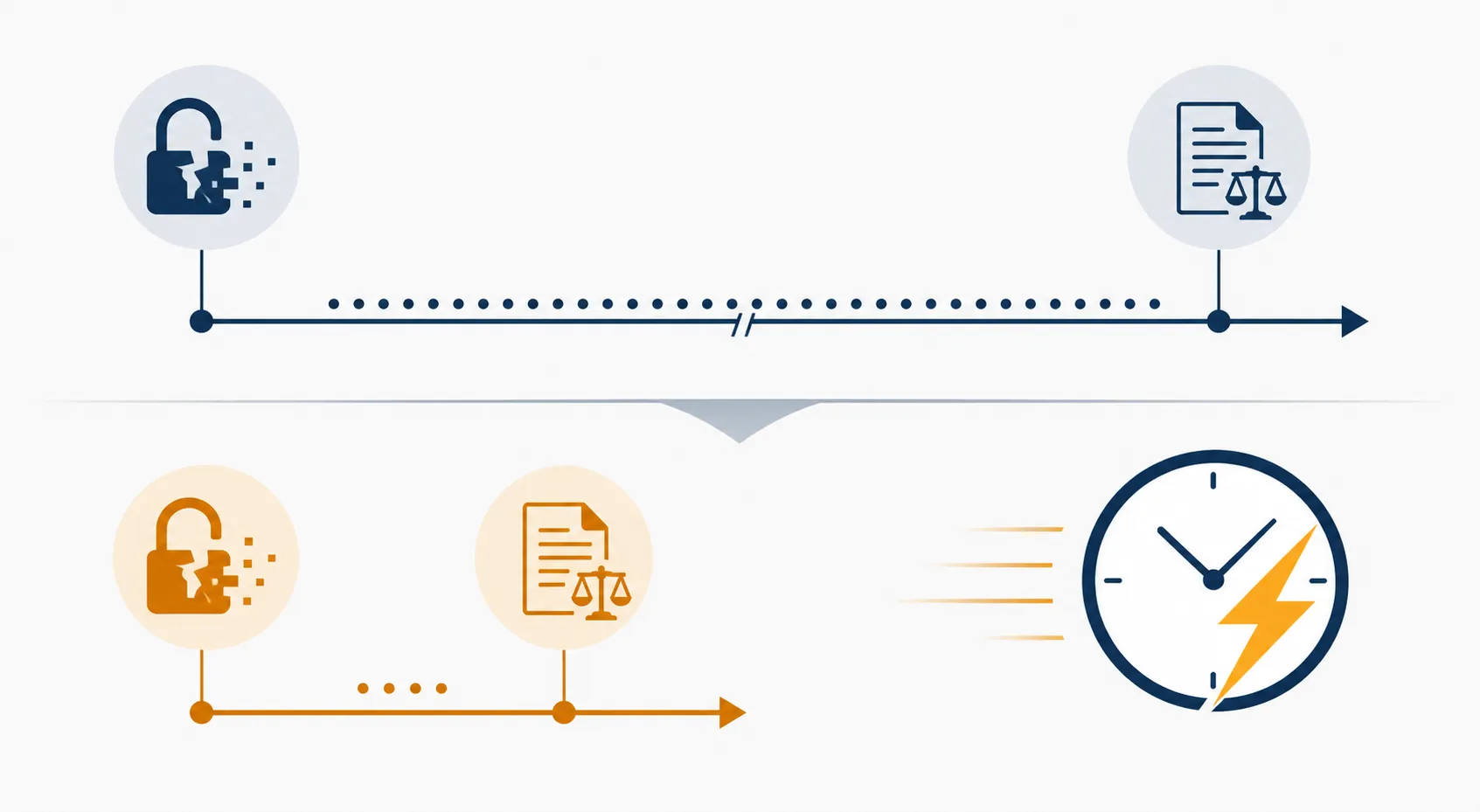
A complaint filed early can shape the public narrative while the company is still validating systems, determining affected populations, and reconciling forensic findings with business records. The legal department may be drafting notice language under statutory deadlines while also preserving privilege, briefing executives, responding to regulators, and deciding whether to remove, compel arbitration, or coordinate with related matters.
That is where AI-enabled attack speed matters legally even when no one can prove that AI alone caused the lawsuit. The stronger claim is compounding exposure: faster or more scalable attack activity can compress the company’s factual-development period, and a compressed factual period gives plaintiffs more room to plead aggressively before the defense record is clean.
Old Privacy Statutes Are Becoming Breach Leverage
The second multiplier is statutory creativity. The Chubb coverage describes plaintiffs repurposing decades-old wiretapping and video-privacy statutes against standard web technologies.[2][3] That matters because a breach case does not have to remain a negligence fight over whether the company’s security controls were reasonable. Plaintiffs can reach for statutes that carry different pleading dynamics, damages theories, or settlement pressure.
The move is not limited to the most technically exotic facts. Web pixels, session replay tools, chat functions, video content, and analytics scripts may become part of the claim narrative when plaintiffs allege that consumer data was intercepted, disclosed, or used in a way an older statute can be made to cover. Whether those theories succeed depends on the statute, jurisdiction, facts, and procedural posture. The point for planning is narrower: breach response now needs a litigation review of data flows and web technology practices, not merely a forensic account of intrusion and exfiltration.
That review should happen early enough to affect notice language and defense positioning. A company that treats web-tracking claims as a separate privacy issue may miss how quickly they can become part of the breach litigation package. The complaint will not politely confine itself to the incident-response workstream.
Class Actions Are Only One Aggregation Problem
Corporate counsel already see cybersecurity and privacy disputes moving up the docket. Norton Rose Fulbright’s midyear 2026 survey reported that 56% of corporate counsel saw increased cybersecurity and data privacy dispute exposure at the federal level, and 51% identified data breaches as the likeliest class action trigger.[4] The survey is useful as a directional signal from 135 general counsel, not as a population-level measurement of all corporate legal departments.[4]
Even so, the in-house perception is unsurprising. A single breach can create a plaintiff inventory across customers, employees, patients, users, subscribers, and business partners. The pleadings may not wait for a final forensic report. The first class complaint may allege delayed notice, inadequate safeguards, unjust enrichment, breach of contract, statutory privacy violations, or increased risk of identity theft before the company has finished determining which systems were accessed.
The trap is to assume that class certification is the only aggregation pressure worth modeling. It is not. Arbitration provisions, often adopted to reduce class exposure, can create their own fee problem when claims arrive in volume.
Mass Arbitration Can Create Merits-Free Cost Pressure
Mass arbitration deserves a separate budget line because the pressure can arise before a merits determination. Chubb’s 2026 findings, as reported, warn that mass arbitration can expose defendants to more than $10 million in nonrefundable administrative fees before the substance of the claims is reached; one operator reportedly faced more than $40 million in arbitration exposure that was negotiated down to $6.5 million.[2][3]
Those are not damages numbers in the ordinary sense. Administrative fees can become settlement leverage precisely because they are procedural costs that may be triggered by volume. A defendant may believe it has strong defenses and still face a painful economic choice if the arbitration clause requires it to advance or absorb large forum fees across thousands of demands.
This is where pre-breach contract drafting meets breach litigation in an unflattering way. Consumer terms, employee agreements, delegation provisions, batching language, fee-allocation terms, opt-out mechanics, and provider rules may decide whether arbitration reduces exposure or simply moves the pressure point. The person managing the breach after the fact cannot rewrite those terms when the demand letters arrive.
Insurance May Not Be the Backstop the Budget Assumes
The fifth multiplier is insurance friction. The Chubb coverage reports that cyber-insurance carriers are adding exclusions for AI-facilitated attacks unless insureds document specific controls.[2][3] That does not mean every AI-enabled breach will be denied. It does mean the policy review cannot wait until after the incident, when the carrier is reserving rights and the company is hunting for proof that controls existed in the form the application represented.
Coverage fights are legal costs of their own. They consume counsel time, create uncertainty around defense funding, and can complicate settlement authority in the underlying litigation. If exclusions, sublimits, panel requirements, consent provisions, or control warranties apply, the company’s expected transfer of risk may shrink just as plaintiff-side pressure increases.
The practical question is not whether the policy says “AI” in a headline. It is whether the insured can show the controls the policy, application, endorsement, or underwriting file requires. A legal department that cannot locate that evidence before the breach will not enjoy searching for it under a reservation-of-rights letter.
Regulatory Exposure Is a Separate Layer, Especially in Europe
Regulatory exposure should not be blurred with U.S. plaintiff litigation. It operates through different authorities, standards, penalties, and timelines. Still, it belongs in the same planning model because it competes for the same facts, witnesses, documents, and executive attention.
The EU AI Act adds a distinct penalty layer as high-risk system obligations begin taking effect in August 2026. Reported legal analysis has warned that penalties can reach up to €35 million or 7% of global turnover, depending on the violation.[5] That is not a U.S. class action number, and it should not be treated as one. It is a regulatory ceiling that may matter for organizations using or deploying AI systems in ways that fall within the Act’s scope.
For a multinational company, the uncomfortable part is sequencing. The same incident may require U.S. breach notices, U.S. litigation decisions, insurance communications, European regulatory analysis, and internal AI-governance documentation. None of those workstreams becomes easier because another one is more urgent.
What the Budget Has to Separate
A defensible breach budget in 2026 needs to separate operational response from litigation leverage. Combining them into one “cyber incident” reserve hides the very costs most likely to surprise the legal department.
- Baseline incident response: forensics, outside breach counsel, notification, communications, credit monitoring, call centers, and remediation.
- Early litigation response: complaint monitoring, preservation, privilege management, removal strategy, motion practice, and coordination among related filings.
- Statutory-claim analysis: review of web technologies, data sharing, video or session tools, consent language, and jurisdiction-specific privacy theories.
- Aggregation exposure: class action defense, mass arbitration intake, administrative fee scenarios, batching procedures, and settlement authority.
- Coverage and regulatory friction: carrier notices, control documentation, reservation responses, regulator communications, and AI-governance evidence.
This is not a call to inflate every reserve until it becomes useless. It is a call to stop pretending that the first invoice stack describes the whole incident. An AI-enabled breach that costs $6 million on average at the operational layer can still produce legal costs that equal or exceed the initial response, depending on filing speed, statutory theories, arbitration mechanics, insurance posture, and regulatory scope.[1][2][3][4][5]
The clean causal story is tempting and wrong. AI is not the sole explanation for the rise in breach litigation, and the available sources do not prove that it is. The better-supported conclusion is more useful: AI-enabled attacks are raising the operational baseline while existing legal mechanisms are becoming faster, more creative, and more expensive to manage. Legal teams that treat the IBM average as the full problem will be planning for the visible breach and leaving the multiplier to whoever answers the first complaint.
References
- IBM Study: One in Four Malicious Breaches are AI-Enabled, Costing Companies $6 Million on Average, IBM, July 29, 2026
- US Cyber Breach Costs Hit Record $10.2 Million as AI Accelerates Attack Timelines, Risk & Insurance
- Cyber Claim Severity Surges as AI, Litigation Accelerate Risk, Triple-I Blog
- Midyear Litigation Trends Survey Finds Cyber, AI Threats Intensifying Corporate Litigation Exposure, Norton Rose Fulbright
- AI-enabled cyber threats: the legal response is familiar but the clock is ticking, Thomson Reuters, June 29, 2026
Related records
Tool profile
How Meta's AI Spending Reshapes Law Firm ProfitabilityGoverning regulation
Browse the obligations tracker →Preventive workflow
Browse verification workflows →
Report a correction or tip
Spotted an outdated figure, a misstated fact, or a ruling this case record should reflect? Public comments are disabled for this content given the professional cost of a misreported case outcome, penalty amount, or rule text — use the structured correction channel instead.
Report a correction or tip for this record →