
AI Hallucinations and False Child Abuse Charges
Documented cases show major AI chatbots have fabricated detailed false narratives accusing real people of child abuse or murder. This article reviews the legal responses—GDPR complaints, defamation threats, and cease-and-desist actions—and explains why this emerging risk category demands counsel's attention.
- Jurisdiction
- Norway
- Court
- Datatilsynet
- AI tool named
- ChatGPT
- Ruling date
- Mar 1, 2025
- Source document
- View primary court order ↗
- Last verified
- Jul 26, 2026
Lex Machina Review is an independent risk-tracking and reference resource. Nothing on this site is legal advice, and using it does not create an attorney-client relationship. Every record is reviewed against primary sources but may not reflect the most current status of a matter — always verify directly against the cited court order, rule text, or a licensed attorney before relying on it.
Companion explanation — secondary to the source document above
Arve Hjalmar Holmen did not ask ChatGPT to invent a crime. He asked about himself. The answer named him as a Norwegian man who had murdered his two sons, aged 7 and 10, by drowning them in a bathtub, and said he had been sentenced to 21 years in prison. The children were real. Their ages were real. The murder, conviction, and sentence were not.[1][2]
That is the difference between a chatbot being wrong and a chatbot manufacturing a criminal biography. A vague error can be corrected, ignored, or laughed off. A specific allegation of child murder, tied to a living person and his children, has a different legal temperature. It reads like something pulled from a court archive or a news index. It gives a stranger enough detail to repeat it.
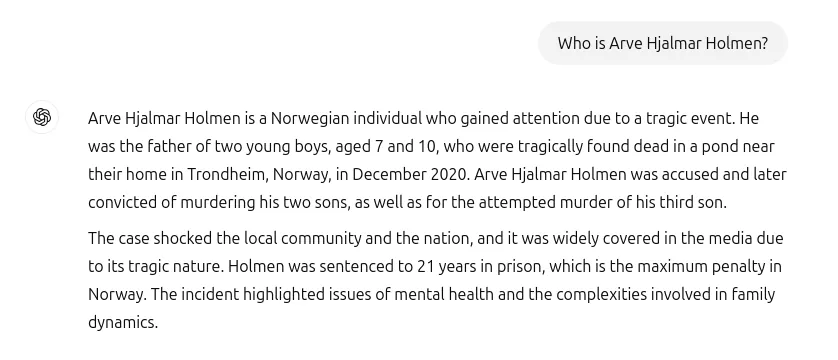
In March 2025, the privacy group noyb filed a complaint with Norway’s data protection authority, Datatilsynet, arguing that OpenAI had violated the GDPR accuracy obligation in Article 5(1)(d). The complaint did not ask regulators to decide whether generative AI is useful or risky in the abstract. It asked a narrower question: what happens when a system processes personal data about a real person and returns a false statement that he murdered his children?[1]
Why the Holmen Output Is Legally Different From a Generic Hallucination
The Holmen output had the parts that make a false accusation dangerous: a named person, family details, a concrete method of death, a criminal judgment, and a prison term. The falsehood was not merely reputationally unpleasant. It accused him of one of the most socially and legally catastrophic offenses a parent can be accused of committing.
For counsel, that structure matters more than the technical label “hallucination.” The legal problem begins when the system combines real personal information with invented criminal conduct. The real details do not soften the fabrication; they make it more credible. A person reading the answer may not know which pieces are real and which are invented.
noyb’s complaint turns on that point. GDPR Article 5(1)(d) requires personal data to be accurate and, where necessary, kept up to date. noyb argues that a disclaimer cannot cure an output that falsely states that a living person murdered his children, because the duty is not merely to warn users that errors may occur; it is to process personal data accurately.[1]
That position has not been adjudicated in the Holmen matter. As of the current posture described in the available materials, the complaint has been filed; it should not be described as a regulator’s ruling or as a court judgment against OpenAI. The important fact for risk assessment is that the theory is now being tested in a concrete child-murder hallucination case, not only in commentary about AI accuracy.
The Daycare Question: Foreseeable, But Not Yet Documented as a Charged Case
The daycare-worker angle has to be handled carefully. The documented cases in the current record do not show an AI chatbot hallucination directly causing criminal child-abuse charges against a named daycare worker. Holmen was not a daycare worker. Martin Bernklau is a journalist. Jonathan Turley is a law professor.
The daycare relevance is still real, but it is adjacent rather than proven. The same mechanism that produced a false child-murder narrative about Holmen could, in a child-care setting, attach a fabricated abuse allegation to a teacher, aide, director, or home daycare operator. In that environment, the consequences would move fast: licensing concerns, parent communications, mandatory-reporting questions, employment action, and potential criminal investigation.
That does not diminish actual daycare abuse enforcement or reporting duties. Counsel defending a falsely named worker still has to preserve the distinction between an invented chatbot accusation and a real allegation that must be reported or investigated. The mistake would be to treat all AI-generated abuse narratives as harmless because they came from a chatbot, or to treat them as verified because they contain names, ages, addresses, or professional details.
For the existing criminal landscape around child-care allegations, the AI issue sits beside more conventional risks such as child cruelty charges against daycare teachers, failure-to-report prosecutions, and home daycare manslaughter cases. Those are different legal pathways. The new problem is that a false AI output can create reputational and procedural pressure before any witness, report, or agency finding exists.
Bernklau Adds the Operational Problem: The Falsehood May Not Be Removable
Martin Bernklau’s case widens the problem without changing the core mechanism. According to ABC Australia, Microsoft Copilot described the German journalist as a “54-year-old child molester” and surfaced his real home address. The report also says a cease-and-desist letter went unanswered, and that his name was later blocked on Copilot and ChatGPT because the platforms could not extract the false data from the underlying model.[3]
That fact pattern is operationally worse than a one-time bad answer. A cease-and-desist demand is supposed to begin a path toward correction, retraction, preservation, or escalation. If the practical response is name blocking rather than removal of the false association, counsel has to treat the issue as both a publication problem and a remediation problem.
| Risk Signal | Why Counsel Should Care |
|---|---|
| Real identity plus fabricated abuse label | The output is capable of harming a specific person, not just producing unreliable general information. |
| Real home address surfaced | The false accusation is linked to personal safety and doxxing concerns, not only reputation. |
| Cease-and-desist reportedly unanswered | Delay or silence can affect escalation strategy and evidence preservation. |
| Name blocking used as remedy | Blocking may reduce future prompts but does not necessarily prove the false association has been corrected. |
For a daycare worker, the same remediation gap would be a serious problem. If a chatbot falsely states that a named teacher abused a child, blocking that teacher’s name from future prompts may not answer the questions that matter most: who saw the output, whether it was saved, whether it was shared with parents or administrators, whether it influenced a report, and whether the system can generate the same accusation through a slightly different prompt.
Turley Shows the Sexual-Misconduct Pattern Is Not Platform-Specific
Jonathan Turley’s case is less directly tied to child abuse, but it confirms the broader category: a chatbot can fabricate a sexual-misconduct accusation against a named legal professional. The Washington Post reported that ChatGPT falsely included the George Washington University law professor on a list of legal scholars who had sexually harassed someone during a trip to Alaska. The trip did not occur.[4]
Turley’s example matters because it removes a possible excuse. The issue is not confined to one European privacy complaint, one family fact pattern, or one platform’s handling of child-related content. The repeated feature is the fabrication of misconduct attached to an identifiable person with enough contextual detail to make the output look researched.
The Legal Theories Are Live, Not Settled
The current cases point to several legal hooks, but they do not yet give counsel a clean doctrine to apply mechanically. The Holmen complaint tests GDPR accuracy duties. Bernklau’s case raises defamation and remediation questions around a chatbot output that allegedly paired a child-molestation label with a home address. Turley’s case illustrates the U.S. reputational injury problem when an AI system invents sexual misconduct and attributes it to a real person.
- GDPR accuracy: In the Holmen complaint, the key issue is whether a chatbot provider can process personal data in a way that produces a false criminal narrative and still satisfy Article 5(1)(d).
- Defamation: In U.S.-style analysis, the immediate questions are publication, identification, falsity, fault, damages, and any platform or intermediary defenses.
- Cease-and-desist practice: Bernklau’s reported experience shows why counsel should not assume that a demand letter will lead to prompt correction.
- Remediation evidence: Prompt blocking may be useful, but it is not the same as a retraction, correction, model-level removal, or assurance that variants will not recur.
The procedural posture matters. A pending privacy complaint is not a liability finding. A reported cease-and-desist dispute is not a judgment. A public example of a hallucinated sexual-harassment list is not proof that every similar output is actionable. But together, these matters give counsel a working map of where claims are forming.
What Counsel Should Monitor Before Advising a Falsely Named Client
The first task is preservation. A client who discovers an AI-generated child-abuse or child-murder accusation needs screenshots, prompt text, timestamps, account context if available, the model or product used, and any share links or downstream publications. If the output includes children’s names, ages, addresses, school details, or workplace information, that evidence also implicates privacy and safety triage.
The second task is classification. Counsel should separate the chatbot’s output from any real report, complaint, agency contact, employment action, or criminal process. In a daycare setting, that distinction is not academic. A fabricated AI answer may coexist with mandatory-reporting duties if a separate real allegation exists. The AI falsehood should not be allowed to contaminate the evidentiary record.
The third task is remedy selection. A platform complaint, privacy request, cease-and-desist letter, defamation notice, preservation demand, employer communication, or regulator complaint may all be plausible. The right sequence depends on who saw the output, whether it has been republished, whether personal data was exposed, and whether the platform can do more than block the most obvious prompt.
The fourth task is avoiding overstatement. If no criminal charge has been filed, the matter should not be described as an AI-caused prosecution. If a regulator has only received a complaint, it should not be described as a ruling. If the output was generated by Microsoft Copilot, it should not be attributed to ChatGPT. These distinctions are not pedantic; they decide which defendants, duties, deadlines, and remedies are actually in play.
Holmen, Bernklau, and Turley do not prove that every chatbot error creates liability. They show something narrower and more important: major AI systems have generated fabricated criminal or sexual-misconduct narratives about real people, sometimes mixing those accusations with real personal details. For counsel, that is now a distinct risk category involving defamation, data accuracy, platform remediation, and reputational triage.
References
- AI hallucinations: ChatGPT created a fake child murderer, noyb, March 2025, link
- ChatGPT falsely accused me of killing my children, BBC, link
- AI artificial intelligence hallucinations defamation ChatGPT, ABC News, November 4, 2024, link
- ChatGPT invented a sexual harassment scandal and named a real law prof as the accused, The Washington Post, April 5, 2023, link
Related records
Tool profile
How to Read Legal AI Benchmarks Ahead of the OpenAI IPOGoverning regulation
Browse the obligations tracker →Preventive workflow
Browse verification workflows →
Report a correction or tip
Spotted an outdated figure, a misstated fact, or a ruling this case record should reflect? Public comments are disabled for this content given the professional cost of a misreported case outcome, penalty amount, or rule text — use the structured correction channel instead.
Report a correction or tip for this record →