
Lawsuits Are Charting the Legal and Ethical Risks of AI Replacing Teachers
A wave of 2025–2026 lawsuits against ed-tech vendors and school districts is forging the legal framework for AI replacing teachers in classrooms. This article maps the seven active cases and the ethical principles at stake—from data privacy to special education obligations—to help litigators and counsel anticipate emerging liability.
- Jurisdiction
- US Federal
- Court
- Various Federal District Courts
- AI tool named
- Instructure/Canvas, Google, Curriculum Associates/i-Ready, IXL, PowerSchool, Seesaw
- Ruling date
- Jul 25, 2026
- Source document
- View primary court order ↗
- Last verified
- Jun 17, 2026
Lex Machina Review is an independent risk-tracking and reference resource. Nothing on this site is legal advice, and using it does not create an attorney-client relationship. Every record is reviewed against primary sources but may not reflect the most current status of a matter — always verify directly against the cited court order, rule text, or a licensed attorney before relying on it.
Companion explanation — secondary to the source document above
Current as of Q3 2026, the legal and ethical implications of AI replacing teachers in classrooms are being shaped less by a single federal education-AI statute than by complaints, agency guidance, accessibility rules, and vendor-facing litigation. This article is a litigation and risk survey, not legal advice. The EdTech Law Center active-cases page used here was last updated June 17, 2026, so newer filings may exist.
That posture matters. In May 2026, AFT President Randi Weingarten warned that “without regulation, AI policy will be made by lawsuits.” For school districts and ed-tech vendors, that is no longer a prediction about some future regulatory gap. It is a description of the forum in which responsibility is already being assigned: who collected the student data, who reviewed the machine’s output, who signed the plan, who disciplined the child, and who can explain the decision afterward. [1]

The Seven-Case Map Is the Starting Point
The most useful way to read the current docket is not as a set of isolated disputes about classroom software. The cases are beginning to outline where AI or AI-adjacent ed-tech systems can become legally significant: data collection, assessment, biometric or behavioral surveillance, breach exposure, and educational decisions that traditionally required accountable human judgment.
| Matter | Filed | Primary Risk Theory in the Current Map | Authority Status |
|---|---|---|---|
| Instructure / Canvas | March 2025 | Ed-tech AI data collection and assessment practices | Active lawsuit; allegations, not adjudicated rules |
| April 2025 | Student data collection in school technology environments | Active lawsuit; allegations, not adjudicated rules | |
| Curriculum Associates / i-Ready | December 2025 | AI-supported assessment and student data practices | Active lawsuit; allegations, not adjudicated rules |
| IXL | May 2024 | Assessment and ed-tech data practices | Active lawsuit; allegations, not adjudicated rules |
| PowerSchool data breach | January 2025 | Student data security and breach-related exposure | Active lawsuit; allegations, not adjudicated rules |
| Seesaw | May 2025 | Student data collection and platform practices | Active lawsuit; allegations, not adjudicated rules |
| Additional active ed-tech AI case identified by EdTech Law Center | Between March 2025 and mid-2026 | Data collection, assessment, or related AI education practice | Active lawsuit; allegations, not adjudicated rules |
The table is deliberately cautious. A complaint is not a holding, and an active-cases page is not a merits ruling. But for counsel, active allegations still matter because they identify the theories plaintiffs are willing to test and the operational records districts and vendors may be asked to produce. If a product was described internally as instructional support but operated as assessment infrastructure, discipline infrastructure, or disability-services infrastructure, the label will not do much work once discovery begins.
The scale problem is practical, not decorative. The K-12 AI ed-tech market was estimated at $391.2 million in 2024 and projected to reach $9 billion by 2034. Those figures do not prove that any tool is effective, lawful, or widely trusted. They do explain why litigation exposure can expand quickly: procurement spreads faster than institutional memory, and software decisions made at the district level can affect thousands of student records at once. [3]
What the Lawsuits Are Really Sorting
The phrase “AI replacing teachers” can easily pull a legal analysis into a culture-war argument about whether software should ever stand in front of a class. The litigation record is narrower and more useful. The sharper question is where a school system has allowed software to perform a judgment-bearing function without preserving a responsible human decision-maker in the record.
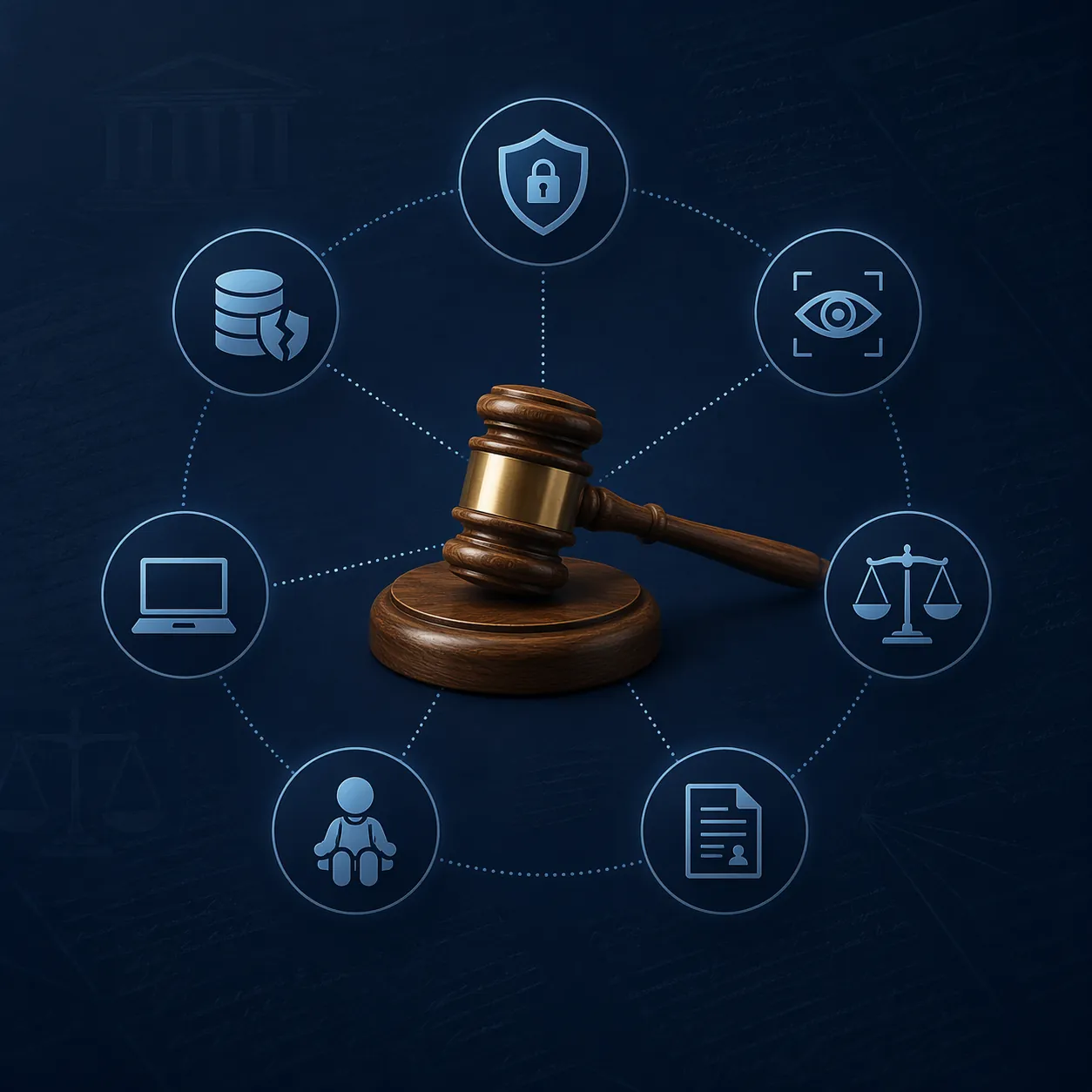
So far, the emerging liability theories cluster around five functions: collecting student data, observing or classifying students, assessing academic performance, triggering discipline, and shaping disability-related services. They overlap, but they are not the same. A privacy claim asks what was collected, shared, secured, or consented to. A discrimination claim asks whether the tool’s outputs burdened protected groups. A special-education claim asks whether the district still met its own procedural and substantive obligations when software entered the drafting or decision process.
Data Privacy: The Vendor Contract Becomes the District’s Record
The FERPA and COPPA frame appearing in the ed-tech cases is not only about whether a vendor had a privacy policy. It is about whether the school system can reconstruct the data flow after adoption: what student information moved into the product, whether the vendor’s use matched the educational purpose represented to families, what was retained, and who had authority to approve secondary use. The active cases involving Instructure/Canvas, Google, Curriculum Associates/i-Ready, IXL, PowerSchool, and Seesaw are all described in the EdTech Law Center map as targeting ed-tech AI data-collection and assessment practices, with PowerSchool also standing out as a breach-related matter. [2]
That distinction matters in procurement review. A district may believe it bought a classroom efficiency tool, while the pleadings may characterize the same deployment as large-scale student profiling, assessment, or data monetization. The legal risk increases when the person who approved the tool cannot explain what student data the vendor needed to deliver the promised educational function.
Biometric and Behavioral Surveillance: Oversight Cannot Be Implied After the Fact
Surveillance theories are especially uncomfortable in schools because the student often cannot meaningfully refuse the environment. Where software watches, scores, flags, or classifies behavior, the key record should not begin at the moment a parent complains. It should show why the tool was adopted, what conduct it was supposed to measure, what human review was required before consequences followed, and whether students with disabilities or language differences were considered before deployment.
The current research materials do not support a broad claim that every AI surveillance tool in schools violates biometric privacy law. They do support a narrower and more defensible warning: when a district describes human oversight as a safeguard, that safeguard needs to be visible in the workflow before the challenged decision, not supplied as a litigation explanation later.
Discriminatory Assessment: A Score Is Not Neutral Because It Is Automated
Assessment litigation is where the teacher-replacement issue becomes less metaphorical. If software places a student into an instructional track, signals remediation, affects access to enrichment, or supplies a record that teachers are expected to accept, the district has to know whether the system is advising a human or quietly becoming the decision-maker.
The Yale/GPTZero matter illustrates the point from a different angle. The cited Title VI bias claim concerns allegations that AI detection tools can burden non-native English speakers when used to identify AI-generated writing. The material supports the existence of that claim and its theory; it does not establish, by itself, a general rule that all AI-writing detectors are discriminatory or that every adverse result is unlawful. [4]
For counsel, the operational question is more immediate: before a school relies on an automated assessment or detection result, who checks whether the output is plausible in light of the student’s actual work, language background, disability status, and classroom record? If the answer is “the software vendor says the model is accurate,” the district has not identified its own decision-maker.
AI-Cheating Discipline: The Appeal Record Is the Risk Record
Cheating accusations show how quickly an AI tool can move from classroom aid to disciplinary authority. The Hingham High School family lawsuit in Massachusetts, as summarized in the provided JD Supra and SchoolHouse materials, concerns an improper AI-cheating discipline dispute. The case is useful here not because it resolves the legality of AI detection, but because it places process at the center: what the school accused, what evidence supported the accusation, and how the family could contest the finding. [5]
This is where ethical language becomes concrete. A student accused of misconduct needs more than a confidence score. The family needs to know what rule was violated, what tool was used, whether the tool was determinative, who reviewed the student’s work, and what contrary evidence would matter. If the school cannot answer those questions, the technology has not merely assisted discipline; it has obscured responsibility for it.
Special Education Is Where Human Oversight Carries the Most Weight
The special-education problem deserves more space because it is where efficiency arguments can do the most institutional damage. Drafting an IEP or Section 504 plan is paperwork, but it is not only paperwork. The document records evaluation, eligibility, accommodations, services, placement, progress monitoring, and the district’s legal commitments to a particular child. A tool that reduces clerical drag may be welcome. A tool that normalizes a plan before the team has exercised judgment changes the nature of the meeting.
OCR’s November 2024 guidance, as described in the provided materials, warned that AI-drafted Section 504 plans can become discriminatory if used without human oversight. That is agency guidance, not a private complaint and not the same thing as a court judgment. Its significance is still plain: the federal civil-rights lens is focused on whether a school preserved individualized review when automation entered the accommodation process. [6]
The Center for Democracy & Technology has raised related concerns that AI use in IEP and 504 processes can compromise privacy and reinforce bias. That warning should not be overstated into a finding that every AI-assisted draft is unlawful. It does, however, point to the precise failure mode counsel should look for: sensitive disability information feeding a system whose training, retention, access, or output-review rules are not well documented. [7]
A defensible workflow looks different from a ceremonial one. If staff use AI to summarize meeting notes, the district should still know who checked the summary against the record. If a tool proposes accommodations, the team should know who accepted, rejected, or modified each proposal and why. If a parent challenges the plan, the district should be able to produce more than a final PDF. It should be able to show the human reasoning that survived the software.
This is also where the ethical consequence lands on staff. A special-education coordinator may be asked to defend an AI-influenced plan at a meeting, in mediation, or in a due-process posture. If procurement and implementation records treated the tool as a harmless productivity layer, that staffer may be left explaining a system they did not select, cannot audit, and were never trained to challenge.
Accessibility Duties Are Not Waiting for AI-Specific Rules
Not every obligation in this area is merely emerging. The DOJ’s April 2024 rule requires covered digital content to meet WCAG 2.1 AA compliance by April 2026. That rule is not an AI-in-education statute, but it directly affects the digital systems schools use to deliver instruction, assessment, communication, and services. [8]
For AI-enabled ed-tech, accessibility cannot be left until after the model is embedded in the workflow. If a student cannot access the interface, challenge an output, read generated feedback, or use required content with assistive technology, the accessibility issue is not separate from the educational decision. The tool becomes part of the path through which the school delivers the service.
State Timelines Are Moving Targets, Not Safe Harbors
State AI law adds another layer, but the provided materials support only a narrow point here. The Colorado AI Act timeline shifted materially: an original February 2026 deadline was stayed in April 2026 and replaced by SB 26-189, effective January 2027. That kind of movement is a warning against building a national school AI program around a single projected compliance date. [9]
The materials do not support a separate analysis of EU AI Act applicability to U.S. schools serving EU students. Without source support on that question, it should remain outside this survey rather than being converted into a speculative compliance section.
What Counsel Should Track in Each Matter
The current patchwork does not produce a single checklist that answers every AI-in-classrooms dispute. It does suggest the records that will matter when the complaint arrives. The first file to review is rarely the marketing deck. It is the chain of responsibility.
- Decision function: identify whether the tool only assisted instruction or affected assessment, discipline, placement, accessibility, accommodations, or services.
- Human reviewer: name the role responsible for accepting, rejecting, or modifying the AI output before it affected the student.
- Student data flow: document what information entered the product, where it was stored, who accessed it, and whether the use matched the educational purpose.
- Challenge process: preserve how a student or family can contest an AI-influenced accusation, score, placement, or accommodation decision.
- Disability and language review: test whether outputs were evaluated against known accommodation needs, assistive-technology requirements, and language-background concerns.
- Vendor accountability: align contract promises, product behavior, audit rights, breach obligations, and district-facing explanations.
Those records do not guarantee a litigation outcome. They do something more basic: they make the human decision visible before a district has to explain it in a complaint, investigation, mediation, or due-process posture.
For now, the central risk is not simply AI in classrooms. It is the undocumented substitution of AI for accountable human educational judgment across privacy, discipline, assessment, accessibility, and special education.
References
- AFT President Weingarten May 2026 warning, AFT, May 2026.
- Active Cases, EdTech Law Center, last updated June 17, 2026.
- K-12 AI Ed-Tech Market Data, research draft.
- Yale/GPTZero Title VI bias claim synthesis, SchoolHouse.
- Hingham High School AI-cheating discipline synthesis, JD Supra and SchoolHouse.
- OCR November 2024 guidance on AI-drafted Section 504 plans, Office for Civil Rights, November 2024.
- AI use in IEP/504 processes compromising privacy and reinforcing bias, Center for Democracy & Technology.
- Nondiscrimination on the Basis of Disability; Accessibility of Web Information and Services of State and Local Government Entities, U.S. Department of Justice, April 2024.
- SB 26-189, Colorado General Assembly, effective January 2027.
Related records
Tool profile
Browse tool evaluations →Governing regulation
Browse the obligations tracker →Preventive workflow
Browse verification workflows →
Report a correction or tip
Spotted an outdated figure, a misstated fact, or a ruling this case record should reflect? Public comments are disabled for this content given the professional cost of a misreported case outcome, penalty amount, or rule text — use the structured correction channel instead.
Report a correction or tip for this record →