
The AI Singularity Debate Is Already Changing Legal Ethics
The AI singularity debate is not an academic hypothetical for lawyers—it is already generating record sanctions, state-level personhood bans, and binding bar rule amendments. This article maps the converging risk signals and explains why prudence requires documented human judgment over reliance on any AGI prediction.
- Jurisdiction
- United States
- Court
- US Bankruptcy Court
- AI tool named
- Westlaw Precision
- Ruling date
- Jul 1, 2026
- Source document
- View primary court order ↗
- Last verified
- Jul 30, 2026
Lex Machina Review is an independent risk-tracking and reference resource. Nothing on this site is legal advice, and using it does not create an attorney-client relationship. Every record is reviewed against primary sources but may not reflect the most current status of a matter — always verify directly against the cited court order, rule text, or a licensed attorney before relying on it.
Companion explanation — secondary to the source document above
The practical legal question in the AI singularity debate is no longer whether a machine will someday deserve metaphysical respect. It is what happens today when a lawyer treats an AI system’s output as if it can carry professional judgment on its own. Courts have started answering that question in sanctions orders, legislatures have started answering it in personhood bills, and bars have started answering it in ethics rules.
That makes the debate less theatrical and more uncomfortable. A lawyer does not need to believe that artificial general intelligence is imminent to create an ethics problem. The problem begins earlier, at the moment an unverified citation enters a brief, a client confidence enters a tool, a supervising lawyer cannot explain the workflow, or a filing presents machine-generated authority as if a lawyer had checked it.
The Sanctions Record Is Where the Debate Became Real
The cleanest way to understand the ethics risk is to follow the filings. In June 2023, Mata v. Avianca became the first widely recognized AI-hallucination sanctions case, with a $5,000 sanction after lawyers submitted fictitious authorities generated through ChatGPT-assisted research.[1] It was easy, then, to treat the matter as a spectacular one-off: embarrassing, avoidable, and useful for CLE slides.
That reading has not aged well. In May 2025, a special master in Lacey v. State Farm ordered a $31,100 sanction tied to 11 fabricated cases.[1] In December 2025, Couvrette v. Wisnovsky involved more than $110,000 in sanctions after 15 nonexistent cases and 8 fabricated quotations appeared in the record.[1] In July 2026, In re Rosslyn2016 produced a $29,877 sanction in a bankruptcy matter where Westlaw Precision was implicated.[1]
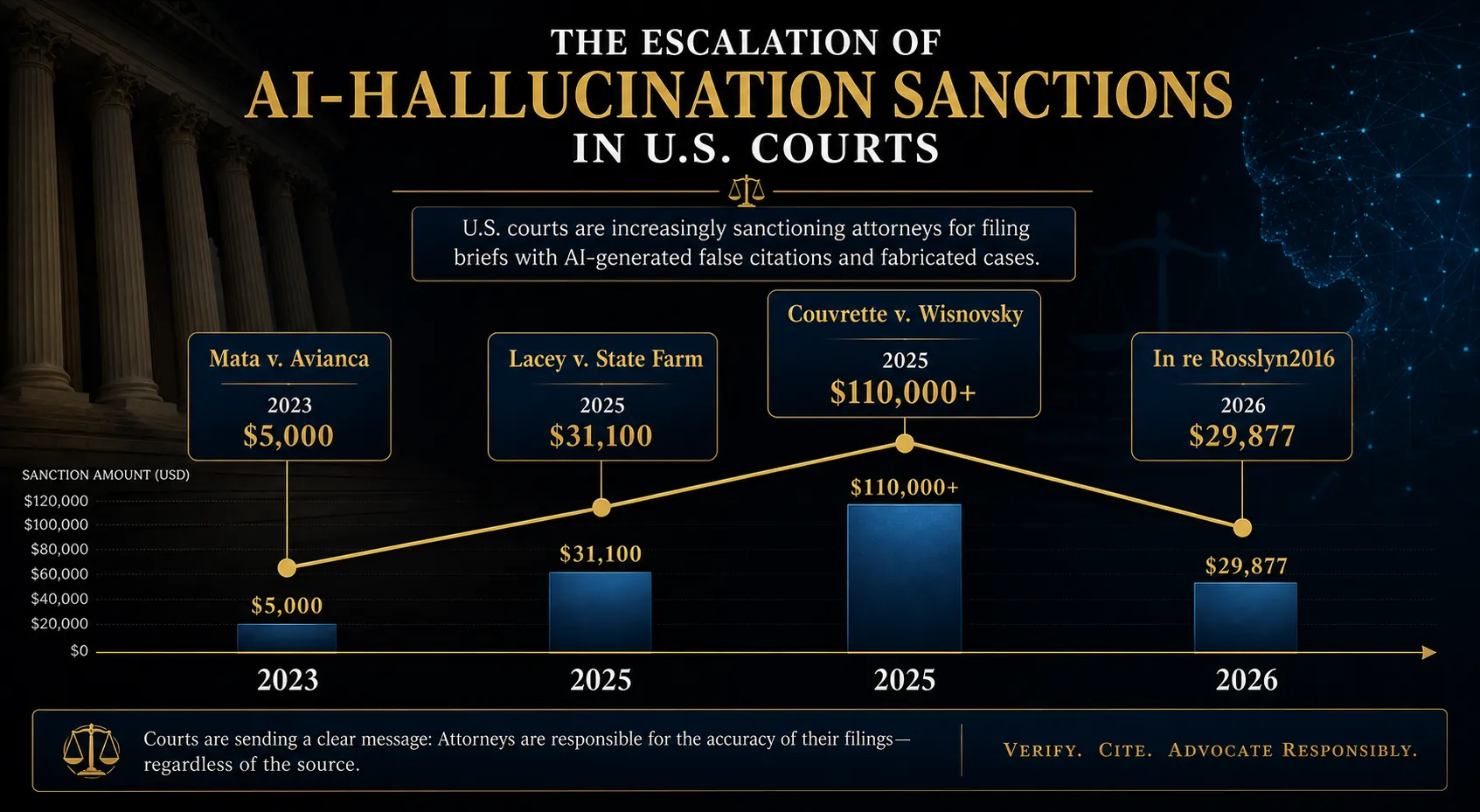
The dollar amounts matter because they mark the movement from novelty to aggravation. A fabricated case is not merely a technology failure once it reaches a court. It becomes a candor problem, a supervision problem, a competence problem, and often a docket-cleanup problem imposed on opposing counsel and the judge. The lawyer who later says the tool sounded authoritative is not giving the court a reason to excuse the filing. The lawyer is identifying the gap where professional review should have happened.
The scale has also changed. Damien Charlotin’s AI hallucination database recorded 1,811 documented hallucination cases globally as of July 29, 2026, including 1,252 in U.S. courts, 705 involving lawyers, and 1,060 involving pro se litigants.[2] The database is a living record, not a closed census of every error ever made. That is exactly why the number is useful for legal risk: it shows a growing, observable docket phenomenon rather than a single scandal frozen in 2023.
There is a temptation to file these cases under “hallucinations” and move on, as if the ethics lesson is only that generative AI sometimes invents things. That understates the problem. The sanctionable act is not the model’s generation of false text. It is the human legal process that allowed false text to become a representation to a tribunal.
What Courts Are Really Punishing
The recurring misconduct is ordinary in form: nonexistent cases, misquoted authorities, unsupported propositions, and weak explanations after the fact. AI changes the speed and polish of the error, but it does not change the lawyer’s duty to verify what is filed. If anything, the polish makes the duty more important because the output may look more finished than it is.
This is where the singularity debate can become a bad professional habit. The more a tool is discussed as approaching general intelligence, the easier it becomes for hurried users to treat its answers as quasi-authoritative. Courts have not accepted that move. They are asking who checked the authorities, who supervised the work, what review occurred before filing, and why the burden of correction fell on everyone else.
| Matter | Date | Reported AI issue | Reported sanction |
|---|---|---|---|
| Mata v. Avianca | June 2023 | Fictitious authorities in an AI-assisted filing | $5,000 |
| Lacey v. State Farm | May 2025 | 11 fabricated cases | $31,100 |
| Couvrette v. Wisnovsky | December 2025 | 15 nonexistent cases and 8 fabricated quotations | $110,000+ |
| In re Rosslyn2016 | July 2026 | AI-assisted research issue involving Westlaw Precision | $29,877 |
The table is not a complete taxonomy of AI misconduct. It is a warning about reliance. A lawyer who uses AI for research, drafting, summarization, or deposition preparation can still practice competently. But the review trail has to show that the lawyer, not the system, made the legal judgment.
Personhood Bills Are Closing Off an Escape Route
The second front is legislative. At least nine states have enacted or considered measures denying AI legal personhood or consciousness claims, but they are not all at the same stage. Idaho enacted such a law in 2022, North Dakota in 2023, and Utah in 2024. Oklahoma’s HB 3546 passed committee by a 94-2 vote in February 2026. Bills were introduced in Ohio, Tennessee, South Carolina, Washington, and Missouri.[3]
Those distinctions matter. An enacted statute is not the same thing as an introduced bill, and a committee vote is not the same thing as final passage. Still, the pattern is hard to ignore. Legislatures are not waiting for a settled scientific account of machine consciousness before deciding that AI systems should not be treated as legal persons.
The most legally interesting detail is not simply that these bills deny personhood. It is that they reportedly lack sunset clauses or scientific-review mechanisms that would require reconsideration if AI capabilities materially change.[3] That design choice does not prove that conscious AI is impossible. It shows something narrower and more consequential for lawyers: lawmakers are building default legal answers under uncertainty, and those defaults may become sticky.
For litigation and counseling, that matters because it narrows the room for arguments that treat an AI system as an autonomous legal actor. A client may want to blame the model. A vendor may want contract language that diffuses responsibility. A lawyer may be tempted to describe the tool as if it exercised independent judgment. Personhood-denial laws push in the opposite direction: they keep responsibility attached to humans, organizations, and licensed professionals.
Bar Guidance Is Moving From Advice Toward Discipline
The professional-responsibility response has followed a familiar path. First come advisory opinions and warnings. Then come court orders. Then, if the pattern persists, regulators begin writing the issue into rules that can support discipline.
California is the clearest current example. In May 2026, the State Bar of California proposed what it described as the first AI-specific changes to ethics rules, addressing competence, communication, confidentiality, candor, supervision of lawyers, and supervision of nonlawyers through amendments to Rules 1.1, 1.4, 1.6, 3.3, 5.1, and 5.3.[4] Coverage of the proposal emphasized the same shift: AI obligations were moving beyond advisory guidance and into rule text with disciplinary consequences.[5]
That development should not surprise anyone who has watched the hallucination cases accumulate. Competence asks whether the lawyer understands the tool well enough to use it responsibly. Communication asks whether the client needs to know how the work is being performed. Confidentiality asks what information went into the system and under what safeguards. Candor asks whether the filing is true. Supervision asks who reviewed the work and what controls existed before it left the office.
Those duties do not depend on a prediction about AGI. A lawyer cannot postpone them until the technical community agrees on whether a model has understanding, agency, or inner experience. The ethics rules already know how to allocate responsibility: to the lawyer who used the tool, the lawyer who supervised the work, and the firm or legal department that designed the process.
The Workflow Question Is Evidence, Not Branding
Many AI vendors now describe responsible use with variations on prompt, verify, and audit. As workflow advice, that is sensible. As proof of compliance, it is incomplete. The legal question is not whether a firm adopted the right slogan. It is whether the firm can show what was verified, against which source, by whom, and before what representation was made.
- Primary authorities should be checked in the official or otherwise reliable source that the lawyer would have used without AI.
- AI-assisted research should leave a review trail showing who accepted, rejected, or revised the output.
- Client-confidential information should not enter a system unless the lawyer understands the confidentiality, retention, and access terms.
- Supervising lawyers should be able to explain the process well enough to answer a court, client, regulator, or insurer.
- Final responsibility should be assigned to a human legal professional, not to the apparent confidence of the generated text.
This is deliberately mundane. It is also where many failures occur. The risk does not usually announce itself as a grand claim about machine consciousness. It appears as a missing cite check, a pasted paragraph, an associate who assumed the partner had reviewed the cases, or a vendor workflow no one in the legal team can reconstruct.
Expert Disagreement Makes Prudence More Important, Not Less
The expert surveys are useful only if they are kept in their lane. They do not tell a lawyer what the standard of care is. They explain why no prediction about the singularity can responsibly substitute for professional verification.
A January 2026 National Law Review survey of 85 legal professionals found that 77.4% said AGI would not arrive in 2026, and 58.3% rejected the claim that AI would replace entry-level lawyers within five years.[6] The survey is a signal from a small, AI-proficient group, not a statistically reliable measure of the profession as a whole. It is still useful for one modest point: even people paying close attention to legal AI were not converging around a near-term AGI assumption.
The uncertainty is not limited to lawyers. Rost’s account of AI-consciousness legislation cites a survey of 582 AI researchers reporting a median 25% to 30% probability of AI inner experience within a decade.[3] That figure should be handled carefully; the underlying work is a preprint, and “inner experience” is not the same legal question as personhood, liability, privilege, or professional judgment. But it helps explain why legislatures and bars are acting before consensus arrives.
Older legal-personhood data show a similar divide from another angle. A 2021 discussion of Martínez and Winter’s research reported that roughly 6% of law professors endorsed some AI legal personhood, compared with roughly 33% of laypeople.[7] The date matters; attitudes may have shifted in a fast-moving field. The contrast nevertheless captures a persistent institutional instinct in law: personhood is not granted because a system impresses users, and legal responsibility is not dissolved because a system produces fluent text.
None of these surveys settles whether AGI will arrive, when it will arrive, or what it would mean if it did. For legal ethics, that is the point. A lawyer’s duty cannot be built on the most exciting forecast, the most dismissive forecast, or the vendor’s preferred forecast. It has to be built on verifiable work.
The Standard of Care Does Not Need to Wait
The AI singularity debate has already changed legal ethics because it has changed the excuses available after failure. A lawyer who says the technology was advanced, persuasive, or widely adopted has not answered the professional-responsibility question. The question is who verified the work, who supervised the workflow, who protected the client’s information, and who made the judgment call.
Sanctions cases show courts treating AI-generated false authority as a serious filing failure. Personhood-denial bills show legislatures resisting arguments that would relocate responsibility into the machine. Bar amendments show regulators translating AI use into familiar duties of competence, candor, communication, confidentiality, and supervision. Expert disagreement supplies the fog, not the answer.
For a prudent lawyer, the working rule is narrow enough to apply now: verify primary sources, document supervision, preserve confidentiality, communicate when AI use matters to the representation, and keep human legal judgment visibly in charge. The profession does not need to know when AGI arrives to know that an AI system’s apparent authority is not a substitute for a lawyer’s own.
References
- AI Legal Ethics, GC AI, https://gc.ai/blog/ai-legal-ethics
- Hallucination Database, Damien Charlotin, https://www.damiencharlotin.com/hallucinations/
- Legislating AI Consciousness Without an Exit, The Regulatory Review, June 2026, https://www.theregreview.org/2026/06/29/rost-legislating-ai-consciousness-without-an-exit/
- State Bar of California Proposes First AI-Specific Changes to Ethics Rules, California Courts Newsroom, https://newsroom.courts.ca.gov/news/state-bar-california-proposes-first-ai-specific-changes-ethics-rules-0
- California Ethics Panel Turns Up the Heat on Artificial Intelligence, Esquire Deposition Solutions, https://www.esquiresolutions.com/california-ethics-panel-turns-up-the-heat-on-artificial-intelligence/
- 85 Predictions for AI and the Law in 2026, National Law Review, January 2026, https://natlawreview.com/article/85-predictions-ai-and-law-2026
- Protecting Sentient Artificial Intelligence: A Survey of Lay Intuitions on Standing, Personhood, and General Legal Protection, Legal Priorities Project, https://law-ai.org/protecting-sentient-artificial-intelligence/
Related records
Tool profile
Browse tool evaluations →Governing regulation
Browse the obligations tracker →Preventive workflow
Browse verification workflows →
Report a correction or tip
Spotted an outdated figure, a misstated fact, or a ruling this case record should reflect? Public comments are disabled for this content given the professional cost of a misreported case outcome, penalty amount, or rule text — use the structured correction channel instead.
Report a correction or tip for this record →