
How Air Force One's Delivery Delays Cost Boeing $2.8B
The VC-25B program's firm-fixed-price contract left Boeing absorbing over $2.8 billion in losses without government liability for delivery delays. This case study examines the contract structure, the loss trajectory, and the risk-management lessons for in-house counsel advising on government procurement.
- Jurisdiction
- US Federal
- Court
- U.S. Court of Appeals for the Federal Circuit
- AI tool named
- None
- Ruling date
- Jul 28, 2026
- Source document
- View primary court order ↗
- Last verified
- Jul 29, 2026
Lex Machina Review is an independent risk-tracking and reference resource. Nothing on this site is legal advice, and using it does not create an attorney-client relationship. Every record is reviewed against primary sources but may not reflect the most current status of a matter — always verify directly against the cited court order, rule text, or a licensed attorney before relying on it.
Companion explanation — secondary to the source document above
Boeing’s latest Air Force One charge is not a footnote to a late aircraft program. It is the contract working as written.
On July 28, 2026, Boeing took another $280 million charge on the VC-25B program, the effort to build two replacement presidential aircraft. Forbes reported that the program has now cost Boeing $2.8 billion so far, while The Hill, citing parallel reporting, described cost overruns as exceeding $3.1 billion.[1][2] That range should not be papered over. It likely reflects differences in what each account includes in the overrun tally. For counsel, the important point is narrower and more useful: public reporting now places Boeing’s cumulative exposure well above $2.8 billion on a program originally valued at $3.9 billion.
The aircraft are also late. Boeing Defense leadership has said delivery is now expected in 2028, and additional costs remain possible.[3] That timing is why the phrase “Air Force One delivery delay 2028 contract breach legal” attracts attention. But delay does not automatically equal breach, and cost growth does not automatically migrate back to the government. The first legal fact to read is the contract type.

The fixed-price term did most of the work
The VC-25B deal was a firm-fixed-price development contract. Under FAR Subpart 16.2, a firm-fixed-price contract is not adjusted based on the contractor’s cost experience; it places maximum risk and full responsibility for costs and resulting profit or loss on the contractor.[4] That is not procurement jargon. It is the allocation clause that explains why Boeing can keep recording charges years after the award while the government does not become the insurer of the development effort.
In 2018, President Donald Trump and then-Boeing CEO Dennis Muilenburg reached a handshake understanding around a $3.9 billion price for the two-aircraft program. The Air Force later announced the formal VC-25B contract in 2019.[5] The handshake is useful evidence of deal posture, not because it makes the contract theatrical, but because prestige, customer pressure, and executive-level commitment can narrow the room in which contracts and legal teams later negotiate risk.
Once the agreement hardened into a firm-fixed-price development contract, the commercial story became legally secondary. If the work proved harder, suppliers failed, security requirements consumed more labor, or delivery slipped, the default cost consequence remained Boeing’s unless a compensable change, equitable adjustment, or other contract remedy fit the facts. A late program can generate disputes. It does not, by itself, rewrite a fixed-price bargain.
| Issue | Why it matters legally |
|---|---|
| Firm-fixed-price development structure | The contractor bears cost overruns rather than receiving automatic reimbursement. |
| 2028 delivery expectation | Delay increases pressure, but delay alone does not establish government liability. |
| $2.8B-plus reported Boeing losses | The loss trajectory shows compounding exposure under the same allocation of risk. |
| Continuing modification practice | Negotiated changes may address discrete issues without converting the whole deal into a cost-reimbursement arrangement. |
The loss did not arrive all at once
The most instructive part of the VC-25B record is the cadence. By the first quarter of 2022, Boeing had already recorded $1.1 billion in losses on the program. Then-CEO Dave Calhoun said Boeing “probably shouldn’t have taken” the deal and described it as involving “a very unique set of risks.”[6] That admission has aged less like a moment of executive candor than like a board packet warning label.
From there, the charges continued. The July 2026 $280 million charge did not create the problem; it added another entry to a ledger already moving in the wrong direction.[1] A fixed-price development contract can look tolerable when management models the overrun as bounded. It becomes much harder to defend when each new engineering, certification, supply-chain, or schedule problem is absorbed through the same contractual funnel.
That is the governance failure counsel should care about. A one-time miss can be a bad estimate. A repeated charge pattern under the same contract type suggests that the approval process did not make the downside visible enough, or that visible downside was accepted because the award was too politically and commercially valuable to lose.
No one advising a contractor should treat “fixed price” as a mere pricing label in that setting. On development work, it is a financing decision. The contractor is agreeing to fund the gap between promise and performance unless the contract gives it a path to shift particular costs back to the customer. When the customer is the federal government, that path usually runs through the actual text: changes clauses, specifications, delay provisions, inspection and acceptance terms, data obligations, security requirements, subcontractor flowdowns, and the record supporting any request for equitable adjustment.
Why the delay is not the same thing as a government breach
The legal temptation is to see a 2028 delivery date and ask whether Boeing can make the government pay because the program is late. The better question is more specific: what government act, if any, caused a compensable delay or change under the contract, and what cost can be tied to that act?
Newsweek’s 2025 legal analysis framed actual litigation as very unlikely, citing expert views that the contract remained in place and that the parties continued to negotiate modifications rather than posture for a broad breach suit.[7] That is a narrower conclusion than “Boeing has no legal arguments.” It means the public record does not support treating a lawsuit as the expected commercial path.
Government-caused delay arguments are not magic words. They require chronology, notice, causation, and proof of cost. They also sit alongside the contractor’s own performance obligations. A contractor may be entitled to relief for a discrete government change and still remain responsible for unrelated overruns. That distinction matters because large troubled programs usually contain both: customer-driven changes and contractor-side execution pain.
The bankruptcy dispute involving GDC Technics, a former VC-25B interiors supplier, shows how a subcontractor problem can become part of the program’s cost story without automatically becoming a government liability story. Jones Day reported an October 2021 resolution involving a $57 million claim.[8] For prime-contract counsel, the lesson is not that subcontractor failure is unforeseeable. It is that fixed-price prime risk and subcontractor recovery are different buckets, and the prime may be waiting a long time before the second bucket offsets the first.
The portfolio pattern makes the Air Force One case harder to dismiss
If VC-25B were the only Boeing defense program with this profile, it would be easier to quarantine it as a presidential-aircraft exception. It is not. Defense News reported in January 2024 that Boeing’s KC-46 tanker had accumulated $7 billion in losses under a similar fixed-price structure.[9] The same reporting discussed Boeing’s T-7A Red Hawk and MQ-25 programs as additional fixed-price development programs booked at a loss.[9]
That does not prove every fixed-price development contract is a mistake. It does show that the risk is repeatable. Complex defense development work combines immature design, changing mission needs, demanding customer oversight, supplier dependency, certification constraints, and long schedules. A contractor can price some of that uncertainty. It cannot price all of it with confidence unless the scope is more stable than the sales narrative admits.
Boeing’s own posture has changed. CFO Brian West said the company has not signed, and does not intend to sign, fixed-price development contracts.[9] That statement deserves more weight than a generic industry warning because it comes from a contractor with a live ledger of what these terms can do across multiple programs.
The market has been sending similar signals elsewhere. L3Harris declined two attractive opportunities because of fixed-price risk, according to Breaking Defense reporting, and the Air Force used a cost-plus structure for the E-7A Wedgetail award in 2023.[3][9] Those are not enough data points for a full market survey. They are enough to show that sophisticated contractors and government buyers have been recalibrating where development uncertainty should sit.
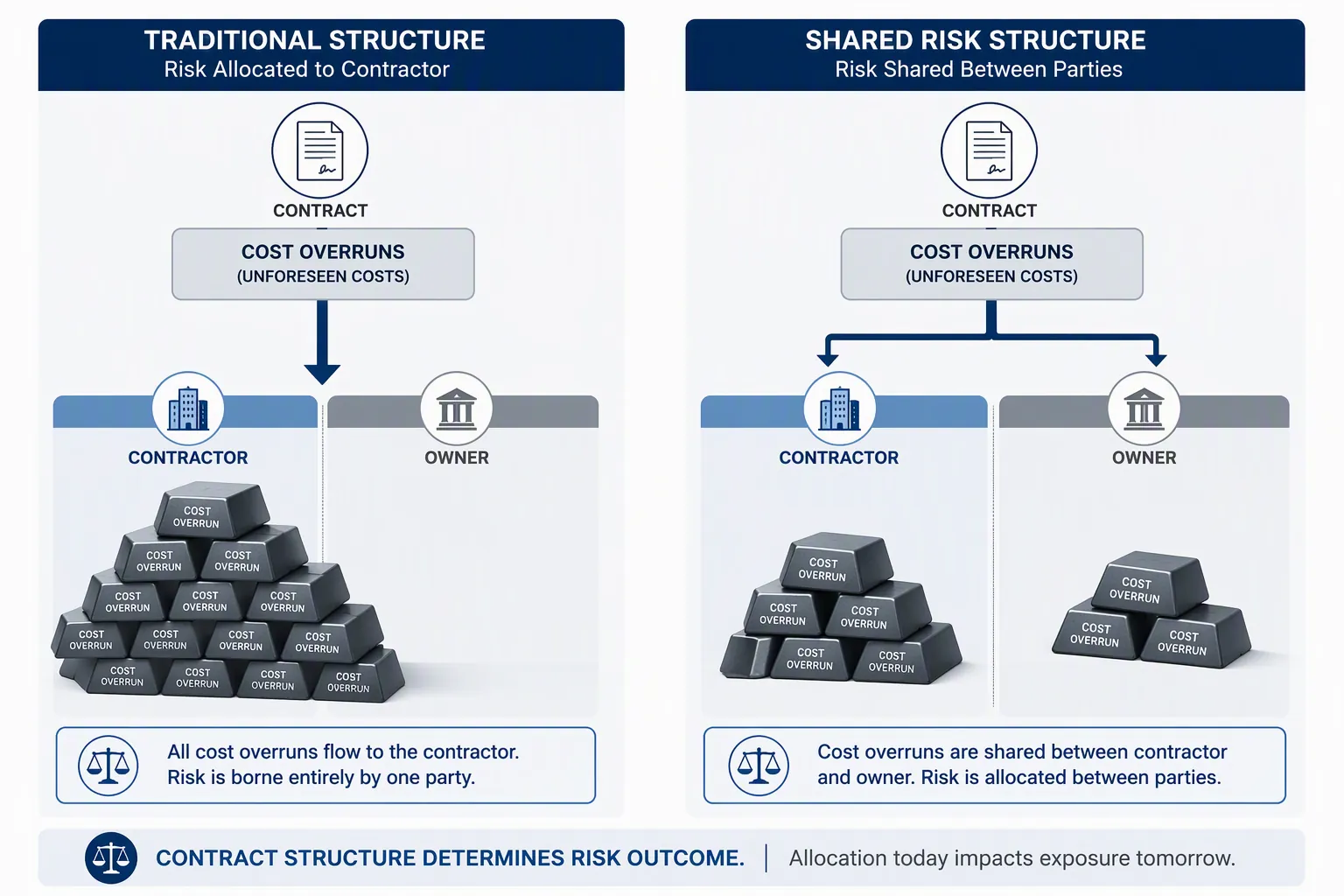
What counsel should translate before approval
The useful legal work happens before signature, when the organization still has choices. By the time the public charge appears, counsel is often explaining why the document did exactly what it said it would do.
For a development contract, the approval memo should translate the pricing model into operational consequences. If engineering takes longer than expected, who pays the incremental labor? If the government changes a requirement, what notice and documentation preserve relief? If the customer’s review cycle extends the schedule, does the contractor receive money, time, both, or neither? If a critical subcontractor fails, does the prime have a recovery path that is fast enough to matter?
Those questions should not be left as legal caveats at the end of a business presentation. They should set approval thresholds. A contractor accepting fixed-price terms on uncertain development work should be able to identify, in advance, which risks it is deliberately financing and which risks it has contract language to recover. If the answer is “we will manage it,” the risk has not been allocated; it has been deferred.
- Separate scope uncertainty from execution uncertainty; they do not produce the same legal arguments later.
- Require a written cost consequence for late government approvals, changed specifications, and delayed furnished information.
- Tie subcontractor assumptions to enforceable flowdowns, remedies, and realistic recovery timing.
- Model cumulative downside, not only the first likely overrun.
- Escalate fixed-price development approvals to officers who can accept balance-sheet exposure, not only program-margin variance.
Contract-cost disputes with the federal government do reach litigation. Boeing Co. v. United States, decided by the Federal Circuit in 2024, is one example of Boeing litigating a contract-cost dispute with the government.[7] But litigation precedent should not distract from the more common business reality: the parties may continue performance, negotiate modifications, and book charges while the fixed-price baseline continues to control the economics.
The same risk logic applies beyond aircraft
The VC-25B program is not an AI procurement story. Its relevance to legal teams evaluating AI systems is the contract-risk pattern. Complex technical systems often begin with confident demos, executive urgency, uncertain integration work, changing user needs, and incomplete knowledge about performance at scale. A vendor that accepts fixed outcomes in that environment may be making the same kind of asymmetric bet Boeing made, even if the subject matter is software rather than aircraft.
For buyers, fixed-price development can look disciplined because it appears to cap public spending. For vendors, it can look attractive because it secures a strategic customer. Neither view is wrong, but neither is complete. The missing sentence is the one the contract will enforce later: who pays when the system takes longer, requires more customization, fails a performance threshold, or depends on third-party components that do not behave as promised.
That is the drafting and governance test the Air Force One delay leaves behind. Before approving a fixed-price development contract, identify who pays when the schedule slips, the government changes requirements, subcontractors fail, or the technology proves harder than promised. If the contract does not answer that question in usable language, the financial answer may already have been written.
References
- Overdue Air Force One Has Cost Boeing $2.8 Billion So Far, Forbes, July 28, 2026.
- Boeing takes $280 million hit on troubled Air Force One program, The Hill, July 28, 2026.
- Boeing Defense CEO's statement on 2028 delivery and additional cost expectations, Breaking Defense, July 2026.
- FAR Subpart 16.2 - Fixed-Price Contracts, Federal Acquisition Regulation.
- Contract formalization announcement for VC-25B, Air Force.mil, February 2019.
- Boeing CEO says company 'probably shouldn't have taken' Air Force One deal, CNBC, April 2022.
- Legal expert analysis on Air Force One contract breach framework, Newsweek, 2025.
- GDC Technics bankruptcy resolution involving $57 million claim, Jones Day, October 2021.
- Cautionary tale: Boeing's fixed-price losses across defense programs, Defense News, January 2024.
Related records
Tool profile
Browse tool evaluations →Governing regulation
Browse the obligations tracker →Preventive workflow
Browse verification workflows →
Report a correction or tip
Spotted an outdated figure, a misstated fact, or a ruling this case record should reflect? Public comments are disabled for this content given the professional cost of a misreported case outcome, penalty amount, or rule text — use the structured correction channel instead.
Report a correction or tip for this record →