
What's the Penalty for a First Doxing Conviction in Alabama?
The penalty for a first doxing conviction under Alabama law is a Class A misdemeanor — up to one year in jail and $6,000 in fines. This article explains the current statute, the actual-harm requirement, and the failed 2026 amendment that would have changed it.
- Jurisdiction
- US-Alabama
- Court
- Alabama state courts
- AI tool named
- None
- Ruling date
- Jul 29, 2026
- Source document
- View primary court order ↗
- Last verified
- Jul 29, 2026
Lex Machina Review is an independent risk-tracking and reference resource. Nothing on this site is legal advice, and using it does not create an attorney-client relationship. Every record is reviewed against primary sources but may not reflect the most current status of a matter — always verify directly against the cited court order, rule text, or a licensed attorney before relying on it.
Companion explanation — secondary to the source document above
A first doxing conviction under Alabama’s current anti-doxing statute is a Class A misdemeanor. That means exposure of up to one year in county jail and a fine of up to $6,000, assuming the charge is prosecuted as a first offense under Ala. Code § 13A-11-38 and sentenced under Alabama’s general Class A misdemeanor provisions.[1][2][3]
That answer is current as of July 29, 2026. It is not legal advice, and anyone publishing or relying on the answer should still verify the current official Alabama Code text directly. The important point for a same-day risk assessment is that the 2026 Legislature did not enact the proposed bill that would have changed the definition and penalty structure.
| Conviction under current Alabama law | Classification | Jail or prison exposure | Fine exposure |
|---|---|---|---|
| First conviction | Class A misdemeanor | Up to 1 year | Up to $6,000 |
| Second or subsequent conviction | Class C felony | 1 to 10 years | Up to $15,000 |
Publication Alone Is Not the Current Alabama Offense
The easiest way to overstate Alabama anti-doxing law penalties for a first offense is to treat “posting someone’s information” as the completed crime. The current statute is narrower than that. Alabama’s doxing provision requires more than publication of personal identifying information; it requires intentional publication, a prohibited intent, and actual harassment or harm.[1][4]
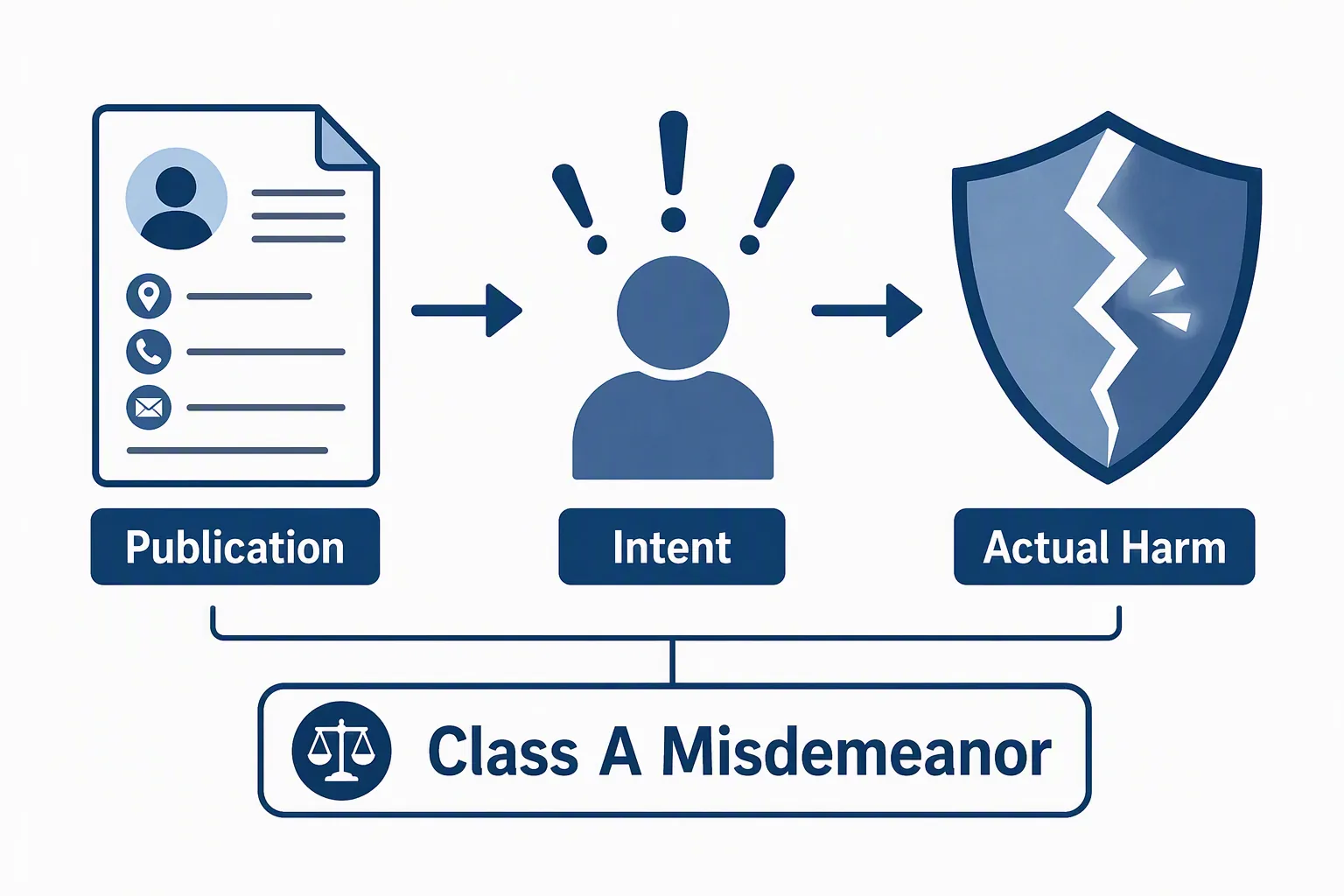
Those parts should stay separate in the analysis. First, the accused must intentionally publish, post, or otherwise make available personal identifying information. Second, the publication must be done with the required intent to harass or harm. Third, the publication must actually result in harassment or harm. If the record supports only the first part, the current Alabama doxing statute has not been satisfied merely because the conduct looks like doxing in ordinary speech.[1][4]
That distinction matters because the penalty question only begins after the statutory offense is complete. A first conviction carries Class A misdemeanor punishment; conduct that falls short of the statute may still create civil, employment, platform, professional-discipline, or other criminal issues, but it is not automatically a first doxing conviction under § 13A-11-38.
The Three Elements to Check Before Discussing Penalty
- Publication: Was personal identifying information intentionally made available?
- Intent: Was it done with the purpose required by the statute, rather than merely carelessly or incidentally?
- Result: Did the publication actually cause harassment or harm?
- Offense count: Is this a first conviction, or is there a prior conviction that would trigger the repeat-offense felony provision?
For risk managers and counsel, the third question is the one most likely to be flattened in informal summaries. Alabama’s current statute does not merely punish a completed upload, screenshot, post, or share. The actual-harm requirement makes the prosecution question more fact-bound: who saw the information, what happened next, whether harassment or harm followed, and how the state would connect that result to the publication.
Repeat Convictions Move the Case Into Felony Exposure
The first-offense answer should not be carried over to repeat cases. Under the current structure, a second or subsequent doxing conviction is treated as a Class C felony, with exposure of one to 10 years and a fine of up to $15,000.[1]
That escalation is not a small enhancement. It changes the case from misdemeanor exposure to felony exposure. The practical intake question is therefore not just “was this a first incident?” but “would this be a first conviction under the statute?” A messy factual history does not automatically make the current charge a subsequent conviction, but an actual prior conviction under the statute changes the sentencing range.
The 2026 Bill Did Not Change the Current Penalty
Readers looking up Alabama anti-doxing law penalties in 2026 may have seen coverage of HB106 and assumed the law changed. It did not. The House passed the bill unanimously, 105-0, on March 4, 2026, but House passage was not enactment.[5]
The bill then moved to the Senate side, where it was carried over in the Senate Judiciary Committee for redrafting on March 19, 2026. The regular session adjourned sine die on April 9, 2026, without enactment. As a result, the current Class A misdemeanor first-offense penalty remained in place.

HB106 mattered because it would have changed the point at which criminal liability attached. The proposal would have removed the current statute’s actual-harm requirement and created a graduated structure: publication-only conduct would have been a Class A misdemeanor, publication resulting in harm would have been a Class C felony for a first offense, and a later offense with harm would have been a Class B felony.[5]
That proposal is useful for risk planning, but not because it currently controls. It shows legislative appetite to tighten the statute around publication and to make harm a penalty escalator rather than an element needed to complete the offense. Until such a bill is enacted, the current statute still requires actual harassment or harm.
What the Reported Prosecutions Show—and What They Do Not
Publicly reported prosecutions under Alabama’s doxing statute are sparse. The available examples show that the law has been invoked, not that every ugly online publication will fit it.
In June 2024, John Robert Grubbs of Eufaula was reported as the first known arrest under § 13A-11-38, accused of doxing a law enforcement officer and released on bond.[6] The publicly available material identified the arrest and charge; it does not establish the final outcome of the case. That limitation matters. An arrest can show charging willingness, but it does not prove how the elements will hold up through plea negotiations, motion practice, trial, or dismissal.
A later Mobile County matter involving Catherine Elizabeth Rogers was reported in May 2025 as the county’s first doxing prosecution, but the available reporting indicates the case ended in conviction on a different charge.[7] That is a narrow data point, not a statewide pattern. Still, it is consistent with the practical problem created by the actual-harm element: prosecutors may be able to describe disturbing online conduct while still facing proof questions under the doxing statute itself.
These cases do not establish conviction frequency, common sentencing outcomes, or a settled appellate interpretation of the statute. They are useful mainly because they keep the analysis grounded: Alabama’s statute is not dormant on paper, but the path from publication to doxing conviction still runs through specific statutory elements.
Why Alabama Looks Narrow Compared With Many State Doxing Laws
A national comparison should not drive the Alabama penalty answer, but it helps explain why summaries can become misleading. A 2025 Council of State Governments report found that Alabama was one of only three states, along with California and Illinois, that explicitly used the term “doxing” in statute; one of eight states with criminal-only remedies and no civil cause of action; and one of seven states limiting protections to public-sector officials.[8]
That same comparison supports a limited point: Alabama’s current statute is unusually narrow in several respects. It should not be used to imply that Alabama has the broadest anti-doxing regime or that all doxing-like conduct carries the same criminal consequence. State-law comparisons also age quickly; the CSG report used a June 2025 data cutoff, and states may have changed their laws since then.[8]
For broader doxing-liability context outside Alabama’s criminal statute, see the site’s discussion of how the Epstein survivor doxing lawsuit tests privacy law. The Alabama first-offense question, however, remains a state criminal-code question.
The Practical Answer as of Q3 2026
As of July 29, 2026, the penalty for a first doxing conviction in Alabama remains a Class A misdemeanor: up to one year in jail and up to $6,000 in fines. A second or subsequent conviction is a Class C felony. The current statute still requires intentional publication, intent to harass or harm, and actual harassment or harm.
The failed HB106 vote changes the risk signal, not the law. A unanimous House vote is a serious marker that the actual-harm element is politically vulnerable. It is not a sentencing amendment, and it is not a basis to brief a first offense today as anything other than a Class A misdemeanor under the statute now in force.
References
- Alabama Code § 13A-11-38. Doxing. Justia.
- Alabama Code § 13A-5-7. Sentences of imprisonment for misdemeanors and violations. Justia.
- Alabama Code § 13A-5-12. Fines for misdemeanors and violations. Justia.
- HB287-enr.pdf. Alabama Legislature.
- House passes bill to increase doxing penalties, change definition. Alabama Daily News.
- Eufaula man arrested for doxing law enforcement officer. Wiregrass Daily News.
- Mobile County first doxing prosecution ended in conviction on different charge. FOX10 News.
- Doxing: State Protections Against Digital Threats. Council of State Governments, October 31, 2025.
Related records
Tool profile
Browse tool evaluations →Governing regulation
Browse the obligations tracker →Preventive workflow
Browse verification workflows →
Report a correction or tip
Spotted an outdated figure, a misstated fact, or a ruling this case record should reflect? Public comments are disabled for this content given the professional cost of a misreported case outcome, penalty amount, or rule text — use the structured correction channel instead.
Report a correction or tip for this record →