
Alabama Solicitation Charges Carry More Than Just Jail Time
This article breaks down the specific criminal penalties and collateral consequences under Alabama Code § 13A-12-121 for a solicitation charge, using the July 2026 arrest of Yea Alabama's content director to illustrate the real-world impact on licensing, employment, and background checks.
- Jurisdiction
- US-Alabama
- Court
- Shelby County District Court
- AI tool named
- None
- Ruling date
- Jul 23, 2026
- Source document
- View primary court order ↗
- Last verified
- Jul 26, 2026
Lex Machina Review is an independent risk-tracking and reference resource. Nothing on this site is legal advice, and using it does not create an attorney-client relationship. Every record is reviewed against primary sources but may not reflect the most current status of a matter — always verify directly against the cited court order, rule text, or a licensed attorney before relying on it.
Companion explanation — secondary to the source document above
The practical consequences of the Alabama NIL director arrest began showing up before any adjudication. Aaron Suttles, identified in reports as Yea Alabama's content director, was arrested on July 23, 2026, in Shelby County and charged with "prostitution: commercialized sex." Reports said he was one of 15 people arrested in the operation and was released on a $1,000 bond.[1][2]
Within roughly a day, Yea Alabama had suspended him, removed his staff biography and byline, and issued a statement saying the alleged conduct was "personal and unconnected to any Yea Alabama business."[2][3] That is the first practical lesson in the file: the arrest itself created an employment and reputational event before a court decided guilt, before any sentence existed, and before the public record could answer the questions that lawyers and risk managers actually need answered.
As of July 26, 2026, no plea, trial date, or resolution has been reported. Suttles has not been convicted. The point is not to treat an allegation as proof; it is to separate the stages that too often get flattened together when someone calls a solicitation case "just a misdemeanor."
The Charge Is Low-Level Only in a Narrow Statutory Sense
The reported charge tracks Alabama's prostitution and solicitation framework under Alabama Code § 13A-12-121, with penalty classification addressed in § 13A-12-122. The available statutory page identifies § 13A-12-121 as the prohibited-activities provision, while secondary legal-education sources describe the solicitation offense and related penalty consequences.[4] That caveat matters: the primary statutory text was not fully accessible in the research record, so any element-level description should be checked against the current Alabama Code before it is used in a pleading, advice memo, or charging analysis.
For risk purposes, the classification is still enough to reject the soft version of the misdemeanor label. A first conviction for solicitation of prostitution is treated as a Class A misdemeanor, carrying up to 365 days of incarceration and a fine of up to $6,000. Alabama practice sources also identify a mandatory $500 victim-compensation fund fine on a first conviction, with a 50% increase for each subsequent conviction.[5]
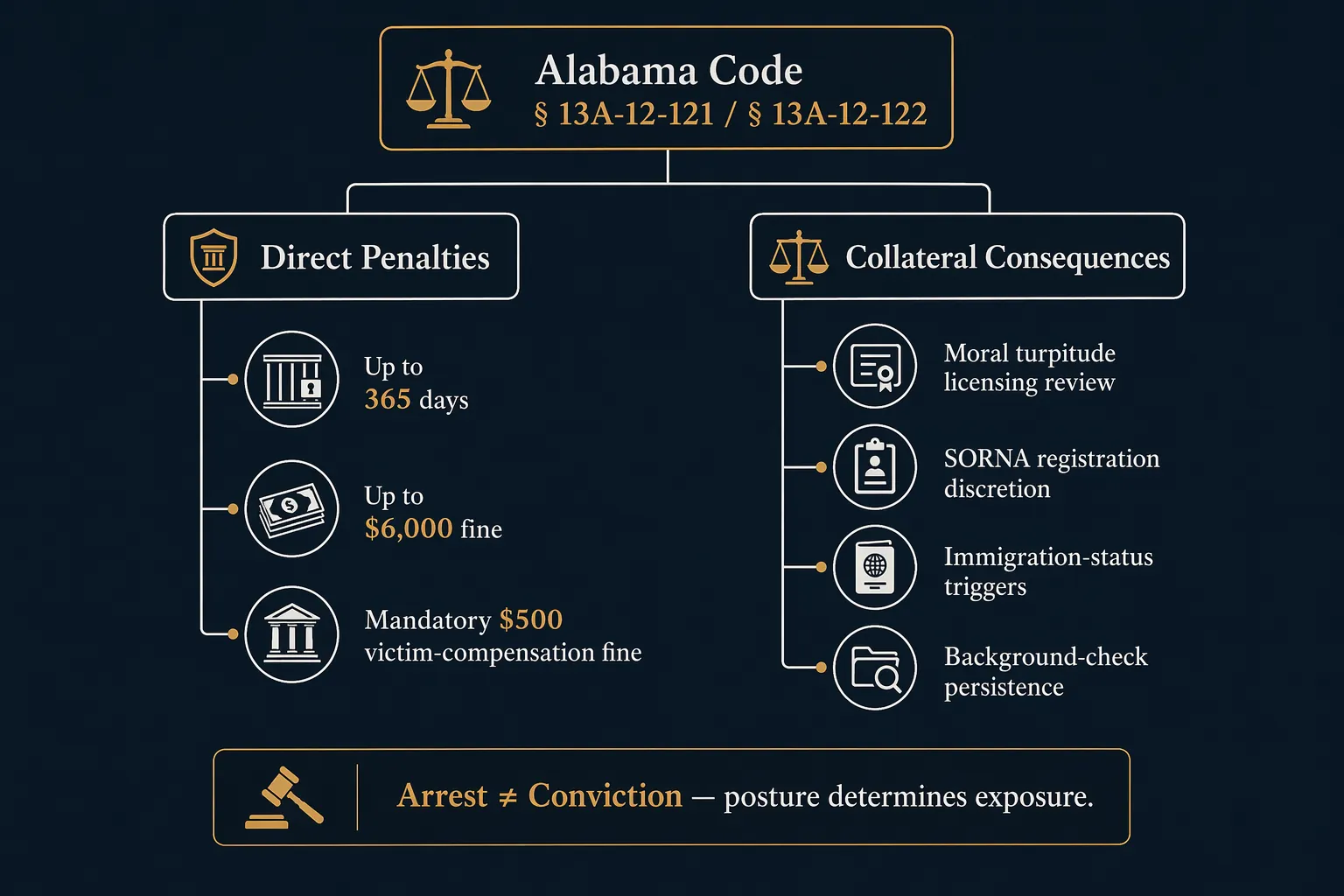
Those numbers are maximums and conviction-based consequences, not predictions. A statutory ceiling is not a sentencing forecast. A mandatory fine on conviction is not a pretrial condition. A charge is not a finding. The analysis has to keep those lines intact, especially in a public employment matter where the noncriminal consequences can arrive first.
| Procedural posture | What it can trigger | What it does not prove |
|---|---|---|
| Arrest | Booking record, bond, employer notice, media reporting, background-check entries | Guilt or statutory sentencing exposure actually imposed |
| Pending charge | Pretrial conditions, diversion screening, employment suspension, licensing disclosure questions | Conviction-based fines, jail sentence, or final moral-turpitude finding |
| Conviction | Class A misdemeanor penalties, mandatory victim-fund fine, collateral licensing and immigration review | That every discretionary collateral consequence will be imposed |
| Dismissal or completed diversion | Possible route to reduce criminal exposure, depending on eligibility and court practice | Automatic disappearance from every database or private background-check product |
The Direct Penalty Stack
The direct criminal stack is the easiest part to state and the easiest part to misuse. For a first conviction, the reported Alabama solicitation framework exposes a defendant to up to 365 days in jail, up to a $6,000 fine, and the mandatory $500 victim-compensation assessment.[5] A later conviction increases the victim-compensation fine by 50% per subsequent conviction.[5]
Defense counsel will normally translate that into several different conversations, not one. There is the bond and release conversation. There is the pretrial posture conversation. There is the plea-risk conversation. There is the sentencing conversation if the case ends in conviction. And, in a case attached to a public-facing sports organization, there is the separate conversation with the client who is already suspended while the criminal case is still pending.
The Suttles matter, as publicly reported, sits at the arrest-and-charge stage. The $1,000 bond reported in the news is not a fine and does not answer the sentencing question.[1][2] The reported suspension is not a criminal sanction. The absence of a reported plea or trial date as of July 26, 2026, means there is no public basis to describe a likely sentence, a negotiated outcome, or a judicial finding.
Diversion May Matter More Than the Fine
Alabama defense-practice sources identify pretrial diversion as available for some first-time prostitution defendants, but eligibility depends on facts that are not public here, including prior record and local program criteria.[6] That makes diversion a question, not an assumption.
For a professional client, diversion is not valuable only because it may reduce jail or fine exposure. It may affect what must be disclosed to an employer, insurer, licensing board, credentialing body, immigration lawyer, or future background-check reviewer. The exact effect depends on the program terms, the final disposition, and whether a separate petition is needed to limit record visibility.
That is why the early advice cannot stop at "try to avoid conviction." Counsel also has to ask what databases will show the arrest, how the charge is coded, whether the employer has already preserved screenshots or media reports, what future application questions actually ask, and whether a dismissal or diversion completion is enough for the client's real-world purpose.
Collateral Consequences Are Not All the Same Kind of Risk
The useful risk map separates automatic consequences from discretionary review and from merely plausible private-sector fallout. Putting them in one bucket makes the analysis sound harsher than the law in some places and too reassuring in others.
- Automatic on conviction: the reported mandatory $500 victim-compensation fund fine for a first conviction, with the reported 50% increase for subsequent convictions.[5]
- Statutory maximums: up to 365 days in jail and up to a $6,000 fine for a first Class A misdemeanor conviction.[5]
- Discretionary or review-based: licensing consequences, moral-turpitude analysis, and sex-offender-registration decisions in simple solicitation cases.[6][7]
- Plausible private-sector consequences: suspension, termination, loss of duties, media scrutiny, sponsor concern, and future background-check friction, depending on contract terms and employer policy.
Licensing is a particular problem because it does not wait for the criminal court to write a neat narrative. Alabama defense-practice materials state that licensing boards may treat solicitation convictions as crimes involving moral turpitude, triggering review or denial issues for teaching certificates, coaching certifications, nursing licenses, and legal-profession admission.[6] That is not the same as saying every board must impose the same discipline. It means the conviction can become the predicate for a separate proceeding, with its own standards and deadlines.
Sex-offender registration has to be stated with the same care. CriminalDefenseLawyer.com describes registration for simple solicitation as discretionary, depending on the judge's decision, while promotion-related charges can carry mandatory registration consequences.[7] In other words, simple solicitation should not be described as automatically requiring registration, but it also should not be dismissed as registration-proof.
Immigration analysis is similarly posture-sensitive. Defense-practice materials flag prostitution-related offenses as immigration-sensitive, which means a noncitizen defendant needs immigration counsel before plea language is treated as a housekeeping detail.[6] The risk is not reducible to the misdemeanor label; immigration consequences often turn on statutory phrasing, admissions, prior history, and federal classification.
The Record Problem Outlasts the Docket Entry
Background checks are where a technically favorable outcome can still disappoint the client. Alabama defense-practice materials warn that the state lacks a broad misdemeanor-expungement statute and that dismissed charges or diversion completions may still appear in NCIC and private background checks unless a formal petition succeeds through limited available pathways.[6]
That does not mean every employer will see the same thing or that every database will update at the same speed. It means the defense plan should include record-cleanup questions early, not after the client has accepted a disposition and then asks why a private screening vendor still reports the arrest.
The public nature of the Suttles arrest adds another layer that no expungement pathway can fully control: media records and employer statements. Yea Alabama's reported suspension and removal of staff materials are separate from the criminal docket.[2][3] Even if a criminal case later ends favorably, search results, archived stories, and institutional records can continue to create explanation duties.
Employment Action Does Not Need a Conviction
There is not enough public information to say what Suttles's contract allowed Yea Alabama to do, whether he was at-will, what internal policy applied, or what process was required before further discipline. Yea Alabama's governance documents and its contractual relationship with the University of Alabama are not public in the research record. Those gaps matter.
Still, the reported sequence is a clean example of how employment risk operates on a different clock. An employer in a reputation-sensitive sports environment may respond to an arrest because it affects public trust, sponsor comfort, student-athlete association, media requests, and workplace judgment. That response may be framed as administrative leave or suspension rather than punishment. It can occur while the criminal defense lawyer is still trying to obtain reports, confirm the charge language, and evaluate diversion.
For in-house counsel, the immediate work is less dramatic than the headlines. Preserve the statement. Avoid declaring guilt. Identify who must know. Check policy language. Separate conduct allegedly outside business operations from duties tied to the organization. Decide whether removal of public-facing materials is temporary housekeeping, reputational containment, or evidence of an employment decision. None of those steps requires pretending the charge has already been proved.
What the Suttles Matter Can and Cannot Show
The public reports establish a narrow set of facts: a July 23, 2026 arrest in Shelby County, a reported charge of "prostitution: commercialized sex," a $1,000 bond, 15 total arrests in the operation, and Yea Alabama's suspension and public distancing statement.[1][2][3] They do not establish guilt, contract breach, future licensing discipline, immigration consequences, sex-offender registration, or a likely sentence.
The legal materials establish another narrow set of facts: Alabama solicitation exposure includes Class A misdemeanor penalties, conviction-based fines, possible diversion questions, moral-turpitude review risk, discretionary registration issues for simple solicitation, immigration sensitivity, and record-persistence problems.[5][6][7] They do not establish that every consequence will apply to Suttles.
Suttles has not been convicted, and the case remains unresolved as of July 26, 2026. But the arrest shows why the defense and risk-management analysis cannot stop at the misdemeanor label or the nominal jail range. In a public employment setting, the first wave may be suspension, removal from public pages, and institutional distancing. After conviction, the analysis may turn to jail and fine exposure, mandatory assessments, licensing review, registration discretion, immigration consequences, and databases that do not always forget when the docket moves on.
References
- University Alabama NIL content director arrested in human trafficking operation, WBRC, July 24, 2026
- Yea Alabama content director arrest Suttles Shelby County, WVTM13
- Yea Alabama director arrested in prostitution sting, Tuscaloosa News, July 24, 2026
- Alabama Code Title 13A. Criminal Code § 13A-12-121, FindLaw
- Promoting Prostitution and Solicitation of Prostitution Laws in Alabama, Polson Firm
- Prostitution, Elizabeth Hunter & Associates
- Alabama Prostitution and Solicitation Laws, CriminalDefenseLawyer.com
Related records
Tool profile
Browse tool evaluations →Governing regulation
Browse the obligations tracker →Preventive workflow
Browse verification workflows →
Report a correction or tip
Spotted an outdated figure, a misstated fact, or a ruling this case record should reflect? Public comments are disabled for this content given the professional cost of a misreported case outcome, penalty amount, or rule text — use the structured correction channel instead.
Report a correction or tip for this record →