
Why Infowars Bankruptcy Hasn't Paid Families a Cent
This procedural update explains why the Sandy Hook families have collected nothing from over $1.4 billion in defamation judgments against Alex Jones, and details the current status of the federal bankruptcy and Texas state-court tracks as of Q3 2026.
- Jurisdiction
- US-Federal
- Court
- U.S. Bankruptcy Court for the Northern District of Texas
- Judge
- Christopher Lopez
- AI tool named
- None
- Ruling date
- Oct 1, 2025
- Source document
- View primary court order ↗
- Last verified
- Jul 30, 2026
Lex Machina Review is an independent risk-tracking and reference resource. Nothing on this site is legal advice, and using it does not create an attorney-client relationship. Every record is reviewed against primary sources but may not reflect the most current status of a matter — always verify directly against the cited court order, rule text, or a licensed attorney before relying on it.
Companion explanation — secondary to the source document above
The current answer in the Infowars bankruptcy and The Onion bid fight is legally simple and practically maddening: the Sandy Hook families hold judgments totaling roughly more than $1.4 billion, but they have not received a distribution from those judgments. The Connecticut judgment is roughly $1.28 billion to $1.3 billion, the Texas judgment is roughly $50 million, and the U.S. Supreme Court rejected Jones’ appeal from the Connecticut judgment in October 2025.[1] That still did not put a dollar in the families’ hands.
This is outside Lex Machina Review’s usual AI-risk lane. It belongs in a risk digest because it is a clean procedural-risk case study: liability can be final enough for public purposes while collection remains split across bankruptcy jurisdiction, state receivership power, appellate stays, and unresolved rights questions. The headline number is not the operative fact. The operative fact is who can sell which asset, under which order, while which appeal is pending.
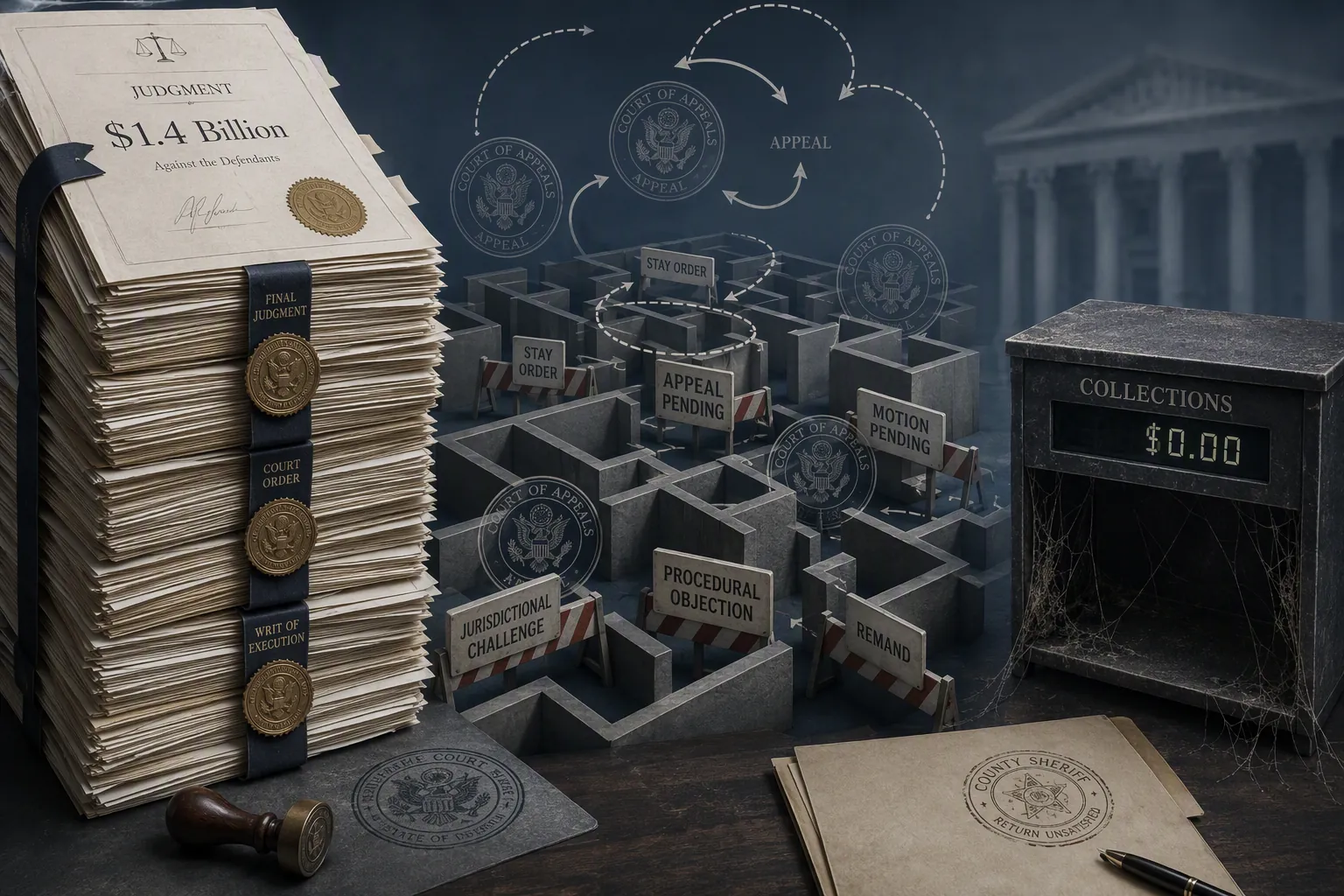
The status frame: final judgments, no collection channel
The families’ enforcement problem is not that they failed to prove liability. They did. The problem is that the assets most people associate with Infowars have moved through different procedural containers, and each container has imposed its own limits.
| Track | What mattered | Q3 2026 collection consequence |
|---|---|---|
| Federal bankruptcy | Jones’ personal bankruptcy and Free Speech Systems’ Chapter 11 created the first sale process, including The Onion’s later attempted auction purchase. | The federal court rejected the auction result and later limited what could be sold to Jones’ ownership stake once Free Speech Systems was no longer in that bankruptcy forum.[2] |
| Texas state receivership | The families turned to state court, where a receiver was appointed over Free Speech Systems assets. | A receiver’s licensing deal with The Onion was paused by the Texas 3rd Court of Appeals, and the families’ Texas Supreme Court petition remained pending as of late July 2026.[3][4] |
| Brand and domain rights | The public shorthand of “buying Infowars” collapses ownership, licensing, domain control, and trademark exposure into one phrase. | The Onion’s parody site could launch under theonion.info, but that is not the same as a completed transfer or live license of infowars.com.[6][7] |
That table is the case in miniature. The judgments are large. The enforcement path is fragmented. The families’ leverage has increased at points, but each increase has been followed by a jurisdictional or appellate bottleneck.
Only enough background to understand the collection fight
The defamation judgments arose from Jones’ false claims about the Sandy Hook shooting. The Connecticut proceedings produced the much larger award, and the Texas proceedings produced a separate judgment of about $50 million.[1] Those numbers are frequently rounded together as “more than $1.4 billion,” but the rounded total should not be mistaken for a liquid fund available for execution.
The bankruptcy timeline matters because it explains why the first major public sale headline did not deliver collection. Free Speech Systems, the Infowars parent company, filed Chapter 11 in April 2022, and Jones filed personal bankruptcy later in 2022.[2] Those filings pulled asset control, creditor priority, sale mechanics, and court approval into federal bankruptcy procedure.
Once that happened, a creditor’s ordinary instinct—find the assets, seize the assets, sell the assets—had to be filtered through estate boundaries and bankruptcy-court authority. The later dispute over The Onion’s bid was not a sideshow. It exposed the difference between a sale process that attracts attention and a sale order that can survive review.
Why The Onion’s 2024 auction win did not produce a sale
The Onion’s bid for Infowars-related assets was publicly treated in some quarters as if it had ended the matter. It had not. In December 2024, U.S. Bankruptcy Judge Christopher Lopez rejected The Onion’s winning auction bid, which included $1.75 million in cash plus $750,000 in forbearance by the Sandy Hook families.[2]
The important part of that ruling was not that a satirical publisher failed to acquire a conspiracy-media brand. The important part was procedural: Judge Lopez found flaws in auction transparency. A bankruptcy sale depends on process integrity because the court is not merely picking a preferred buyer; it is approving a transaction on behalf of an estate and its creditors. If the auction method is defective, the “winning” bid can stop being winning before anything changes hands.
Then came the narrower ruling that mattered even more for collection. In February 2025, Judge Lopez ruled that the federal bankruptcy process could sell only Jones’ ownership stake in Free Speech Systems because Free Speech Systems itself had exited that bankruptcy forum.[2] That distinction is dry, but it is decisive. Selling an owner’s stake in an entity is not the same thing as selling all operating assets, domain rights, intellectual-property rights, accounts, inventory, and brand control of the entity itself.
That is why shorthand such as “The Onion bought Infowars” or “Infowars was transferred” misstates the status. The bankruptcy court had power over some interests, not every asset associated with the business. Once the court drew that boundary, the families needed another route for Free Speech Systems assets.
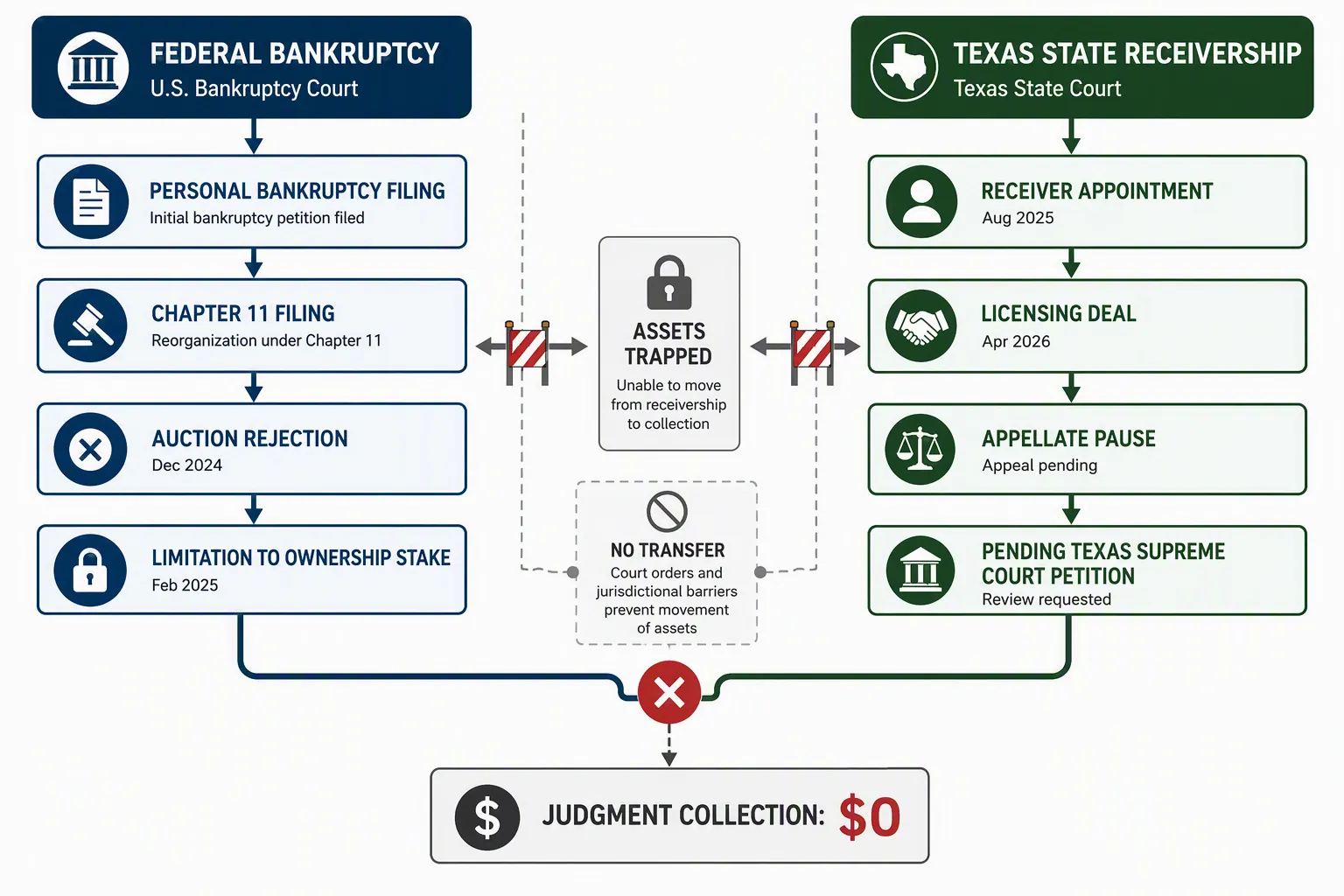
The Texas receivership route, and the appellate pause that stopped it
The next meaningful enforcement move was in Texas state court. In August 2025, Judge Maya Guerra Gamble appointed Gregory Milligan as receiver over Free Speech Systems assets.[3] That appointment moved the families’ collection effort into a forum that could address the company’s assets more directly than the post-limitation federal bankruptcy track.
A receiver can change practical leverage because the debtor is no longer the only actor controlling the asset’s commercial use. Here, the receiver’s most visible step was an April 2026 licensing agreement with The Onion. The reported terms were $81,000 per month for six months, renewable, for use of infowars.com.[4] If it had gone forward, the deal would have created a revenue-producing bridge while ownership and sale questions continued to be fought.
It did not go forward. The Texas 3rd Court of Appeals immediately paused the licensing arrangement, and the families then sought relief from the Texas Supreme Court.[4] As of late July 2026, the Texas Supreme Court had not issued a final ruling. That is the collection answer in its most concrete form: the receiver had a proposed monetization step, the intermediate appellate court stopped it, and the high court had not yet cleared or rejected the path.
The pause matters more than the monthly dollar figure. A stayed licensing deal cannot function as a collection channel. It also cannot settle who controls the domain for future operations. So even when the families moved out of the narrowed federal bankruptcy lane and into a state receivership lane, the next step became appellate review rather than payment.
Asset pressure is real, but allegations are not distributions
The enforcement atmosphere has not been passive. Bankruptcy trustee Christopher Murray accused Jones of hiding more than $5 million after the bankruptcy filings.[5] That allegation is relevant because it shows why the creditors and estate representatives have treated asset control as a live enforcement issue rather than a bookkeeping exercise.
But the accusation should not be inflated into a completed recovery. An allegation of hidden assets can support investigation, motion practice, sanctions requests, turnover fights, or settlement leverage. It does not itself pay the judgment creditors. Collection law rewards proof and enforceable orders, not suspicion alone.
Why The Onion’s 2026 parody site is not a completed Infowars transfer
The Onion later did something it could do without waiting for a completed transfer of infowars.com: it launched a parody version on July 2, 2026, under theonion.info.[6] It also donated $100,000 from merchandise sales.[6][7]
Those facts are concrete, and the donation is not nothing. But it is not a judgment distribution from Jones’ assets. It is a voluntary payment connected to The Onion’s own activity while the receiver’s licensing deal remains paused. Treating it as collection would blur exactly the line this litigation keeps enforcing: a public-facing gesture can coexist with unresolved control over the asset everyone is watching.
The domain distinction is also not cosmetic. The Onion launched at theonion.info, not infowars.com.[6][7] That matters because the receiver’s attempted license concerned infowars.com, and that arrangement was the one paused on appeal.[4] A parody site on a separate domain can be live while the legally contested domain remains out of operational reach.
Trademark exposure keeps the brand question from being just a domain question
There is another reason to be precise about what has and has not transferred. Infowars-related branding raises unresolved trademark exposure if content operates under the brand without a completed transfer or valid license of the relevant rights.[8] Domain control, trademark control, ownership interests, and receivership authority may overlap in business terms, but they are not interchangeable legal rights.
That is why the case resists a clean media-business headline. A buyer can want the brand. A receiver can try to license the domain. A bankruptcy trustee can administer an estate. Judgment creditors can press for monetization. An appellate court can stop the next move before money flows. None of those events alone completes the asset transfer.
Late-July 2026 status
- The Connecticut and Texas judgments together are commonly rounded to more than $1.4 billion, with the Connecticut judgment left standing after the U.S. Supreme Court rejected Jones’ appeal in October 2025.[1]
- The federal bankruptcy sale path did not deliver a transfer of Infowars assets to The Onion because the December 2024 auction result was rejected and the February 2025 ruling limited what the bankruptcy process could sell to Jones’ ownership stake.[2]
- The Texas receivership path produced a receiver and an attempted license, but the Texas 3rd Court of Appeals paused that license, and the Texas Supreme Court petition remained pending as of late July 2026.[3][4]
- The Onion’s July 2026 parody relaunch occurred under theonion.info, not infowars.com, and its $100,000 merchandise-sales donation was not a judgment recovery from Jones’ assets.[6][7]
- No completed transfer of Infowars rights had occurred, and unresolved trademark issues remained legally sensitive.[8]
The families’ position is not hard to understand: they proved liability, obtained enormous judgments, and have watched the enforceable value of those judgments move into a multi-forum maze. The debtor-side lesson is equally plain, though less comfortable: bankruptcy boundaries, entity separateness, appellate pauses, and rights fragmentation can keep final liability from becoming collectible money for years. As of Q3 2026, the first collectable dollar from the judgments still had not arrived.
References
- Supreme Court rejects Alex Jones' appeal — PBS NewsHour, Oct. 2025
- NPR Feb. 2025 report on Judge Lopez's Infowars bankruptcy sale rulings — NPR, Feb. 2025
- NPR Aug. 2025 report on the appointment of receiver Gregory Milligan over Free Speech Systems assets — NPR, Aug. 2025
- NPR Apr. 2026 report on The Onion's licensing deal with the Free Speech Systems receiver — NPR, Apr. 2026
- Bloomberg Law bankruptcy article on trustee Christopher Murray's accusation that Jones hid more than $5 million post-bankruptcy — Bloomberg Law
- PBS Jul. 2026 report on The Onion's unilateral parody relaunch under theonion.info — PBS NewsHour, Jul. 2026
- KUT Jul. 2026 report on The Onion's parody relaunch and merchandise-sales donation — KUT, Jul. 2026
- Bloomberg Law IP analysis on unresolved trademark exposure tied to Infowars-branded content — Bloomberg Law
Related records
Tool profile
Browse tool evaluations →Governing regulation
Browse the obligations tracker →Preventive workflow
Browse verification workflows →
Report a correction or tip
Spotted an outdated figure, a misstated fact, or a ruling this case record should reflect? Public comments are disabled for this content given the professional cost of a misreported case outcome, penalty amount, or rule text — use the structured correction channel instead.
Report a correction or tip for this record →