
How Alexander Blockx's Tarp Accident Could Lead to a Lawsuit
A structured case record analyzing Alexander Blockx's tarp-accident injury at Roland Garros and the viability of a negligence claim against the FFT, based on the Bouchard v. USTA precedent and documented prior notice of the identical hazard. Offers a liability framework for litigators evaluating event-organizer premises risk.
- Jurisdiction
- France
- Court
- French civil court
- AI tool named
- None
- Ruling date
- May 26, 2026
- Source document
- View primary court order ↗
- Last verified
- Jul 25, 2026
Lex Machina Review is an independent risk-tracking and reference resource. Nothing on this site is legal advice, and using it does not create an attorney-client relationship. Every record is reviewed against primary sources but may not reflect the most current status of a matter — always verify directly against the cited court order, rule text, or a licensed attorney before relying on it.
Companion explanation — secondary to the source document above
Procedural Posture: Potential Claim, Not Filed Lawsuit
The Alexander Blockx tarp accident is, for now, a risk-digest issue rather than a filed compensation lawsuit. As of July 25, 2026, no public complaint has been confirmed. The available record is that Blockx’s camp was considering compensation and investigating after he injured his ankle at Roland Garros, not that litigation has already begun.
The incident itself is concrete enough to analyze. Blockx, then 21 years old and ranked world No. 37, stepped on folded tarpaulin rain covers at the Jean-Bouin practice court on May 26, 2026. The injury was reported as a sprained ankle, with an audible “snap,” and it forced him to withdraw from a second-round French Open match against world No. 8 Alex de Minaur.[1]
That posture matters. A U.S.-audience negligence analysis can identify the likely pressure points: notice, foreseeability, premises control, available remedial measures, causation, damages, and comparative fault. But a claim arising from a Roland Garros practice court would be litigated under French law if brought in France. The American case most likely to be cited by U.S. lawyers, Bouchard v. USTA, is useful as an organizer-liability analogy, not as governing law for the Fédération Française de Tennis.
The Hazard Was Not Just a Bad Step
The legally important fact is not that a tennis player rolled an ankle. Elite athletes roll ankles. They lunge, slide, decelerate, and misjudge surfaces. The more serious fact pattern is narrower: a player stepped onto a folded tarp placed within the working court environment at Roland Garros, and that type of tarp had already injured another player at the same tournament.
David Goffin’s 2017 French Open injury is the first link in that notice chain. Goffin injured his ankle after slipping on a tarp at Roland Garros and had to retire from his match.[2] The available materials also report the Goffin incident through later secondary coverage, so anyone pleading the Blockx case would want the match video, tournament incident records, medical documentation, and contemporaneous court-layout materials before treating every detail as locked down. But the core similarity is not subtle: tarp, ankle, Roland Garros.
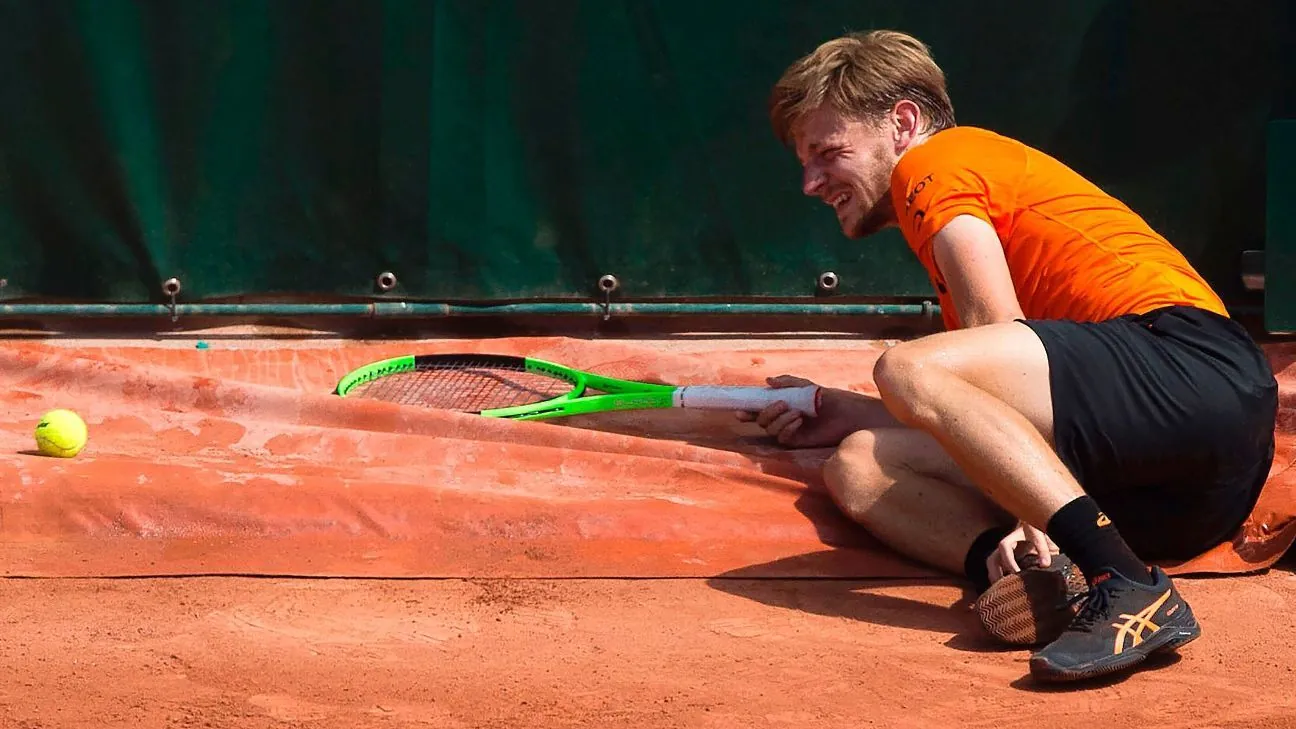
The second link is the complaint record. PTPA Executive Director Romain Rosenberg told The Athletic that players had complained about Jean-Bouin court safety “for a while.”[1] That statement does not prove negligence by itself. It does, however, move the analysis away from pure hindsight. If players had been raising safety concerns about that practice-court environment before Blockx stepped onto the tarp, the organizer’s knowledge becomes a fact issue rather than a post-accident accusation.
In premises cases, prior actual notice is often the difference between an unfortunate accident and a serious liability file. A defendant can usually say it did not predict a freak sequence. It is harder to say that when the same object, in the same tournament setting, has already produced the same kind of bodily consequence, and when player representatives say complaints had been made before the later injury.
Why the Notice Chain Carries the Claim
A viable Blockx theory would likely start with control. The FFT and Roland Garros controlled the Jean-Bouin practice-court environment: where tarps were stored, how much run-off space players had, what objects sat near the playable area, and whether a known edge condition would remain exposed during practice. A professional player does not get to redesign the court perimeter before training.
Foreseeability would then turn on the prior record. Goffin’s 2017 injury supplies a concrete prior event. The PTPA complaint history supplies a broader warning channel. Together, those facts support the argument that a tarp near the playing area was not merely a passive background object; it was a known trip-or-slip hazard in a zone where players predictably chase balls, decelerate, and step without looking down.
The remedial-options question is equally practical. The issue is not whether Roland Garros could eliminate rain or avoid tarps altogether. It is whether folded tarpaulins had to remain in a position where a player could step onto them during practice, after a materially similar incident and after reported complaints. A court does not need an engineering manifesto to ask whether the tarp could have been moved, flattened, covered, isolated, or kept outside the player run-off path.
| Claim Element | Record Point That Matters |
|---|---|
| Duty / control | Tournament operator controlled the practice-court layout, including tarp placement. |
| Notice | Goffin’s 2017 tarp-related ankle injury and reported PTPA complaints create a prior-warning record. |
| Foreseeability | Players predictably move beyond the baseline and court edges during practice and match preparation. |
| Breach | The contested question is whether leaving the folded tarp in that position was unreasonable after prior warnings. |
| Causation | Blockx would need medical and factual proof tying the sprained ankle and withdrawal to stepping on the tarp. |
| Damages | The record includes withdrawal from a second-round match, prize-money and ranking-point consequences, and possible career-earnings arguments. |
That is the strongest version of the Blockx claim. It does not require proving that every Roland Garros court was unsafe. It does not require turning every cramped corner of a Grand Slam venue into a legal defect. It requires proving that this recurring tarp hazard was known and left in a player-accessible position long enough to injure another athlete.
Bouchard Is a Useful Analogy, Not French Law
Bouchard v. USTA is the obvious comparison because it is also a Grand Slam premises case involving a player injured by a condition controlled by the event operator. Eugenie Bouchard sued after a fall on a locker-room floor at the 2015 US Open. In 2018, a jury found the USTA 75% liable and Bouchard 25% responsible; the parties later reached a settlement, and the settlement amount was confidential.[3]
The percentage split is more important than any attempt to guess the settlement value. It shows how comparative fault can operate in a sports-premises case. The player’s own conduct may matter. Awareness, movement, footwear, haste, and familiarity with the setting may all become defense themes. But those themes do not automatically defeat liability where the organizer controlled the hazard and the factfinder concludes the condition should not have been present.
That is the lesson for Blockx. FFT would almost certainly argue that a professional player understands the movement demands and physical risks of tennis. It may also argue that Blockx could see the surroundings, that tarps are ordinary at clay-court tournaments, and that players bear some responsibility for where they step. Under a Bouchard-style analysis, those arguments go to allocation as much as they go to liability. They may reduce exposure without ending the case.
The jurisdictional caveat remains substantial. Bouchard was a U.S. common-law negligence case against the USTA. Blockx’s potential claim would arise from a French tournament site and would have to be pleaded under the applicable French liability framework. Still, for risk managers and U.S. litigators, Bouchard is a clean warning: Grand Slam status does not convert organizer-controlled premises hazards into accepted athletic risk.
The Broader 2026 Layout Complaints Help, but They Are Not the Main Case
The 2026 French Open produced other layout complaints that would likely appear in a demand letter, though they should not carry the tarp claim. Zeynep Sonmez required two stitches after colliding with advertising boards. Katie Boulter said she narrowly avoided injury from the same boards. Iga Swiatek publicly called for layout changes, and Marta Kostyuk said she avoids chasing certain balls because of injury concerns.[4][5]
Those facts are useful for atmosphere only if handled carefully. Advertising boards are not folded tarps. A match-court collision is not automatically the same hazard as a practice-court ankle injury. What the concurrent complaints may show is broader player concern about constrained run-off zones and object placement during the same tournament week. They do not replace the much cleaner notice evidence created by Goffin and the PTPA complaints.
The FFT response also has limited value for both sides. Roland Garros reportedly repositioned advertising boards onto the tarpaulins and said “adjustments” were underway.[6] That may show responsiveness to visible safety controversy. It does not necessarily show that the practice-court tarp placement that injured Blockx was corrected. A post-incident adjustment aimed at one object can leave the legally relevant hazard untouched.
The ITF Minimum Is a Defense Point, Not the End of the Analysis
FFT’s cleanest defense begins with compliance. The ITF minimum distance from baseline to backstop is 6.4 meters, or 21 feet, and Roland Garros has stated that all of its courts exceed that distance.[7][8] If the defense can show the Jean-Bouin practice court complied with applicable specifications, that evidence matters.
Compliance narrows the question. It lets the organizer say this was not an undersized court in violation of a baseline rule. It supports an argument that the facility met sport-governance requirements and that professional players were operating within an accepted tournament environment. In a close case, that kind of record can affect breach, reasonableness, and comparative fault.
But minimum-distance compliance does not answer the specific tarp question. A court can exceed a dimensional minimum and still contain a negligently placed object. The relevant inquiry is not only how far the backstop sat from the baseline. It is what occupied the player’s movement path, what the organizer knew about that object, and whether the known condition was left where another ankle injury was foreseeable.
Renovation history would function the same way. The cited commentary notes Roland Garros renovations in 2018 and 2019.[8] Renovation may help show investment in the venue and attention to facilities. It may also invite a sharper question: if the site was renovated after Goffin’s 2017 tarp injury, why was a similar tarp hazard still available to injure Blockx in 2026?
Damages Would Need More Than the Withdrawal
The immediate damages record is straightforward but incomplete. Blockx withdrew from a second-round match against de Minaur, with associated prize-money and ranking-point consequences, and commentators have identified potential lost career earnings given his age and top-40 status.[1][8] Those are categories, not proven amounts.
A serious claim would need medical proof of the ankle injury, recovery timeline, treatment costs, training interruption, tournament withdrawals, ranking effects, and any sponsor or appearance consequences. The more speculative the future-earnings theory becomes, the more the case would depend on expert evidence rather than the obvious unfairness of losing a French Open opportunity.
Causation also cannot be skipped. The record supports that Blockx stepped on the folded tarp and then suffered the ankle injury that forced his withdrawal.[1] In litigation, that would still need to be tied down through video, witnesses, tournament reports, medical records, and expert testimony if the claimed damages extend beyond the immediate sprain and missed match.
Likely Defense Themes
The FFT would not be defenseless. Its strongest arguments would likely be practical rather than sentimental: the courts exceeded ITF minimum space requirements, tarps are ordinary equipment at clay-court events, players are highly trained professionals familiar with court perimeters, and the injury resulted from an individual movement decision rather than a hidden defect.
- Regulatory compliance: the court layout met or exceeded applicable dimensional requirements.
- Open and obvious condition: the tarp was visible, not concealed.
- Assumption of risk: professional players understand movement hazards around competitive courts.
- Comparative fault: Blockx’s own step, speed, angle, or awareness contributed to the injury.
- Causation and damages limits: the proven injury may be narrower than any broader career-loss theory.
Those defenses are real. They are also not complete if prior actual notice is proven. An organizer that knows players have complained about a specific practice-court safety condition, and that has a prior same-tournament tarp injury in its institutional memory, faces a different case from an organizer confronted with a genuinely novel accident.
Viability, Not Certainty
A Blockx compensation claim would have a credible negligence framework because the best fact is not emotional. It is notice. Goffin’s 2017 tarp-related ankle injury, the PTPA’s reported complaints about Jean-Bouin safety, and Blockx’s later tarp-related ankle injury create a sequence that a premises lawyer would recognize immediately.
Bouchard reinforces the exposure point without deciding the French case. A Grand Slam operator can be treated as primarily responsible for an unsafe premises condition even when the athlete shares some fault. The 75%/25% jury allocation in Bouchard is useful for that principle; the confidential settlement amount is not a damages benchmark.[3]
The claim would still depend on French-law pleading, admissible proof of prior notice, causation, medical damages, economic loss, and how the court treats player awareness or assumption of risk. The current record supports viability. It does not support certainty.
References
- Alexander Blockx French Open tarpaulin accident withdrawal, The Athletic, May 27, 2026
- David Goffin exits match after slipping on tarp, injuring ankle at French Open, ESPN
- Bouchard reaches settlement in lawsuit against USTA, Reuters
- French Open court layouts are causing injuries to players, says Iga Swiatek, The Guardian, May 29, 2026
- French Open court layout injuries coverage, BBC
- Roland Garros to change controversial injury, Yahoo Sports
- Court Size Organisation Requirements, International Tennis Federation
- Alex Blockx Injury Raises Bigger Questions for Tennis: How Much Responsibility Do Tournaments Owe Their Players?, Suffolk Law Sports & Entertainment Law Association, June 29, 2026
Related records
Tool profile
Browse tool evaluations →Governing regulation
Browse the obligations tracker →Preventive workflow
Browse verification workflows →
Report a correction or tip
Spotted an outdated figure, a misstated fact, or a ruling this case record should reflect? Public comments are disabled for this content given the professional cost of a misreported case outcome, penalty amount, or rule text — use the structured correction channel instead.
Report a correction or tip for this record →