
Is Alibaba's Qwen 3.8 Max Safe for Legal Work?
Qwen 3.8 Max leads Alibaba's own legal benchmark table, but those scores measure rubric-graded reasoning rather than citation accuracy, and no independent legal evaluation had been published as of August 4, 2026. This evaluation classifies the model as an evaluation target for legal work, not a production tool, and identifies the verification obligations attached to any pilot.
- Jurisdiction
- United States
- Court
- Multiple U.S. courts
- AI tool named
- Alibaba Qwen 3.8 Max
- Ruling date
- Aug 3, 2026
- Source document
- View primary court order ↗
- Last verified
- Aug 4, 2026
Lex Machina Review is an independent risk-tracking and reference resource. Nothing on this site is legal advice, and using it does not create an attorney-client relationship. Every record is reviewed against primary sources but may not reflect the most current status of a matter — always verify directly against the cited court order, rule text, or a licensed attorney before relying on it.
Companion explanation — secondary to the source document above

As of August 4, 2026, Alibaba Qwen 3.8 Max should be treated as an evaluation target for legal work, not as a production legal tool. Alibaba’s own release gives it the strongest legal-benchmark showing in the vendor’s comparison table, including a PLawBench lead and a PRBench-Legal tie, but those are rubric-graded reasoning results. They do not measure whether the model’s citations are real, current, jurisdictionally appropriate, or supportive of the proposition being asserted.
| Record item | Status |
|---|---|
| Last verified | August 4, 2026 |
| Use classification | Evaluation target for legal work; not production-ready for client advice, court filing, or procurement approval |
| Legal-advice status | This article is an editorial risk evaluation, not legal advice |
| Primary benchmark source | Alibaba’s August 3, 2026 Qwen 3.8 release and benchmark table [1] |
| Independent Qwen 3.8 Max legal evaluation found | None found as of August 4, 2026 for legal-task performance or citation hallucination |
That classification is not a finding that Qwen 3.8 Max performs poorly. It is a finding about evidence quality. The model may be worth testing, especially for drafting, issue-spotting, clause comparison, or internal knowledge workflows. But legal deployment turns on a narrower question than whether a model can score well on a benchmark: who verifies the authorities before a lawyer, court, regulator, or client relies on the output?
What Alibaba’s legal scores actually show
Alibaba’s official Qwen 3.8 Max release matters because it finally places legal rows inside the vendor’s own comparison table rather than leaving legal users to infer risk from coding, math, or general reasoning scores. The headline legal result is strong inside that table: Qwen 3.8 Max scores 73.2 on PLawBench, ahead of GPT-5.6 Sol at 72.3, Claude Fable 5 at 70.2, Opus 4.8 at 69.6, and the prior Qwen 3.7-Max at 58.9. On PRBench-Legal, Qwen 3.8 Max scores 57.6, tied with Claude Fable 5 and GPT-5.6 Sol in Alibaba’s table [1].
| Alibaba benchmark row | Qwen 3.8 Max | Comparison points in Alibaba table | What the row can support |
|---|---|---|---|
| PLawBench | 73.2 | GPT-5.6 Sol 72.3; Claude Fable 5 70.2; Opus 4.8 69.6; Qwen 3.7-Max 58.9 | A vendor-reported legal reasoning advantage in this benchmark setting [1] |
| PRBench-Legal | 57.6 | Tied with Claude Fable 5 and GPT-5.6 Sol | A vendor-reported tie on this legal benchmark row [1] |
Those rows are useful risk signals. A legal buyer comparing Qwen 3.8 Max with other frontier systems should not ignore them. A model that improves materially over Qwen 3.7-Max on a legal benchmark is more interesting than one whose legal performance is left entirely unstated.
The footnotes are doing important work, though. Alibaba describes the table as using in-house or third-party harnesses, depending on the benchmark. The release is a vendor publication, not an independent legal audit, and the legal rows are not presented as a citation-veracity test [1]. That distinction should survive every procurement deck built from the table.
The release also includes a compliance-counsel-style showcase involving review of 1,284 clauses in under an hour. That is best read as a product demonstration claim, not as evidence that Qwen 3.8 Max can safely identify governing law, distinguish binding from persuasive authority, or avoid invented citations in a live matter [1]. A clause-workflow demo may justify a pilot hypothesis. It does not remove the verification burden.

The missing measurement is citation truth
For legal research, the critical failure mode is not only a weak answer. It is a plausible answer with a citation that does not exist, a real citation that does not support the stated proposition, or a correct authority applied outside its procedural or jurisdictional limits. A benchmark can reward structured reasoning while leaving that failure mode under-measured.
The independent legal-AI literature is uncomfortable on this point. Stanford HAI and RegLab reported that purpose-built retrieval-augmented legal research tools hallucinated on more than 17% of benchmark queries for Lexis+ AI and Ask Practical Law AI, and on more than 34% for Westlaw AI-Assisted Research. The same work reported substantially higher hallucination rates for general chatbots, in the 58% to 82% range [2].
That study’s distinction between fabricated citations and misgrounded citations is especially relevant. A fabricated case is easier to catch once someone checks whether the authority exists. A misgrounded answer can be more dangerous because the citation is real; the problem is that the law cited does not support the claim being made. Vendor benchmark rows that do not separately test citation grounding cannot answer that operational question.
HAQQ’s 2026 legal-AI benchmark supplies a similar calibration point from another direction: across 3,000 frontier-model legal answers, 24% cited or applied law that did not support the claim [3]. That is not a Qwen 3.8 Max result. It is evidence that legal-answer evaluation and citation-support evaluation must be separated before any model is trusted in a filing or client-advice workflow.
This is why Alibaba’s PLawBench lead is meaningful but incomplete. It says Qwen 3.8 Max is a serious candidate for testing on legal reasoning. It does not say a junior associate can paste its output into a memo and stop there. The person left holding the file still has to prove that every cited authority exists, remains good law, and supports the proposition for which it is used.
What failure looks like when citation checking is skipped
The sanction docket is not useful because it makes AI failure theatrical. It is useful because it shows the professional surface area. Damien Charlotin’s AI hallucination database recorded 1,811 documented cases globally as of July 29, 2026, including 1,252 in the United States [4]. Those counts come from a case-tracking project, not from a randomized measure of how often lawyers misuse AI, but they are enough to show that courts have moved beyond treating fabricated-law episodes as curiosities.
The individual examples are concrete. In Ledoux v. Outliers, sanctions were recorded at $3,000. In In re Rosslyn2016, the sanction figure was $29,877. In Akerlund v. Atlas Air, the record included an Eleventh Circuit bar referral [4]. HAQQ separately reported $145,000 in Q1 2026 sanctions associated with legal-AI misuse [3].
None of those cases establishes anything specific about Qwen 3.8 Max. They do establish the consequence of treating model fluency as authority verification. The practical risk is mundane: a partner sees a benchmark score, a team runs a model on a brief or memo, and someone lower in the chain spends the evening proving which citations are real and which propositions survive primary-source review.
A responsible Qwen 3.8 Max pilot has to be built around verification
The National Center for State Courts’ guidance for legal practitioners is the right baseline: never trust, always verify. The guidance calls for checking citations against primary sources, matching review intensity to risk, and keeping a human in the loop [5]. For U.S. lawyers, the pilot file should also be mapped to ABA Formal Opinion 512 and the duties commonly implicated by generative AI use: competence, communication, and confidentiality.
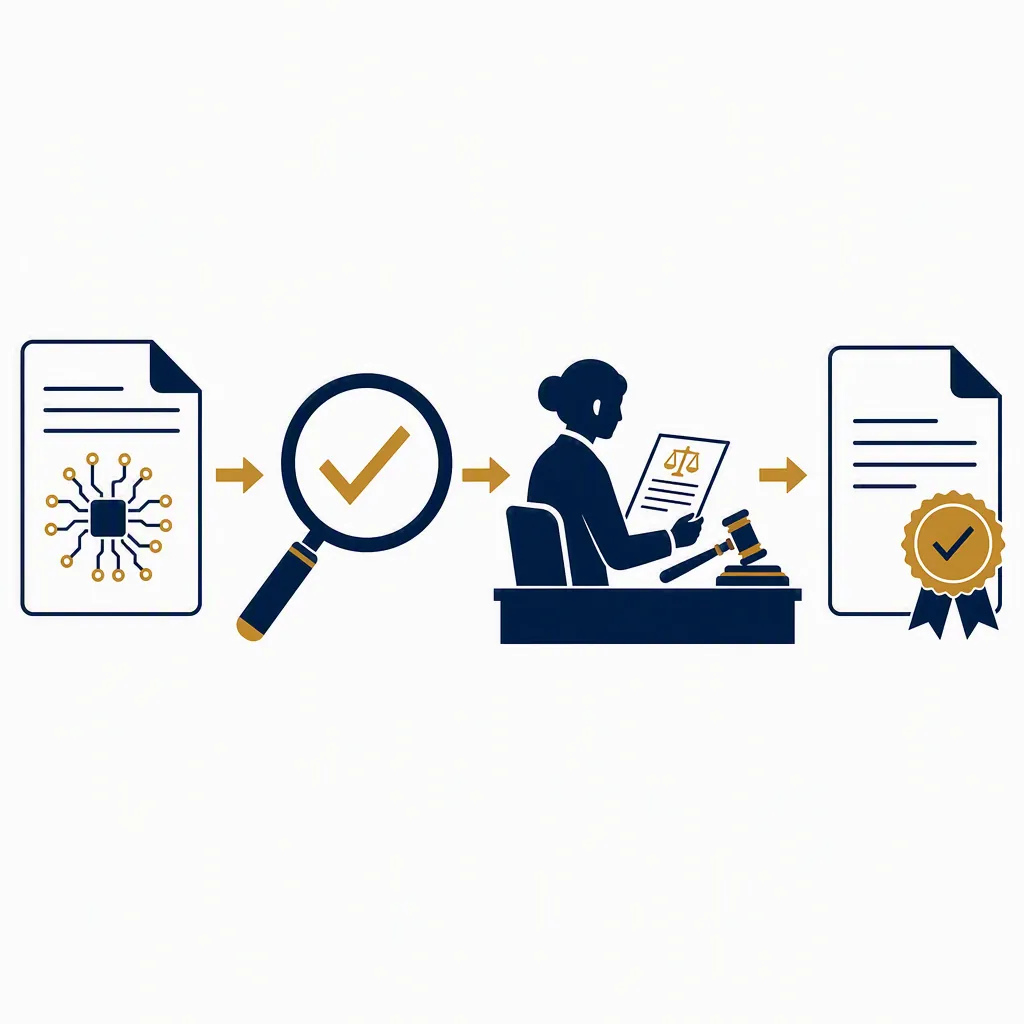
That means the pilot cannot be limited to asking whether lawyers like the first draft. It needs a dated test set, retained prompts and outputs, reviewer notes, and a citation log. The reviewer should record whether each cited authority exists, whether it is primary or secondary authority, whether it remains current, whether it is binding or persuasive for the intended jurisdiction, and whether the quoted or summarized proposition is actually supported.
| Pilot use | Minimum review posture | What should be documented |
|---|---|---|
| Internal brainstorming or issue spotting | Human review before reuse | Prompt, output, reviewer, matter type, and whether any legal propositions were carried forward |
| Research memo or client-facing advice | Primary-source verification for every authority | Citation existence, currentness, jurisdiction, proposition support, and reviewer signoff |
| Court filing, regulator submission, or adversarial use | No reliance without full lawyer review and source-by-source verification | Complete authority log, final human approval, confidentiality review, and communication analysis where required |
A pilot can still learn useful things. It can test whether Qwen 3.8 Max produces better first-pass issue lists than a prior model, whether it spots missing contract concepts, whether it summarizes long materials coherently, or whether it reduces time spent on non-authority drafting. Those are separate questions from whether its legal authorities can be trusted. Keeping those questions separate is the difference between an evaluation and a quiet production rollout.
Teams that already maintain a model-comparison file may want to place this record beside other frontier-model evaluations, such as a DeepSeek V4 vs GPT-5.6 legal research comparison or a broader AI contract review buyers guide. The important point is that Qwen 3.8 Max needs its own dated legal test record, not borrowed confidence from unrelated model families or general benchmark categories.
Procurement caveats that matter before legal deployment
The model and platform details also push toward evaluation rather than production classification. Alibaba describes Qwen 3.8 Max as a sparse mixture-of-experts model with 2.4 trillion total parameters and 95 billion active parameters [1]. The context window is reported around the one-million-token range, but public descriptions are not perfectly aligned: one integration-oriented account reports 983,616 tokens [6]. For legal teams, that discrepancy is less important than reproducibility. If the endpoint changes, the team needs to know which version produced which output.
Preview status creates a similar problem. A moving endpoint without a pinned, dated checkpoint makes it harder to reproduce a prior answer after a dispute, audit, or privilege review. Alibaba’s release also said open weights were promised for the following week, but as of August 4, 2026, the legal evaluation question still rests on the hosted release and vendor-published benchmark table, not an independently tested open-weight checkpoint [1].
Pricing and usage terms are not just finance details. Coursiv reported credit-based Token Plan pricing tiers rather than a clear published per-token rate, and also reported restrictions against automated backend or batch use under the Token Plan [6]. If a legal department’s intended pilot depends on high-volume document review, automated research queues, or background citation checking, that restriction can change the architecture of the pilot before the first legal-quality question is answered.
Self-hosting is not a simple escape hatch. eesel AI estimated that the model would require about 1.2 TB of storage at 4-bit quantization, while an H200 has 141 GB of memory [7]. That does not make local deployment impossible for every organization, but it does make it unrealistic for many legal teams that do not already operate large-model infrastructure. A buyer that cannot self-host also has to address data residency, confidentiality, and cross-border data-flow questions, including any Singapore-region processing route used in the planned deployment.
The outside evaluation record is thin. The only independent head-to-head test identified in this review was not a legal test at all: Trilogy AI’s software-architecture benchmark scored Qwen 3.8 Max at 80/100 against Kimi K3 at 83/100, with 44 tool calls and zero failures reported [8]. That is useful as a sign that outsiders are beginning to test the model. It does not answer whether Qwen 3.8 Max can cite law safely.
Verdict for legal work
Alibaba has shown enough to make Qwen 3.8 Max a serious legal-evaluation candidate. Its PLawBench score leads the vendor’s table, and its PRBench-Legal result ties the strongest listed comparators. Those are not empty signals.
But the evidence stops before the point that matters most in legal research. There was no independent legal-task or citation-hallucination evaluation of Qwen 3.8 Max found as of August 4, 2026. The available benchmark rows measure vendor-reported legal reasoning performance, not source truth. Independent legal-AI research shows that even purpose-built legal tools can produce unsupported, fabricated, or misgrounded legal answers at rates that are unacceptable without review.
The defensible procurement label is therefore narrow: evaluate Qwen 3.8 Max for legal workflows, but do not approve it as a production legal tool unless every legal authority in its output is checked against primary sources and the pilot is documented under the applicable professional-responsibility standards. No AI-assisted legal work from this model should be treated as ready for client advice, court filing, or procurement approval merely because the model leads a vendor benchmark row.
References
- Qwen3.8, Qwen, August 3, 2026, https://qwen.ai/blog?id=qwen3.8
- AI on Trial: Legal Models Hallucinate in 1 out of 6 (or More) Benchmarking Queries, Stanford HAI, https://hai.stanford.edu/news/ai-trial-legal-models-hallucinate-1-out-6-or-more-benchmarking-queries
- Legal AI Statistics 2026, HAQQ, 2026, https://www.haqq.ai/blog/legal-ai-statistics-2026
- AI Hallucination Cases, Damien Charlotin, https://www.damiencharlotin.com/hallucinations/
- Legal Practitioners’ Guide to AI Hallucinations, National Center for State Courts, https://www.ncsc.org/resources-courts/legal-practitioners-guide-ai-hallucinations
- Qwen 3.8, Coursiv, https://coursiv.io/blog/qwen-3-8
- Qwen 3.8 Max Review, eesel AI, https://www.eesel.ai/blog/qwen38-max-review
- Qwen 3.8 Max Benchmark: How It Compares, Trilogy AI, https://trilogyai.substack.com/p/qwen-38-max-benchmark-how-it-compares
Related records
Tool profile
Browse tool evaluations →Governing regulation
Browse the obligations tracker →Preventive workflow
Browse verification workflows →
Report a correction or tip
Spotted an outdated figure, a misstated fact, or a ruling this case record should reflect? Public comments are disabled for this content given the professional cost of a misreported case outcome, penalty amount, or rule text — use the structured correction channel instead.
Report a correction or tip for this record →