
Amazon's $2.5B Settlement Redefines Subscription Compliance Risk
The FTC's $2.5 billion settlement with Amazon over deceptive Prime enrollment practices sets the largest ROSCA penalty ever and names individual executives as defendants. This article examines the settlement's enforcement theory, the four UI patterns now actionable as dark patterns, and what subscription-based companies must audit immediately.
- Jurisdiction
- US-Federal
- Court
- Federal Trade Commission
- AI tool named
- None
- Ruling date
- Sep 1, 2025
- Source document
- View primary court order ↗
- Last verified
- Jul 27, 2026
Lex Machina Review is an independent risk-tracking and reference resource. Nothing on this site is legal advice, and using it does not create an attorney-client relationship. Every record is reviewed against primary sources but may not reflect the most current status of a matter — always verify directly against the cited court order, rule text, or a licensed attorney before relying on it.
Companion explanation — secondary to the source document above
If you are looking for how to file an Amazon $2.5 billion settlement claim in 2026, the operative point is immediate: eligible consumers must use the official settlement process by today, July 27, 2026, and should treat the FTC Consumer Advice alert and the FTC Amazon Refunds page as the controlling starting points. The FTC also warns that it will not contact people directly about the refund process, so a message claiming to be from the FTC should not be treated as a shortcut to filing.[1][2]
That consumer deadline is the public-facing edge of a settlement that deserves a different kind of attention from companies with subscription, membership, trial, checkout, or embedded enrollment flows. The question for counsel is no longer whether a confusing subscription screen can become an enforcement problem. The question is whether the company can explain, screen by screen, why its consent, decline, disclosure, and cancellation paths would not look like the Amazon Prime flows the FTC just converted into a penalty map.

The settlement amount is severe, but the design order is the real precedent risk
The FTC announced in September 2025 that Amazon would pay a $1 billion civil penalty and create a $1.5 billion consumer restitution fund to resolve allegations involving deceptive Prime enrollment and cancellation practices. The agency described the penalty as the largest ever under the Restore Online Shoppers’ Confidence Act and the restitution award as the second-largest in FTC history.[3]
Those numbers will travel easily through board decks. They should. But the more durable compliance consequence is what the FTC required Amazon to change. The agency’s release identifies operational obligations that go directly to product design: a clear and conspicuous way to decline Prime, clear disclosure of material terms before consent, a cancellation process available through the same method used to enroll, and an independent third-party compliance monitor.[3]
A settlement does not produce the same clean judicial rule that a litigated appellate decision might. It also does not make every subscription dispute an Amazon case. But it gives the FTC an order-backed enforcement template. When the agency reviews another company’s checkout funnel, free-trial path, upgrade prompt, or renewal flow, it can now point to a resolved matter in which specific interface choices were tied to Section 5 and ROSCA liability, a billion-dollar civil penalty, restitution, and forward-looking design controls.
The four Prime interfaces are now an audit map
The important point is not that Amazon is large, or that Prime is familiar, or that regulators dislike “dark patterns” in the abstract. The FTC’s theory centered on four identifiable enrollment interfaces: the universal Prime decision page, the shipping selection page, single-page checkout, and the Prime Video enrollment flow.[3] That is useful for compliance review because it turns a broad consumer-protection theory into a sequence of screens that can be tested.
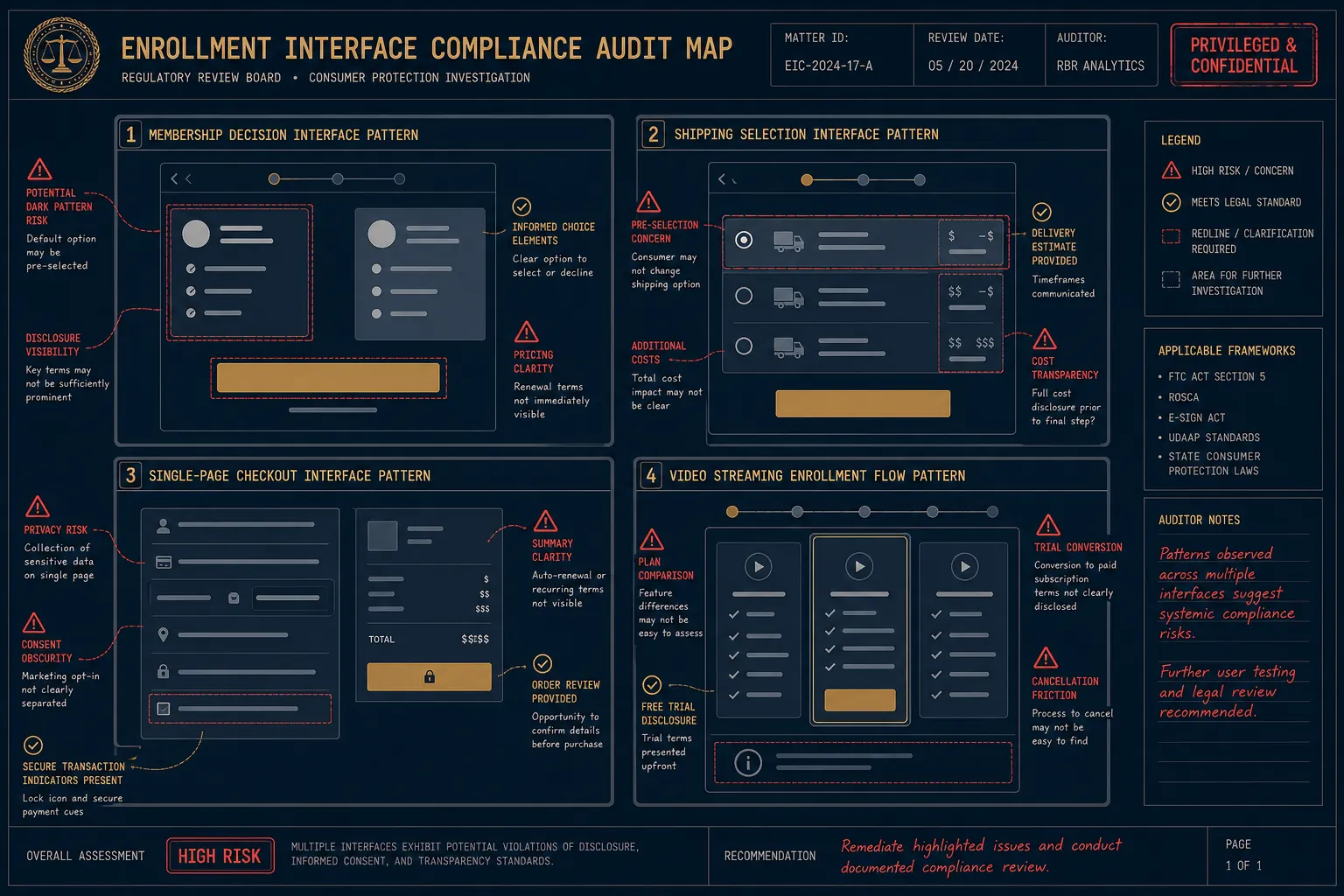
| Prime interface identified by the FTC | Compliance question for another company |
|---|---|
| Universal Prime decision page | Can a user clearly decline enrollment without hunting for a less visible or ambiguously worded path? |
| Shipping selection page | Does the screen separate a shipping choice from consent to a recurring paid membership? |
| Single-page checkout | Are material subscription terms visible before the final action that creates a charge or renewal obligation? |
| Prime Video enrollment flow | Does a content-access prompt make subscription consent clear, or does it collapse viewing access and recurring billing into one hurried click? |
Universal Prime decision page: the decline path is evidence
A universal decision page is the obvious place to measure whether enrollment is voluntary in any meaningful sense. If the enrollment path is visually dominant and the decline path is weaker, delayed, confusing, or framed as something other than a real choice, the company should expect a regulator to ask whether the screen obtains informed consent or merely captures fatigue. The FTC’s required clear-decline obligation matters because it treats refusal as part of lawful enrollment design, not as a conversion leak to be hidden.[3]
For counsel reviewing a subscription flow, the audit should not stop at whether a decline option technically exists. The better question is whether a reasonable user can identify it at the moment the paid relationship is being formed. Screenshots, experiment logs, and copy iterations become important because they show whether the company designed the refusal path as a genuine alternative or as a trapdoor.
Shipping selection page: enrollment cannot be smuggled into logistics
A shipping selection page carries a different risk. The user arrives to choose delivery terms, not necessarily to evaluate a recurring membership. That context matters. When an enrollment offer appears inside a transactional step, the legal issue is whether the user understands that a shipping-related click also creates a subscription relationship with future charges.
This is where material-term placement becomes more than disclosure hygiene. A disclosure that appears after the commitment, below the visual decision point, or outside the user’s likely reading path may be defensible in a product meeting as “available.” In a ROSCA review, availability is not the same thing as clear and conspicuous presentation before consent. The FTC’s settlement terms put that distinction in operational form.[3]
Single-page checkout: the final button does too much work
Single-page checkout is attractive because it removes friction. That same compression creates legal exposure when purchase confirmation, subscription enrollment, renewal terms, and payment authorization compete for attention on one screen. If a user thinks the final action completes a purchase, while the company treats the same action as enrollment in a recurring program, the interface becomes more than a layout decision.
The compliance review should therefore identify the legal consequence of each final button. Does it buy an item, start a trial, authorize recurring billing, accept membership terms, or all of those at once? If the answer is “all of those,” the screen needs unusually clear term placement and consent language. The litigation problem is that ambiguity at checkout is easy to preserve: the screenshot, the button copy, the A/B-test variant, and the conversion analysis tend to survive long after the product team has moved on.
Prime Video enrollment flow: content access is not consent by itself
The Prime Video flow matters because it shows how subscription consent can arise outside a classic shopping cart. A user trying to watch content may be focused on access, not on recurring billing architecture. That is precisely why embedded enrollment flows in streaming, software, legal-tech tools, marketplaces, and AI products deserve closer review: the user’s immediate goal may be functionally different from the legal commitment the company is trying to obtain.
The audit question is not whether the enrollment offer appears in a polished interface. It is whether the screen gives the user enough information, at the right time, to understand the commitment. If access to a desired feature or item is used as the moment to capture a recurring payment relationship, the disclosure and decline mechanics need to be built for that pressure point.
The mandated fixes are product requirements, not settlement boilerplate
The FTC’s remedial terms point to the places where a subscription company should start its own review. The first is the decline path. If a user can accept in one visible click but must search, scroll, interpret soft language, or pass through repeated prompts to decline, the company has created the kind of asymmetry that regulators now have a high-profile settlement to challenge.
The second is material-term placement. Price, renewal timing, trial conversion, cancellation mechanics, and recurring billing consequences should appear before the user takes the action that creates the obligation. Product teams often treat term placement as a copy problem. In a ROSCA setting, it is evidence of whether consent was informed.
The third is cancellation parity. The FTC’s same-method cancellation requirement is a direct answer to a common growth tactic: make enrollment available online, then force cancellation through a more burdensome path. Companies that allow a user to subscribe through a web flow, app flow, or embedded checkout should be prepared to explain why cancellation through that same channel is not equally available.[3]
The fourth is monitoring. A third-party compliance monitor changes the internal economics of subscription design. It means the company cannot rely only on periodic legal review after launch. It must produce a defensible operating record showing how screens are approved, how variants are tested, how complaints are reviewed, and how cancellation performance is measured over time.[3]
That is why this settlement should matter to SaaS companies, marketplaces, app developers, legal-tech platforms, and AI-product vendors with paid trials or embedded upgrades. The relevant control is not a policy that says the company avoids dark patterns. The control is the ability to place the actual screens, term disclosures, consent records, cancellation paths, and experiment history in front of a regulator or opposing counsel without needing to reconstruct intent after the fact.
Personal defendants move this from UX review to governance risk

The FTC did not frame the case only as an institutional failure. It named Amazon Senior Vice President Neil Lindsay and Vice President Jamil Ghani as individual defendants.[3] For general counsel and risk committees, that is the detail that should change attendance at subscription-design meetings.
Individual naming does not mean every executive who approves an enrollment flow is personally liable. It does mean product leadership, growth leadership, and legal leadership should stop treating subscription screens as disposable UX artifacts. When senior personnel know that a flow produces confusion, complaints, or cancellation friction and the company continues to optimize around those results, the record may start to look less like design iteration and more like evidence of knowledge.
The discovery record is a separate reason for caution. Fair Patterns, a commercial consultancy, has summarized court-record material as including a pretrial document-sanctions ruling involving 70,000 withheld documents, withdrawal of 92% of challenged privilege claims, and internal phrases such as “chief dark arts officer” and “a bit of a shady world.” Those specifics should be checked against the docket before being used as stand-alone evidence, but even in qualified form they point to a familiar litigation problem: internal language that sounded clever in a product channel can become intent evidence once a regulator starts reading it.[4]
This is where compliance programs often fail quietly. Legal may approve a screen once. Growth may test a dozen versions afterward. Customer-support complaints may be tagged as friction or confusion without being escalated. Engineers may document the cancellation path as a retention surface. None of that is necessarily unlawful by itself. But in discovery, the pieces are not read as isolated workstreams. They are assembled into a narrative about what the company knew and why it left the design in place.
The audit should follow the user path and the evidence path
A useful post-Amazon review should begin with the live enrollment experience, but it should not end there. Counsel should ask product teams to preserve and explain the path from offer to consent to cancellation, including variants that are no longer live. The version history may matter as much as the current screen if a regulator asks when the company learned that users were confused.
- Map every screen where a user can enter a paid subscription, trial, membership, upgrade, or renewal relationship.
- Identify the exact action that creates the billing obligation and confirm that material terms appear before that action.
- Compare the visual prominence and wording of accept and decline options.
- Test whether a user can cancel through the same channel used to enroll.
- Review A/B-test records, support tickets, refund requests, complaint categories, and internal messages for evidence that the company knew users were misunderstanding the flow.
- Assign executive-level ownership for subscription compliance rather than leaving it as a dispersed product-design issue.
The same review belongs in AI-related products that rely on free trials, usage-based upgrades, embedded renewals, or account prompts that move users from access to payment. In an AI-fraud or enrollment dispute, the interface will not remain a neutral design object. It can become the source document, the privilege fight, the deposition exhibit, and the intent evidence.
Companies with subscription or enrollment flows should audit decline paths, material-term placement, cancellation parity, monitoring obligations, and executive knowledge now. The Amazon settlement is not just a refund event closing on July 27, 2026; it is a regulatory and litigation-risk template for the next enrollment flow a company ships.
References
- Questions about your Amazon Prime settlement refund? Read this | FTC Consumer Advice | January 2026
- Amazon Refunds | Federal Trade Commission
- FTC Secures Historic $2.5 Billion Settlement Against Amazon | Federal Trade Commission | September 2025
- Amazon’s $2.5B Dark Patterns Settlement: What All E-Retailers Must Change Now | Fair Patterns
Related records
Tool profile
Browse tool evaluations →Governing regulation
Browse the obligations tracker →Preventive workflow
Browse verification workflows →
Report a correction or tip
Spotted an outdated figure, a misstated fact, or a ruling this case record should reflect? Public comments are disabled for this content given the professional cost of a misreported case outcome, penalty amount, or rule text — use the structured correction channel instead.
Report a correction or tip for this record →