
Amazon's AGI Layoffs Pressure Undefined AI Disclosure Rules
Amazon's July 2026 AGI cuts create a live test case for the new AI-disclosure WARN Act requirements in Connecticut, New York, and pending California legislation. This analysis examines the definitional gap that leaves certifying counsel exposed even when reporting in good faith.
- Jurisdiction
- US-Federal
- Court
- Various
- AI tool named
- Amazon AGI
- Ruling date
- Jul 22, 2026
- Source document
- View primary court order ↗
- Last verified
- Jul 30, 2026
Lex Machina Review is an independent risk-tracking and reference resource. Nothing on this site is legal advice, and using it does not create an attorney-client relationship. Every record is reviewed against primary sources but may not reflect the most current status of a matter — always verify directly against the cited court order, rule text, or a licensed attorney before relying on it.
Companion explanation — secondary to the source document above
Amazon’s July 22, 2026 cuts inside its artificial general intelligence group are the kind of event that makes the phrase “AI-related layoff” look simple until someone has to sign a notice. Public reports say Amazon eliminated some roles in the AGI unit, but they do not establish the affected headcount, the locations, or whether any WARN threshold was triggered.[1][2] The legal problem is not solved by the unit’s name. It starts there.
For employers tracking the legal impact of Amazon’s AGI layoffs, the useful question is not whether critics can draw a straight line from AI investment to job loss. They often can. The harder question is what a company can certify when a state form asks whether a reduction is related to AI, while the regulator has not yet said what “related” means.

Amazon’s AGI Cuts Are a Bad Fit for a Neat Checkbox
The July 22 cuts landed in a business area that already carried legal and factual ambiguity. Reuters reported that Amazon cut jobs in its artificial general intelligence group and that the number of affected employees was not disclosed.[1] CNBC similarly described the action as affecting “some employees” in the AGI unit.[2] That is enough to make the event significant, but not enough to decide whether any mass-layoff notice obligation was triggered.
The restructuring did not arrive in isolation. The Next Web reported that Amazon shut its AGI Lab after barely 18 months.[3] GeekWire described the company as cutting jobs in the AGI group while putting more focus on customer-facing AI.[4] Reuters and CNBC also placed the cuts against a leadership shift: Rohit Prasad left in December 2025, David Luan left in February 2026, and Peter DeSantis moved to consolidate the AGI work under a broader organization.[1][2]
Those facts are unusually awkward for disclosure purposes. A layoff inside an AGI unit is not automatically an AI-caused layoff. A lab closure can reflect budget discipline, product strategy, leadership change, technical underperformance, duplication, investor pressure, or ordinary reorganization. It can also coincide with AI adoption that changes the number or type of roles needed. Public reporting does not let outside readers separate those strands.
Amazon’s broader record increases the stakes. Vanderbilt Law described Amazon as having laid off more than 30,000 employees since October 2025 amid increased AI investment, while also noting the company’s formal 90-day notice policy as attentive to WARN Act requirements.[5] That combination matters because formal process does not eliminate classification risk. A company can have a notice calendar, a review workflow, and counsel involvement, and still face a contested causation label if the form asks for a conclusion the law has not defined.
There is also a business reason the AGI group was under pressure. In June 2026, CNBC reported Peter DeSantis’s acknowledgment that Amazon’s models “haven’t been at the very frontier,” a statement relevant to why the company might restructure frontier-model work.[6] But that context cuts both ways. It supports a business rationale for organizational change; it does not, by itself, prove that specific positions were eliminated because AI replaced the work.
What Would Counsel Actually Be Certifying?
A WARN analysis usually begins with facts that are more concrete than the eventual business explanation: affected site, look-back and look-forward periods, employment losses, part-time exclusions, remote-reporting relationships, bumping rights, and whether separate actions must be aggregated. The AI-disclosure question adds a different kind of representation. It asks the employer to characterize why the loss happened.
That characterization can be more fragile than the layoff count. A headcount spreadsheet can be wrong, but it is at least built from payroll and HRIS records. A causal label requires interviews, strategy documents, budget materials, role mapping, and sometimes executive statements made for audiences that were not thinking about WARN forms. If the company has publicly said it is increasing AI investment while reducing headcount, the reviewer has to decide whether that public narrative is part of the evidentiary file or just background noise.
Amazon’s AGI facts illustrate the problem without proving a violation. The record available from public sources shows an unspecified number of AGI cuts, a lab closure, leadership departures, consolidation, and a broader layoff pattern amid AI investment.[1][2][3][4][5] It does not show the internal decisional memo, the position-by-position rationale, the affected worksites, or the WARN notices, if any. A regulator, plaintiff’s lawyer, or state attorney general would ask for those materials later. Counsel has to make the disclosure call before that later record is assembled in litigation form.
The State Rules Do Not Create the Same Risk
The emerging state patchwork is often described as AI-layoff disclosure law, but the jurisdictions are not doing the same thing. Connecticut is moving toward a form-based disclosure. New York already has a checkbox. California is considering a more consequential notice and damages framework. The common defect is definitional: each regime turns an AI causation label into a legal fact before employers have a stable operational test.
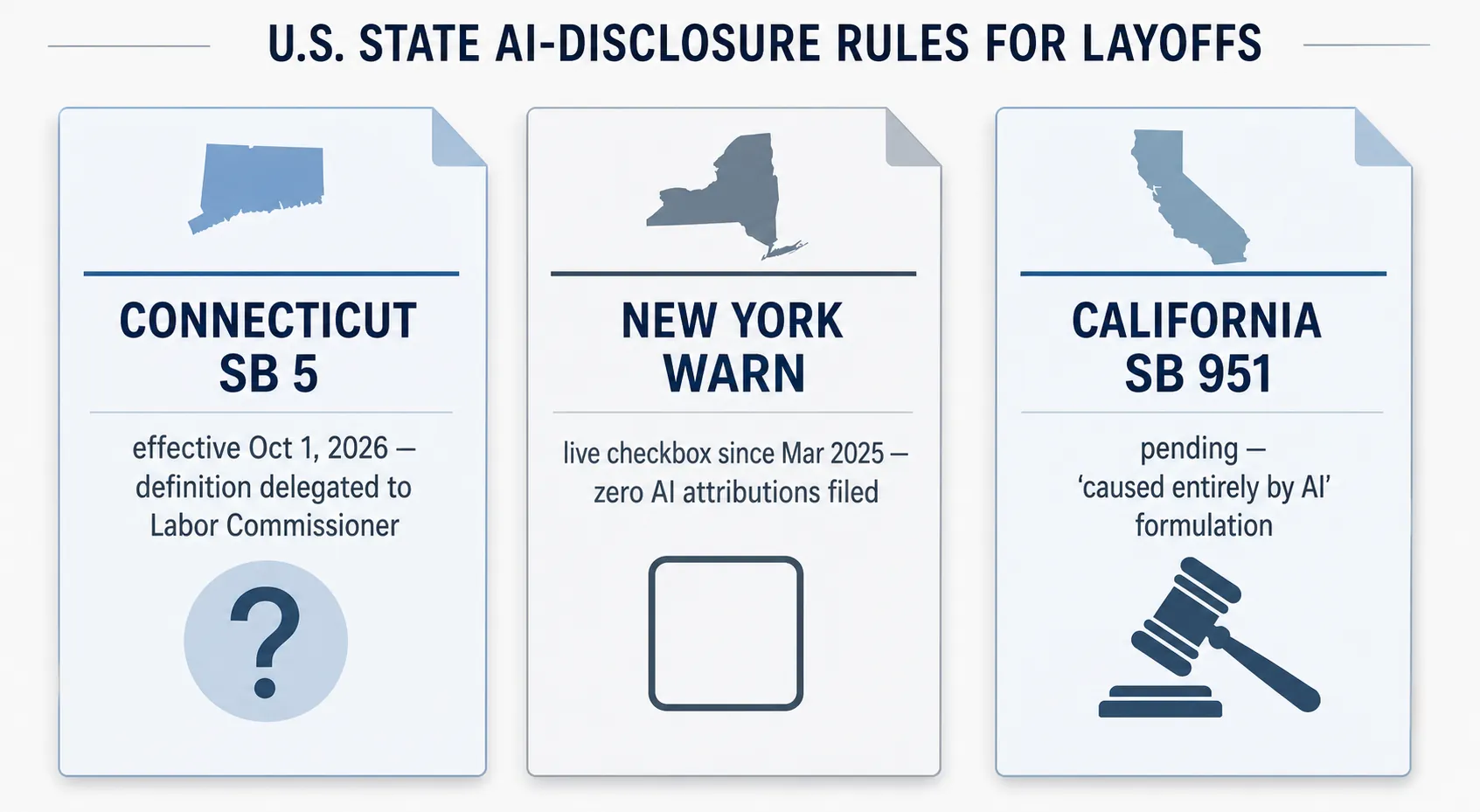
| Jurisdiction | Current posture | Why it matters for an AGI-unit layoff |
|---|---|---|
| Connecticut | SB 5 takes effect Oct. 1, 2026 and requires employers to state whether a mass layoff is related to AI or other technological change. | The key definition is still delegated to the Labor Commissioner, leaving counsel to document a judgment before the operative line is published. |
| New York | The WARN system has included an AI checkbox since March 2025, with zero AI attributions reported by more than 160 companies in the first year. | The empty field may reflect reality, underreporting, uncertainty, or cautious classification; it cannot be treated as clean labor-market evidence. |
| California | SB 951 remains pending and would cover certain AI-driven cuts under a “caused entirely by AI” formulation. | That wording narrows the trigger in one sense but invites disputes over mixed-motive decisions and individual position eliminations. |
Connecticut: Disclosure Before Definition
Connecticut SB 5 is scheduled to take effect on October 1, 2026. Pebblous describes it as the first U.S. law requiring employers to state on a mass-layoff form whether the reduction is “related to the use of AI or other technological change,” with violations handled under the Connecticut Unfair Trade Practices Act through attorney general enforcement and a 60-day cure period.[8] The missing piece is the one the person signing the packet most needs: the operational definition of AI-relatedness has been delegated to the Labor Commissioner and has not yet been published.[8]
That makes Connecticut the cleanest version of the problem. If an employer closes a department after deploying software that automates half the work, the disclosure instinct is obvious even if the legal test is unfinished. Amazon’s AGI restructuring is not that clean from the public record. The work being reorganized concerns AI development itself; the reason for the cuts may be strategy, product direction, leadership consolidation, or investment allocation. The form language “related to” could capture far more than direct substitution of software for workers, but counsel should not have to infer the width of that phrase from the name of the business unit.
New York: A Live Checkbox With No AI Attributions
New York’s AI checkbox is no longer theoretical. Hunton reported in May 2026 that, in the first year after the state added AI-related disclosure to the WARN system in March 2025, zero out of more than 160 companies attributed layoffs to AI.[9] The tempting reading is that AI is not yet producing reportable job losses. The more careful reading is that the field may be measuring reporting behavior as much as labor-market causation.
Zero is a useful number only if the label is understood, applied consistently, and checked against an external truth source. Without that, it can mean several things: no covered layoffs were AI-related, companies did not view mixed-motive restructurings as AI-related, counsel interpreted the checkbox narrowly, or employers lacked enough internal evidence to select it. For a company with Amazon-like facts, New York’s first-year result should not be comforting. It should prompt the question a reviewer will ask later: why did this employer check or not check the box when others were leaving it empty?
California: Pending, but Already Drafting the Fight
California SB 951 is pending as of July 30, 2026, so it should not be treated as enacted law. As described by Shaw Law Group, the bill would require 90 days’ advance notice for AI-driven cuts involving 25 or more employees or 25% or more of a workforce, with wage-and-benefit damages and daily civil penalties.[10] Shaw Law Group also warned that the bill’s “caused entirely by AI” standard is “vague enough to invite a fight over every single layoff.”[10]
The phrase “caused entirely by AI” sounds narrower than Connecticut’s “related to” formulation, but it creates its own evidentiary trap. Few real workforce decisions are caused entirely by one thing. If a team is cut after a product pivot, budget reduction, leadership change, and deployment of AI tooling, the employer may argue the standard is not met. A claimant may argue the other factors are pretext or implementation details. Either way, the record has to be built at the time of the decision, not after demand letters arrive.
The Data Problem Is Not Academic
Pebblous identifies three defects in the “caused by AI” label: no operational definition, labeler bias because the company self-reports, and no ground-truth verification channel. Its conclusion is blunt: the dataset these laws create “starts life carrying all three defects.”[8] That is a data-quality critique, but it is also a litigation map.
No operational definition means employers will build their own thresholds. Labeler bias means the party with legal exposure is the party selecting the label. No ground-truth channel means the state database cannot, on its own, prove whether the employer was right. The resulting record may be administratively tidy and evidentially thin.
The Challenger, Gray & Christmas figure that AI has been cited in about 23% of job-cut announcements in 2026 carries the same self-reporting concern Pebblous flags.[8] It may show that AI is part of the layoff narrative more often. It does not establish a consistent legal standard for causation.
New York’s proposed Automation Displacement Protection Act would raise the stakes further by disqualifying violators from state grants, loans, or tax incentives for five years.[8] That proposal is not the same as current WARN disclosure law, but it shows why the label will not remain a harmless data field if legislatures keep attaching collateral consequences to automation-related employment decisions.
Investigations Matter Even Without a Final Violation
The Strauss Borrelli investigation into Amazon’s TMB8 facility in Homestead, Florida is not an adjudicated WARN violation, and it should not be cited as if it were. The firm announced an investigation involving 616 employees at the facility and framed it around potential WARN Act issues.[7] Its value here is narrower: it shows that large employers with formal notice practices can still become targets for WARN scrutiny.
That distinction matters. A demand letter, investigation notice, or plaintiff-side announcement is not proof that a company violated the law. It is, however, a preview of how records get tested. The reviewer will not ask whether the company generally takes WARN seriously. The reviewer will ask what happened at this site, for these employees, during this decision window, and why the notice said what it said.
For AI-related disclosures, that last question becomes more exposed. If the employer said the layoff was AI-related, it may face questions about whether it admitted technological causation, whether additional obligations were triggered, and whether affected workers were selected because work was automated. If the employer said it was not AI-related, it may face questions about contrary internal documents, public statements about AI investment, or executive descriptions of the restructuring.
The Record Counsel Needs Before the Form Is Filed
The defensible answer is not to invent a universal definition of AI-driven layoff before the agencies do. It is to make the uncertainty visible in the file and to preserve the basis for the disclosure call. Good faith is easier to assert than to prove; the proof has to exist before the company knows which sentence will be challenged.
For a restructuring like Amazon’s AGI cuts, the pre-reporting file should separate at least five questions.
- What business rationale was approved: lab closure, product shift, cost reduction, leadership consolidation, AI deployment, or another reason.
- Which roles disappeared, which roles changed, and which work moved to another team, vendor, tool, or location.
- Whether AI tools replaced job functions, merely supported remaining workers, or were unrelated to the selected positions.
- Which public statements about AI investment, model strategy, or workforce efficiency were reviewed for consistency with the notice position.
- Who reviewed the AI-relatedness label, what definition or interim standard they used, and what regulatory guidance was unavailable at the time.
That file should not be built only by lawyers. HR owns the affected-employee data. Finance usually owns the savings case. Business leaders know whether the work stopped, moved, or was automated. Legal has to translate those inputs into statutory language, but it should not be the first function to discover that the official reorganization rationale and the executive AI narrative do not match.
The most important drafting discipline is to avoid false precision. If the current law does not define AI-relatedness, the file should say what standard the company applied. If the facts show mixed causes, the file should say so. If the employer concludes the layoff is not AI-related because no job function was replaced by AI, that criterion should be documented. If the employer concludes the layoff is AI-related because AI tooling materially reduced the need for particular roles, that reasoning should be tied to the affected positions rather than to a broad corporate AI strategy.
Amazon’s July 22 AGI cuts do not answer whether an AGI-unit layoff is legally AI-driven. Public sources do not establish the headcount, the WARN-triggering scope, or Amazon’s internal causation analysis.[1][2] They do show why the phrase cannot be treated as obvious. In the current disclosure regime, the safer practice is not a confident checkbox. It is a contemporaneous record showing what facts were known, what definitions were missing, who made the causation judgment, and why the notice language followed from that record.
References
- Amazon cuts jobs in its artificial general intelligence group, Reuters, July 22, 2026
- Amazon lays off some employees in its AGI unit, CNBC, July 22, 2026
- Amazon shuts AGI lab in frontier model retreat, layoffs, The Next Web
- Amazon cuts jobs in AGI group as it puts more focus on customer-facing AI, GeekWire, 2026
- Amazon Lays Off Thousands Amid Boosts in AI Investments but Attentive to WARN Act Requirements, Vanderbilt Law
- Amazon AI executive says company’s models ‘haven’t been at the very frontier’, CNBC, June 17, 2026
- Amazon TMB8 WARN Act Investigation, Strauss Borrelli, April 20, 2026
- AI Layoff Disclosure Laws 2026, Pebblous
- New York WARN Act: No AI-Related Layoffs Reported in First Year of Adding AI-Related Disclosure to the System, Hunton, May 2026
- AI Layoffs Are Coming: Watch for New Notice Obligations, Shaw Law Group, June 2026
Related records
Tool profile
Browse tool evaluations →Governing regulation
Browse the obligations tracker →Preventive workflow
Browse verification workflows →
Report a correction or tip
Spotted an outdated figure, a misstated fact, or a ruling this case record should reflect? Public comments are disabled for this content given the professional cost of a misreported case outcome, penalty amount, or rule text — use the structured correction channel instead.
Report a correction or tip for this record →