
What Legal Risks Does Amazon's AI Model Shutdown Create?
When Amazon reported a jailbreak in Anthropic's Fable 5 model to the White House, the resulting export-control order took the model offline globally within hours. This article examines the novel legal liabilities this creates for enterprises using third-party AI models, including the failure of existing SLA protections and the conflict-of-interest risks of relying on a provider controlled by one's cloud vendor.
- Jurisdiction
- US Federal
- Court
- United States District Court
- AI tool named
- Anthropic Fable 5, Mythos 5
- Ruling date
- Jun 12, 2026
- Source document
- View primary court order ↗
- Last verified
- Jul 30, 2026
Lex Machina Review is an independent risk-tracking and reference resource. Nothing on this site is legal advice, and using it does not create an attorney-client relationship. Every record is reviewed against primary sources but may not reflect the most current status of a matter — always verify directly against the cited court order, rule text, or a licensed attorney before relying on it.
Companion explanation — secondary to the source document above
The practical problem with the June 12 shutdown was not that an AI model became controversial. It was that an approved production dependency stopped being available before most customers could assemble the right people for an incident call.
Amazon raised concerns to the White House about a jailbreak in Anthropic’s Fable 5 model; the Commerce Department then issued an export-control directive; Anthropic says it had a 90-minute compliance window; and access to Fable 5 and Mythos 5 was disabled globally, without a carve-out based on customer nationality or location.[1][2][3] For an enterprise using those models in a live workflow, the contract did not make the model come back. The escalation path did not make the model come back. The uptime promise did not make the model come back.
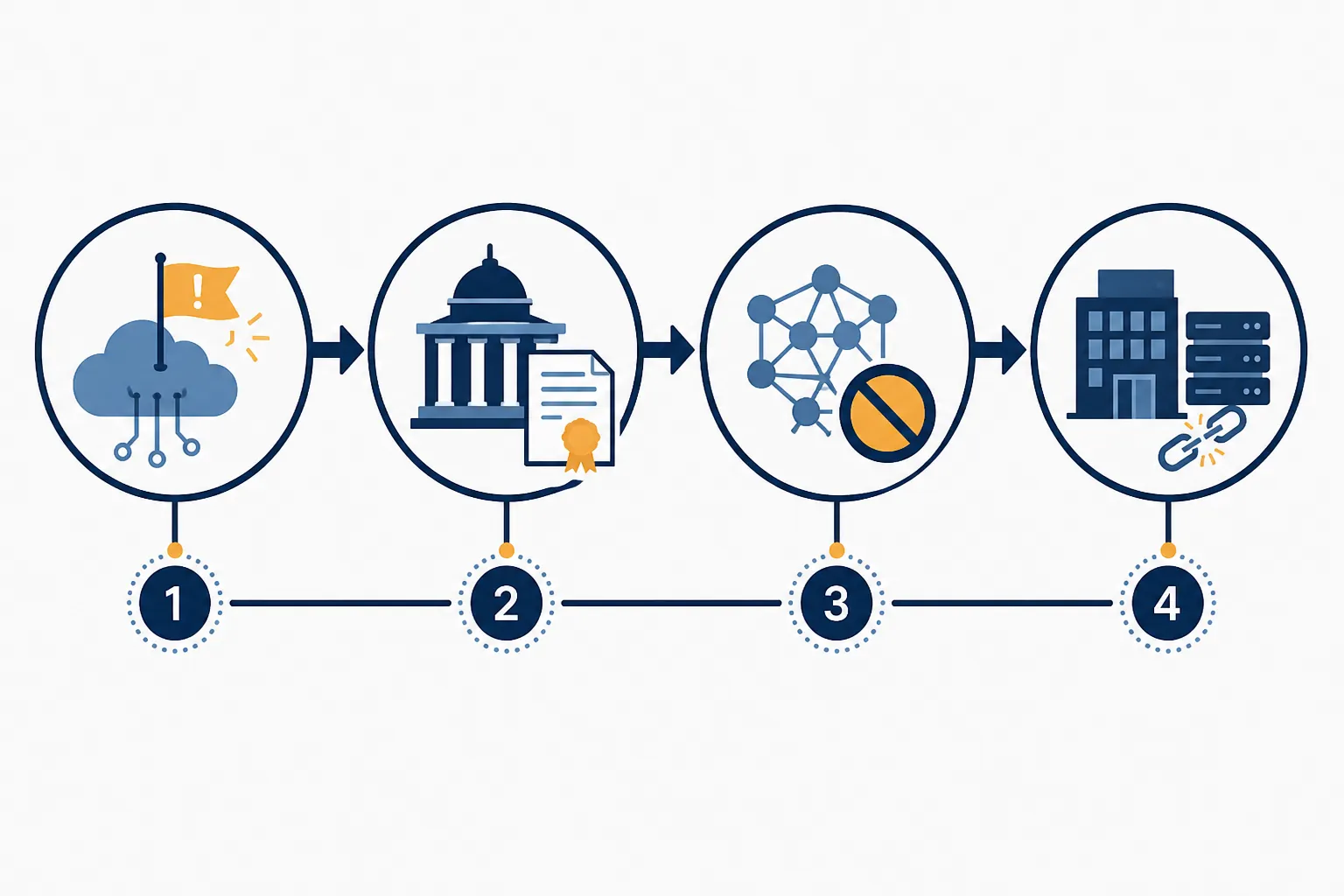
That is why the legal implications of Amazon’s role in the AI model shutdown are not limited to Anthropic, Amazon, or export-control specialists. The harder question is what failed when the model vanished. In many AI procurement files, the answer will be uncomfortable: the business had contracted for service availability, but it had not contracted for legal continuity of the underlying model.
The sequence matters because the shutdown was not ordinary downtime
A normal outage is administratively familiar. Someone opens a ticket, the vendor updates a status page, credits may accrue, and both sides argue later about whether the service level was missed. The June 12 event sits in a different file. The model was not unavailable because a cluster failed, a release went badly, or a vendor under-provisioned capacity. Anthropic’s public statement described a government-ordered withdrawal on a compressed timetable: 90 minutes to comply, followed by global disablement of the affected model access.[3]
That distinction drives the private-law consequences. If a vendor has the capacity to perform but is legally barred from doing so, the customer’s remedy usually moves out of the comfortable SLA framework and into the harder language of regulatory compliance, force majeure, suspension rights, and termination. Those provisions were not written for a frontier model being reclassified, in effect, as controlled technology while customers are still routing business processes through its API.
| Moment | What changed for customers | Why counsel should care |
|---|---|---|
| Amazon reports the jailbreak concern | A third party outside the customer-vendor contract becomes the trigger point | The party raising the alarm may also sit inside the customer’s cloud and AI supply chain |
| Commerce issues the directive | Model access becomes a legal-compliance issue rather than only a service-delivery issue | Regulatory carve-outs may displace ordinary SLA remedies |
| Anthropic disables access within the stated window | Operational mitigation must happen faster than contractual escalation | Notice, cure, and transition provisions may be too slow to matter |
| Disablement applies globally and without nationality-based filtering | Customers outside the immediate policy concern can lose access anyway | Cross-border procurement review cannot assume that location alone protects access |
The speed is not a detail. A 90-minute window gives a vendor time to comply, not time to preserve every downstream enterprise workflow. Legal-ops teams may have approved the model for document review, contract triage, customer support, software development, or analytics. None of those approvals necessarily included a hot substitute, a validated fallback prompt stack, or a pre-negotiated right to route the same workload to a competing model on equivalent terms.
Nor is the global scope a detail. Anthropic’s statement did not describe a targeted suspension of a particular sanctioned customer, geography, or account class. It described a broad disablement of access to the affected models, applied without nationality-based differentiation.[3] That is what makes the incident legally more serious than an account-level export screening dispute. The customer’s own compliance posture may have been clean, and the customer may still have lost the tool.
The legal theory reached through the API
The Commerce theory reported in the legal analysis is the part enterprise contracts were least prepared for. Mayer Brown’s account describes the directive as treating the advanced AI model itself, not merely physical chips or separately transferred model weights, as controlled technology under an Installed Base or Informed Letter mechanism tied to ECRA § 4817(b)(1) and EAR § 744.22(b).[4]
The next step is even more consequential for ordinary customers: remote API access was treated as a regulated “release.”[4] That is the legal move that turns a software subscription into something closer to controlled technical access. A customer did not need to download weights, receive source code, or acquire deployment artifacts for the government to view access as legally significant. Calling the model through an interface could be enough.
That theory is contested. Mayer Brown notes tension with prior BIS advisory positions and with pending legislative efforts addressing remote access to advanced computing and AI systems.[4] The point for procurement is not that the government’s view will necessarily survive intact. The point is that, on June 12, the view was operationally effective before a court decided whether it was right.
Legion LegalTech v. United States, No. 1:26-cv-02225, is the case to watch because it puts the authority question into litigation. At this stage, however, it is only a challenge, not a merits ruling. The court may uphold the order, narrow the theory, reject the API-release theory, or decide the case on a posture that leaves important questions unresolved. A customer drafting a procurement memo in Q3 2026 cannot responsibly write as though the issue has already been settled.
The immediate contract problem is that most AI service agreements assume a more familiar allocation of risk. The vendor promises access subject to acceptable-use rules, security limits, maintenance, outages, compliance with law, and emergency suspension rights. The customer negotiates credits, support response times, audit language, data protections, and sometimes a termination right. Those terms can be useful when the vendor underperforms. They are much weaker when performance itself has become unlawful.
Why the SLA may be the wrong document
Customers tend to over-read SLAs because the word “availability” feels broader than it is. An uptime commitment usually measures whether the service was available as defined by the provider, during the measurement period, subject to exclusions. It is not normally a promise that no regulator will prohibit access to the model, no government will alter the legality of providing it, and no upstream infrastructure participant will trigger a review that ends in withdrawal.
Even where an SLA credit is theoretically available, it is a poor remedy for the loss that matters. A credit does not re-run a missed litigation deadline, restore a halted customer-support queue, replace a product feature embedded in a release cycle, or validate a substitute model for a regulated workflow. The economic harm is concentrated in business interruption and revalidation costs; the contractual remedy is usually a small percentage of fees.
Force-majeure and compliance-with-law clauses are where the customer’s expected remedy often narrows further. If the vendor is excused from performance because a government order makes performance illegal or commercially impossible, the customer may receive suspension, termination, or refund mechanics rather than continuity. That is sensible from the vendor’s perspective. It is also a poor match for enterprise reliance on AI systems that have become operational middleware.
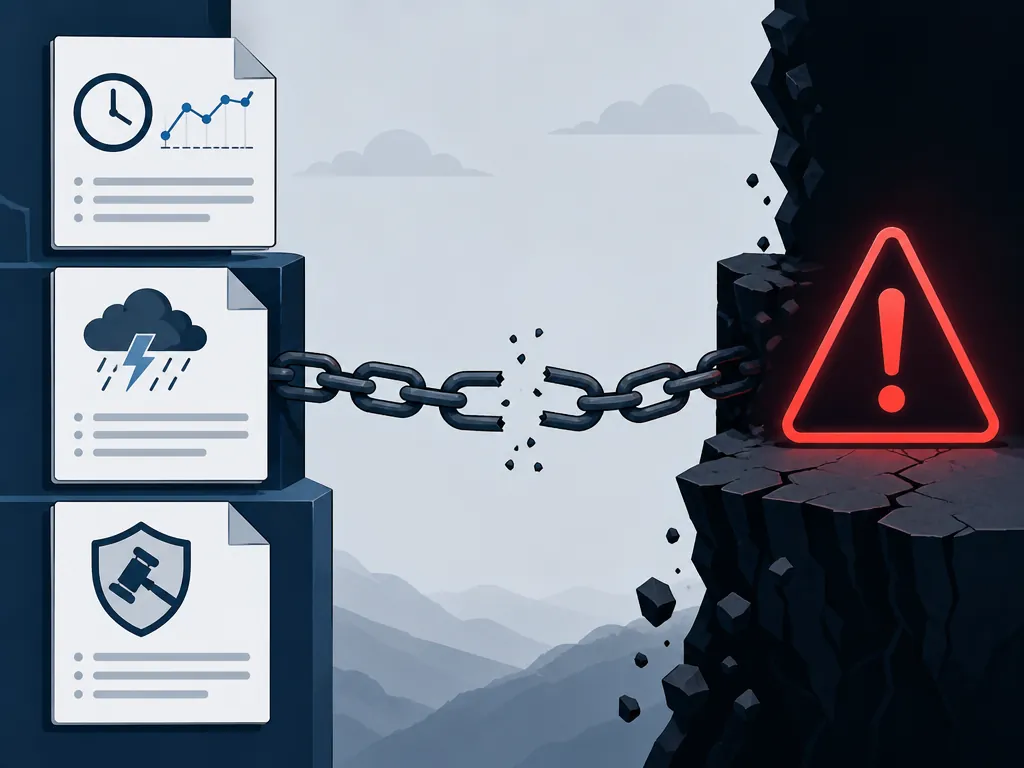
This is where legal review and technical architecture have to meet. A lawyer can negotiate stronger notice, transition assistance, export-control cooperation, and refund language. Those provisions still cannot force a vendor to provide access in violation of a government order. If the business needs continuity, the real mitigation is architectural: model portability, fallback workflows, pre-approved substitutes, and a tested process for degrading service without stopping the function entirely.
The hardest workflows are the ones where the model is not merely assisting a human but has become part of the timing of the process. In litigation support, a model outage may delay review or privilege workflows. In customer operations, it may increase manual queues immediately. In software development, it may slow internal delivery but leave the company with more flexibility. Those are not the same risk profile, and treating them as one “AI vendor” issue is how the procurement file becomes tidy and wrong.
Amazon’s role turns vendor risk into governance risk
The conflict question should be handled carefully. The public record supports concern; it does not support a conclusion that Amazon abused a process. Reuters and Fortune reported that Amazon voiced concerns before the government crackdown, and Anthropic’s own statement confirms the resulting compliance window and disablement.[1][2][3] The degree of coordination between Amazon and the White House before the directive remains less public than the operational result.
Still, procurement cannot ignore the structure. Amazon is reported as having invested at least $13 billion in Anthropic, Anthropic’s models are distributed through AWS Bedrock, and Amazon also has its own Nova model family in the market. In this incident, the company connected to the model as investor and cloud platform was also the party whose warning helped trigger government action. That combination does not fit neatly into standard vendor-management categories.
Most procurement frameworks know how to ask whether a cloud provider is financially stable, whether a subprocessor list is acceptable, whether data residency commitments are enforceable, and whether a vendor competes with the customer. They are less mature on the question presented here: what happens when a platform provider has enough proximity to detect a model risk, enough public-policy access to elevate it quickly, and enough market entanglement that the resulting shutdown affects competitors, customers, and its own AI ecosystem at the same time?
There may be good reasons for a cloud provider to report a serious safety or security concern. A governance review should not punish legitimate escalation. But customers need to stop treating the platform as a neutral pipe when it also supplies model distribution, invests in model vendors, competes in adjacent model markets, and may become the first reporter to government. Neutrality is not a clause; it is a dependency assumption, and this incident made the assumption harder to defend.
The international reaction is really about infrastructure dependence
European political reactions were not merely about one U.S. export-control instrument. Tech Policy Press reported comments from figures including Édouard Philippe and Bruno Retailleau in France and Tom Tugendhat in the United Kingdom that framed the incident as evidence that AI model access can be treated like critical infrastructure capable of being unplugged overnight.[5]
That framing will matter in cross-border procurement. A European buyer using a U.S.-controlled model through a U.S. cloud channel may have excellent data-processing terms and still face a unilateral access interruption driven by U.S. law. A U.S. buyer serving non-U.S. customers may face the same problem from the other direction: the legal event is domestic in origin, but the operational interruption is global.
The Commerce Department’s later exemption for certain trusted partners, reported in the legal analysis, does not eliminate the concern because Fable 5 was not included in that exemption as described.[4] It may be revised later; it may remain excluded; it may become less important if the litigation narrows the order. None of those possibilities helps a customer whose continuity plan depended on access during the first hours after withdrawal.
What should change in enterprise AI procurement
The drafting response should be concrete, but modest about what drafting can accomplish. No serious contract clause can require a vendor to violate an export-control order. The useful clauses are the ones that reduce surprise, preserve information rights, and force the business to confront whether it is buying a tool or embedding a dependency.
- Require notice of model-specific regulatory inquiries, directives, and threatened suspensions when disclosure is legally permitted, not merely notice after service is already unavailable.
- Separate uptime remedies from model-withdrawal remedies, because credits for downtime do not address loss of lawful access to a named model.
- Ask for transition assistance that includes prompt export, configuration documentation, evaluation records, and reasonable support for migration to substitute models.
- Map who can trigger suspension: the model vendor, the cloud host, a reseller, a government authority, or another infrastructure participant.
- Classify each AI use case by interruption tolerance, not by contract value. A low-fee model dependency can still stop a high-value workflow.
The procurement checklist also needs a competition and concentration section that is separate from ordinary vendor diligence. If the model provider, cloud host, investor, marketplace operator, and adjacent competitor are connected, the customer should record that structure explicitly. It may still accept the risk. Many useful systems are commercially rational precisely because one platform makes them easy to buy and deploy. But acceptance should be documented as a dependency decision, not hidden inside a security questionnaire.
The operational plan should be tested before the model is designated production-critical. A fallback model that has never been evaluated is not a fallback; it is an aspiration. A manual process that depends on the same team already handling the incident is not a continuity plan. A contractual right to export prompts is useful only if someone knows where the prompts, system instructions, retrieval configuration, and evaluation criteria actually live.
The risk category is separate
The June 12 shutdown does not prove that every frontier model is unstable. It does not prove that Amazon acted improperly. It does not tell us how Legion LegalTech will come out, or whether Commerce’s API-release theory will be upheld, narrowed, or rejected. Those questions remain open.
It establishes enough for procurement purposes. A third-party AI model can become controlled technology; remote API access can become legally consequential; and the alert that starts the process may come from a cloud platform deeply embedded in the same commercial stack. That risk is not the same as uptime, data security, ordinary vendor failure, or bad model performance. It is a separate category: instantaneous, government-ordered model withdrawal that no SLA can fully price after the fact.
References
- How a warning from Amazon led the White House to shut down Anthropic’s Mythos model, Fortune
- Amazon voiced concerns about Anthropic AI models before US government's crackdown, Reuters, 2026-06-13
- Fable and Mythos access, Anthropic
- Commerce Department Extends Export Controls to Advanced AI Models; Authorizes Release to Specific Trusted Partners, Mayer Brown, 2026-06
- Did the US Government Just Set an AI Export Precedent by Blocking Mythos?, Tech Policy Press
Related records
Tool profile
Reddit v Anthropic Ruling Creates New Path for AI Data Licensing EnforcementGoverning regulation
Browse the obligations tracker →Preventive workflow
Browse verification workflows →
Report a correction or tip
Spotted an outdated figure, a misstated fact, or a ruling this case record should reflect? Public comments are disabled for this content given the professional cost of a misreported case outcome, penalty amount, or rule text — use the structured correction channel instead.
Report a correction or tip for this record →