
Amazon Prime Settlement 2026 Eligibility and Legal Tech Risk
The Amazon Prime $2.5B settlement establishes new compliance benchmarks for subscription interfaces that directly affect legal-tech vendors and law firm procurement due diligence, beyond consumer eligibility requirements.
- Jurisdiction
- US Federal
- Court
- U.S. District Court for the Western District of Washington
- AI tool named
- Amazon Prime
- Ruling date
- Sep 25, 2025
- Source document
- View primary court order ↗
- Last verified
- Jul 27, 2026
Lex Machina Review is an independent risk-tracking and reference resource. Nothing on this site is legal advice, and using it does not create an attorney-client relationship. Every record is reviewed against primary sources but may not reflect the most current status of a matter — always verify directly against the cited court order, rule text, or a licensed attorney before relying on it.
Companion explanation — secondary to the source document above
Readers looking for amazon prime settlement eligibility requirements 2026 need the status first: the FTC announced a $2.5 billion Amazon Prime settlement made up of a $1 billion civil penalty and a $1.5 billion consumer redress fund, tied to allegations that Amazon used deceptive Prime enrollment and cancellation practices affecting roughly 35 million consumers.[1] As of July 27, 2026, the Phase 2 claims window closes today. The reported $51 figure is a maximum per-claimant cap, not a guaranteed payment; actual payment depends on the valid claims process and fund administration. This article is not claims advice and does not determine anyone’s individual payout eligibility.
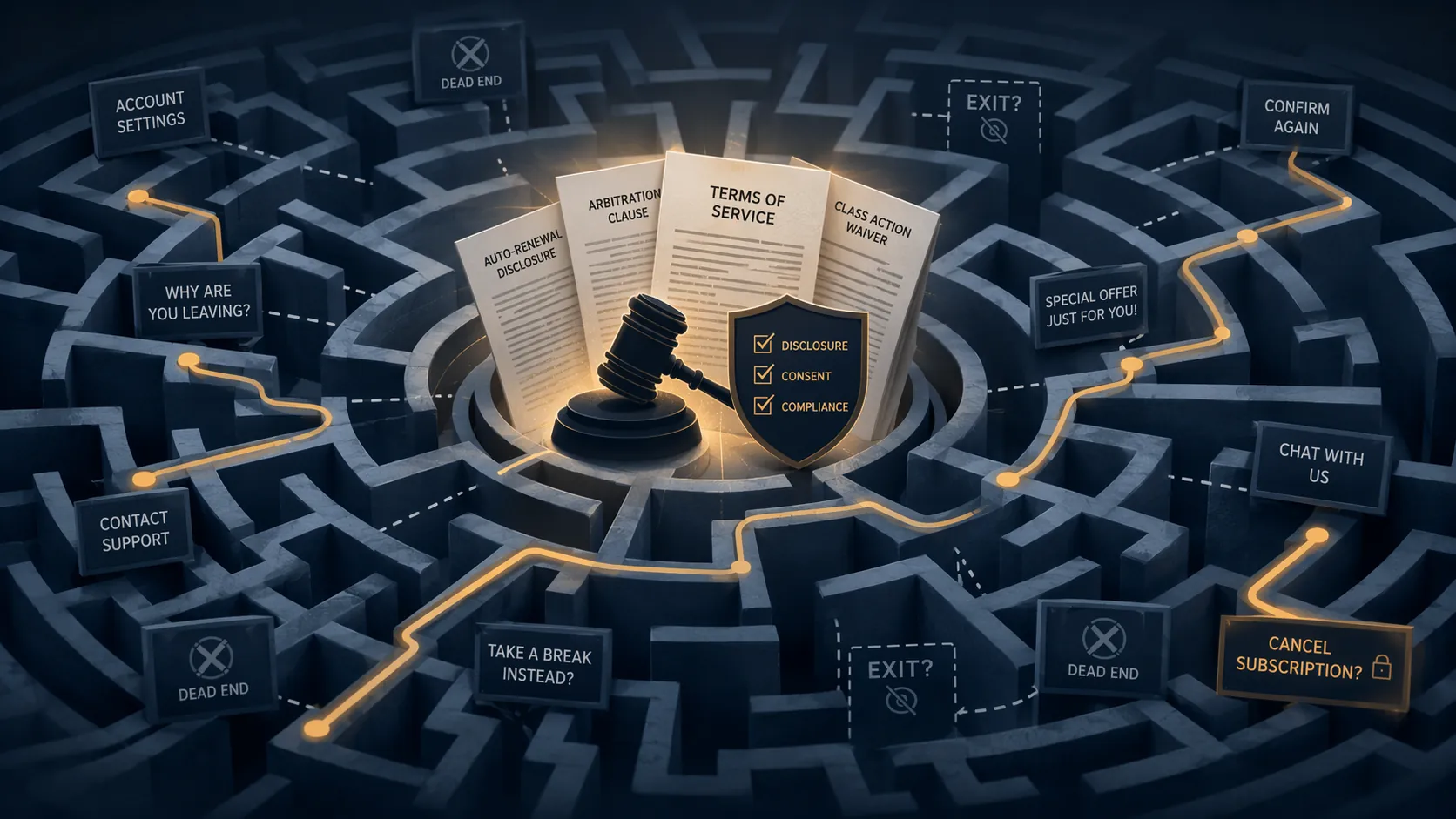
That eligibility point matters because many readers arrive here with a refund question. But the settlement’s longer shelf life is not the mechanics of individual redress. For legal-tech buyers, compliance officers, and law-firm procurement teams, the durable issue is that subscription interface design has become an enforcement record: enrollment prompts, payment disclosures, decline buttons, renewal architecture, cancellation paths, internal UX commentary, and document handling all moved from product operations to litigation material.
What the settlement actually establishes
The FTC framed the Amazon matter under the Restore Online Shoppers’ Confidence Act, or ROSCA, and Section 5 of the FTC Act. The agency said the $1 billion civil penalty was the largest ever for an FTC rule violation, while the $1.5 billion redress component was the second-highest restitution award the FTC had obtained.[1] Those labels are not cosmetic. A subscription interface that converts users into recurring charges without clear consent, or makes stopping charges materially harder than starting them, is now attached to a settlement number large enough for board materials.
The case did not produce a fully adjudicated merits ruling. Amazon settled three days into trial, so the disputed legal theories were not tested through final judgment. That distinction matters. The settlement binds Amazon through its stipulated terms; it does not, by itself, enact a new statute or revive a vacated rule. Still, enforcement benchmarks often travel through procurement practice before they travel through appellate doctrine. A buyer does not need a Supreme Court holding to ask why a vendor’s cancellation path takes more screens than enrollment.
The stipulated order’s operational terms are the part procurement teams should read like a controls document. Amazon must use clear decline options that are as prominent as acceptance options, disclose material subscription terms before collecting payment information, make cancellation at least as easy as enrollment through the same method used to enroll, and operate under an independent third-party compliance monitor.[1][6]
The “Iliad Flow” is the part every subscription vendor should diagram
The FTC’s complaint focused heavily on what was described as Amazon’s “Iliad Flow,” a cancellation sequence alleged to require four pages, six clicks, and fifteen options to cancel Prime, compared with one to two clicks to enroll.[2] The name is memorable, but the compliance lesson is prosaic: when a company can measure the difference between joining and leaving, so can a regulator, a plaintiff’s lawyer, or a customer’s procurement team.
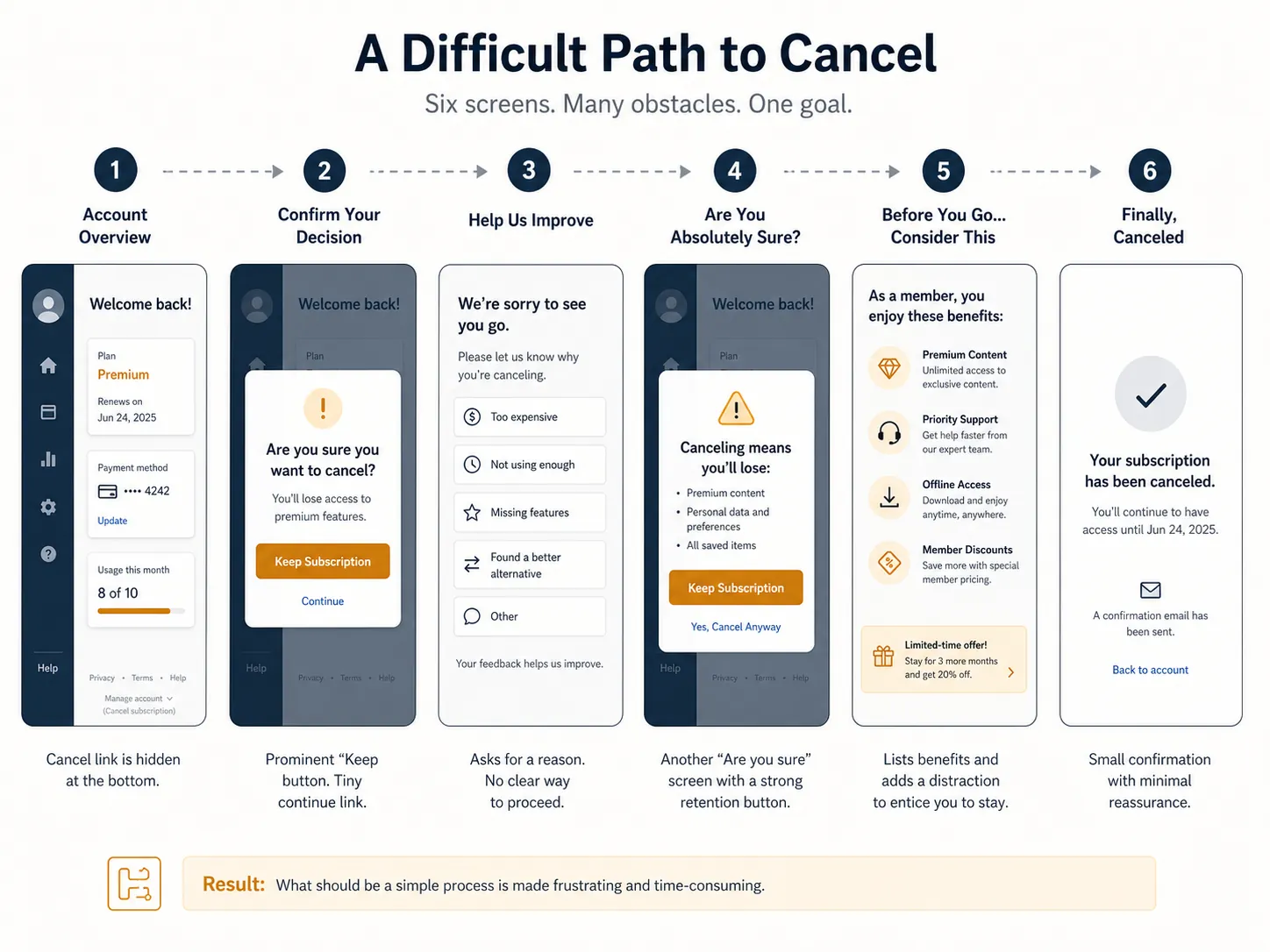
For legal-tech platforms, the comparable issue is rarely labeled “cancel.” It may be hidden in an admin portal, tied to seat reductions, routed through an account representative, deferred until annual renewal, or split between product access and billing authority. A law firm can often add a trial workspace, enable an AI research module, or increase seats inside a vendor dashboard faster than it can terminate the same access or stop the next renewal invoice. That asymmetry is the audit surface.
A cancellation path does not have to be hostile to create risk. It only has to make the legally material action less visible, more conditional, or procedurally heavier than the enrollment action. If a vendor lets a knowledge-management administrator activate a paid AI add-on in-product but requires cancellation by emailed notice to a sales address, procurement counsel should not treat that as a mere customer-success preference. It is a control question.
The Click-to-Cancel vacatur did not clear the field
The most common misreading of the 2025 enforcement landscape is that the Eighth Circuit’s vacatur of the FTC’s Click-to-Cancel Rule ended federal dark-pattern exposure. It did not. The Eighth Circuit vacated the rule on July 8, 2025 because the FTC failed to conduct a mandatory preliminary economic analysis before rulemaking; the court did not hold that dark-pattern enforcement itself was unlawful.[3]
That procedural distinction is not academic. The Amazon settlement was reached after the rule vacatur, and the FTC proceeded through existing authority rather than waiting for a new rulemaking cycle. The same post-vacatur enforcement environment included actions involving Chegg, Uber One, LA Fitness, and Adobe, confirming that regulators still had statutory tools even without the Click-to-Cancel Rule in force.[4][5]
For legal-tech review, the point is straightforward: a vendor cannot answer a subscription-interface diligence request by saying the Click-to-Cancel Rule was vacated. That may be relevant to a narrow rule-compliance analysis. It does not answer whether the vendor’s recurring billing, renewal consent, cancellation mechanism, or interface language can be defended under ROSCA, Section 5, state consumer-protection laws, contract doctrines, or customer-specific procurement obligations.
Why internal UX communications are now a procurement issue
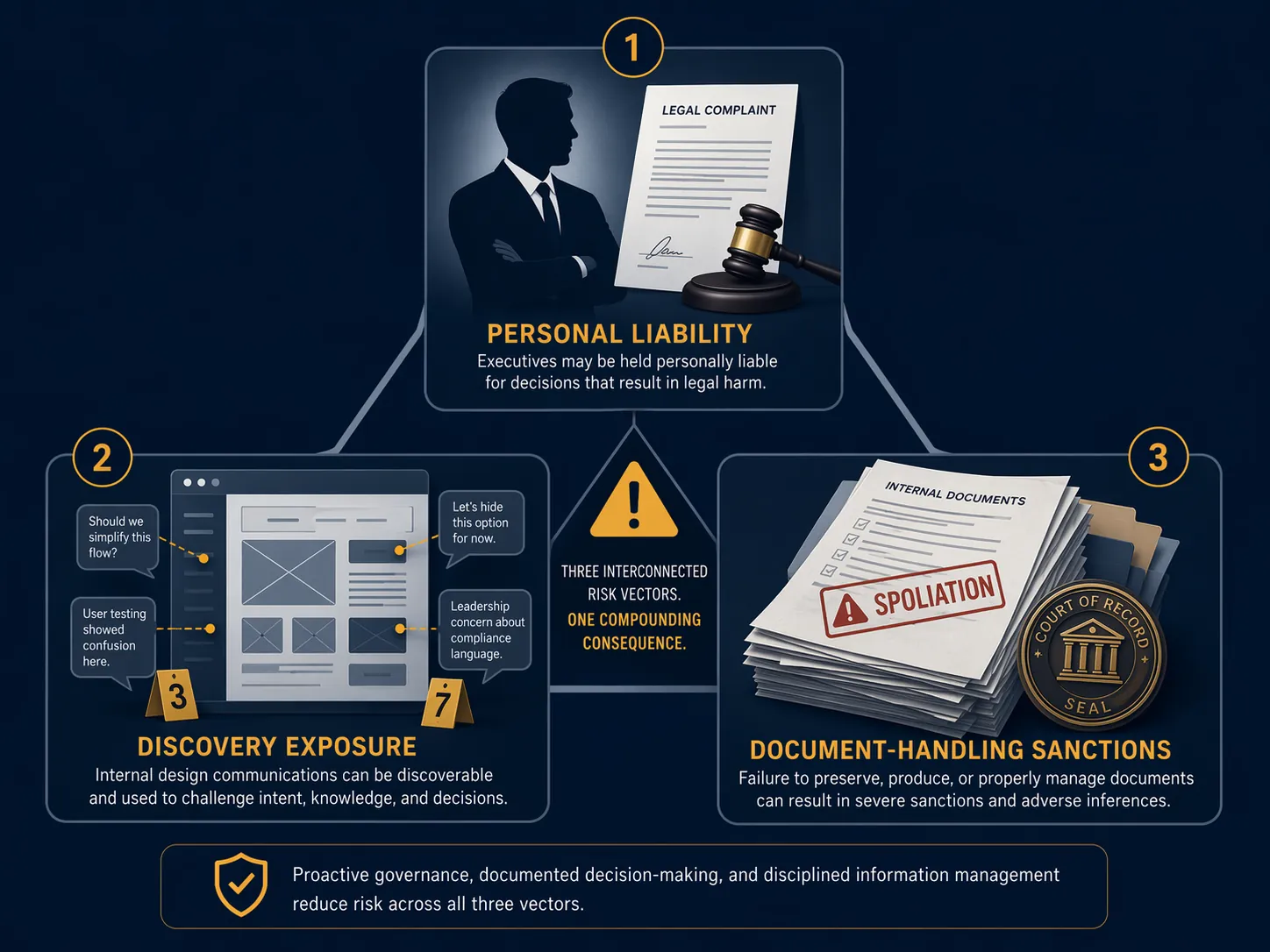
The most uncomfortable facts in the Amazon record are not the click counts. They are the internal descriptions. Public analyses of the litigation record identified emails in which employees described Prime enrollment as “a bit of a shady world,” unwanted subscriptions as “an unspoken cancer,” and referenced a “chief dark arts officer.”[3][4] Those phrases do what polished policy language cannot undo: they create a discoverable record of how people inside the company understood the design environment.
Legal-tech vendors should be especially careful here because their product teams often work in dense collaboration with legal, security, sales, customer success, and AI-governance personnel. A Slack thread joking about “burying” cancellation, a ticket asking design to “make the downgrade less attractive,” or a growth memo celebrating “involuntary retention” may later be read by someone with no patience for product shorthand. If the company’s actual position is that a design choice improves clarity, security, or license integrity, the record should say that. If the real purpose is to create friction around stopping payment, the record may say that too, even when no one intended to write a litigation exhibit.
This is where vendor due diligence should stop treating UX as a demo topic and start treating it as a documentable compliance surface. Procurement counsel does not need every Figma file. But for subscription products that auto-renew, convert trials, bill by seat, or meter AI usage, buyers should ask who reviews enrollment and cancellation flows, what standards they apply, where approvals are logged, and whether legal review occurs before payment collection and renewal prompts are changed.
The document-handling episode is not a side note
The Amazon litigation also produced a court-sanctioned document-handling issue. Public commentary on the case states that Amazon initially withheld 70,000 documents under privilege claims and later withdrew 92% of those claims upon review, with the court sanctioning Amazon for bad-faith withholding.[4] That episode changes how a legal department should think about subscription UX evidence. The problem is not only whether the interface was lawful; it is whether the organization can credibly preserve, classify, review, and produce the records that explain it.
Legal-tech vendors sell into customers who themselves live under preservation duties. A vendor that cannot explain how product-decision records, legal-review comments, A/B test results, cancellation analytics, and customer-complaint escalations are retained creates a secondary risk for institutional buyers. The buyer may never be sued over the vendor’s interface. But the buyer may still have to answer why procurement accepted opaque billing and cancellation controls from a vendor handling privileged workflows, client data, or firmwide research access.
Privilege discipline is part of this review. Communications are not privileged because a lawyer was copied. Product teams should not be trained to launder ordinary business decisions through legal channels, and legal teams should not allow genuine advice to become indistinguishable from growth commentary. When interface design becomes evidence, sloppy privilege practices become leverage.
Personal liability moves the issue above product operations
The FTC’s case named two Amazon executives, Senior Vice President Neil Lindsay and Vice President Jamil Ghani, as individual defendants.[1] That fact should get more attention in legal-tech boardrooms than another generic warning about “dark patterns.” Individual naming changes the internal audience for subscription-interface review. It is no longer just the head of growth, the product manager, or the billing operations lead. The executives who approve retention strategy, renewal economics, and customer-conversion targets may become part of the enforcement story.
This does not mean every difficult cancellation path creates personal liability. The narrower and better-supported lesson is that regulators may look for senior knowledge and continued maintenance of challenged flows. A legal-tech company with recurring revenue tied to annual firmwide contracts, AI add-ons, or seat expansion should be able to show that leadership received accurate information about consent, renewal, cancellation, and complaint trends—not only revenue dashboards.
What legal-tech buyers should inspect now
Amazon was not a legal-tech case. It was a consumer subscription case involving Prime. The bridge to legal tech is not the product category; it is the subscription architecture. Legal research platforms, AI drafting tools, litigation analytics products, contract-review systems, e-discovery add-ons, and firm knowledge platforms increasingly use self-service trials, tiered access, auto-renewal, usage-based billing, seat expansion, and in-product upgrade prompts. Those are the same kinds of interfaces where consent and cancellation evidence is created.
| Subscription-interface surface | Procurement question | Evidence worth requesting |
|---|---|---|
| Trial-to-paid conversion | Does the user see material payment, renewal, and cancellation terms before payment information is collected? | Current enrollment screens, term-disclosure placement, change logs, legal approval record |
| AI add-on activation | Can an admin enable paid functionality faster than the firm can disable it or stop recurring charges? | Role-permission matrix, enablement and disablement workflow, billing-trigger documentation |
| Seat expansion | Are additional users, practice groups, or matters added through prompts that clearly identify price consequences? | Seat-addition prompts, invoice mapping, admin confirmation screens |
| Cancellation or downgrade | Is cancellation available through the same channel used to enroll, with comparable effort and prominence? | Cancellation flow screenshots, click path, account-representative dependency, notice requirements |
| Renewal notices | Are renewal terms and deadlines delivered to the person with actual authority to approve spend? | Renewal notice templates, delivery logs, contract-owner mapping |
| UX governance | Who reviews interface changes that affect consent, payment, renewal, or cancellation? | Approval workflow, product tickets, legal-review criteria, retained A/B test summaries |
| Document preservation | Can the vendor preserve and produce design-intent records without overclaiming privilege? | Retention schedule, privilege-review protocol, litigation-hold process for product records |
The practical review should compare paths, not just policies. A master services agreement may say cancellation is allowed at renewal. The interface may tell a different story: downgrade buttons buried under benefits messaging, “contact sales” loops, unclear effective dates, or post-cancellation screens that still leave paid modules active. Procurement teams should capture both the contract language and the operational path a customer must actually follow.
For vendors, this is also a design-documentation problem. If a cancellation step exists because the vendor must verify administrator authority, preserve client data, prevent accidental deletion, or coordinate ethical walls, the record should identify that legitimate function. If the step exists mainly to save revenue by delaying customer exit, the Amazon record shows why that rationale should not live casually in product notes.
Risk classification for legal-tech procurement
The Amazon Prime settlement belongs in a legal-tech risk digest because it turns subscription UX into a reviewable compliance category. Its significance is not that Amazon sells legal AI, and not that a vacated Click-to-Cancel Rule quietly came back to life. The significance is that existing statutes supported a major settlement involving recurring-charge consent, cancellation friction, individual executives, internal design communications, and sanctioned document handling.
A legal-tech vendor that monetizes access through subscriptions should expect sophisticated buyers to ask for proof that enrollment, renewal, upgrade, downgrade, and cancellation flows have been reviewed as legal-risk surfaces. A law firm or corporate legal department buying that tool should ask before signing, not after a renewal dispute, regulator inquiry, or preservation notice. Even after the Click-to-Cancel vacatur, cancellation friction is not safely outside legal review simply because product growth calls it retention.
References
- FTC Secures Historic $2.5 Billion Settlement Against Amazon — Federal Trade Commission — Sept. 25, 2025 — link
- A Prime Example of Dark Patterns: FTC Sues Amazon for Use of Dark Patterns in Prime Enrollment — Davis+Gilbert — link
- Eighth Circuit Vacates the FTC’s Click-to-Cancel Rule, But Federal and State Regulators Likely to Remain Active — WilmerHale — Aug. 1, 2025 — link
- Click-to-Cancel Is Mostly Dead, But Amazon Settlement Proves Enforcement Lives On — Nelson Mullins — link
- Dark Patterns Lead to Enforcement Spotlight: Key Compliance Steps for Businesses — Reed Smith — link
- Amazon’s $2.5B Dark Patterns Settlement: What All E-Retailers Must Change Now — Fair Patterns — link
Related records
Tool profile
Browse tool evaluations →Governing regulation
Browse the obligations tracker →Preventive workflow
Browse verification workflows →
Report a correction or tip
Spotted an outdated figure, a misstated fact, or a ruling this case record should reflect? Public comments are disabled for this content given the professional cost of a misreported case outcome, penalty amount, or rule text — use the structured correction channel instead.
Report a correction or tip for this record →