
Amazon Prime Settlement Sets Subscription Compliance Benchmark
The $2.5B Amazon Prime FTC settlement provides a concrete compliance benchmark for subscription-based businesses. This article distills the settlement's six-part audit checklist and personal-liability implications for in-house counsel assessing their own enrollment and cancellation flows.
- Jurisdiction
- US Federal
- Court
- U.S. District Court for the Western District of Washington
- AI tool named
- Amazon Prime
- Ruling date
- Sep 1, 2025
- Source document
- View primary court order ↗
- Last verified
- Jul 26, 2026
Lex Machina Review is an independent risk-tracking and reference resource. Nothing on this site is legal advice, and using it does not create an attorney-client relationship. Every record is reviewed against primary sources but may not reflect the most current status of a matter — always verify directly against the cited court order, rule text, or a licensed attorney before relying on it.
Companion explanation — secondary to the source document above
For consumers searching “amazon prime settlement claim deadline how to file,” the immediate date is July 27, 2026: that is the FTC’s posted deadline for eligible consumers to submit a claim through the Amazon Prime settlement refund process.[1] But as that window closes, the more durable consequence of the case is not the claim form. It is the interface record the settlement leaves behind for every company selling a negative-option subscription.
The settlement requires Amazon to pay a $1 billion civil penalty and create a $1.5 billion redress fund for roughly 35 million consumers. The FTC described the civil penalty as the largest ever for an FTC rule violation, and the redress fund as the second-highest restitution award ever obtained by FTC action.[2] For counsel, the significance is not just that the number is large. It is that the money is paired with ordered product changes, named individual obligations, and an independent compliance mechanism.
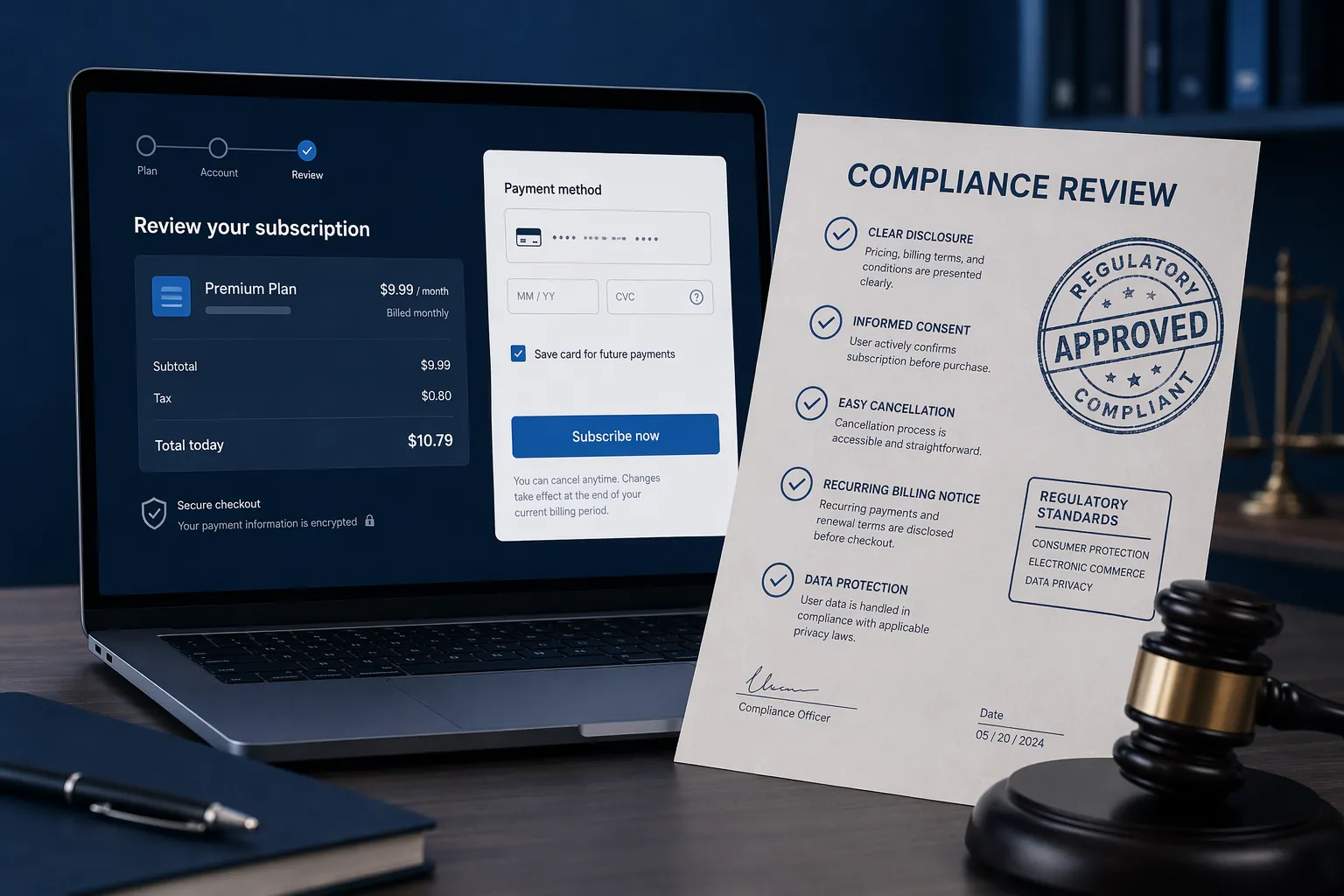
That combination changes the internal conversation. A checkout redesign can no longer be defended only as a conversion experiment if the decline path, paid-subscription disclosure, or cancellation route would look bad when frozen into a complaint exhibit. Product screens are evidence. Button copy is evidence. The number of steps between “cancel” and “actually canceled” is evidence.
What the FTC actually objected to
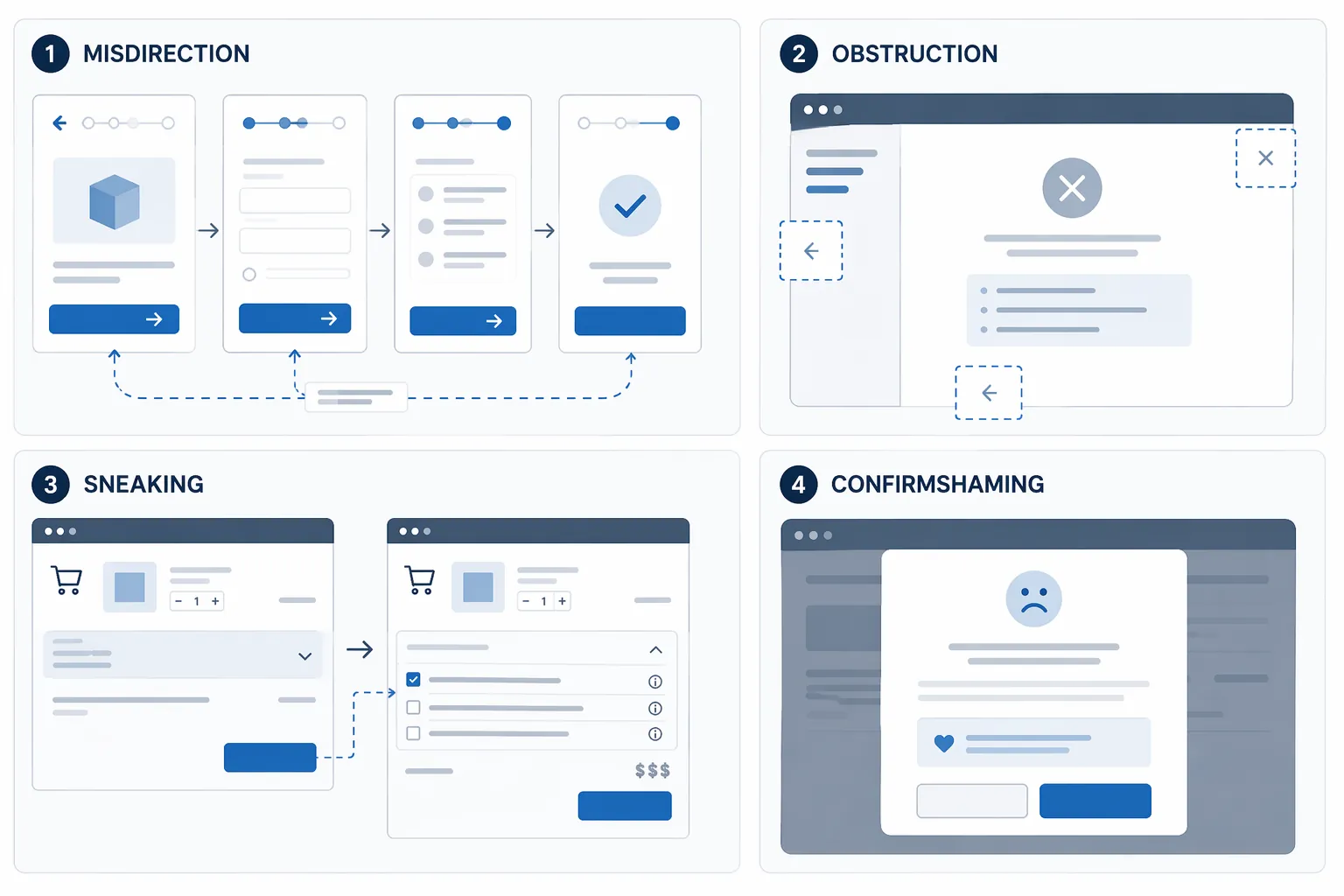
The useful part of the Amazon record is its specificity. The FTC’s case did not rest on a general dislike of subscriptions, free trials, or interface testing. It challenged enrollment and cancellation designs that allegedly made Prime easier to start than to avoid or stop. Client alerts tracking the case identified four dark-pattern categories at issue: misdirection, obstruction, sneaking, and confirmshaming.[3]
Those labels are only helpful if they are translated back into the screens people actually ship. The FTC’s allegations and related analysis focused on Amazon surfaces including the universal Prime decision page, the shipping selection page, single-page checkout, and Prime Video enrollment flow.[3] Those are ordinary product moments: a user is buying something, choosing delivery, watching video, or trying to complete a transaction. The compliance issue is whether the subscription choice is made clear at the moment the user acts.
| FTC category | Interface question counsel should ask | Practical audit target |
|---|---|---|
| Misdirection | Does the screen visually steer the user toward Prime while making the non-Prime path harder to notice? | Compare prominence, placement, color, and language of accept and decline paths. |
| Obstruction | Does avoiding or canceling the subscription require unnecessary screens, detours, or repeated confirmations? | Count steps, decision points, and dead ends from enrollment through cancellation. |
| Sneaking | Is the paid nature of the offer, renewal, or charge disclosed only after the user has acted or in a place unlikely to be read? | Move material terms before the enrollment action and test them on the actual device view. |
| Confirmshaming | Does button copy pressure the user by making refusal sound irrational, embarrassing, or self-defeating? | Replace guilt-based refusal language with neutral decline language. |
| Disclosure placement | Are price, renewal, and cancellation terms visible before consent rather than hidden in secondary text? | Treat material terms as part of the enrollment control, not as legal footer material. |
| Cancellation parity | Can the customer cancel through the same medium used to enroll? | Test web-to-web, app-to-app, and other same-medium cancellation paths before release. |
The six audit points that now belong in subscription review
The settlement remedies turn the FTC’s dark-pattern vocabulary into a workable review sequence. They include eliminating deceptive enrollment buttons, adding a clear and conspicuous decline option, front-loading material disclosures, requiring cancellation through the same method used to enroll, and appointing an independent monitor.[4] A lawyer reviewing a subscription flow does not need to turn every release meeting into litigation discovery. But the lawyer does need a repeatable way to ask whether the user’s consent is clean.
1. Start with the decline path, not the accept button
The most useful first question is simple: where is the “no” path? On a subscription offer page, counsel should ask product and UX to identify the exact control that lets a user continue without enrolling. If the team has to explain that the user can avoid enrollment by closing a modal, clicking a less prominent text link, scrolling past the offer, or selecting a button whose consequence is not obvious, the screen is not ready for legal signoff.
One remedy singled out in commentary on the order was the elimination of the “No, I don’t want Free Shipping” button and the requirement for a clear, conspicuous decline option.[4] That matters because refusal language is not cosmetic. A decline button that frames the customer as rejecting a benefit instead of declining a paid subscription can obscure the actual choice being made.
2. Put the paid nature of the offer before the action
Subscription teams often treat price, renewal, and cancellation terms as disclosures to be attached somewhere near the offer. That is not enough if the user can take the enrollment action before understanding that the offer creates a paid recurring relationship. The audit should look at the screen in the same state the customer sees it: mobile viewport, checkout pressure, competing delivery information, and any preselected or emphasized option.
For the shipping selection page and single-page checkout examples, the practical issue is timing. If a user is trying to finish a purchase, a subscription enrollment offer must not borrow the momentum of checkout while pushing the cost and renewal consequences into weaker visual space. Legal review should require screenshots showing the disclosure before the enrollment click, not a later confirmation email or account page.
3. Treat button copy as a regulated control
Button copy tends to arrive late in review, often as a brand or growth decision. In a subscription flow, it deserves earlier treatment. “Start,” “continue,” “try,” “claim,” “unlock,” and “get free shipping” may all be acceptable in some contexts and misleading in others. The question is whether the words tell the user that clicking creates or continues a paid negative-option relationship.
Confirmshaming should be easier to catch. If the refusal option tells the user they do not want savings, convenience, protection, or some other obviously desirable benefit, the copy is doing more than offering a choice. It is pressuring the user to accept. Neutral refusal language is not a style preference; after this settlement, it is a risk control.
4. Count cancellation friction the same way growth counts conversion
Cancellation review should not stop at whether cancellation is technically possible. Counsel should ask customer support and product teams to walk the live path: where the customer starts, how many pages appear, how many times the customer must reaffirm the decision, whether alternative offers interrupt the path, and when the account actually stops renewing.
Obstruction is often built out of individually defensible moments. A reminder of benefits, a survey, a downgrade offer, a final confirmation, a retention discount: none of those features is automatically unlawful in isolation. The risk appears when the architecture makes exit materially harder than entry. That is why the same team that A/B tests enrollment should be able to produce a cancellation-step map.
5. Require same-medium cancellation
One of the clearest operational lessons is cancellation parity. The order requires cancellation through the same method used to enroll.[4] If a customer can enroll on the web, the customer should not be forced to call. If a customer can enroll in an app, the app experience should not become a maze that ends in a desktop-only instruction.
This is the point in an audit where legal needs help from support data. Complaint logs, chat transcripts, refund requests, and chargeback narratives often reveal where the cancellation path fails long before a regulator does. If customers repeatedly say they could not find how to cancel, that is not just a service issue. It is evidence about the interface.
6. Preserve the review record
A clean flow should leave a clean file. Counsel should preserve the tested screenshots, device views, button variants, disclosure text, cancellation step counts, support escalation data, and the decision-maker list for material subscription changes. If the company later has to explain why it believed the customer gave informed consent, a vague statement that legal reviewed the page will not be as useful as a dated audit tied to the actual interface.
This does not mean every color change needs a memo. It means changes affecting price disclosure, renewal consent, decline language, enrollment placement, cancellation access, or retention steps should have a documented review. Those are the controls the Amazon settlement makes visible.
Why executives should be in the room
The settlement also changes who should care internally. The FTC announced obligations not only for Amazon, but also for Neil Lindsay, former Senior Vice President of Amazon Worldwide Prime, and Jamil Ghani, former Vice President of Amazon Prime.[2] Analysis of the settlement described those individual obligations as lasting three years.[5]
Individual obligations do not make every subscription manager personally liable for every disputed button. They do send a governance signal. If senior leaders approve or tolerate high-friction cancellation architecture, the issue is no longer a periodic marketing-page cleanup. It belongs in product governance, risk review, and board-level reporting when the subscription program is material.
The independent third-party compliance monitor reinforces that point.[4] A monitor is not a copy edit. It is an external accountability structure imposed because the regulator does not trust ordinary internal process to be sufficient. For companies outside the order, the practical question is whether they can show a serious internal equivalent before anyone asks for one.
The benchmark has limits
The Amazon order should not be overstated. It is a settlement, not a universal subscription code. It binds the parties to the order and reflects the facts, claims, and remedies in that case. Counsel should be careful with any advice that turns it into a complete replacement for the FTC Act, ROSCA, state automatic-renewal laws, payment-network rules, or sector-specific requirements.
The broader legal terrain is still moving. The Eighth Circuit vacated the FTC’s Click-to-Cancel Rule in July 2025, and the FTC had recurring-subscription rulemaking activity underway in March 2026. The Amazon settlement also includes a savings clause contemplating that future FTC Negative Option Rulemaking may supersede its terms.[5] That is an awkward posture for compliance teams: one prominent rule was vacated, another rulemaking track is active, and a major settlement now supplies the clearest operational map.
That awkwardness is not a reason to wait. If anything, it makes the settlement more useful. A company can acknowledge that the law is unsettled while still auditing against the concrete remedies the FTC just obtained: clear decline, front-loaded disclosures, same-medium cancellation, neutral copy, reduced obstruction, and documented oversight.
A practical audit file
The safest internal response is not a memo saying the company has reviewed the Amazon case. It is a subscription-flow audit that attaches the current enrollment and cancellation screens, maps them to the settlement’s specific remedies, records the support evidence considered, and names the business owner responsible for fixes.
- Capture every enrollment surface where a user can start a paid or trial subscription.
- Mark the accept path, decline path, price disclosure, renewal disclosure, and cancellation disclosure on each screen.
- Run the cancellation path from the same medium used for enrollment and count every required action.
- Review refusal and retention copy for pressure, guilt, ambiguity, or benefit-framing that hides the paid-subscription choice.
- Compare support complaints, refund requests, and chargebacks against the screens the team believes are compliant.
- Save the evidence, decision notes, and remediation plan before the next experiment ships.
The Amazon Prime settlement is not the entire law of negative-option subscriptions. It is now the clearest enforceable map counsel can use when reviewing enrollment and cancellation flows under the FTC Act and ROSCA. Treat it less as a story about Amazon and more as a set of product questions that should be answerable before Friday’s checkout release.
References
- Amazon Refunds | Federal Trade Commission — Federal Trade Commission
- FTC Secures Historic $2.5 Billion Settlement Against Amazon — Federal Trade Commission, September 2025
- FTC Targets 'Dark Patterns' in Actions Against Amazon and Publishers Clearing House — WilmerHale
- An Amazonian-Sized Settlement: FTC Secures $2.5 Billion Against Amazon for Use of 'Dark Patterns' In Prime Enrollment Scheme — Davis+Gilbert
- Amazon Settles FTC Dark Patterns Case with $2.5B Payout — National Law Review/Katten
Related records
Tool profile
Browse tool evaluations →Governing regulation
Browse the obligations tracker →Preventive workflow
Browse verification workflows →
Report a correction or tip
Spotted an outdated figure, a misstated fact, or a ruling this case record should reflect? Public comments are disabled for this content given the professional cost of a misreported case outcome, penalty amount, or rule text — use the structured correction channel instead.
Report a correction or tip for this record →