
AMD's AI Bubble Denials and Securities-Fraud Risk
AMD's AI revenue projections and CEO Su's denial of an AI bubble create a disclosure gap aligning with the SEC's AI-washing enforcement theory. Analogous cases like Richtech Robotics and Fermi Energy show that such statements can survive motions to dismiss, though AMD's tailored risk factors and the PSLRA safe harbor remain available defenses.
- Jurisdiction
- US Federal
- Court
- Northern District of California
- AI tool named
- C3.ai
- Ruling date
- Mar 12, 2026
- Source document
- View primary court order ↗
- Last verified
- Jul 29, 2026
Lex Machina Review is an independent risk-tracking and reference resource. Nothing on this site is legal advice, and using it does not create an attorney-client relationship. Every record is reviewed against primary sources but may not reflect the most current status of a matter — always verify directly against the cited court order, rule text, or a licensed attorney before relying on it.
Companion explanation — secondary to the source document above
The legal problem in AMD’s AI story is not that management is optimistic. Public companies are allowed to compete for attention, capital, customers, and talent. The problem, if one later develops, is the distance between AMD’s public-facing certainty and the uncertainty it preserved in its filings.
That distance is now easy to mark up. At its November 2025 Investor Day, AMD projected more than $100 billion in cumulative AI revenue over the next three to five years.[1] Its OpenAI arrangement adds an even more concrete exhibit: a 6-gigawatt GPU deployment deal paired with a warrant for up to 160 million AMD shares at $0.01 per share, vesting against GPU purchase milestones and stock-price targets.[2] CEO Lisa Su also publicly rejected the idea that AI demand reflects a bubble.[1]
Then the 2025 Form 10-K gives the defense file its own exhibits. AMD warned that “the long-term trajectory of generative AI solutions is unknown,” that demand depends on customers’ actual utilization, and that export restrictions had already produced roughly $800 million in MI308 inventory charges, with $360 million later reversed.[2]
If AMD’s AI thesis disappoints, these are the sentences that will be placed side by side. Plaintiffs would not need to plead that AI was a fraud or that AMD invented demand from whole cloth. The more plausible theory would be narrower: AMD allegedly spoke about AI revenue, major customer adoption, and market durability in a register of confidence that did not match what it knew, or was warning elsewhere, about utilization, timing, export controls, and conversion of announced demand into recognized revenue.
That is why the legal issue is not really whether Su was right about macro demand. In securities litigation, the sharper question is whether the challenged statements would be treated as immaterial optimism, protected forward-looking statements, or actionable misstatements once paired with a later stock drop and a corrective-disclosure narrative.
The SEC’s AI-washing Theory Has Moved Out of the Speechmaking Phase
The enforcement backdrop matters because plaintiffs’ lawyers borrow SEC vocabulary quickly. “AI washing” began as a useful label for exaggerating the role, quality, or commercial significance of artificial intelligence. It is now a framework for pleading that a company’s AI narrative gave investors a misleading picture of what the company actually had, sold, used, or could monetize.
The first SEC AI-washing actions came in March 2024 against investment advisers Delphia and Global Predictions, which paid $225,000 and $175,000, respectively, to settle allegations about misleading AI-related claims.[3] Those cases were adviser cases, not operating-company revenue-disclosure cases, but they supplied the basic enforcement grammar: if a firm claims AI capability or AI-driven performance, the SEC will ask whether the claim is accurate, substantiated, and consistent with actual operations.
By January 2025, the theory had reached a reporting company. The SEC action against Presto Automation was described as the first AI-washing case against a public reporting company, moving the issue closer to the 10-K, earnings-call, and investor-presentation setting that matters for AMD.[4] The 2024–2025 Joonko and Nate criminal cases show an additional escalation path: when AI claims are tied to alleged deception about customers, technology, or commercial traction, the government may treat the facts as more than disclosure hygiene.[4]
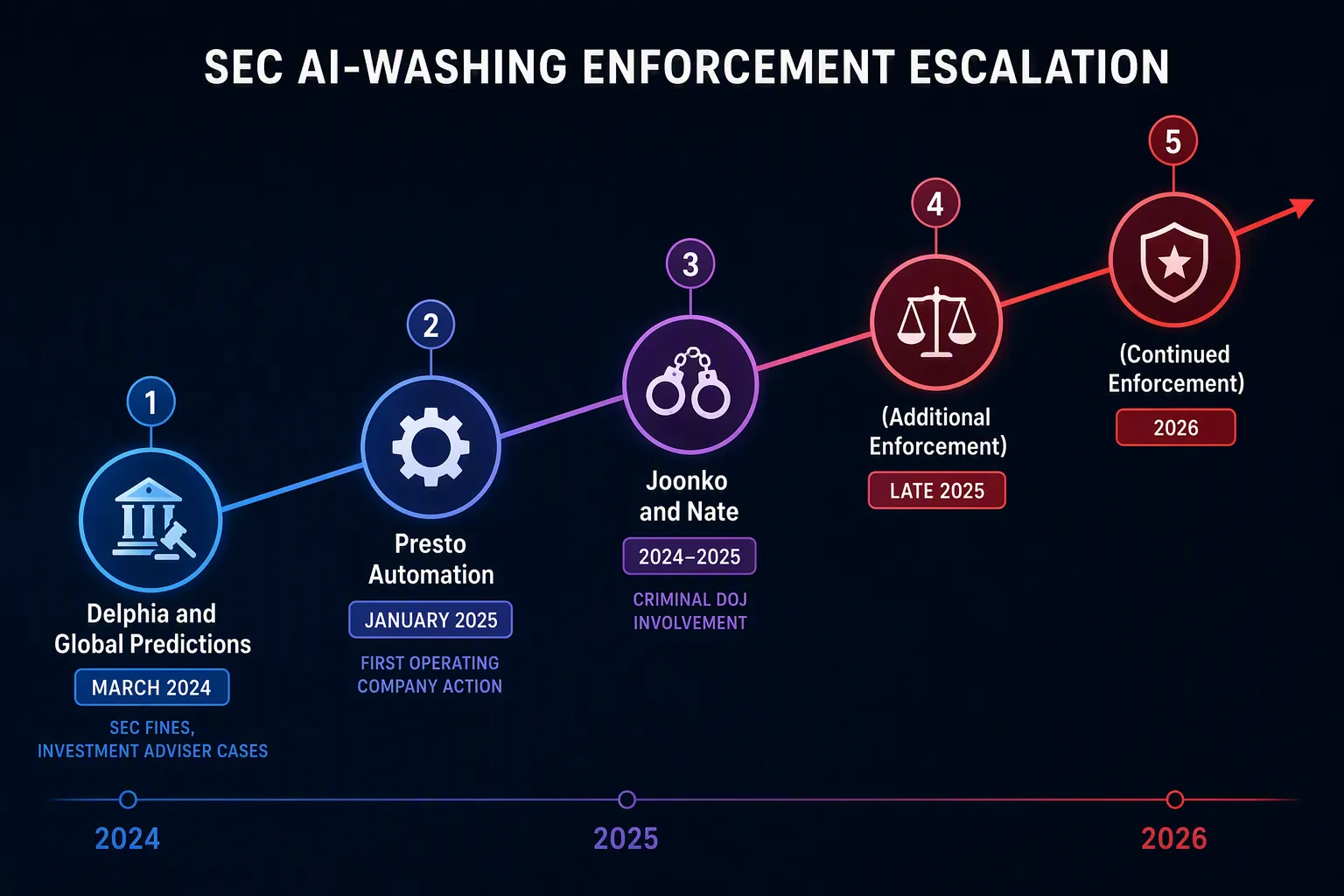
This does not mean AMD faces an SEC action. No AMD securities suit is identified in the research record as of July 2026, and enforcement exposure cannot be inferred merely from a large AI forecast. The useful point is more technical: the SEC has made AI claims a disclosure category, and private plaintiffs now have a tested vocabulary for converting AI enthusiasm into misrepresentation, omission, scienter, loss-causation, and control-person allegations.
What the Closest Private Cases Actually Add
The analogies that matter are not generic “AI bubble” complaints. They are cases showing how plaintiffs arrange AI statements around partnership claims, customer-demand narratives, market reaction, and later corrections. Richtech Robotics, Fermi Energy, and C3.ai are useful for that limited purpose. They do not resolve AMD’s exposure, and they are not merits-stage proof that similar claims should win.
Richtech Robotics: the partnership pump model
Richtech Robotics is the cleanest pleading model because it turns on the inflationary force of a named technology relationship. According to the reported complaint history, Richtech’s stock rose 44% after the company announced what investors understood as a Microsoft collaboration. Hunterbrook Media later reported that the arrangement was a standard customer program available to anyone. Richtech’s stock then dropped 20.87%, and a putative class action was filed on February 2, 2026 in Nevada under Sections 10(b) and 20(a).[5]
The AMD comparison is not one-to-one. OpenAI is not a vague badge pasted onto a press release; the disclosed arrangement includes deployment scale and warrant mechanics. That specificity helps AMD. But specificity also gives plaintiffs defined purchase milestones to interrogate. A future complaint would likely ask whether public descriptions of the OpenAI relationship blurred the distinction between contracted capacity, expected GPU purchases, customer utilization, revenue recognition, and stock-price-contingent warrant value.
That distinction is central. A 6-gigawatt deployment headline can be commercially meaningful without being equivalent to realized revenue. A warrant that vests against GPU purchase milestones and stock-price targets can signal alignment without proving end-customer utilization. Securities law does not require AMD to strip all enthusiasm from those facts. It does require that the enthusiasm not make the facts mean more than they do.
Fermi Energy: the demand-collapse model
Fermi Energy supplies a different template. The case, filed in January 2026 in the Southern District of New York, was described as the first AI-bubble securities case. The company was post-IPO, had no operating history, lost a single tenant, and saw its stock fall 59%. The complaint alleged that the company overstated tenant demand and relied too heavily on a single funding commitment.[6]
AMD is not a post-IPO company with no operating history, and that difference is not cosmetic. AMD has an established business, recurring reporting obligations, and product-line complexity that can make a single-customer-collapse theory harder to plead. But Fermi shows how quickly “AI demand” can become a securities-law allegation when market value depends on future users showing up on schedule.
For AMD, the corresponding issue would be customer utilization. Its own 10-K warns that demand depends on actual utilization of generative-AI solutions.[2] If later evidence showed that customers were delaying, underusing, or renegotiating AI infrastructure commitments while AMD continued to speak in confident cumulative-revenue terms, plaintiffs would have a pleading bridge between the risk factor and the challenged statements.
C3.ai: the deteriorating partnership model
C3.ai adds a partnership-disclosure variant. In the reported class action, plaintiffs alleged that the company overstated the depth of its Baker Hughes relationship and used flawed accounting to conceal deterioration in that relationship. The motion to dismiss was denied in part on March 12, 2026 in the Northern District of California.[7]
For AMD, the relevance is not Baker Hughes or accounting mechanics as such. It is the idea that a customer or partner relationship can become misleading when public descriptions lag the relationship’s actual condition. If a future AI customer arrangement remained technically in place but economics, timing, deployment appetite, or utilization materially weakened, the disclosure question would be whether AMD’s public statements updated investors with the same precision it used when announcing the upside.

The Filing Momentum Is Real, but It Should Not Do More Work Than It Can Bear
There is enough litigation activity to make this more than an academic exercise. NERA data cited in December 2025 reported 13 AI-related securities suits in the first half of 2025, compared with 16 for all of 2024. Allianz Commercial’s Eric Wedin said AI was “poised to surpass COVID-19 and crypto as a leading driver of D&O litigation.”[8]
That data supports likelihood of filing, not likelihood of liability. A filing wave tells counsel that AI-forward statements will be screened by plaintiffs’ firms after stock drops. It does not answer whether any particular complaint will plead falsity, scienter, loss causation, or damages. For AMD, the litigation significance is practical: if the stock reacts sharply to disappointing AI revenue, delayed OpenAI purchases, export-control disruption, or lower customer utilization, plaintiffs will already have models for the complaint.
| Pleading model | What plaintiffs would try to map onto AMD | What AMD would likely emphasize |
|---|---|---|
| Richtech Robotics | Named AI relationship allegedly inflated by market interpretation | OpenAI deal terms were specifically disclosed, including milestone mechanics |
| Fermi Energy | AI demand narrative allegedly undermined by loss or weakness in expected customers | AMD has an established operating history and disclosed demand-utilization uncertainty |
| C3.ai | Public partnership narrative allegedly lagged actual deterioration | A future claim would need particularized facts showing changed relationship conditions |
Private Securities Fraud Is Not the Same Case as SEC AI Washing
A private Section 10(b) case would have to do more than point to ambitious AI language. Plaintiffs would need to plead a material misstatement or omission, scienter, reliance, loss causation, and damages. Section 20(a) control-person claims would rise or fall with an adequately pleaded primary violation. A complaint that merely says AMD was bullish and the stock later fell should not survive Rule 12(b)(6).
The stronger private theory would be built from mismatched specificity. Plaintiffs would quote the $100 billion cumulative revenue projection, the OpenAI deployment and warrant structure, and Su’s denial of an AI bubble. They would then quote the 10-K language acknowledging that generative-AI trajectory and customer utilization remain uncertain, plus the export-control-related MI308 inventory charge. The argument would be that AMD possessed or warned of the precise uncertainties that made its AI-forward statements misleading when made.
Scienter would be the harder climb. Because Su and other executives are expected to know the company’s most important growth markets, plaintiffs would argue access to customer forecasts, purchase milestones, utilization signals, and export-control effects. But access allegations are not enough by themselves. The complaint would need particularized facts showing that management knew, or was reckless in not knowing, that the public AI story overstated the probability, timing, quality, or revenue implications of demand.
An SEC case could be structured differently. Depending on the provision used, the agency may not need to plead the same private-litigation package of reliance, loss causation, damages, and scienter. That is why the Delphia, Global Predictions, Presto, Joonko, and Nate sequence matters even if AMD never faces a class action. The SEC can ask a more compliance-centered question: were AMD’s AI claims adequately supported and consistent with what the company knew internally?
AMD’s Best Defense Is Also the Plaintiffs’ Best Exhibit
AMD’s risk factors are not afterthoughts. The 2025 10-K addresses uncertainty in generative AI’s long-term trajectory, dependence on customer utilization, and export-control consequences.[2] Those disclosures give AMD a serious PSLRA safe-harbor and bespeaks-caution argument for forward-looking AI revenue projections.
The safe-harbor fight would turn on tailoring. A long risk-factor section does not protect a company merely because it is long. The cautionary language must address the risk that allegedly materialized. If the later stock drop is tied to export restrictions, AMD’s MI308 disclosure may be directly relevant. If the drop is tied to slower-than-expected customer utilization, the utilization warning becomes central. If the drop is tied to a specific OpenAI milestone, the question becomes whether the warrant and purchase mechanics were described with enough clarity to prevent investors from treating potential purchases as banked revenue.
This is where corporate disclosure practice often becomes too clever by half. Companies want the market to credit specific upside: named customers, very large revenue opportunities, AI infrastructure scale, and management conviction. But when challenged, they point to generalized uncertainty. The defense works best when the risk factor is as specific as the upside. If the upside is “OpenAI deployment milestones,” the caution should speak in the vocabulary of deployment, purchases, utilization, timing, revenue recognition, and milestone nonachievement.
Nvidia’s crypto-disclosure history is the defense-side warning against overclaiming. The Supreme Court dismissed the Nvidia crypto-disclosure case in December 2024, showing that semiconductor revenue-disclosure claims can fail as a matter of law.[9] At the same time, the SEC had separately obtained a $5.5 million settlement from Nvidia over inadequate cryptomining disclosures, showing that adjacent enforcement theories can remain viable even when private litigation fails.[9]
For AMD, that means neither side gets an easy slogan. Plaintiffs cannot simply say “AI bubble” and avoid the PSLRA. AMD cannot simply say “risk factors” and assume the cautionary language matches every challenged statement.
The Hardest Sentences to Defend Later
In a future complaint, the most dangerous AMD statements would not necessarily be the most enthusiastic ones. Courts often tolerate corporate optimism, especially when phrased as belief, expectation, or market view. The more difficult statements are those that appear to convert uncertain AI adoption into measurable revenue confidence, or that invite investors to treat signed framework economics as equivalent to utilization-backed demand.
- Revenue projection risk: the $100 billion cumulative AI revenue figure gives plaintiffs a large, memorable number to connect to later disappointment.
- Customer-conversion risk: the OpenAI deployment and warrant terms may be framed as evidence of concrete demand, but plaintiffs would test what had actually become purchase commitments and recognized revenue.
- Utilization risk: AMD’s own 10-K language makes actual customer use of generative-AI solutions a known uncertainty.
- Export-control risk: the MI308 charge and partial reversal show that regulatory constraints can affect AI product economics in a way investors can measure.
- Tone risk: Su’s denial of an AI bubble is probably defensible as market opinion unless later facts show management had contradictory internal demand or utilization information.
The last point is important. A CEO saying the AI cycle is real is not securities fraud. A CEO saying, in substance, that demand is durable while internal materials show weakening utilization, slipping milestones, or customer reluctance would be a different pleading problem. The legal exposure lives in that evidentiary gap, not in the word “bubble” by itself.
Where the Legal Risk Lands
AMD’s profile is litigation-plausible, not liability-predetermined. Its AI-forward statements map cleanly onto current AI-washing pleading theories: large revenue projections, a marquee AI customer arrangement, market-moving expectations, and risk factors admitting uncertainty about generative-AI trajectory and customer utilization. Richtech Robotics, Fermi Energy, and C3.ai show how plaintiffs are arranging those ingredients into Section 10(b), Section 20(a), and related claims.
But those cases should be used with restraint. Richtech and Fermi are early pleading-stage models, not final adjudications of AI-washing liability. C3.ai survived in part at the motion-to-dismiss stage, which matters, but it does not decide whether AMD’s disclosures are misleading. The analogy helps identify where a complaint would be built; it does not supply the missing AMD-specific facts.
The decisive issue is whether AMD’s 10-K risk factors are sufficiently specific to the exact risks plaintiffs would attack: AI-demand durability, customer utilization, export-control disruption, projection assumptions, and the distinction between deployment milestones and revenue. If those warnings track the risk that later materializes, AMD has a substantial PSLRA safe-harbor defense. If public statements gave investors one level of certainty while the filing record and internal facts reflected another, the AI bubble warning becomes less a market debate than a securities pleading.
References
- Morningstar coverage of AMD November 2025 Investor Day and AI statements, Morningstar, Nov. 2025
- Advanced Micro Devices, Inc. 2025 Form 10-K, AMD, Feb. 2026
- SEC Announces First AI Washing Enforcement Actions, Holland & Knight, Apr. 2024
- AI-Washing Enforcement and Criminal Cases, NYSBA Journal, Jan. 2026
- Richtech Robotics Hit With AI-Washing Securities Suit, The D&O Diary, Feb. 2026
- First AI Bubble Securities Suit Filed Against Fermi Energy, The D&O Diary, Jan. 2026
- C3.ai Securities Class Action Motion to Dismiss Denied in Part, Hagens Berman, Mar. 2026
- AI D&O Litigation Trends and NERA Filing Data, Insurance Business Magazine, Dec. 2025
- Supreme Court Dismisses Nvidia Crypto-Disclosure Securities Case, The D&O Diary, Dec. 2024
Related records
Tool profile
How Meta's AI Spending Reshapes Law Firm ProfitabilityGoverning regulation
Browse the obligations tracker →Preventive workflow
Browse verification workflows →
Report a correction or tip
Spotted an outdated figure, a misstated fact, or a ruling this case record should reflect? Public comments are disabled for this content given the professional cost of a misreported case outcome, penalty amount, or rule text — use the structured correction channel instead.
Report a correction or tip for this record →