
Does American Airlines' contract cover its own IT outage?
The July 28, 2026, ground stop delayed thousands but most passengers fell below the contractual refund threshold. This analysis examines whether American Airlines' force majeure clause covers internal IT failures — and what that means for passenger claims and DOT regulatory exposure.
- Jurisdiction
- US Federal
- Court
- United States District Court
- AI tool named
- None
- Ruling date
- Jul 28, 2026
- Source document
- View primary court order ↗
- Last verified
- Jul 29, 2026
Lex Machina Review is an independent risk-tracking and reference resource. Nothing on this site is legal advice, and using it does not create an attorney-client relationship. Every record is reviewed against primary sources but may not reflect the most current status of a matter — always verify directly against the cited court order, rule text, or a licensed attorney before relying on it.
Companion explanation — secondary to the source document above
The contract is where the July 28 outage starts to matter
American Airlines' Conditions of Carriage, updated May 12, 2026, has a familiar force majeure architecture. It names weather, acts of God, strikes, civil disturbances, embargoes, wars, hostilities, unsettled international conditions, government regulations, demands or requirements, shortages of labor, fuel, or facilities, and labor difficulties. It also includes a broader residual phrase: "any fact not reasonably foreseen or predicted." IT system failures are not on the list.[1]
That omission is the legal hinge in the July 28 American Airlines ground stop. The disruption was publicly described by American as a "technology issue impacting connectivity," not as severe weather, air-traffic control congestion, a labor action, or a government restriction.[2] The event was brief in operational terms: a nationwide ground stop lasting about 45 minutes, followed by thousands of delayed passengers as the airline worked through the queue.[3] But a short operational event can still expose a long contractual problem when the carrier's tariff speaks fluently about twentieth-century interruptions and less clearly about the systems on which a modern airline actually depends.
As of July 29, 2026, American has not publicly disclosed the specific cause of the July 28 connectivity issue. That matters. A failure inside American's own systems does not present the same force majeure question as a third-party network failure, a vendor event, or some other condition outside the carrier's reasonable control. The analysis below therefore should not be read as a final factual classification. It is a contract-risk assessment on the facts currently public.
The clause lists many disruptions, but not the one now in dispute
Force majeure clauses do not operate as weather reports. They are drafted allocations of risk. The first question is not whether the event was inconvenient, widespread, or outside the passenger's control. The first question is whether the event falls within the risk categories the carrier wrote into its own contract.
American's clause comfortably anticipates several external interruptions. Storms and natural events are there. Government action is there. Labor and fuel constraints are there. Civil unrest and international conditions are there. A technology failure affecting connectivity is not. That does not automatically defeat a force majeure position, because the catch-all exists. But it changes the work the catch-all must do.
The interpretive problem is a familiar one. When a drafter lists specific events and then adds a general residual phrase, the general phrase is often read against the company of the listed terms. Here, the listed terms tend toward events external to ordinary airline systems management: weather, civil disturbance, labor difficulty, government requirements, and supply shortages. A carrier arguing that its own connectivity failure belongs in the same clause has to explain why the omission of technology failure is not meaningful.
American would not need to prove that every listed item is external in the same way. Labor difficulty, for example, can arise within the carrier's own enterprise. But the clause still shows what American knew how to name. It named operational disruptions that airlines have long treated as exceptional risks. It did not name reservation systems, flight-information systems, dispatch connectivity, cybersecurity events, vendor outages, data-center failures, or other technology dependencies. In a 2026 conditions document, that silence is not trivial.
The catch-all depends on foreseeability, and American has a 2025 problem
The catch-all phrase - "any fact not reasonably foreseen or predicted" - gives American its strongest textual route. If the July 28 outage was caused by an unusual external failure, a novel third-party collapse, or a condition the airline could not reasonably anticipate, the omission of IT failures from the enumerated list may matter less. The catch-all is broad enough to invite that argument.
But foreseeability is not the same as precise prediction. A carrier need not foresee the exact minute, server, vendor, protocol, or failure path for a category of risk to be reasonably foreseeable. The practical question is whether a technology outage affecting operations was still an unanticipated kind of event for American by July 2026.
That is where the June 27, 2025 outage becomes important. CNN reported that American's operations were returning to normal after a widespread computer outage, with more than 40% of flights delayed and 7% canceled that day.[4] That episode does not prove liability for the July 28, 2026 ground stop. It does not prove that the systems were the same, that the cause was the same, or that American failed to maintain anything. It does, however, make it harder to say that a flight-information or connectivity failure was outside the universe of reasonably foreseeable operational risks for this carrier.
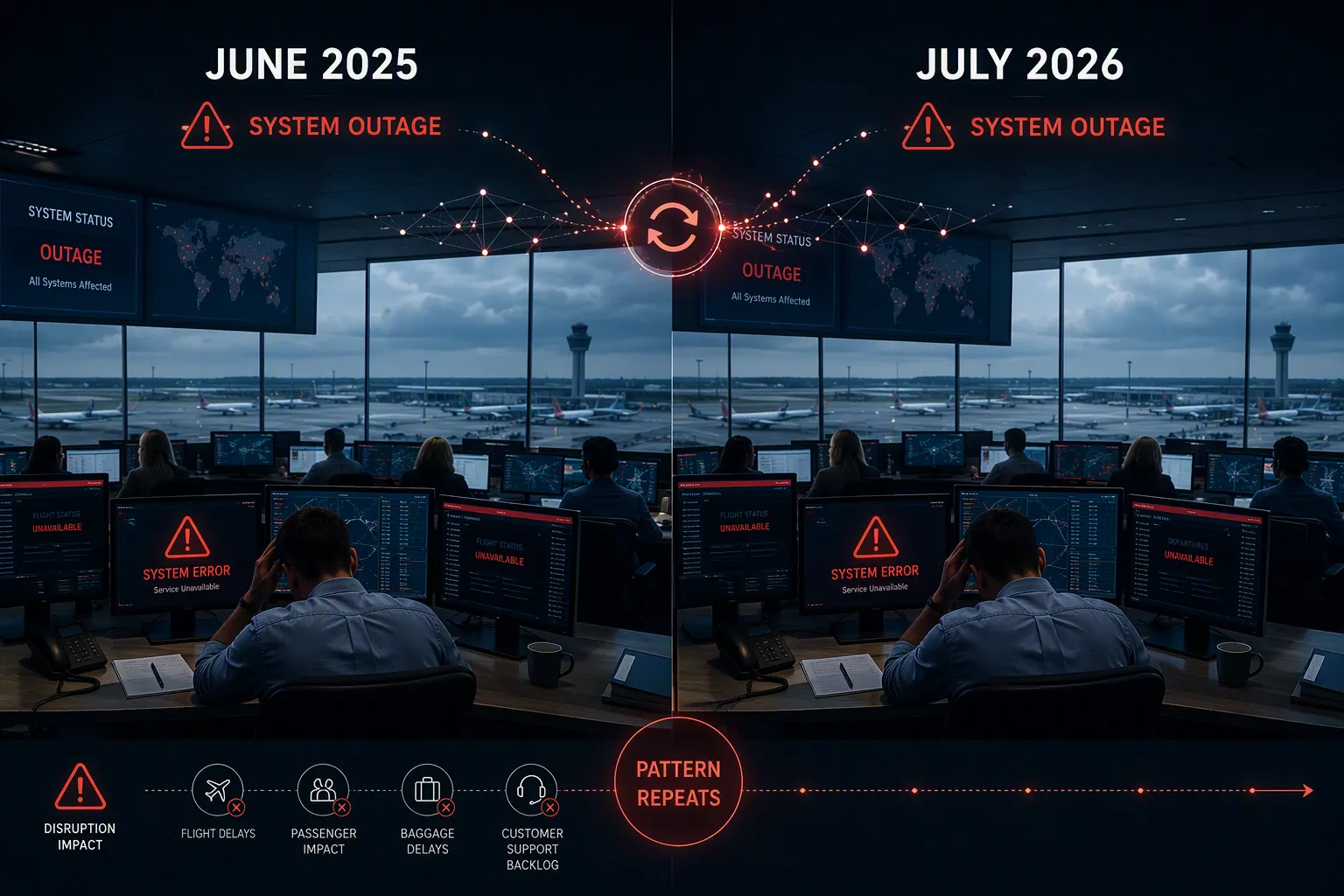
The difference matters in litigation because the passenger does not need to show that American predicted the specific July 28 outage. The passenger would argue that American had already experienced a serious technology-related operational disruption, kept a force majeure clause that still omitted IT failures, and then sought to place another technology disruption into the residual bucket for facts not reasonably foreseen or predicted. That is a narrower argument than saying every outage is misconduct. It is also a more contractually serious one.
American's answer would likely press the unresolved facts. The July 28 public description says "technology issue impacting connectivity," not "internal system failure."[2] If later evidence identifies a third-party provider, an external network condition, or an unforeseeable event beyond ordinary maintenance and redundancy planning, the catch-all analysis changes. The 2025 outage would still be relevant to general foreseeability, but it would not by itself settle whether this later event was reasonably foreseen or preventable.
Why the refund threshold makes the classification more important, not less
American's Conditions of Carriage provide refund rights tied to delay length: generally 3 hours or more for domestic flights and 4 hours or more for international flights.[1] A 45-minute nationwide ground stop therefore sits in an awkward remedial space. It can produce meaningful downstream inconvenience without automatically crossing the contractual refund threshold for many passengers.[3]
That is why the force majeure classification is not academic. If the outage is treated as force majeure, American's obligation is largely confined to refunding the unused value of affected tickets where the contract otherwise requires it.[1] For passengers whose delay did not reach the threshold, or who ultimately traveled after a shorter delay, the practical contractual remedy may be thin or nonexistent.
If the outage is not force majeure, the disruption looks more like a controllable operational failure. That does not automatically create a large damages claim for every delayed passenger. Airline contracts still contain limitations, causation problems, proof issues, and federal-law complications. But the classification changes the posture. It gives passengers and regulators a basis to argue that the carrier is trying to route an ordinary technology risk through a clause drafted for exceptional events.
| Classification | Practical consequence |
|---|---|
| Force majeure | American's exposure is more likely limited to unused-ticket refunds where the contract's refund rules are triggered. |
| Controllable disruption | Passengers have a stronger basis to contest the limitation of remedies, and regulators have a stronger basis to examine prevention and mitigation. |
| Unresolved external or vendor cause | The analysis turns on evidence about foreseeability, control, contract allocation, and reasonable mitigation. |
The small-dollar nature of most individual delay claims makes the classification even more consequential. American's Conditions of Carriage include a class action waiver.[1] That provision does not answer whether the July 28 outage was force majeure. It does affect leverage. A passenger with a modest fare dispute or incidental delay costs is unlikely to litigate individually unless the claim has unusual value. The contract can therefore leave a passenger with a theoretically contestable classification and no economically rational way to contest it.
DOT controllability is a related question, not the same question
The Department of Transportation framework asks a different question than the conditions of carriage. The contract asks whether the event fits American's force majeure language and remedial limitations. DOT controllability asks whether the airline could have prevented or mitigated the disruption through reasonable measures. Those questions overlap, but they are not identical.
The closest public analog is Delta's 2024 CrowdStrike-related disruption. DOT treated that episode as controllable and opened an investigation into whether Delta could have prevented or mitigated the failure through reasonable system maintenance and recovery practices.[5] That does not decide American's July 28 contract question. It does show that an airline cannot assume a technology disruption will be treated as uncontrollable merely because a computer system failed.
No DOT investigation into American's July 28, 2026 ground stop has been opened as of the research date. That absence should be treated as absence, not exoneration. If regulators later examine the incident, the facts that would matter are likely to be operationally specific: what failed, who controlled it, what redundancy existed, what maintenance or monitoring was in place, how quickly American identified the problem, and whether the carrier mitigated passenger impacts once the ground stop began.
The DOT inquiry, if one ever comes, would also be less impressed by the label "force majeure" than by the underlying facts. A contract can allocate private remedies one way while a regulator evaluates preventability and mitigation another way. A carrier's better argument on one track does not resolve exposure on the other.
The present record favors a controllability argument, with one unresolved hinge
On the facts public as of July 29, 2026, American has a harder force majeure argument than it would have if the disruption were clearly external and unprecedented. The clause does not list IT system failures. The catch-all depends on lack of reasonable foreseeability. American had already experienced a serious computer outage in June 2025. And the July 28 public explanation has not yet supplied facts showing that the failure came from a source outside American's reasonable control.
That makes the July 28 ground stop more likely to be argued as a controllable disruption than as a clean force majeure event. The consequence is not automatic passenger compensation across the board. The consequence is a widened zone of contest: over unused-ticket refunds, over the practical effect of the class action waiver, over whether individual claims are worth bringing, and over whether DOT should view the outage through the same preventability and mitigation lens it applied in the Delta CrowdStrike episode.
The hinge remains the actual cause. If later evidence shows a third-party or otherwise unforeseeable failure that American could not reasonably prevent or mitigate, the legal classification should shift with the facts. If the outage was internal, recurring, or reasonably manageable through ordinary system resilience, American's contract has a gap exactly where the airline now needs coverage.
References
- Conditions of Carriage, American Airlines, May 12, 2026.
- American Airlines flights resume after being halted due to an IT problem, CNN, July 28, 2026.
- American Airlines flights resume after brief IT outage led to nationwide ground stop, ABC News, July 28, 2026.
- American Airlines operations returning to normal after widespread computer outage, CNN, June 27, 2025.
- 2024 Delta Air Lines disruption, Wikipedia.
Related records
Tool profile
Browse tool evaluations →Governing regulation
Browse the obligations tracker →Preventive workflow
Browse verification workflows →
Report a correction or tip
Spotted an outdated figure, a misstated fact, or a ruling this case record should reflect? Public comments are disabled for this content given the professional cost of a misreported case outcome, penalty amount, or rule text — use the structured correction channel instead.
Report a correction or tip for this record →