
How the Amy's Kitchen soup recall tests class action standing
Assesses whether Amy's Kitchen's June 2026 voluntary recall of 184,200 cans of Organic Lentil Soup will lead to certifiable consumer class actions, and evaluates the strength of an Article III standing defense given the FDA Class II classification and the company's documented recall history. No class action has been publicly filed as of July 24, 2026.
- Jurisdiction
- US-Federal
- Court
- U.S. District Court
- AI tool named
- None
- Ruling date
- Jul 24, 2026
- Source document
- View primary court order ↗
- Last verified
- Jul 24, 2026
Lex Machina Review is an independent risk-tracking and reference resource. Nothing on this site is legal advice, and using it does not create an attorney-client relationship. Every record is reviewed against primary sources but may not reflect the most current status of a matter — always verify directly against the cited court order, rule text, or a licensed attorney before relying on it.
Companion explanation — secondary to the source document above
The Amy's Organic Lentil Soup recall has the shape of a class action invitation, but not yet a filed class action. Amy's Kitchen initiated a voluntary recall on June 22, 2026, involving 184,200 cans, or 15,350 cases, of Organic Lentil Soup, Less Sodium, distributed across roughly 28 to 29 states; the FDA classified the event as Class II on July 14, and national coverage followed around July 21 to 23.[1][2] As of July 24, 2026, no publicly filed class action specific to this lentil soup recall has been identified.
That timing matters because the first litigation question is not whether a recall sounds troubling. It is whether a purchaser who bought a recalled can, without reported illness, confirmed contamination, or a refused refund, has Article III standing to bring an economic-loss class action. Amy's has unusually good facts for that defense. It also has a quality-event history that makes the defense less tidy than a one-off manufacturing mishap.

The recall facts point first toward standing, not damages
The reported defect is an easy-open tab manufacturing issue that may allow spoilage. The available public record does not describe confirmed contamination, and the news accounts report no illnesses or injuries tied to the recall.[1][2] The FDA's Class II classification also matters: it generally signals a situation in which use of or exposure to a product may cause temporary or medically reversible adverse health consequences, or where the probability of serious adverse health consequences is remote.[1]
Those are not merits details at the edge of the case. They are the case, at least at the motion-to-dismiss stage. A plaintiff who alleges only that a product was recalled often still needs to plead a concrete injury: illness, consumption of an actually defective unit, overpayment linked to a misrepresentation, retained unusable product, or an unavailable refund path. A recall can supply notice of a problem. It does not automatically supply standing.
| Recall fact | Why it matters legally |
|---|---|
| Voluntary recall initiated June 22, 2026 | Creates notice and possible economic-loss framing, but not injury by itself |
| 184,200 cans / 15,350 cases reported | Supports numerosity if a class is filed, but says little about individual injury |
| FDA Class II classification on July 14 | Helps a defense argument that serious health consequences were remote |
| No reported illnesses in available public accounts | Weakens personal-injury allegations and supports consumption-without-incident arguments |
| Retailer-level refunds reported | May moot or reduce economic-loss claims if accessible and actually honored |
Why recent post-recall dismissals help Amy's
The defense framework is not hypothetical. A March 2026 Cozen O'Connor analysis identified three recent post-recall consumer class action dismissals that map closely onto Amy's likely first move: Ward v. J.M. Smucker Co., McLean v. Walmart Inc., and Catalano v. Grimmway Enterprises.[3] The cases are not binding everywhere, and they are not interchangeable. Still, they describe the argument any defense brief would want to make before discovery expands the case.
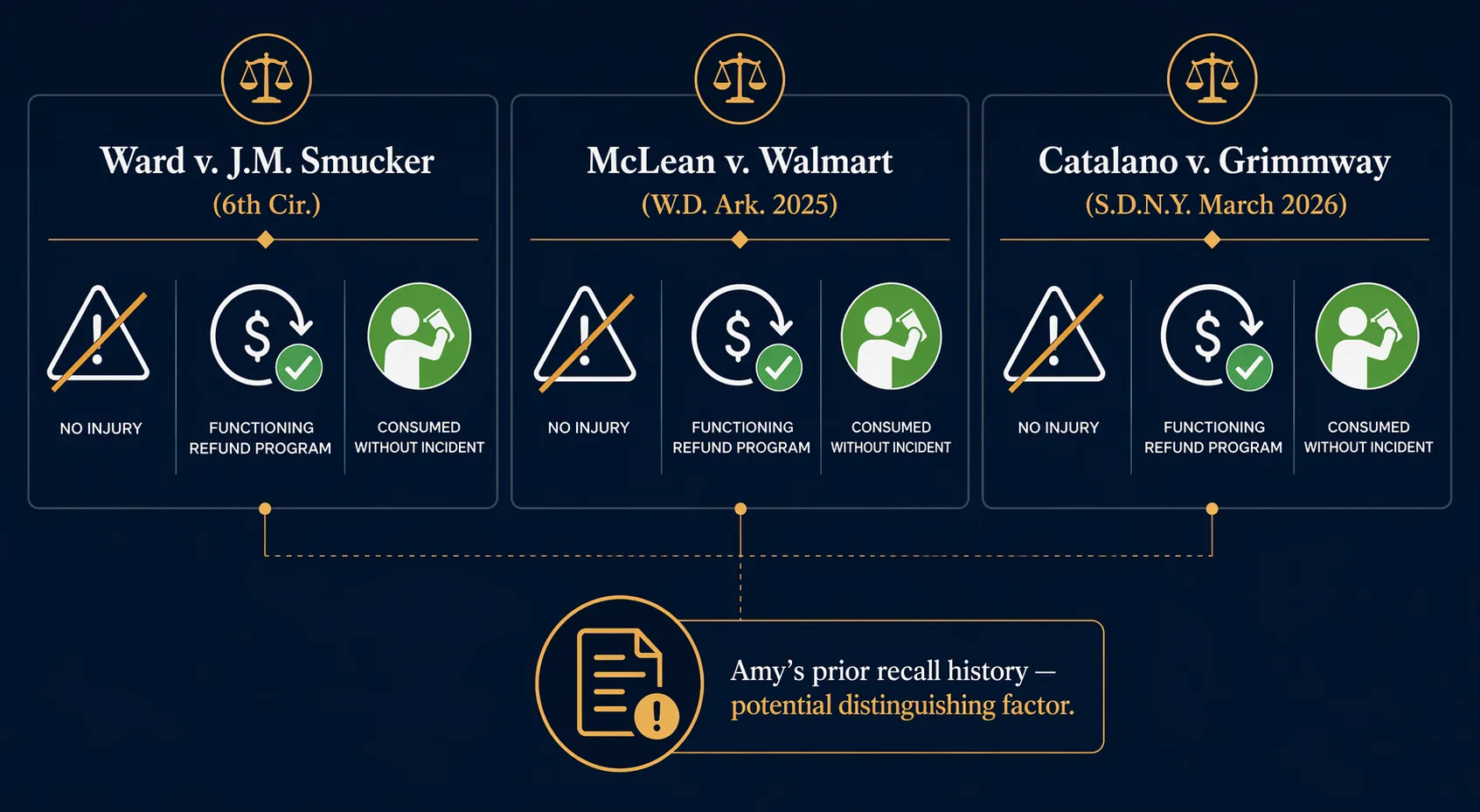
Ward is the cleanest recall-alone point. As summarized by Cozen, the Sixth Circuit rejected standing where the plaintiff relied on a recall without showing that the purchased product was contaminated or caused injury.[3] That logic matters for the lentil soup recall because the public facts do not identify confirmed contamination in the plaintiff's can, or in any consumer's can. A recall population of 184,200 cans may be enough to support notice and numerosity. It is not, without more, proof that every purchaser received a product that was unsafe, worthless, or legally injurious.
McLean supplies the refund-program version of the same defense. Cozen described McLean v. Walmart Inc. as a dismissal in which a functioning refund program mooted economic-loss claims.[3] For Amy's, that point depends on a fact still more fragile than it looks. Public reports indicate refunds are being handled through retailers, including examples such as Wegmans, Seward Co-op, and SpartanNash, rather than through one centralized company portal.[1][2] That may be enough if purchasers can readily obtain refunds. It becomes less useful if access varies by retailer, geography, receipt requirements, or consumer notice.
Catalano gives defendants a consumption-without-incident argument. Cozen summarized the March 2026 Grimmway dismissal as allowing an inference that products consumed without incident were not contaminated.[3] Amy's can adapt that point because the available reports identify no illnesses. A plaintiff who already ate the soup and alleges no physical harm may have difficulty converting a later recall into a concrete injury unless the complaint pleads a separate economic theory that survives refund and benefit-of-the-bargain problems.
Put together, the early defense brief writes itself: no reported illness, no confirmed contamination, Class II remote-risk classification, a voluntary recall, and a refund route. That does not mean dismissal is automatic. It means a complaint built only on purchase plus recall would be walking into a defense line that has recently worked.
The refund issue is narrower than a press line
Refunds deserve separate treatment because they can change both standing and class certification. Cozen's post-recall analysis identifies refund-program design as a central defense issue and describes minimum features companies should consider, including clear notice, simple claim procedures, broad eligibility, prompt payment, and documentation of participation.[3] Those features matter because a refund program is not legally magic; it has to reach the people whose economic injury the complaint pleads.
The Amy's recall has a possible weak spot here. The publicly described refund path appears retailer-based, and that detail comes from news reports rather than direct verification from Amy's Kitchen.[1][2] A retailer-level program may be perfectly practical for many consumers. It may also create factual questions that a plaintiff can use: whether all retailers accepted returns without receipts, whether consumers in every affected state received comparable access, and whether purchasers who discarded cans after seeing the recall could still recover the purchase price.
Those questions do not defeat a standing motion by existing in the air. They become material only if a complaint pleads them with enough specificity. The difference between “a refund existed” and “a refund was practically available to this plaintiff” is often where a clean defense record becomes a fact record.
Amy's history gives plaintiffs their best distinction
The standing defense is strongest when the recall looks isolated. Amy's does not get that benefit for free. FDA enforcement materials identify a March 2024 Listeria-related recall involving 64,222 pounds of frozen meals, a November 2022 recall involving 21,177 pounds due to plastic fragments, and a January 2022 recall involving 15,626 cases due to undeclared milk.[4] Those events do not prove that the June 2026 lentil soup cans were spoiled. They do make it harder to treat the lentil soup recall as an administrative oddity with no broader litigation meaning.
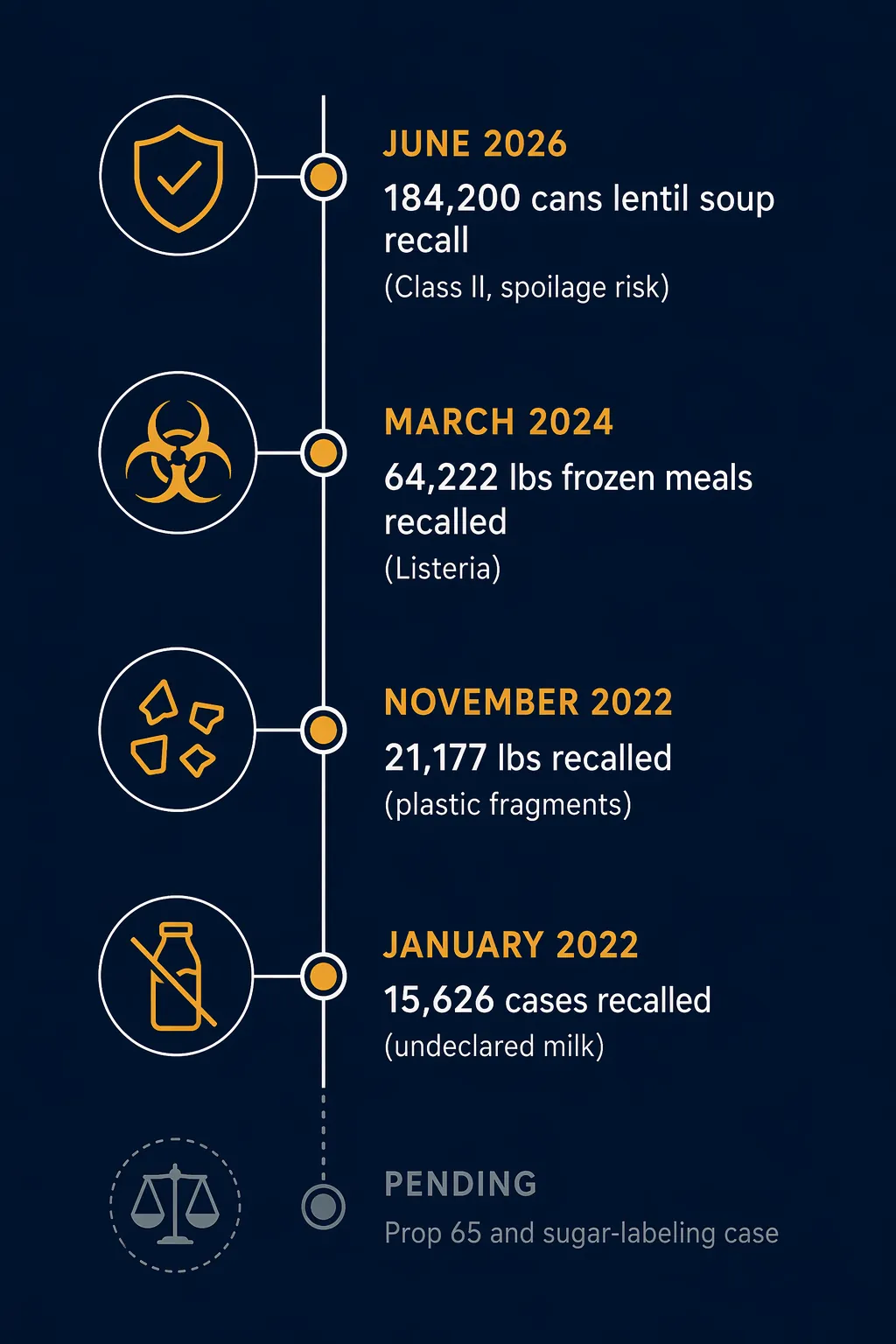
Plaintiffs would likely use that history in a careful way. The earlier recalls involve different products and different alleged defects: Listeria risk, foreign material, undeclared allergen, and now a can-tab defect with spoilage risk. That variety limits their value as direct proof of a single recurring defect. But it may help resist a defense narrative that this is merely one remote-risk Class II event affecting an otherwise clean manufacturer.
The quality-adjacent litigation record adds another layer, though not a decisive one. Amy's previously won a second dismissal in a sugar-labeling class action, according to Top Class Actions.[5] A dismissed labeling case is not evidence that the lentil soup recall created injury. It is useful mainly because plaintiffs' lawyers often frame food cases through repetition: prior recalls, prior consumer-labeling litigation, regulatory notices, and then a new recall. The pending California Prop 65 notice identified in the research record would likely be used the same way: as narrative context, not proof of this can-tab defect.
That distinction matters for class certification. A plaintiff who turns the case into a broad indictment of Amy's quality systems may create common storytelling appeal while making common proof harder. A plaintiff who narrows the case to the recalled lentil soup cans may have cleaner class boundaries but less ability to distinguish Ward, McLean, and Catalano. The strongest complaint would need to do both without overpleading: tie the prior events to notice, quality controls, or consumer expectations, while keeping the injury theory anchored to this recall.
Filing timing is a signal, not evidence of merit
The absence of a public complaint by July 24 is notable but not conclusive. Hollingsworth LLP's January 2026 recall-litigation watch described a pattern in which a relatively small group of plaintiffs' firms often files post-recall consumer cases within roughly 7 to 10 days after public announcement, while also noting that FDA food and supplement recalls rose to 295 in 2025 from 261 in 2024.[6] For Amy's, the national media spike around July 21 to 23 means the most obvious filing window had only just opened as of July 24.[1][2]
That filing pattern should be kept in its place. It helps estimate whether the case will attract attention from repeat plaintiffs' counsel. It does not tell us whether the complaint, if filed, will plead injury well enough to survive dismissal. A fast complaint can still be thin. A slower complaint can be better investigated. The docket, not the media cycle, will decide how much legal risk has actually materialized.
Settlement numbers explain concern, not exposure
Food companies care about these cases because even modest consumer-injury theories can become expensive once class allegations, notice costs, fees, and retailer relationships are in play. Cozen's survey listed recent settlement benchmarks including Quaker Oats at $6.75 million, Mid American Pet Food at $5.5 million, TreeHouse Foods at $4.4 million, and Boar's Head at $3.1 million.[3] Those figures are useful as negotiation context. They are not verdicts, judgments, or direct estimates of Amy's Kitchen's exposure.
The gap is especially important here. A Class II soup recall with no reported illness and a potentially available refund program is not the same risk profile as a case with confirmed contamination, alleged injuries, or a failed remediation process. Settlement values also include strategic considerations that do not appear on the face of a complaint: defense costs, brand fatigue, insurance posture, retailer pressure, and the price of buying peace. Those variables may drive resolution, but they should not be mistaken for proof that standing exists.
The 2026 regulatory backdrop keeps the case visible
The recall also lands in a year when food regulatory litigation is already drawing sustained attention. Morrison Foerster's July 2026 roundup treated food regulatory litigation developments as an active summer issue, which helps explain why a soup recall with no reported illness can still become a litigation-watch item.[7] Visibility is not liability, but visibility affects who searches the recall database, who buys the product for testing, and who drafts a complaint before the refund story is fully settled.
That is the practical posture as of July 24: a plausible class action target, not yet a public class action defendant for this recall. The legal implications turn less on the headline can count than on the first pleaded injury theory. If the theory is “I bought a recalled can,” Amy's has a credible standing defense. If the theory adds inaccessible refunds, retained worthless product, specific spoilage evidence, or a quality-history narrative tied to common consumer overpayment, the case becomes harder to dispose of at the threshold.
What to watch next
The monitored variables are narrow. First, whether a complaint is filed and in which jurisdiction. Second, whether the named plaintiff alleges illness, possession of a defective can, overpayment, loss of refund access, or only purchase of a recalled product. Third, whether refund access differed by retailer or state. Fourth, whether plaintiffs can connect Amy's prior recalls to a certifiable common theory rather than using them as atmosphere.
On the present record, Amy's Kitchen has a serious motion-to-dismiss argument under recent post-recall standing cases, especially if no illness evidence emerges and retailer refunds prove accessible. The company's documented recall history keeps the case from being a clean defense test. It gives plaintiffs their best way to argue that the June 2026 lentil soup recall should not be heard as an isolated manufacturing issue, even if it does not by itself prove injury.
References
- Popular Amy's Kitchen soup recalled over issue that may cause product spoilage, USA Today
- Amy's Kitchen recalls cans of organic lentil soup, NBC Bay Area
- The Continuing Rise of Post-Recall Consumer Class Actions, Cozen O'Connor, March 23, 2026
- FDA Enforcement Reports, U.S. Food and Drug Administration
- Amy's Kitchen wins second dismissal of sugar labeling case, Top Class Actions
- What We're Watching in 2026: Increasing Recalls of Food and Supplement Products in 2026 Will Drive Consumer Class Action Litigation Alleging Violations of State Consumer Protection Statutes, Hollingsworth LLP, January 27, 2026
- Summer So Far: Key Food Regulatory Litigation Developments, Morrison Foerster, July 2026
Related records
Tool profile
Browse tool evaluations →Governing regulation
Browse the obligations tracker →Preventive workflow
Browse verification workflows →
Report a correction or tip
Spotted an outdated figure, a misstated fact, or a ruling this case record should reflect? Public comments are disabled for this content given the professional cost of a misreported case outcome, penalty amount, or rule text — use the structured correction channel instead.
Report a correction or tip for this record →