
How can tab defects in Amy's soup recall create product liability
An analysis of product liability exposure from the Amy's Kitchen lentil soup recall, focusing on the manufacturing defect in the can tab, the strict liability standard, and the defenses that make early dismissal or nuisance-value settlement the most likely outcome.
Lex Machina Review is an independent risk-tracking and reference resource. Nothing on this site is legal advice, and using it does not create an attorney-client relationship. Every record is reviewed against primary sources but may not reflect the most current status of a matter — always verify directly against the cited court order, rule text, or a licensed attorney before relying on it.
Companion explanation — secondary to the source document above
The product-liability question in the Amy's lentil soup recall starts with a small piece of metal, not with the soup recipe. The recalled product is Amy's Organic Lentil Soup, Less Sodium, in cans whose easy-open tab may have a manufacturing defect that compromises container integrity and creates a potential spoilage risk. The reported scope is 184,200 cans, or 15,350 cases, distributed in 28 to 29 states; Amy's Kitchen voluntarily initiated the recall on June 22, 2026, and the FDA classified it as Class II on July 14, 2026.[1][2]
That is enough to make the can legally interesting. It is not enough, by itself, to make a class action valuable. As of July 24, 2026, no publicly filed class action specific to this recall was identified in the available materials, and the secondary reports reviewed did not report illnesses. The FDA enforcement record itself was not directly available in the materials reviewed, so the recall details here depend on news reports describing or linking to that record rather than on a directly reviewed FDA event page.
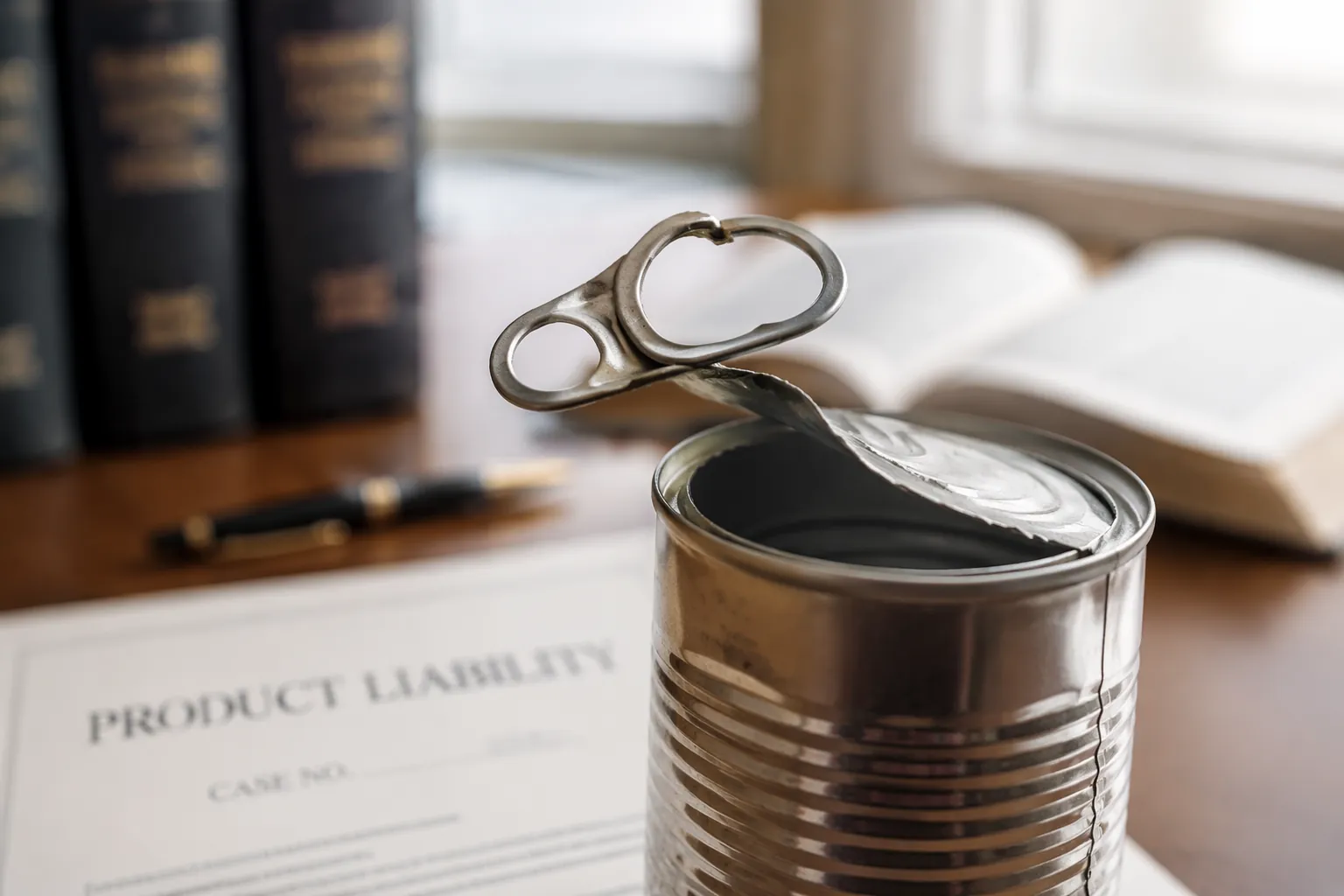
The tab defect is a packaging defect, not just an inconvenience
A failed pull tab can sound like a consumer annoyance: the can is hard to open, the customer is irritated, and the remedy is a refund or replacement. This recall is different because the alleged defect goes to seal integrity. If the tab or its associated closure fails to preserve the intended container barrier, the can is not merely less convenient. It may no longer perform the function that makes canned soup shelf-stable.
That distinction matters for product liability. Packaging can itself be treated as the product for strict-liability purposes, separate from the food inside it. PackagingLaw's discussion of product-liability issues in packaging cites Karle v. National Fuel Gas Distribution Corp. and state statutory formulations such as Connecticut's product-liability definition to illustrate that containers, closures, and packaging components may be the defective product when they cause the alleged harm.[3]
The cleaner theory is manufacturing defect. The allegation is not that all easy-open soup tabs are an unsafe design choice or that Amy's Kitchen should have used a different opening technology. The allegation is that particular cans departed from the intended condition and therefore may not have maintained container integrity. Under the usual strict-liability frame, a plaintiff would not need to prove that the manufacturer acted carelessly. The plaintiff would still need to connect the defective condition to an injury or cognizable loss.
That is where ordinary openability cases become a poor fit. A lawsuit over a stubborn lid or awkward tab asks whether poor usability is a product defect. A lawsuit over a compromised can asks whether the package failed to preserve the food. The second theory is more serious in form, even if the current public record leaves the damages case thin.
The FDA classification narrows the severity band
FDA Class II does not mean harmless. It does mean the agency classification, as reported, falls below the highest recall-severity category. A Class II recall is associated with a situation in which use of or exposure to the product may cause temporary or medically reversible adverse health consequences, or where the probability of serious adverse health consequences is remote.[2]
For pleadings, that classification cuts both ways. It helps a plaintiff explain why the recall was not a purely cosmetic event. But it also gives the defense a ready answer to overstatement: the public recall record, as reported, does not place this event in the category where serious injury is expected or likely.
The Canadian classification underscores the point. The Canadian Food Inspection Agency described the Amy's brand Organic Lentil Soup, Less Sodium recall as Class 3, a lower-risk classification tied to container integrity defects.[4] For a company managing North American communications, that creates a familiar problem: the same event can be compressed into a single headline even when regulators are sending different risk signals. For litigation assessment, those signals should not be flattened.

A viable complaint needs more than a recall notice
The hardest part of a post-recall consumer complaint is not usually writing the defect paragraph. It is pleading injury. A buyer who alleges only that a product was recalled often has not alleged that her own unit was spoiled, contaminated, unusable, or retained after a refund was available. That gap matters before discovery, because federal standing and plausibility rules are not supposed to turn every recall population into a litigation class.
Ward v. J.M. Smucker is the useful recent warning. In that Sixth Circuit decision, discussed by Faegre Drinker, the court treated recall status alone as insufficient to establish injury in fact for purchasers who could not connect the recalled product to an actual injury.[5] The lesson for the soup recall is straightforward: owning or having bought a can within a recall population is not the same as pleading that the purchaser's can was spoiled or that the purchaser suffered a concrete economic loss.
McLean v. Walmart adds the refund problem. Cozen O'Connor's 2026 discussion of post-recall consumer class actions identifies McLean as a standing decision in which a functioning refund program helped defeat Article III standing.[6] If Amy's Kitchen made a full refund available before litigation, a purchaser who did not become ill and did not allege unreimbursed loss has a weaker path to federal court. The issue is not whether the recall was well handled as a public-relations matter. The issue is whether the plaintiff still has a live, redressable injury.
Catalano v. Grimmway Enterprises, also discussed in the same post-recall class-action context, points to the pleading problem for spoilage-risk theories.[6] A complaint that says a container defect could permit spoilage does not necessarily say the plaintiff bought spoiled soup. Without illness, visible spoilage, testing, disposal after being denied a refund, or some other fact tying the plaintiff's own can to loss, the claim begins to look like an abstract risk claim rather than a product-liability injury.
What plaintiffs could plead, and where those theories thin out
The most predictable complaint would combine a strict-liability manufacturing-defect theory with a consumer economic-loss theory. The plaintiff would allege that the can deviated from intended manufacturing specifications, that the product was therefore unsafe or unmerchantable, and that purchasers paid for shelf-stable soup they did not receive.
| Potential allegation | What it would need | Likely defense pressure point |
|---|---|---|
| Personal injury from spoiled soup | A purchaser who consumed an affected can and plausibly links illness to spoilage | No reported illnesses in the public materials reviewed |
| Property or product loss | A can that was spoiled, leaking, unusable, or discarded without reimbursement | Recall risk alone does not show the buyer's own can failed |
| Benefit-of-the-bargain loss | Payment for soup allegedly worth less because of the defect | A full refund program may eliminate or moot the economic injury |
| Injunctive relief | A real likelihood of future harm from the same product condition | A recalled lot and changed sale posture make future-harm allegations difficult |
The personal-injury case would be the strongest if the facts existed. A consumer who ate soup from an affected can, became ill, preserved the can, and could plead facts consistent with spoilage would be in a different position from a purchaser who saw a recall alert after the can was already in the pantry. The current public record does not supply that plaintiff.
The benefit-of-the-bargain theory is easier to file and easier to attack. Plaintiffs often argue that they paid for a safe, non-defective product and received something worth less. In a food-packaging recall, that argument can survive longer if the product cannot be returned, the refund is incomplete, or the recall notice effectively confirms that all units in the lot were unusable. Here, the reported defect creates a potential spoilage risk; it does not establish from the public record that every recalled can was spoiled.
The refund mechanics therefore become litigation facts, not customer-service footnotes. A documented, accessible full-refund program gives the company a concrete answer to economic injury: if the purchaser can receive the purchase price back, what damages remain? That defense is strongest for consumers who still possess cans, saw the recall, and can use the refund process. It is weaker if the process is unclear, burdensome, inconsistently honored, or unavailable to consumers who reasonably discarded the cans after the recall.
Strict liability still matters
The standing defenses should not blur the defect classification. If a recalled can actually lost integrity because the easy-open tab assembly deviated from specification, that is a real manufacturing-defect theory. A defendant would gain little by pretending the defect is merely aesthetic or by trying to convert every issue into negligence. The better defense is narrower: even assuming a defect in some cans, the named plaintiff must allege that the defect caused injury or unreimbursed loss.
That distinction also matters for suppliers. If the defect sits in the can component rather than in the soup formulation, indemnity, specifications, quality-control records, lot traceability, and supplier notice become central. Product-liability exposure may be modest at the consumer class-action level while still creating a serious contract and insurance file between the food company, the can supplier, brokers, and carriers.
The record a risk manager would want is practical: affected lot codes, supplier production dates, deviation reports, seal-integrity testing, consumer complaints, refund uptake, rejected refund claims, and any retained cans showing actual spoilage. Those facts decide whether the case remains a recall-with-refunds matter or becomes evidence of contaminated product reaching consumers.
Why weak recall cases still settle
Dismissal risk does not eliminate settlement risk. Food and consumer-product recall class actions often settle for reasons that have little to do with trial-value merits: defense costs, retailer relationships, insurer economics, customer communications, and the administrative convenience of buying peace. The Duane Morris Class Action Review mid-year settlement report lists recent food and product-related settlements including Quaker Oats at $6.75 million, Mid American Pet Food at $5.5 million, TreeHouse Foods at $4.4 million, and Boar's Head at $3.1 million.[7]
Those numbers are benchmarks, not predictions for Amy's Kitchen. They do not prove that this recall has comparable injury facts, class size economics, contamination evidence, or litigation posture. They simply explain why a company can have strong standing and refund defenses and still consider a small settlement rational if a complaint is filed.
The current exposure is real in form and limited in value
On the present public record, the Amy's Kitchen lentil soup recall has a legally recognizable manufacturing-defect theory: a can component allegedly failed to preserve container integrity, and packaging can be the product for strict-liability purposes. That is the part plaintiffs would emphasize, and they would not be wrong to do so.
The claim then narrows quickly. FDA Class II language, as reported, keeps the severity assessment below the highest-risk band. The Canadian Class 3 classification is even less helpful to a broad injury narrative. No reported illnesses appear in the reviewed public materials. No complaint has yet supplied a named plaintiff with a spoiled can, a medical injury, testing, or unreimbursed loss. And a voluntary refund program announced before litigation gives the defense a concrete standing and mootness argument.
If litigation follows, the most likely path is not a high-value strict-liability case built on personal injury. It is an economic-loss class complaint tested early against standing, plausibility, and refund defenses, with dismissal or a cost-control settlement as the practical endpoint unless stronger facts emerge.
References
- Amy's Kitchen Recalls 184,200 Cans of Lentil Soup in 28 States Due to Potential for Spoilage, PEOPLE
- Popular Amy's Kitchen soup recall July 2026, USA TODAY
- Product Liability Issues in Packaging, PackagingLaw.com / Keller and Heckman LLP
- Amy's brand Organic Lentil Soup, Less Sodium recalled due to container integrity defects, Canadian Food Inspection Agency
- Standing on Shaky Ground: Product Recalls Alone Do Not Constitute an Injury in Fact, Faegre Drinker on Products, September 2025
- The Continuing Rise of Post-Recall Consumer Class Actions, Cozen O'Connor, March 2026
- Duane Morris Class Action Review 2026/2027 Mid-Year Class Action Settlement Report Analysis, Duane Morris Class Action Defense Blog, July 1, 2026
Related records
Tool profile
Browse tool evaluations →Governing regulation
Browse the obligations tracker →Preventive workflow
Browse verification workflows →
Report a correction or tip
Spotted an outdated figure, a misstated fact, or a ruling this case record should reflect? Public comments are disabled for this content given the professional cost of a misreported case outcome, penalty amount, or rule text — use the structured correction channel instead.
Report a correction or tip for this record →