
Why Amy's Soup Recall Is Unlikely to Survive a Motion to Dismiss
Analysis of the Amy's Kitchen soup recall's legal exposure, concluding that a consumer class action for economic damages would face significant standing hurdles under recent food-recall precedent unless plaintiffs can plausibly allege purchase of actually spoiled product.
- Jurisdiction
- United States
- Court
- United States federal courts
- AI tool named
- None
- Ruling date
- Jul 26, 2026
- Source document
- View primary court order ↗
- Last verified
- Jul 26, 2026
Lex Machina Review is an independent risk-tracking and reference resource. Nothing on this site is legal advice, and using it does not create an attorney-client relationship. Every record is reviewed against primary sources but may not reflect the most current status of a matter — always verify directly against the cited court order, rule text, or a licensed attorney before relying on it.
Companion explanation — secondary to the source document above
Food recall class actions sit close enough to litigation-risk work to be familiar: a public notice creates noise, but the case still has to find a plaintiff with a concrete injury. That distinction matters for the Amy's soup recall legal implications because the visible facts, as of July 2026, look more like a pleading problem than a ready-made damages class action.
Amy's Kitchen voluntarily recalled about 184,200 cans of Organic Lentil Soup after a can-tab manufacturing defect created a possibility of spoilage. The recall was initiated on June 22, 2026, classified by the FDA in July 2026, and covered products distributed in 28 states; news reports also stated that no illnesses had been reported as of July 2026.[1]
That is the whole legal starting point, not a prelude to a larger known outbreak. The available materials do not identify a filed consumer class action as of July 2026, so the useful question is predictive: if a purchaser sued for economic damages on a benefit-of-the-bargain theory, would the complaint survive a motion to dismiss?
The Recall Facts Are Modest in the Way Standing Doctrine Cares About
The FDA's Class II category is useful but not dispositive. FDA recall materials describe Class II as a situation in which use of or exposure to a violative product may cause temporary or medically reversible adverse health consequences, or where the probability of serious adverse health consequences is remote.[2] For a defendant, the word "remote" is clean and quotable. For a court, it does not by itself answer whether the named plaintiff bought a spoiled can, paid more than the product was worth, or lost money that was not later refunded.
The absence of reported illness also has to be kept in its lane. It weakens any attempt to make this look like a pathogen-injury case. It does not prove that every can was fine, and it would not defeat a complaint that plausibly alleged a named plaintiff opened an actually spoiled can and could not obtain a refund. But without that kind of allegation, the recall notice does most of the work the plaintiff would need Article III to do.
| Visible Amy's fact | Why it matters at Rule 12 |
|---|---|
| Voluntary Class II recall | Supports a defense argument that serious health consequences were remote, but does not eliminate possible economic injury. |
| Can-tab defect could allow spoilage | Points to risk of spoilage, not necessarily purchase of a spoiled unit. |
| About 184,200 cans across 28 states | Shows recall scope, but not injury to the named plaintiff. |
| No reported illnesses as of July 2026 | Makes personal-injury analogies weaker while leaving room for a properly pleaded spoiled-product claim. |
| Return-to-store instruction reported in available materials | Raises a refund-access question, but the details are not complete enough to treat refund availability as settled. |
Ward Is the Hardest Problem for a Recall-Only Complaint
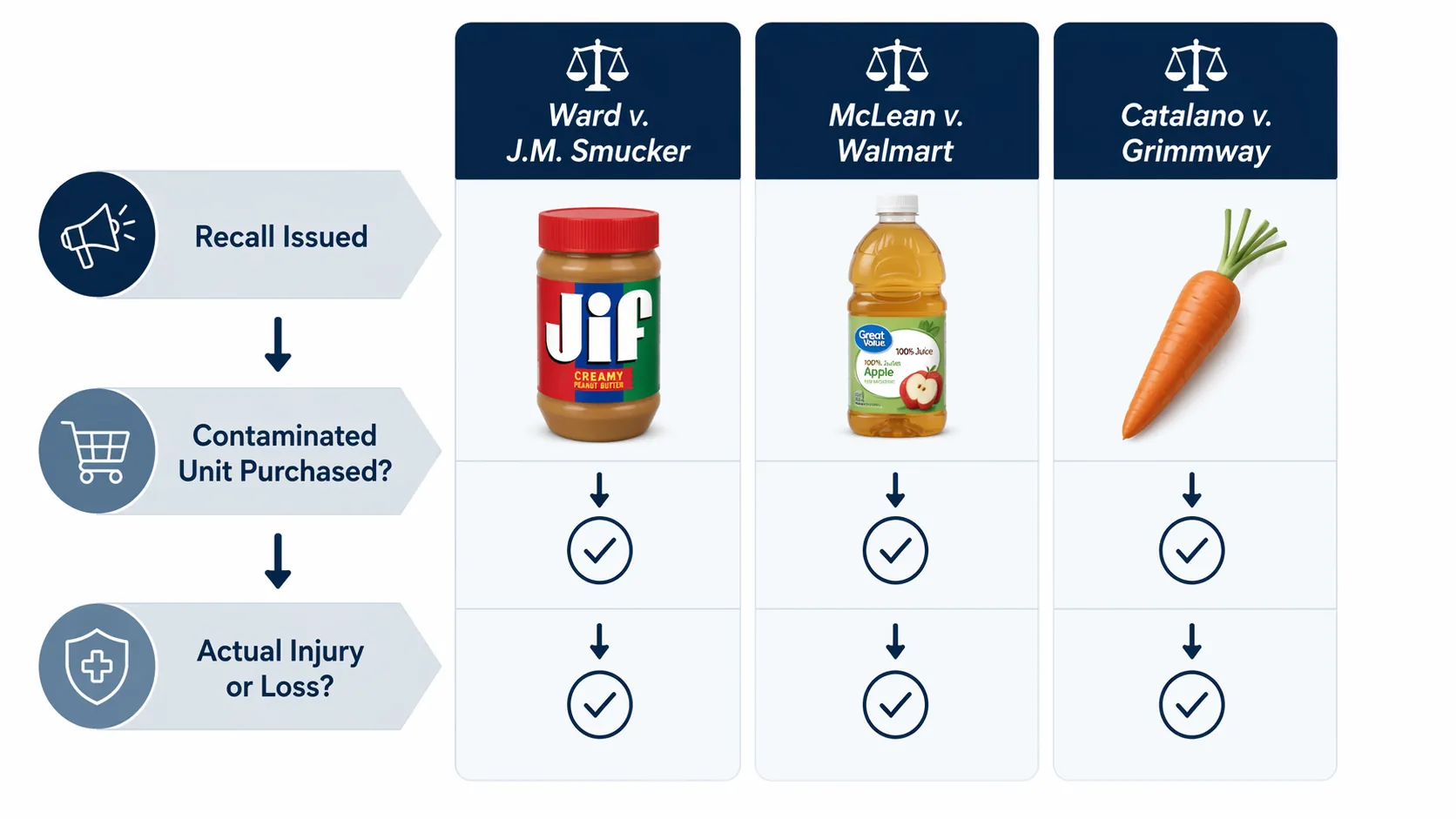
The cleanest standing obstacle is Ward v. J.M. Smucker Co., the Sixth Circuit's Jif peanut butter recall case. The plaintiff there relied on the recall to support food-contamination claims, but the court rejected standing where the plaintiff did not plausibly allege that the specific product purchased was contaminated.[3]
That formulation is uncomfortable for any Amy's complaint that stops at: there was a recall; I bought a recalled can; therefore I overpaid. The missing paragraph is the important one. Did the named plaintiff open the can and observe spoilage? Was there odor, leakage, visible deterioration, or other facts tied to that unit? Was the product discarded because of actual spoilage, or only because the recall notice made the purchaser uneasy? Ward does not let the recall universe substitute for that unit-level allegation.
The can-tab defect makes the pleading question sharper rather than softer. A manufacturing defect that could allow spoilage describes a pathway to harm. It does not say that all, most, or any particular purchaser's cans were spoiled. If the complaint cannot cross from possibility to the plaintiff's own product, Ward gives a defendant a direct standing argument.
McLean Turns the Lens Toward Refunds, but the Amy's Record Is Incomplete
McLean v. Walmart adds a different pressure point. In that recalled apple-juice case, practitioner summaries describe the court as treating an effectively administered refund program, including a full refund without a receipt, as mooting economic injury claims.[4] The lesson is not that every recall refund defeats standing. It is that a plaintiff who can get all of the purchase price back may have difficulty pleading a live economic loss.
Amy's known refund facts are thinner. The available recall instruction points consumers toward returning the product to the place of purchase, but the materials do not fully verify whether Amy's offered a mail-in claim, online process, no-receipt refund, or other practical path for consumers who no longer had a can, receipt, or nearby retailer. That distinction matters. A return-to-store instruction is not necessarily the same thing as the low-friction refund program that mattered in McLean.
A plaintiff's best economic-loss version would therefore not simply say the product was recalled. It would need facts about attempted recovery: a denied refund, an inaccessible process, a retailer refusing the return, or conditions that made reimbursement illusory. Without that, the damages theory starts to look less like loss and more like dissatisfaction with having bought into a recall.
Catalano Narrows the Case Even Further
Catalano v. Grimmway, as described in practitioner coverage, is useful because it strips away another intuitive but legally weak move: the assumption that consuming a recalled food product automatically creates standing. The reported standing analysis rejected claims by a plaintiff who consumed recalled carrots without incident because there was no manifest injury.[4]
For Amy's, that point matters on both sides of the purchase. A consumer who threw away recalled soup without opening it may have trouble proving the soup was worth less than paid unless the refund path failed. A consumer who ate the soup without incident has a different problem: the recall may show regulatory concern, but it does not itself show bodily injury, spoiled product, or unrecovered economic loss. Catalano is the reminder that even contact with the recalled product is not always enough.
Pathogen Settlements Are a Poor Analogy
Recall headlines often invite settlement comparisons that do not survive contact with the facts. Recent food-litigation commentary has pointed to settlements such as Quaker Oats at $6.75 million and TreeHouse at $4.4 million, both tied to pathogen-contamination scenarios involving Salmonella or Listeria and actual injuries.[5] Those are not clean comparators for a Class II spoilage-risk recall with no reported illness in the available record.
The distinction is not cosmetic. Pathogen cases can come with medical treatment, positive tests, outbreak investigations, or at least a stronger story that the product was dangerous when consumed. Amy's current public record is narrower: a packaging defect that could permit spoilage, followed by a voluntary recall before reported illness. A plaintiff can still plead into that gap, but cannot borrow injury from cases with different contamination facts.
The Broader Amy's Risk Context Helps Plaintiffs Only So Much
Plaintiffs would not be irrational to look beyond the single soup notice. Available commentary and news coverage point to a possible pattern of voluntary recalls over roughly five years, including issues described as Listeria-related, undeclared-allergen, rubber-fragment, and spoilage events, although the precise count could vary depending on how one treats enforcement reports, market withdrawals, and stock recoveries.[4] Amy's has also faced separate risk signals, including a March 2026 Prop 65 notice, Cal/OSHA penalties exceeding $100,000, and worker-safety litigation, according to the same available litigation-risk materials.[4]
That surrounding context may matter for settlement posture, document discovery if a case gets that far, or a plaintiff's attempt to resist the phrase "isolated manufacturing defect." It does less work on Article III. A history of operational problems does not identify the named plaintiff's can as spoiled. Nor does a worker-safety dispute convert a soup purchaser's economic theory into a concrete loss.
Where a Plaintiff Could Still Change the Posture
The defense-favorable read depends on a recall-only complaint. A different complaint could be harder to dismiss if it alleged facts tying the named plaintiff to actual spoilage or unreimbursed loss.
- Actual spoiled product: the plaintiff bought a recalled can and observed leakage, odor, visible spoilage, or another concrete condition showing the unit was defective.
- Failed refund process: the plaintiff tried to return the product and was refused, or the refund process was materially unavailable in practice.
- Unrecovered economic loss: the complaint explains what money remained lost after any recall remedy, rather than assuming the recall itself equals damages.
- Quality-control pattern tied to the defect: broader recall history is pleaded carefully as context for why the defect was not isolated, without pretending that context alone proves injury.
- Different circuit posture: a filing outside the Sixth Circuit, especially in a forum with different standing treatment, could change the motion-to-dismiss calculus.
The jurisdiction point should not be treated as a footnote. Ward is Sixth Circuit law. McLean and Catalano are district-court decisions, not nationwide commands. Amy's California presence makes the Ninth Circuit an obvious forum possibility, and defendants would still have to litigate standing under the law that actually governs the chosen court.
The Likely Motion-to-Dismiss Fight
On the currently visible facts, a benefit-of-the-bargain economic-damages class action based only on the Amy's soup recall is unlikely to survive a motion to dismiss. The recall shows a product-risk event. It does not, by itself, show that the named plaintiff bought a spoiled can, consumed a harmful product, or retained an unreimbursed loss after a meaningful refund opportunity.
That is not the same as saying Amy's faces no exposure. A plaintiff with a spoiled can, a failed refund attempt, and a carefully pleaded economic loss would present a different case. So would a forum whose standing doctrine is less hospitable to Ward-style arguments. But if the complaint's strongest fact is simply that 184,200 cans were recalled after a can-tab defect could allow spoilage, the weak link is standing, not publicity.
References
- Amy's Kitchen recalls 184,000 cans of organic lentil soup over possible spoilage, NBC Bay Area, July 2026, link
- Recalls Background and Definitions, U.S. Food and Drug Administration, link
- Sixth Circuit Rejects Food Contamination Claims for Lack of Standing, Inside Class Actions, September 16, 2025, link
- Cozen O'Connor food-recall litigation analysis discussing McLean, Catalano, and Amy's Kitchen risk context, March 2026.
- Widening Recalls and Class Action Lawsuits: Alarming Recall Trends in 2024, Food Safety Magazine, link
Related records
Tool profile
Browse tool evaluations →Governing regulation
Browse the obligations tracker →Preventive workflow
Browse verification workflows →
Report a correction or tip
Spotted an outdated figure, a misstated fact, or a ruling this case record should reflect? Public comments are disabled for this content given the professional cost of a misreported case outcome, penalty amount, or rule text — use the structured correction channel instead.
Report a correction or tip for this record →