
How Anthony Smith's Nebraska Domestic Violence Charges Move Through the Legal Process
A jurisdiction-specific procedural roadmap tracing a Nebraska felony domestic violence prosecution step by step, using the Anthony Smith arrest to illustrate warrantless arrest, probable-cause review, bond hearing, preliminary hearing, and sentencing under state statute.
- Jurisdiction
- Nebraska, USA
- Court
- Sarpy County Court
- AI tool named
- None
- Ruling date
- Jul 27, 2026
- Source document
- View primary court order ↗
- Last verified
- Jul 29, 2026
Lex Machina Review is an independent risk-tracking and reference resource. Nothing on this site is legal advice, and using it does not create an attorney-client relationship. Every record is reviewed against primary sources but may not reflect the most current status of a matter — always verify directly against the cited court order, rule text, or a licensed attorney before relying on it.
Companion explanation — secondary to the source document above
As of July 29, 2026, the useful way to read the legal process around Anthony Smith's reported domestic-violence charges is narrower than most early coverage makes it sound. Smith was reported arrested in Sarpy County, Nebraska, on July 27, 2026, on felony allegations described as attempted first-degree domestic assault, terroristic threats, and first-degree false imprisonment.[1][2] That is arrest-stage information. It is not yet an adjudication, not a plea, and not a substitute for the charging document.
The reported classifications also need a bright line around them. MMA Fighting and Yahoo Sports reported attempted first-degree domestic assault as a Class IIA felony, with terroristic threats and first-degree false imprisonment reported as Class IIIA felonies.[1][2] A separate public-reporting discrepancy has described a much higher punishment range for the attempted domestic-assault allegation. Until the Sarpy County charging document is unsealed, the classification should be treated as unresolved rather than quietly harmonized.
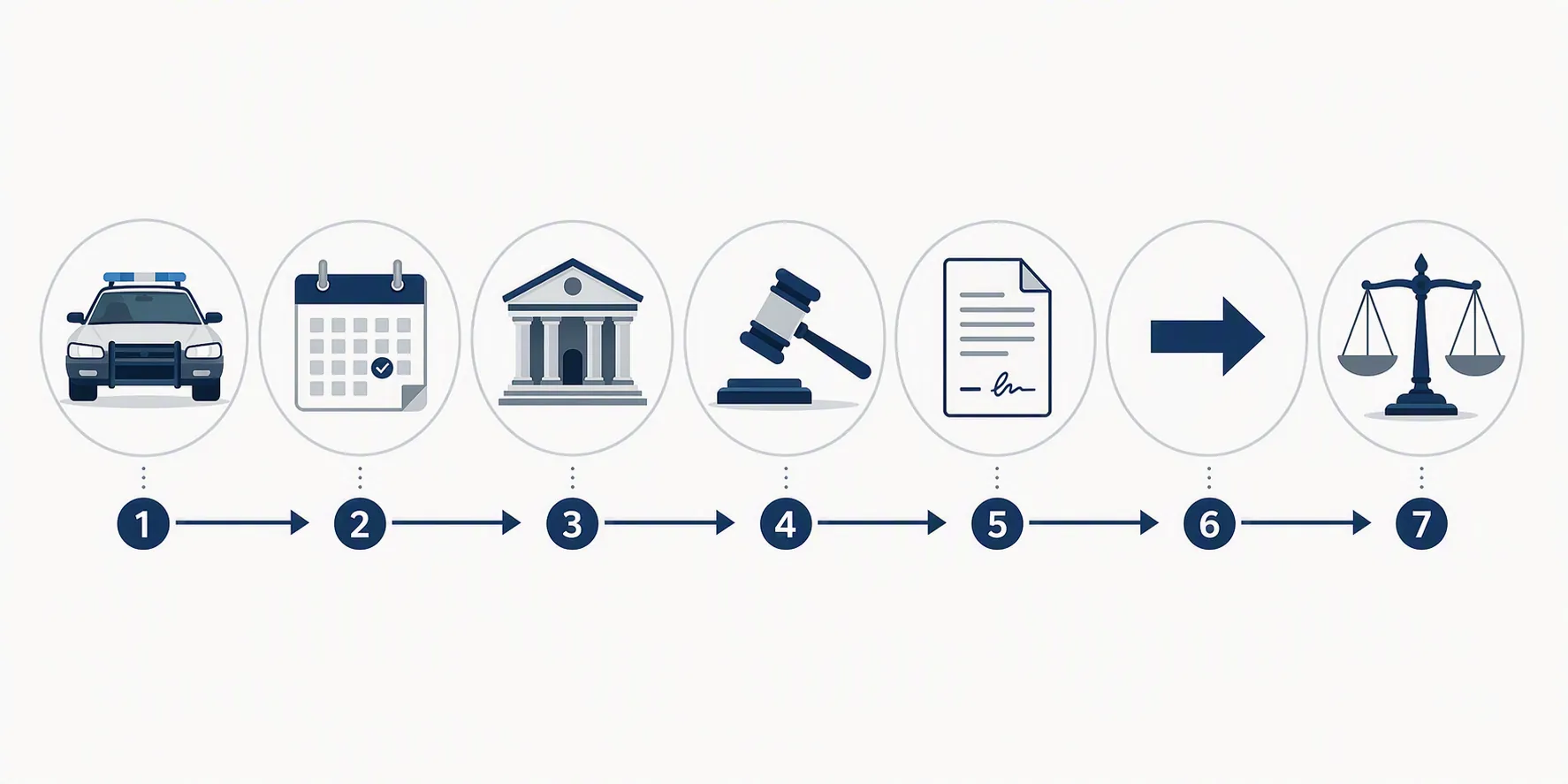
What the Arrest Does, and Does Not, Decide
An arrest starts custody and court supervision questions. It does not decide the final charge, the felony class, admissibility of evidence, credibility of witnesses, or sentencing exposure. In a Nebraska felony domestic-violence matter, the first legally meaningful gates are probable cause for continued detention, release conditions, and the prosecutor’s charging decision.
That distinction matters because domestic-violence allegations often generate immediate collateral decisions: whether the accused can go home, whether contact with an alleged victim is barred, whether an employer must act, whether a licensing or compliance team must disclose a pending matter, and whether a reporter can fairly describe the case without overstating sealed material. Those decisions may be urgent, but the factual record is still thin.
| Procedural point | What it can decide | What it cannot decide |
|---|---|---|
| Arrest | Whether law enforcement takes the person into custody | Whether the person is guilty or what the final filed charge will be |
| Probable-cause review | Whether continued detention has a lawful basis after a warrantless arrest | Whether the state can prove the allegations beyond a reasonable doubt |
| Bond or first appearance | Release terms, court dates, no-contact conditions, and custody status | Final sentencing exposure if the charge classification remains unsettled |
| Preliminary hearing | Whether probable cause supports binding a felony case over toward District Court | Trial guilt, witness credibility in the full evidentiary sense, or punishment |
| District Court plea or trial | Whether the case resolves by plea or proceeds to adjudication | Facts outside the filed record |
Warrantless Arrest and the 48-Hour Review
The first process point after a warrantless arrest is not a press report. It is judicial review of probable cause. Nebraska criminal-procedure explainers describe a 48-hour probable-cause review after a warrantless arrest, a safeguard that determines whether the state has enough basis to continue holding the person while the case moves forward.[3]
For Smith, that means the immediate legal question is modest but important: whether the arrest facts presented to a judge support continued detention or release under conditions. The judge is not deciding final liability at that point. The prosecutor is not yet required, by that review alone, to have proved every element of a felony domestic-violence offense. The defense may still be waiting for the affidavit, reports, recordings, and any witness statements that would make the factual dispute intelligible.
This is where early public language becomes risky. “Facing charges” can mean reported booking allegations in ordinary media use; in court usage, the meaningful document is the complaint or information that the prosecutor files. A sealed or unavailable affidavit leaves outsiders with less than they usually think they have.
First Appearance, Bond, and Nebraska’s No-Commercial-Bail System
After arrest and probable-cause review, the practical question becomes release. Nebraska does not use a commercial bail-bondsman system. The Nebraska Judicial Branch describes pretrial release through mechanisms such as personal recognizance or a 10% cash bond paid directly to the court, rather than a private bail bond purchased through a bondsman.[4]
That difference is not cosmetic. In a commercial-bail state, a headline may focus on a bond amount and whether a bondsman posts it. In Nebraska, the court’s release order is the instrument to read: recognizance, cash percentage, reporting requirements, travel restrictions, weapons restrictions if imposed, and no-contact terms. The dollar figure alone does not describe the risk controls.
At a first appearance or bond hearing, the court can address custody status, advise the defendant of the pending allegations, appoint or confirm counsel where appropriate, set the next hearing, and impose conditions designed to secure appearance and protect safety. In a domestic-violence case, the most consequential condition may not be financial. It may be the contact restriction.
The No-Contact Order Is a Release Condition, Not a Finding
Nebraska defense-practice materials describe no-contact orders as a standard condition of pretrial release in domestic-violence cases, and criminal-defense explainers emphasize that violating such an order can itself create new criminal exposure or jeopardize release.[5][6] The order can bar direct contact, indirect contact through third parties, electronic messages, calls, and physical proximity depending on its terms.
The point is practical rather than symbolic. If a defendant is released, the alleged victim, the defense lawyer, the prosecutor, and the court all need a rule that can be enforced without relitigating the whole allegation every time a message is sent or a location overlap occurs. For counsel and risk managers, the order’s text matters more than a generalized statement that “contact is prohibited.”
A pretrial no-contact order should also be kept separate from Nebraska’s domestic abuse protection order framework. The Nebraska Judicial Branch describes domestic abuse protection orders as civil protective-order tools available through a separate process.[7] The two can overlap in real life, but they are not the same procedural device. One is a condition attached to a criminal release order; the other is a protective-order proceeding with its own paperwork and standards.
From County Court to the Charging Document
A Nebraska felony case commonly begins in County Court and moves toward District Court if it survives the early screening steps. The Nebraska Judicial Branch’s trial-court procedure guide describes the felony path as involving a preliminary hearing in County Court and, if the case is bound over, the filing of an information in District Court.[4]
For a Sarpy County case, that means the early docket may not be the final home of the prosecution. Sarpy County Court handles the first layer: appearances, release conditions, and the preliminary-hearing function. Sarpy County District Court becomes central after the case is bound over and the prosecutor files the information.
The charging document is the hinge. It should identify the formal count, statutory theory, felony class, and any phrasing that clarifies whether “attempted first-degree domestic assault” is being charged through Nebraska’s attempt statute, the domestic-assault statute, or another combination. Until that document is available, the safest description is reported allegations, not confirmed counts.
Arraignment Does Less Than Outsiders Expect
Arraignment is often treated as the dramatic moment when a case becomes real. Procedurally, it is usually more administrative: the court confirms the charge, advises the defendant, and takes a plea. If the plea is not guilty, the case moves into scheduling, discovery, motion practice, plea discussions, or trial preparation.
In the Smith matter, an arraignment would not by itself prove the factual allegations. It would, however, make the formal charge language easier to quote accurately. For journalists, that is the point at which “reported as” can begin to give way to “charged with,” assuming the docket and filing are available.
The Preliminary Hearing Is the First Major Felony Filter
The preliminary hearing is not a trial, but in a felony case it is the first public procedural gate that may reveal more about the state’s evidence. The County Court asks whether probable cause supports the felony charge moving forward. If the answer is yes, the case can be bound over and the prosecutor may file an information in District Court.[4]
That hearing can matter even when it does not end the case. Witnesses may testify. Officers may summarize reports. Defense counsel may test the minimum evidentiary basis for the counts. The burden is not trial-level proof beyond a reasonable doubt, so a bindover should not be reported as a finding of guilt. But it is more informative than a booking entry because it begins to connect alleged facts to statutory elements.
The defense may waive the preliminary hearing, and many felony cases proceed without a contested preliminary-hearing record. If that happens, the public may still have a thin factual record until District Court filings, motions, plea documents, or trial evidence supply more detail.
District Court Is Where the Felony Case Takes Shape
Once an information is filed in District Court, the case has moved out of the County Court screening lane and into the court that can handle felony adjudication. The District Court phase can include renewed arraignment, discovery disputes, suppression motions, plea negotiations, trial scheduling, and sentencing if there is a conviction or plea.
For counsel tracking exposure, this is when the caption alone is not enough. The filed counts, any amended information, and any plea agreement control the operative risk. A case reported as three felonies at arrest may later be filed differently, amended, dismissed in part, resolved by plea to different counts, or tried as charged. None of those outcomes can be inferred from the arrest itself.
The Six-Month Speedy-Trial Clock
Nebraska’s statutory speedy-trial rule is another place where a precise number can mislead if it is detached from procedure. The Nebraska Judicial Branch identifies a six-month speedy-trial window under Neb. Rev. Stat. § 29-1207.[4] The window is central, but it is not a simple calendar prediction from the date of a news article.
Continuances, defense motions, competency questions, interlocutory issues, and other excluded periods can affect the calculation. A risk assessment should therefore treat six months as the statutory frame to investigate, not as a guaranteed trial date. The docket’s continuance orders and motion history are what make the calculation meaningful.
Why the Felony Class Discrepancy Matters
Felony classification is not a labeling detail. It sets the outer punishment range, affects plea leverage, informs pretrial risk analysis, and changes how a compliance team should describe worst-case exposure. That is why the reported inconsistency around the attempted first-degree domestic-assault allegation should not be smoothed over.
Using the classifications reported by MMA Fighting and Yahoo Sports, attempted first-degree domestic assault has been described as a Class IIA felony, while terroristic threats and first-degree false imprisonment have been described as Class IIIA felonies.[1][2] Nebraska penalty summaries identify a Class IIA felony range as up to 20 years of imprisonment and a Class IIIA felony range as up to 3 years of imprisonment, with post-release supervision also associated with Class IIIA exposure.[8]
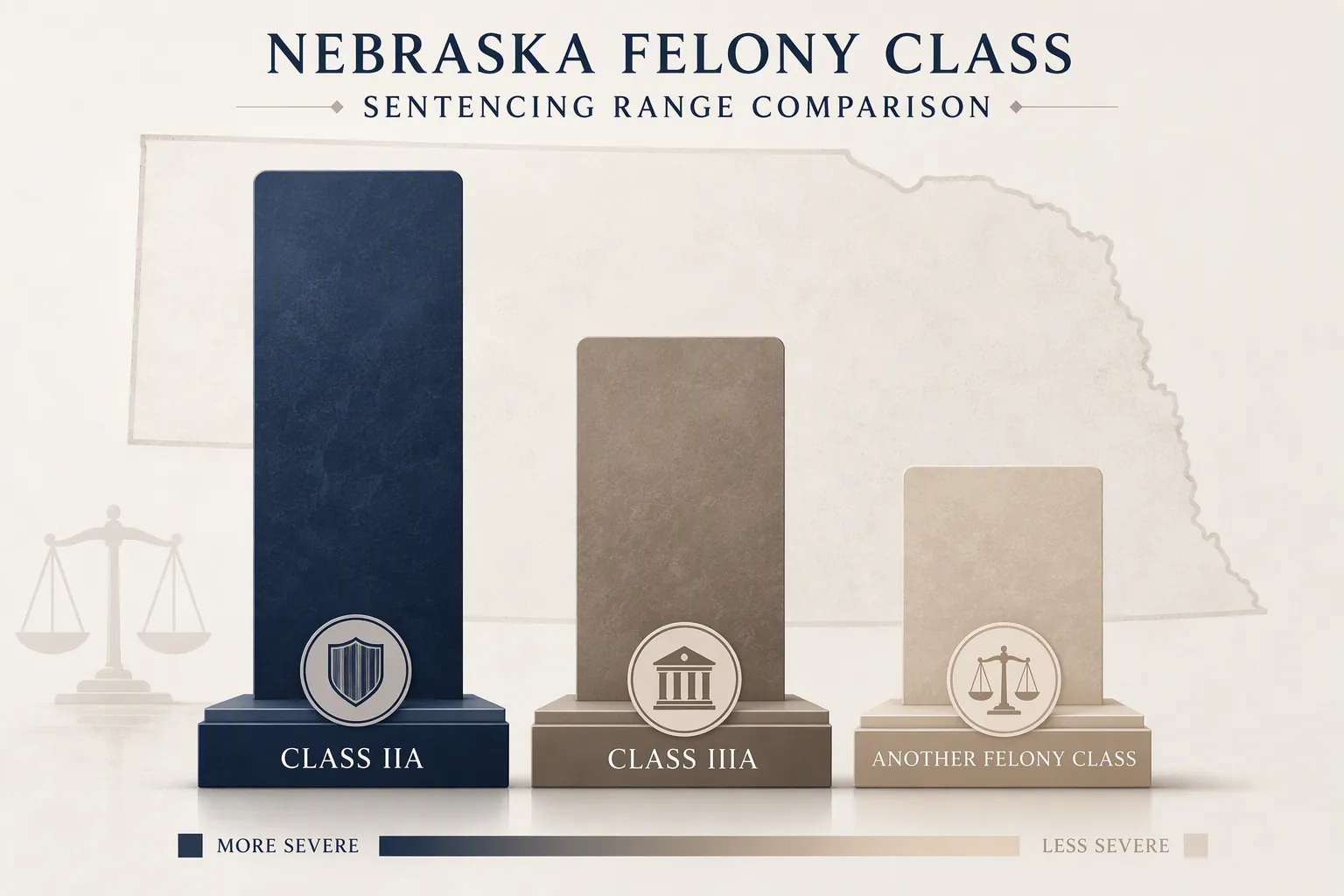
| Reported allegation | Reported felony class | Reported statutory exposure frame |
|---|---|---|
| Attempted first-degree domestic assault | Class IIA felony, according to MMA Fighting and Yahoo Sports | Up to 20 years if the Class IIA classification is confirmed |
| Terroristic threats | Class IIIA felony, according to MMA Fighting and Yahoo Sports | Up to 3 years, with Class IIIA post-release supervision exposure |
| First-degree false imprisonment | Class IIIA felony, according to MMA Fighting and Yahoo Sports | Up to 3 years, with Class IIIA post-release supervision exposure and possible fine exposure as reported |
The table is not a sentencing prediction. It is a classification map based on public reporting and Nebraska penalty summaries. Sentencing, if the case ever reaches that stage, would depend on the filed counts, any amendments, plea terms, conviction offense, criminal-history considerations where applicable, judicial findings, and statutory limits.
Trial, Plea, and the Record That Would Actually Decide the Case
After District Court filing, the case can resolve by plea or proceed toward trial. A plea agreement may narrow the counts, alter the factual basis placed on the record, or recommend sentencing terms within statutory limits. A trial would require the state to prove the charged offense beyond a reasonable doubt. Those are different legal events from the early findings that permit a case to continue.
The distinction is especially important in a domestic-violence felony case because release conditions and protective measures may be imposed long before any trial-level finding. The system can restrict contact and manage risk while still preserving the defendant’s ability to contest the allegations. That tension is not a flaw in the timeline; it is the timeline.
What to Watch Next in the Smith Case
The next reliable case-specific information should come from court filings and docket events, not from broader descriptions of Nebraska procedure. The first documents to watch are the complaint, probable-cause affidavit if released, release order, no-contact terms, and any notice setting a preliminary hearing. After bindover, the information filed in Sarpy County District Court would be the key charging document.
- Whether the attempted domestic-assault allegation is formally filed as a Class IIA felony or under a different classification.
- Whether the release order permits personal recognizance, requires a 10% cash bond, or imposes additional supervision terms.
- The exact scope of any no-contact order, including indirect contact and location restrictions.
- Whether Smith contests, waives, or resolves the preliminary-hearing stage.
- Whether the prosecutor files the same counts in District Court, amends them, or proceeds on a narrower theory.
Until those filings supply more case-specific facts, the Smith matter is best read as a live Nebraska felony-procedure template: arrest first, probable-cause review next, release and no-contact conditions early, preliminary hearing before District Court transfer, and sentencing exposure only after the formal felony class is confirmed.
References
- Anthony Smith arrested on felony charges for domestic violence, terroristic threats and false imprisonment, MMA Fighting
- Anthony Smith faces three felony charges, Yahoo Sports
- How the Nebraska Criminal Justice System Works: A Step-by-Step Guide from Arrest to Appeal, Zanderson Law
- Pre-Trial Process: Criminal Cases, Nebraska Judicial Branch
- Domestic Violence Charges in Nebraska: What You Need to Know, Nebraska Defense Group
- Understanding a No Contact Order, Criminal Defense NE
- Domestic Abuse Protection Order, Nebraska Judicial Branch
- Nebraska Domestic Violence Laws and Penalties, Sopinski Law
Related records
Tool profile
Browse tool evaluations →Governing regulation
Browse the obligations tracker →Preventive workflow
Browse verification workflows →
Report a correction or tip
Spotted an outdated figure, a misstated fact, or a ruling this case record should reflect? Public comments are disabled for this content given the professional cost of a misreported case outcome, penalty amount, or rule text — use the structured correction channel instead.
Report a correction or tip for this record →