
Why the AOC NDAA fact check misses the Israel provision's real risks
AOC called Section 219 of the FY2027 NDAA a merger of the US military with the IDF — a literal inaccuracy, but one that obscures a genuine legal novelty: a dedicated executive agent empowered to override Pentagon technology-security determinations for a single foreign country. This article provides a tiered assessment of what the provision actually does, what risks the fact-checks miss, and why a binary true/false verdict is insufficient for attorneys and compliance officers evaluating the legislative language.
- Jurisdiction
- United States
- Ruling date
- Jul 22, 2026
- Source document
- View primary court order ↗
Lex Machina Review is an independent risk-tracking and reference resource. Nothing on this site is legal advice, and using it does not create an attorney-client relationship. Every record is reviewed against primary sources but may not reflect the most current status of a matter — always verify directly against the cited court order, rule text, or a licensed attorney before relying on it.
Companion explanation — secondary to the source document above
The cleanest AOC NDAA Israel provision fact check starts with an unhelpful fact for both sides of the argument: “merge parts of our military with the IDF” is not what the House-passed text says. Section 219 does not put U.S. troops under Israeli command, create a joint U.S.-Israel chain of command, transfer units into the Israel Defense Forces, or impose a mutual-defense obligation. If that is the only question being graded, the phrase fails.
But that is only the first tier of the legal analysis. The House-passed provision in H.R. 8800, passed on July 22, 2026, by a 216-212 vote, is Section 219; the Senate version uses Section 1217; earlier materials referred to a draft Section 224. Conference could change the provision again. The version that matters for this analysis is therefore the House-passed Section 219, not a generic idea of “defense cooperation” and not every numbered version circulating in the same legislative cycle. A New Policy’s section-by-section account also notes that the House text requires annual reports through 2030 but does not include a sunset clause or mandatory reauthorization trigger.[1]
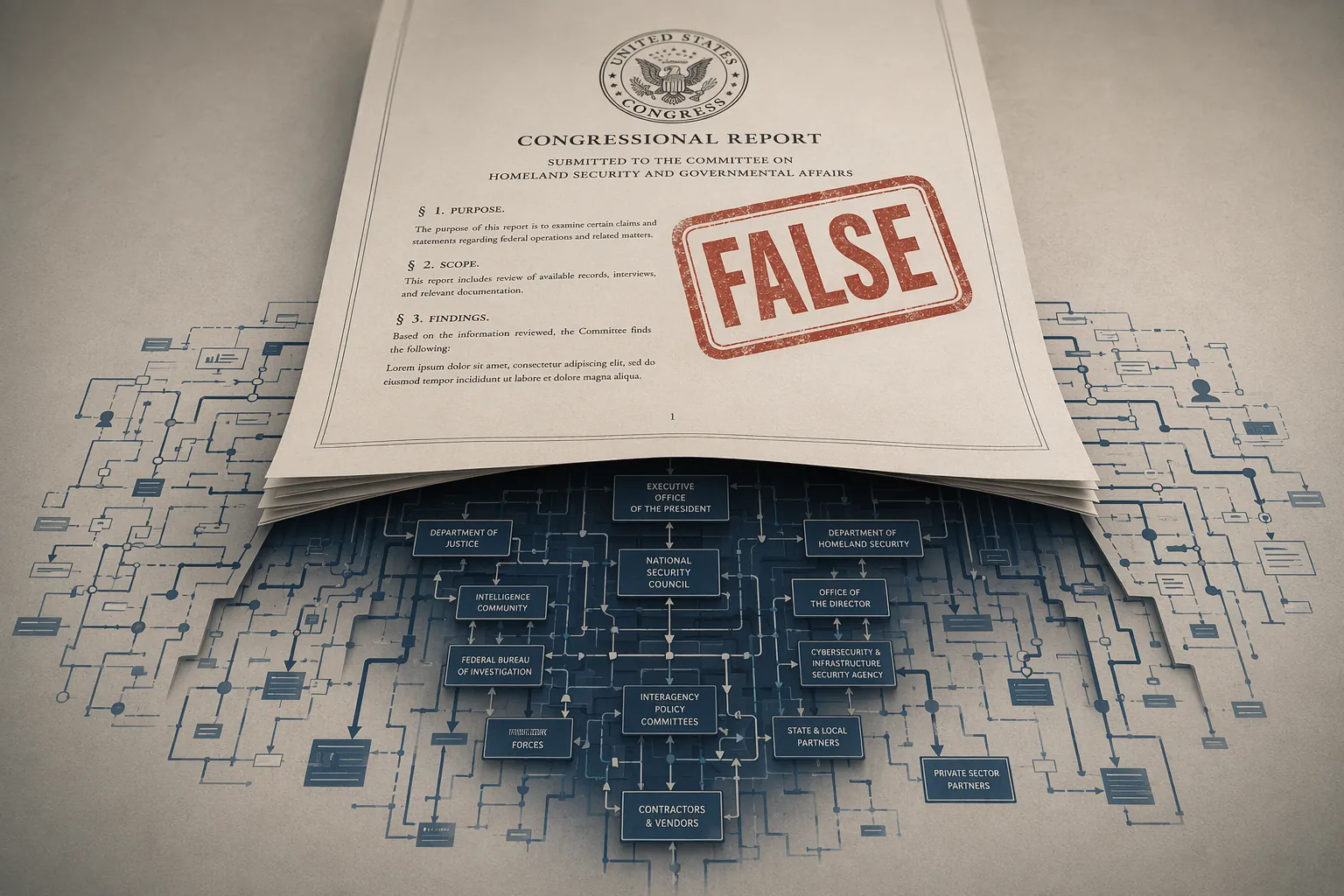
That distinction matters because a binary “false” label can correct the word “merge” while leaving the operative legal novelty untouched. Section 219 is not a merger provision. It is an institutional-routing provision. For a compliance officer, agency lawyer, or contractor counsel, those are different questions.
The operative issue is not command; it is precedence authority
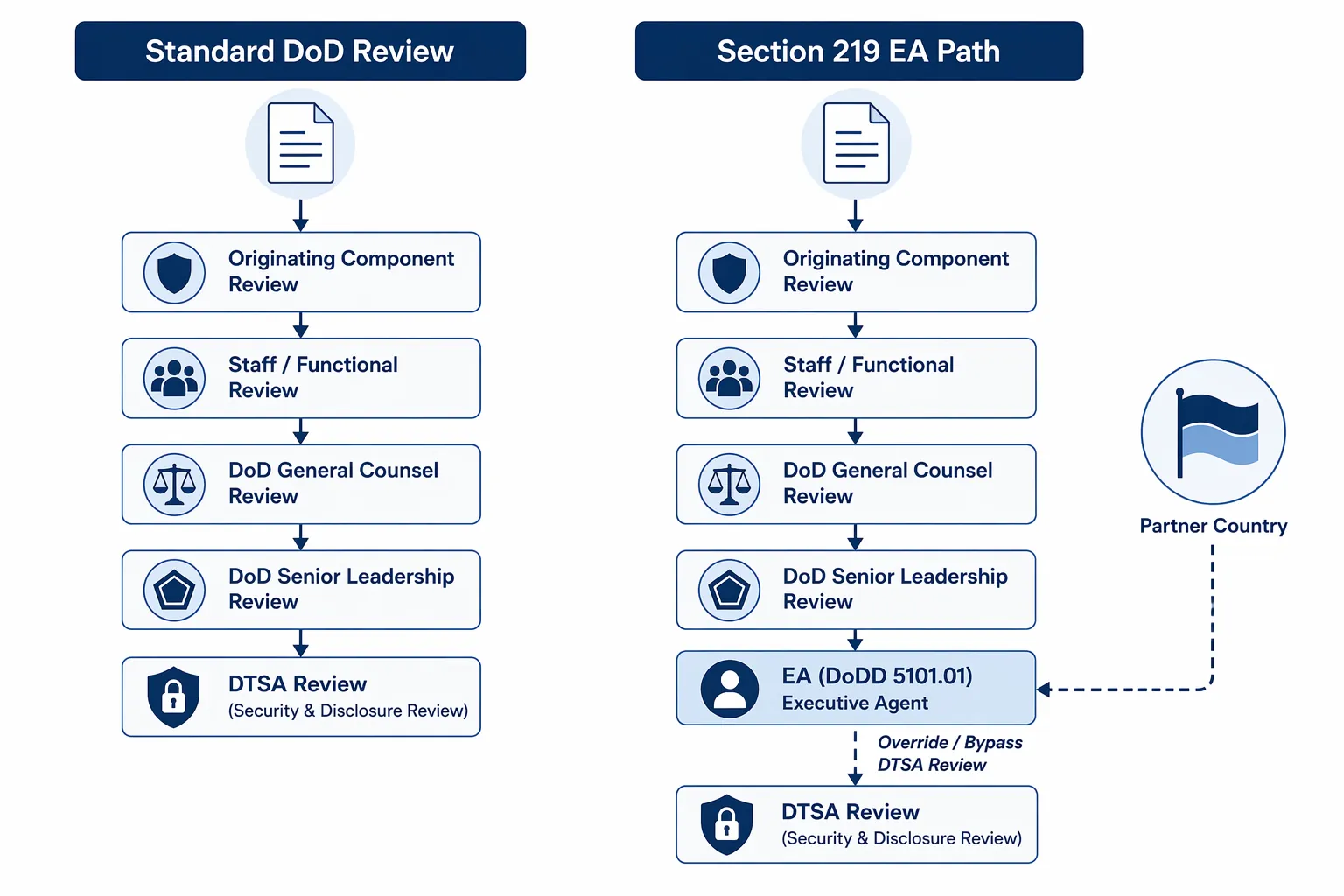
The load-bearing feature is the creation of a dedicated executive agent for U.S.-Israel defense technology cooperation. Quincy Institute’s analysis ties that designation to Department of Defense Directive 5101.01, under which an executive agent has “precedence authority over the authority of other DoD component officials performing related responsibilities.” Quincy argues that this would allow the executive agent to overrule Defense Technology Security Administration determinations on Israeli access to covered defense technologies.[2]
That is a narrower and more serious claim than “military merger.” DTSA is not a television-friendly acronym, but it is exactly the kind of office that matters when the question is whether a technology transfer, joint project, or export-sensitive cooperation should proceed. If Congress creates a country-specific executive agent with precedence authority over officials performing related responsibilities, the question for counsel is not whether a U.S. brigade has been reassigned. It is who gets to say no, and whether that no can be displaced.
Ordinary bilateral defense cooperation can be deep without changing that review hierarchy. Allies share intelligence, run exercises, co-develop systems, and sign memoranda of understanding. None of that automatically means one partner receives a statutory executive-agent channel with precedence over ordinary Pentagon component officials. The legal novelty sits there, not in the rhetorical image of two militaries becoming one.
This is also why comparisons to NATO, Five Eyes, or AUKUS are useful only up to a point. They can show that the United States has many forms of privileged defense cooperation. They do not answer the more precise question: has Congress created this kind of dedicated executive-agent structure, with DoDD 5101.01 precedence implications, for one foreign country in the defense technology review path? On the materials available here, Quincy says no analogue exists in those relationships.[2]
Why the review path changes the risk analysis
The practical legal problem is not that every future Israeli request would be approved. The text does not support that. The problem is that the institutional referee changes. A normal technology-security objection becomes one input inside a structure where a designated executive agent may claim superior authority over related DoD component officials. That is enough to alter how lawyers draft conditions, how program managers document dissent, and how contractors assess whether an approval reflects ordinary review or a statutory override channel.
The House and Senate versions also do not line up exactly. The research materials identify the House-passed Section 219 as containing an interagency coordination clause involving State and Commerce, while the Senate Section 1217 omits that clause.[1] That difference is not cosmetic. State and Commerce are often where export-control, foreign-policy, and licensing consequences surface. If a final bill weakens or omits their coordination role, the executive-agent structure becomes more internally Pentagon-centered.
The annual-report language does not cure that structural issue. Reporting through 2030 may give Congress periodic visibility, but it is not the same thing as a sunset clause. A report asks the executive branch to describe what happened. A sunset forces Congress to decide whether the authority should continue. Those are different legal controls, and only one of them changes the default.
Counterintelligence is context, not the whole case
The counterintelligence backdrop makes the routing question harder to dismiss. Military.com, citing NBC reporting and U.S. officials, reported that the Defense Intelligence Agency elevated Israel’s intelligence threat rating to “critical,” the highest level, during the same legislative cycle; the report also quoted U.S. officials describing Israeli intelligence collection against U.S. officials as “unhinged.”[3]
That rating should be handled carefully. The source is a news report, not a publicly released DIA document in the materials provided here. It should not be made to carry the whole legal argument. But it is not irrelevant. If the Pentagon’s own intelligence community is reported to have escalated a partner’s threat rating at the same time Congress is considering a statutory pathway for deeper technology cooperation, the appropriate response is not to wave away the concern because the word “merge” was loose.
For a lawyer reviewing implementation, the counterintelligence fact changes the questions asked at the front end: whether compartmentalization rules are preserved, whether dissent from security offices is recorded, whether an override must be justified in writing, whether access decisions can be audited after the fact, and whether contractors receive clear instructions when ordinary DTSA concerns conflict with executive-agent priorities.
Biotechnology is not just another cooperation domain
The covered domains matter because some technologies carry treaty consequences that ordinary defense-industrial cooperation does not. Quincy identifies Section 219(b)(7) as listing “biotechnology, biomanufacturing, and medical defense” among the cooperation areas. The same analysis notes that Israel is one of 10 nations that has neither signed nor ratified the Biological Weapons Convention, while Article III requires States Parties to ensure that cooperation does not contribute to biological weapons programs.[2]
That does not mean Section 219 authorizes a biological weapons program. It does not. The narrower legal issue is whether a fast-tracked or executive-agent-led cooperation structure could weaken the ordinary points at which BWC compliance concerns are identified, documented, and stopped. In a domain like biotechnology, the difference between medical defense, dual-use research, and prohibited assistance can turn on facts that do not fit comfortably inside a political fact-check.
Data fusion and targeting concerns depend on implementation, but they are not imaginary
Human Rights Watch raises a different kind of concern: if Section 219 cooperation includes data fusion, and if that cooperation draws the United States into processing or integrating intelligence used by Israeli AI-enabled targeting systems, the United States could face complicity risks. HRW’s analysis says those Israeli systems rely on data collected through mass surveillance incompatible with international human rights law.[4]
This point should not be overstated either. A statutory reference to cooperation does not prove that U.S. personnel will process unlawfully collected data, approve targets, or participate in a specific strike. The risk depends on implementation: what data sets are shared, what systems are connected, what human review exists, what targeting functions are supported, and whether U.S. officials can segregate lawful defensive cooperation from intelligence products tainted by unlawful surveillance.
Still, implementation-dependent does not mean speculative in the useless sense. Lawyers routinely evaluate provisions by asking what they authorize, what they incentivize, and what guardrails they omit. If a bill creates a privileged channel for data-related defense cooperation while leaving the hard questions to later executive practice, the absence of an immediate violation is not the end of the legal inquiry.
Entrenchment is the quiet consequence
The no-sunset feature matters most when paired with defense technology cooperation that can become operationally and industrially embedded. Once agencies create offices, contractors align product lines, data systems interoperate, and appropriators receive annual reports framed around progress, the cost of unwinding rises even if the statute did not formally promise permanence.
Turkey’s removal from the F-35 program is the useful analogy here only in that limited sense: technologically integrated defense programs are easier to enter than to unwind. The point is not that Israel is Turkey, that the programs are identical, or that the same trigger exists. The point is institutional inertia. A statutory channel with no mandatory reauthorization date can create facts on the ground before Congress has to vote again on whether the arrangement still makes sense.
What a useful fact check would say
A useful verdict would not rescue imprecise language. It would say plainly that “merge parts of our military with the IDF” is inaccurate if readers understand it to mean joint command, U.S. troop deployment under Israeli command, incorporation into the IDF, or a new mutual-defense obligation. Those claims are not in the House-passed Section 219 text described in the available materials.
It would then add the part that matters for legal and compliance readers: the provision appears to create a country-specific executive-agent mechanism for Israeli defense technology cooperation, with DoDD 5101.01 precedence implications over other DoD component officials, including DTSA, and it does so without a sunset clause. It covers sensitive domains including biotechnology, sits against a reported “critical” counterintelligence rating, and may intersect with data-fusion practices that human-rights advocates say could increase U.S. complicity risks.[1][2][3][4]
Those propositions are not all the same kind of risk. The executive-agent routing and no-sunset design are direct structural features of the House-passed provision. The biotechnology issue is a domain-specific treaty compliance concern. The DIA rating is serious context, reported rather than publicly confirmed in an official document available here. The HRW targeting concern depends on how future data-fusion cooperation is implemented. Collapsing those distinctions would be as careless as pretending the word “merge” is legally exact.
So the tiered answer is the only defensible one. AOC’s merger framing fails literally in important ways. The fact-checks that stop there also fail, because the pending House provision’s real legal effect is not theatrical integration of two militaries. It is a change in who can drive and potentially override the technology-security review path for one foreign country. Until conference resolves the House and Senate versions, that is the issue counsel should be tracking.
References
- The National Defense Authorization Act FY 2027 (Sec. 219 and Sec. 1217), A New Policy
- Cooperation without Oversight: The United States-Israel Defense Technology Cooperation Initiative, Quincy Institute
- Pentagon Raises Israeli Spy Threat as NDAA Seeks Deeper Defense Ties, Military.com
- Congressional Proposal Could Deepen US Complicity, Human Rights Watch
Related records
Tool profile
Browse tool evaluations →Governing regulation
Browse the obligations tracker →Preventive workflow
Browse verification workflows →
Report a correction or tip
Spotted an outdated figure, a misstated fact, or a ruling this case record should reflect? Public comments are disabled for this content given the professional cost of a misreported case outcome, penalty amount, or rule text — use the structured correction channel instead.
Report a correction or tip for this record →