
Why Ariana Grande's Lawsuit Is a Long Shot for Unmasking Hackers
This article examines how Ariana Grande's July 2026 John Doe lawsuit uses civil discovery to identify anonymous hackers, the realistic success rates based on expert assessment, and why such suits function primarily as deterrent signals.
- Jurisdiction
- California
- Court
- Los Angeles Superior Court
- AI tool named
- None
- Ruling date
- Jul 27, 2026
- Source document
- View primary court order ↗
- Last verified
- Jul 30, 2026
Lex Machina Review is an independent risk-tracking and reference resource. Nothing on this site is legal advice, and using it does not create an attorney-client relationship. Every record is reviewed against primary sources but may not reflect the most current status of a matter — always verify directly against the cited court order, rule text, or a licensed attorney before relying on it.
Companion explanation — secondary to the source document above
The important fact about the Ariana Grande hackers lawsuit is not a settlement. As of July 30, 2026, the case is three days old, no settlement has been reported, and no anonymous defendant has been publicly identified. The legally useful posture is narrower and more procedural: a July 27, 2026 Los Angeles Superior Court complaint against John Doe defendants 1 through 100, filed so Grande can use civil discovery to try to uncover who allegedly obtained and distributed unreleased music, photos, and related materials. [1]
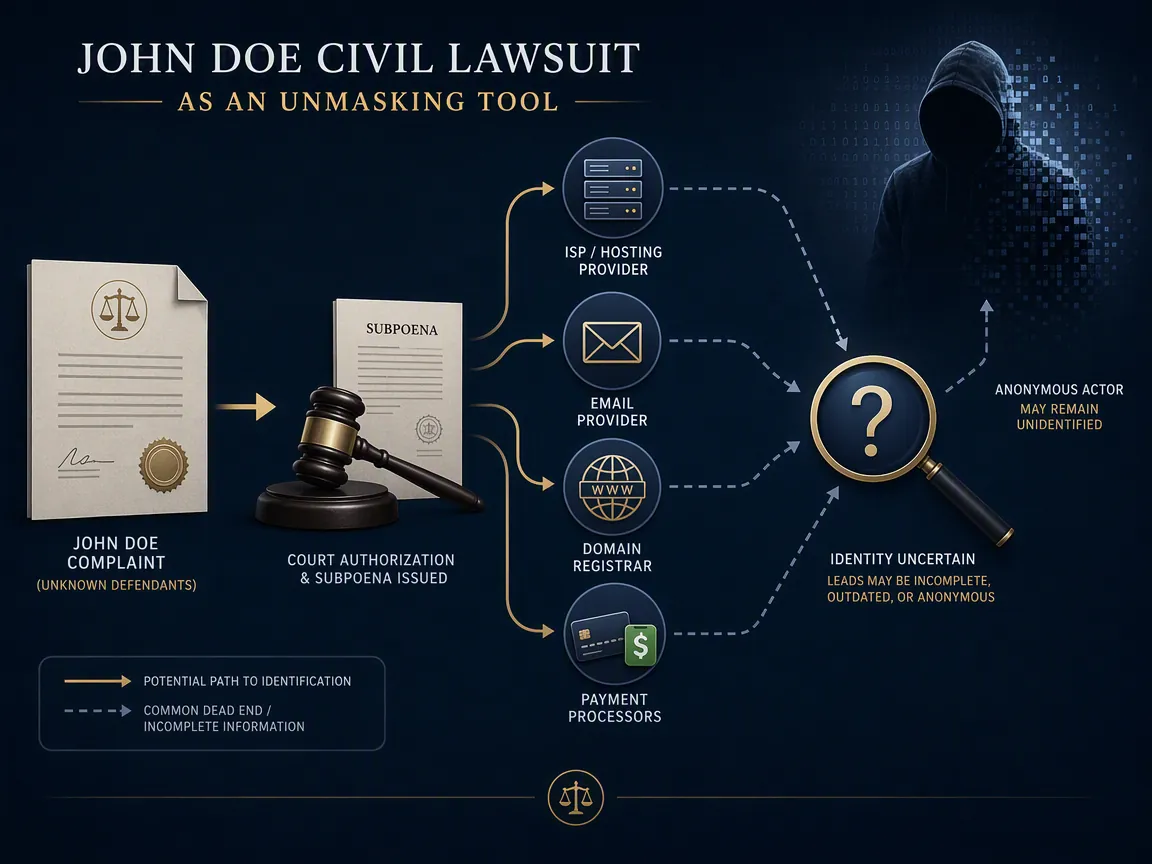
That distinction matters because a John Doe complaint is not proof that the plaintiff has found the hackers. It is usually the opposite. It is a way to start a lawsuit before the plaintiff knows whom she is suing, then ask the court for permission to send subpoenas to third parties that may hold identifying records. In Grande’s case, the reported subpoena targets include internet service providers, email providers, domain registrars, and payment platforms including PayPal and Cash App. [1][2]
What the complaint is trying to buy
The complaint’s most consequential function is access to process. A rights-holder who has only screen names, marketplace handles, email addresses, wallet-like payment identifiers, domain records, or IP logs cannot serve a normal defendant in the ordinary way. Filing against Doe defendants creates a case caption, a judge, and a procedural path for third-party discovery.
That path is familiar in California civil practice. The plaintiff alleges claims against unknown defendants, explains why their identities are necessary to proceed, and seeks subpoenas to intermediaries that may have retained subscriber information, login data, registration details, transaction records, or communications metadata. California Penal Code section 502, the Computer Data Access and Fraud Act, supplies part of the legal context for alleged unauthorized computer access, but the center of gravity here is not a statutory deep dive. The practical question is whether discovery can turn anonymous online activity into a name, address, account holder, or financial trail.
| Discovery target | What counsel is usually trying to obtain | Why it may matter |
|---|---|---|
| Internet service provider | Subscriber records linked to an IP address or access event | Can connect a logged access point to an account holder, if the logs are timely and reliable |
| Email provider | Registration data, recovery information, access logs, related accounts | May expose reuse across accounts or a recovery path tied to a real person |
| Domain registrar | Registrant data, payment details, account history, administrative contacts | Can identify who controlled a site or domain used to host, advertise, or sell leaked material |
| Payment processor | Account holder information, transaction history, linked bank or card details | Often creates a more concrete trail than a disposable handle or masked IP address |
The payment-platform piece deserves more attention than it usually gets in quick coverage. IP addresses and email accounts are easily shared, masked, abandoned, or created with false information. Payment records are not immune to deception, but they can force the inquiry closer to a bank account, card, device, phone number, or compliance file. If the alleged monetization passed through PayPal or Cash App, the plaintiff may have a better trace chain than she would from a dark-web username alone. The BBC reported that Grande’s complaint refers to payment-platform allegations involving PayPal and Cash App. [2]
The case is still in the identification phase
Nothing in the known record supports treating this as an unmasking story yet. The defendants are still Does. The complaint was filed on July 27, 2026. No docket number is publicly available from Los Angeles Superior Court in the supplied materials. The available reporting describes the alleged theft and sale of unreleased music and photos, but the procedural posture remains preliminary: the lawsuit is built to find defendants, not to litigate against already-known defendants. [1]
The allegations explain why the tool was chosen. Reports describe claims that unreleased songs and photographs were obtained and offered for sale online, including through dark-web channels. [3] ABC also reported allegations involving access points tied to collaborators, a fact pattern that would make third-party records especially important because the initial compromise may not have started inside Grande’s own accounts. [4]
Those facts are important only to the extent they shape the discovery map. If the alleged access moved through collaborators, storage accounts, email addresses, file-transfer tools, sellers, buyers, and payment services, counsel has to work backward across institutions that may each hold one fragment. The complaint can create subpoenas, but it cannot make those fragments complete, current, domestic, or truthful.
Where the trace chain breaks
The optimistic version of a John Doe case is linear: file the complaint, subpoena the service provider, receive records, identify the account holder, amend the complaint, serve the defendant. That sequence exists, and sometimes it works. It is not the sequence counsel should promise a client when the alleged wrongdoers are sophisticated hackers or leak sellers.
Jeremy Goldman, an intellectual property and media lawyer at Nixon Peabody, gave CBC the blunt version: the John Doe mechanism is “frequently used,” but “the nature of the internet and the nature of hackers makes it very difficult to pin this down.” [5]
That is the right caution. A subpoena may return an IP address associated with a VPN exit node. An email provider may return registration data created with false information. A domain registrar may show a privacy service, a reseller, or a foreign intermediary. A payment processor may have records for a mule, compromised account, or intermediary buyer rather than the person who took the files. Even a useful record may require another subpoena, then another, with each step creating delay and another opportunity for the trail to go cold.
Staleness is its own problem. Providers do not keep every category of data forever. Some logs rotate. Some metadata is incomplete. Some accounts are deleted. Some platforms will object, narrow production, require additional process, or produce only what their systems preserved. If the relevant actor is outside the United States, the civil subpoena path can run into jurisdictional and enforcement limits before it reaches a usable identity.
There is also the account-holder fallacy. A record can identify the person or entity associated with an account without proving that person committed the alleged intrusion. In household, workplace, shared-device, compromised-account, and reseller scenarios, subscriber identity is a lead, not liability. The plaintiff still has to connect conduct to a defendant with evidence that can survive motion practice and, if necessary, trial.
Why file anyway
A low-probability identification strategy can still be rational. A complaint changes the posture from private complaint to public legal action. It tells leak sellers, buyers, collaborators, platforms, and future intermediaries that the rights-holder is willing to create a record and impose process costs. It may also preserve claims, organize an investigation, and give counsel a court-supervised mechanism for requesting records that a platform might not voluntarily provide.
Grande’s camp has described that function openly. A source close to her told People that the lawsuit is “intended to serve as a deterrent against future acts of this nature.” [6] That is not a throwaway public-relations line. In this kind of case, deterrence may be the most reliable value the filing can produce, especially before any defendant has been identified.
Deterrence works differently from recovery. It does not require the plaintiff to collect damages from every unknown actor. It requires the market around the leak to understand that the plaintiff will spend money, send subpoenas, and increase the legal risk for people who touch the material. That signal may matter to opportunistic sellers, fans who think buying unreleased files is consequence-free, and intermediaries that prefer not to become subpoena recipients.
The Sia comparison shows the playbook is not new
Grande’s filing fits an established rights-holder pattern rather than a novel celebrity maneuver. In 2023, Sia filed a John Doe lawsuit seeking to unmask an alleged identity thief who had stolen unreleased recordings, according to Rolling Stone. [7] The point of the comparison is procedural: an artist facing anonymous exploitation of unreleased material can use a civil case to pursue identifying discovery before naming the actual defendant.
That precedent does not prove Grande will identify the alleged hackers. It shows why counsel would recognize the move. Unreleased music is a rights asset, not just a fan-culture object. Once it is circulating through anonymous accounts and attempted sales, the lawyer’s available tools narrow quickly: demand letters are useless without a recipient, platform takedowns address only visible copies, and criminal referrals do not give the private plaintiff direct control over investigative priorities.
John Doe litigation fills that gap imperfectly. It gives the plaintiff a civil discovery channel. It does not give the plaintiff law-enforcement visibility, guaranteed platform cooperation beyond lawful process, or certainty that the person found at the end of the records is the person who performed the intrusion. For counsel, the Sia comparison is useful because it normalizes the architecture without overstating the odds.
What success would actually look like
The cleanest success would be identification of one or more Doe defendants, amendment of the complaint to name them, service, and litigation on the merits. That is possible, but it is not the only practical measure of success in a case like this.
A more modest success could be learning which accounts, domains, payment channels, or intermediaries were involved, even if the ultimate actor remains obscured. That information can support takedown strategy, platform reporting, security remediation, preservation letters, or future claims if the same identifiers reappear. Another practical success could be disrupting monetization: payment processors and marketplaces that receive subpoenas may become less hospitable to accounts associated with the alleged sale of stolen material.
The mistake is to collapse those outcomes into the word “settlement.” Settlement presumes a counterparty capable of resolving the case. At the moment, the public record describes a plaintiff trying to find counterparties. Until a Doe defendant is identified, appears, defaults, negotiates, or is otherwise brought into the case, settlement talk is search noise.
On the known record as of July 30, 2026, Grande’s lawsuit is best read as a high-effort, low-probability identification strategy with a clearer deterrent function. The complaint may produce useful records. It may even identify someone. But the existence of subpoena power should not be mistaken for the likelihood of unmasking sophisticated hackers.
References
- Ariana Grande Hacking Lawsuit, The New York Times, July 28, 2026.
- Ariana Grande sues hackers over leaked music, BBC News.
- Ariana Grande sues hackers who allegedly sold unreleased music and photos online, The Guardian, July 28, 2026.
- Ariana Grande sues alleged hackers over unreleased music leaks, ABC News.
- Ariana Grande sues hackers over leaked music, CBC News, July 28, 2026.
- Ariana Grande Sues Alleged Hackers for Malicious Invasion of Privacy, People, July 27, 2026.
- Sia Sues to Unmask Identity Thief Seeking Her Unreleased Recordings, Rolling Stone.
Related records
Tool profile
Browse tool evaluations →Governing regulation
Browse the obligations tracker →Preventive workflow
Browse verification workflows →
Report a correction or tip
Spotted an outdated figure, a misstated fact, or a ruling this case record should reflect? Public comments are disabled for this content given the professional cost of a misreported case outcome, penalty amount, or rule text — use the structured correction channel instead.
Report a correction or tip for this record →