
Ashley Moody's Centene Scandal and the Grand Jury Secrecy Fight
Examines how Florida's grand jury presentment sealing statute (Fla. Stat. § 905.28) was deployed in the Centene/Hope Florida investigation, the First Amendment limits on witness disclosure under Butterworth v. Smith, and the press intervention rights that could force unsealing.
- Jurisdiction
- Florida
- Court
- Leon County Circuit Court
- Judge
- J. Lee Marsh
- AI tool named
- No AI tool implicated
- Ruling date
- Feb 25, 2026
- Source document
- View primary court order ↗
- Last verified
- Jul 30, 2026
Lex Machina Review is an independent risk-tracking and reference resource. Nothing on this site is legal advice, and using it does not create an attorney-client relationship. Every record is reviewed against primary sources but may not reflect the most current status of a matter — always verify directly against the cited court order, rule text, or a licensed attorney before relying on it.
Companion explanation — secondary to the source document above
The legal fact worth starting with is not a press conference, a denial, or a leak. It is a sealed presentment that remains unavailable to the public as of July 2026, even though Florida law supplies a procedure that is supposed to move a grand jury report either toward publication or toward repression. Any legal analysis of the Ashley Moody-Centene grand jury fight has to start there, because the present public record is thinner than the political argument around it.
Florida Statutes § 905.28 sets the relevant machinery: when a grand jury returns a presentment that is not accompanied by an indictment and that criticizes a person, the court does not simply publish it. The named person receives a copy and has 15 days to move to repress or expunge it; if an appeal follows, publication is stayed until the appeal is resolved.[1] Florida’s neighboring secrecy statute, § 905.27, separately restricts disclosure of grand jury proceedings, but that statute cannot be read as a permanent gag on a witness’s own testimony after the grand jury term ends.[2][3]

That combination produces the current contradiction. The paper presentment can sit behind a statutory seal. Witnesses may still be able to describe what they themselves said. A press organization may be allowed into the repress proceeding to argue for access. None of that tells the public what the grand jury found in the Hope Florida/Centene matter. It does explain why the access fight may become the most durable legal event in the case.
The statute gives a path to publication without a clear endpoint
Section 905.28 is easy to summarize and harder to live with. It is built around a fair premise: a grand jury presentment can criticize a person without charging that person, and Florida gives the criticized person a chance to object before the report becomes public. That protection is not frivolous. A public report from a grand jury carries institutional weight even when it does not result in an indictment.
The difficulty is in the endpoint. The statute creates a 15-day window for a motion to repress or expunge, and it keeps the presentment sealed while the court considers that motion. If the court denies relief and the affected person appeals, the statute continues the seal pending appeal. What the statute does not provide is a sunset, a mandatory expedited schedule, or a separate public-access clock that begins running once the report has been returned.[1]
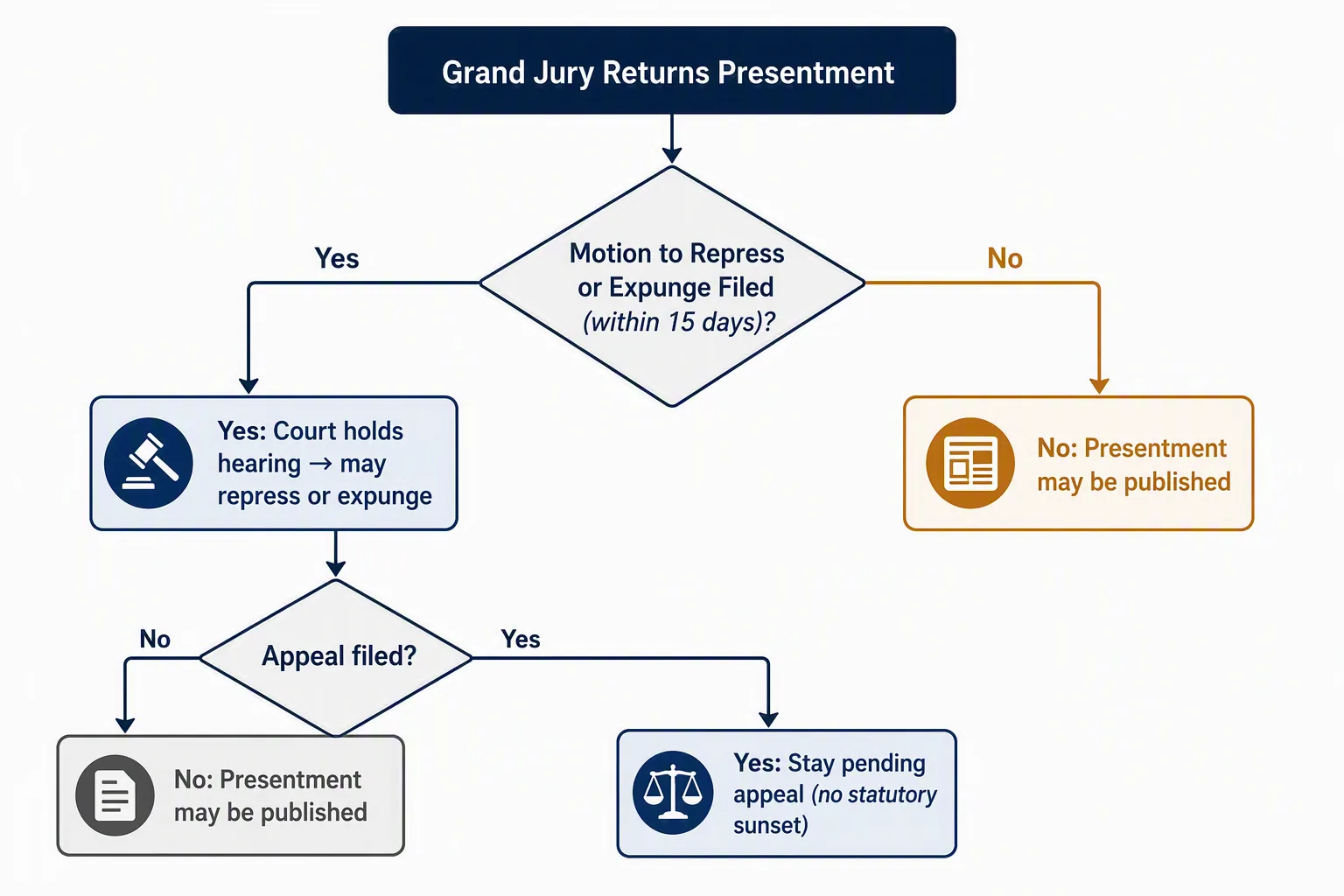
| Stage | What the statute does | Access consequence |
|---|---|---|
| Grand jury returns a presentment | The court reviews whether it criticizes a person and is not accompanied by an indictment. | The report may be withheld rather than immediately published. |
| Notice to the criticized person | The person receives a copy and has 15 days to seek repression or expunction. | The public still cannot verify the report’s text. |
| Motion to repress or expunge | The court hears the challenge under § 905.28. | Access turns into litigation rather than automatic disclosure. |
| Appeal | Publication remains stayed pending appellate review. | The statute supplies no express sunset for the seal. |
In practical terms, “repress” means preventing publication of the presentment. “Expunge” is stronger: it seeks removal from the record in a way that treats the challenged report as something the court should not preserve for public use. The choice matters, but from the outside both remedies initially look the same. The report is unavailable, the docket is spare, and the public is left reading around the sealed object rather than reading the object itself.
That is the procedural gap. Florida gives the affected person a defined opening move. It does not give the public a comparably defined finish line.
What is publicly known about the Hope Florida presentment
The available reporting places the sealed presentment in the Hope Florida investigation, a matter that public discussion has tied to Centene settlement money, political committees, and the role of state officials including Ashley Moody. But the presentment itself is not public, so its findings, legal reasoning, and any recommendations cannot be stated as known facts.
Florida Trident reported on February 25, 2026, that the grand jury had returned a presentment in the Hope Florida investigation and identified three sealed Leon County case numbers connected to that posture.[4] Those case numbers are evidence that sealed court proceedings exist. They are not evidence, by themselves, of what the grand jury concluded.
Nor should the sealed docket be used to fill in missing allegations. Money-laundering and wire-fraud theories have circulated around the public controversy, and Ashley Moody’s settlement-approval role is part of the political setting. Those are adjacent issues for a different record. The access question here is narrower: whether Florida’s grand jury secrecy mechanism can keep a completed presentment practically unreachable while other pieces of the story continue to surface outside the sealed report.
One uncertainty should be kept in view. Public materials available for this analysis do not confirm who, if anyone, filed a motion to repress or expunge the Hope Florida presentment. The existence of sealed case numbers and the continued seal may be consistent with a § 905.28 fight, but they do not prove the contents of a motion that remains unavailable.
Butterworth limits the seal’s reach, but it does not unseal the report
The First Amendment issue enters through a different door. Florida’s grand jury secrecy statute restricts disclosure of testimony and proceedings, and grand jury secrecy has legitimate functions: protecting investigations, encouraging candor, reducing reputational harm from uncharged accusations, and preventing witness coordination.[2] But secrecy is not a perpetual ownership claim over everything a witness knows.
In Butterworth v. Smith, the U.S. Supreme Court held that Florida could not permanently prohibit a grand jury witness from disclosing the substance of the witness’s own testimony after the grand jury’s term ended. The holding matters because it separates the presentment from the witness. A sealed report remains sealed; a witness’s own memory of what the witness said is not automatically locked away forever.[3]

That distinction is not cosmetic. Public reporting has already described witness disclosures connected to the Hope Florida investigation, including statements attributed to Rep. Alex Andrade and Amy Ronshausen. WUSF reported Andrade’s public accusations involving alleged money laundering and wire fraud and his account of text-message direction from James Uthmeier.[6] Those statements are not a substitute for the presentment. They are examples of why sealed-report secrecy does not make all knowledge disappear.
Butterworth should not be overread. It does not authorize a witness to disclose the grand jury’s internal deliberations, publish the sealed presentment, or reveal information learned only because of participation in the grand jury process rather than from the witness’s own experience. It also does not decide whether a particular public statement is accurate. Its force is more precise: after the term ends, the state may not impose a permanent First Amendment gag on a witness’s disclosure of the witness’s own testimony.[3]
The press intervention ruling is a real procedural lever
The second escape valve is not a leak. It is intervention. Florida Trident reported in March 2026 that Judge J. Lee Marsh granted limited intervention to Florida Trident and the Florida Center for Government Accountability in the Hope Florida grand jury case, allowing them to participate in the sealed-report access fight.[5]
Limited intervention is not the same thing as unsealing. It does not mean the press has won access to the presentment. It means the press is not confined to complaining from the courthouse steps while the legal question is decided without an access advocate in the room. In a proceeding that otherwise risks being defined only by the state, the court, and the criticized person, that status matters.
The ruling also fits a longer Florida access tradition: the press can have a role in repress proceedings precisely because publication of a grand jury report is not a private dispute between the report’s subject and the government. Florida Trident’s intervention gives that principle an active docket vehicle in the Hope Florida matter.[5]
This is where the access question becomes sharper than the political argument. A sealed presentment prevents the public from verifying the grand jury’s findings. Butterworth allows some witness speech to survive the seal. Intervention allows an access advocate to test the seal in court. The result is not transparency, exactly. It is a contested legal channel through which transparency may be pursued.
The reported DOJ declination does not answer the state-court access problem
Public officials have referred to a Department of Justice declination in connection with the broader Hope Florida controversy. On the record available here, that reported declination is not independently confirmed by a public statement from the U.S. Attorney’s Office for the Northern District of Florida, and its basis is not publicly documented. It should not be treated as a judicial finding about the sealed Florida presentment.
That caution cuts both ways. A declination, even if confirmed, would not prove that the presentment contains nothing of public consequence. It also would not prove the opposite. Federal charging discretion and state grand jury presentment publication are different legal events. One may affect political messaging; it does not dissolve the § 905.28 seal.
For lawyers and reporters, the safest map is procedural
The current public record supports a few statements with confidence and leaves several tempting claims outside the line.
- It is fair to say that Florida law creates a 15-day repress-or-expunge window for certain grand jury presentments and stays publication during an appeal.[1]
- It is fair to say that Florida’s grand jury secrecy statute cannot permanently bar a witness from later disclosing the witness’s own testimony after the grand jury term ends.[2][3]
- It is fair to say that Florida Trident reported a returned Hope Florida presentment and three sealed Leon County case numbers.[4]
- It is fair to say that Florida Trident and the Florida Center for Government Accountability obtained limited intervention in the access proceeding before Judge J. Lee Marsh.[5]
- It is not fair to state the presentment’s findings as fact, because the presentment remains sealed.
- It is not fair to infer from sealed case numbers alone that a particular person filed a repress motion, unless a public filing or court order confirms it.
- It is not fair to treat public witness statements as the grand jury’s conclusions.
That procedural discipline can feel unsatisfying, especially in a politically charged case. It is still the only way to avoid laundering uncertainty into fact. The public knows there is a sealed presentment. It knows the statutory route by which publication can be delayed. It knows witnesses may retain First Amendment protection for their own testimony. It knows the press has been permitted to participate in the access fight. It does not know what the report says.
The institutional risk is the missing endpoint
Grand jury secrecy is not the problem by itself. Florida can protect uncharged people from immediate publication of a critical report, and it can preserve the integrity of grand jury proceedings. The harder problem is a mechanism that allows a completed presentment to become practically unreachable once the repress process and appeal stay are engaged.
That risk is especially acute in a matter like Hope Florida, where public accountability depends on being able to distinguish allegations, witness accounts, settlement decisions, prosecutorial choices, and grand jury findings. If the presentment remains sealed indefinitely, the public debate will be filled by everything except the document the grand jury actually returned.
The law prevents total darkness. Butterworth keeps witness speech from being permanently swallowed by the grand jury room. Press intervention gives access advocates a place in the repress proceeding. But neither doctrine supplies the missing statutory endpoint. That is the gap the Hope Florida presentment has exposed: Florida law gives secrecy a procedure, gives access a foothold, and leaves the final timing problem to litigation.
References
- Fla. Stat. § 905.28 — Florida Legislature, 2025,
- Fla. Stat. § 905.27 — Florida Legislature, 2025,
- Butterworth v. Smith, 494 U.S. 624 — Justia, 1990,
- Grand Jury Returns Presentment in Hope Florida Investigation — Florida Trident, February 25, 2026,
- Judge grants limited intervention in Hope Florida grand jury case — Florida Trident, March 2026,
- Rep. Andrade accuses Uthmeier of money laundering/wire fraud — WUSF, April 18, 2025,
Related records
Tool profile
How Meta's AI Spending Reshapes Law Firm ProfitabilityGoverning regulation
Browse the obligations tracker →Preventive workflow
Browse verification workflows →
Report a correction or tip
Spotted an outdated figure, a misstated fact, or a ruling this case record should reflect? Public comments are disabled for this content given the professional cost of a misreported case outcome, penalty amount, or rule text — use the structured correction channel instead.
Report a correction or tip for this record →