
Do Ashley Moody's actions violate Florida legal ethics rules?
This digest examines the Florida Bar Rules potentially implicated by Attorney General Ashley Moody's handling of a $10M Medicaid settlement diversion, and why the state's disciplinary immunity mechanism has prevented any investigation.
- Jurisdiction
- Florida, USA
- Court
- Florida Supreme Court
- AI tool named
- None
- Ruling date
- Jul 30, 2026
- Source document
- View primary court order ↗
- Last verified
- Jul 30, 2026
Lex Machina Review is an independent risk-tracking and reference resource. Nothing on this site is legal advice, and using it does not create an attorney-client relationship. Every record is reviewed against primary sources but may not reflect the most current status of a matter — always verify directly against the cited court order, rule text, or a licensed attorney before relying on it.
Companion explanation — secondary to the source document above
The Ashley Moody Florida scandal, explained through a legal-ethics lens, is not a finished disciplinary case. It is a risk file with an unusual procedural defect: the conduct raises colorable questions under Florida professional-conduct rules, but the state’s lawyer-discipline system has not provided the ordinary route for testing them. Moody’s Florida Bar status has been reported as “Member in Good Standing,” Bar No. 487198, with no public disciplinary record, even though Florida Bulldog has reported complaints against her in other contexts.[1]
| Risk item | Current posture |
|---|---|
| Jurisdiction | Florida lawyer-discipline system; Florida Attorney General conduct |
| Actor | Ashley Moody, then Florida attorney general and later appointed to the U.S. Senate |
| Transaction at issue | $10 million from a Medicaid-related Centene settlement directed to the Hope Florida Foundation, then moving through nonprofits into political spending |
| Rules plausibly implicated | Florida Rules 4-8.4(a), 4-1.7, and 4-8.4(d), as ethics-risk questions rather than adjudicated violations |
| Disciplinary status | No public Florida Bar discipline and no publicly confirmed Hope Florida-specific bar complaint |
| Main caveat | Moody’s own full account is absent from the available materials, and no disciplinary body has made findings on the Hope Florida facts |
That distinction matters. A colorable ethics claim is not a finding of misconduct. It means that if the same paper trail appeared inside a law office, agency general counsel’s shop, or bar intake file, a careful reviewer would ask for the missing documents before closing the matter.
The $10 million path is the load-bearing fact pattern
The transaction began with a Medicaid recovery problem. Centene had allegedly overbilled Florida by $67 million, an issue discovered by the outside firm Liston & Deas in 2020. Moody fired that outside firm in 2022. After a period of inaction, the state renegotiated the matter in September 2024: $57 million would go to the state, and $10 million would go to the Hope Florida Foundation, a charity tied to First Lady Casey DeSantis.[2][3]
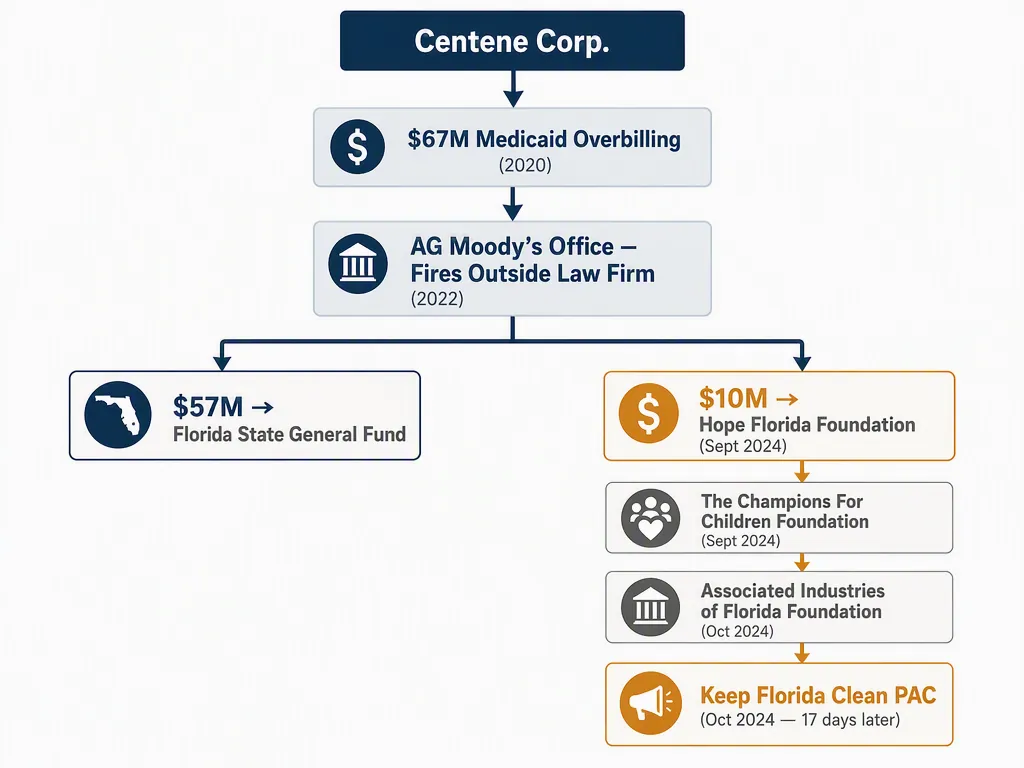
The legal-ethics problem is not simply that a public settlement had political consequences. Settlement discretion can be broad, and attorney general offices routinely make judgment calls about recovery, allocation, and release language. The sharper issue is the route selected for the $10 million and the apparent removal of the ordinary control points that would have made the route auditable.
CBS Miami reported that the $10 million moved from the Hope Florida Foundation through two nonprofits to Keep Florida Clean PAC within 17 days of the settlement signing, less than two weeks before the November 2024 election.[2] AP/WUSF’s timeline similarly frames the Hope Florida controversy around the movement of settlement money through a DeSantis-backed charity and then into political activity.[3]
For an ethics reviewer, speed is not proof of dishonesty. But speed becomes more probative when paired with missing controls. State Rep. Andrade testified, as reported by CBS Miami, that Florida law requires a contract, a grant administrator, and an audit for any entity receiving $750,000 or more in state funds; he said those safeguards were not used here. CBS also reported the absence of a written grant agreement, an AHCA contract, an audit requirement, a grant administrator, and an IRS 501(c)(3) compliance check.[2]
That is the point at which “bad optics” becomes too soft a label. The safeguards were not decorative. A written agreement defines the purpose of the grant. A grant administrator creates an identified officer responsible for monitoring performance. An audit requirement gives later reviewers a right to inspect what happened. A 501(c)(3) compliance check matters when charitable funds may end up supporting political work. When those features are missing from a large state-funded transfer, the record has a hole exactly where accountability would normally attach.
The settlement drafting emails matter because they show risk awareness
The most legally interesting reported detail is not the public-relations aftermath. It is the settlement drafting dispute. Florida Today reported renewed scrutiny over Moody’s role in the Hope Florida matter in July 2026, including attention to the documentation surrounding the settlement path.[4] The available record also includes a Miami Herald/Tampa Bay Times email investigation reporting that Centene’s lawyers repeatedly wanted Moody personally included as a party to the settlement agreement for Centene’s protection, while Deputy Attorney General John Guard repeatedly removed those references.
That fact, if accurately reported, does not decide a bar case. A settlement counterparty may request protective language for many reasons, and a government lawyer may reject personal naming language for legitimate institutional reasons. But the exchange would still be a document reviewers would ask for first. It tends to show that the lawyers around the transaction understood personal authority and legal exposure to be live issues while the $10 million side channel was being papered.
In a private internal review, this is where the questions would become concrete: Who authorized the $10 million destination? Who decided the foundation could receive the money without the usual grant documents? Who reviewed charitable-purpose restrictions? Who knew the funds could move through intermediaries into a PAC? Who approved the omission of Moody’s personal references from the settlement language? Those questions do not presume the answers. They identify where the record would need to be complete.
Rule 4-8.4(a): the hardest claim is also the one that cannot be waved away
Rule 4-8.4(a), in this context, is the misconduct rule most associated here with dishonesty, fraud, deceit, or misrepresentation. The analogous professional-responsibility category appears in the ABA’s misconduct rule, which treats dishonesty, fraud, deceit, and misrepresentation as lawyer misconduct.[5] Applied to the Hope Florida facts, this is the hardest claim because it requires more than proving that the transaction was irregular or politically useful.
A disciplined analysis would not say the rule was “obviously” violated. The public record, as summarized in the available sources, does not include a bar charging document, sworn findings, Moody’s full explanation, or an adjudicator’s conclusion about intent. Missing grant controls can be consistent with concealment, but they can also be defended as discretionary settlement structuring unless the governing documents and communications show otherwise.
The colorable basis is narrower and stronger: a Medicaid recovery was partly redirected away from the state treasury into a foundation connected to the governor’s political circle; the transfer reportedly lacked the safeguards normally required for large state-funded grants; the funds quickly reached a political PAC; and settlement drafting reportedly included efforts by Centene’s lawyers to name Moody personally, followed by removal of those references by her deputy.[2][4]
Those facts would justify asking whether anyone misrepresented the nature of the payment, its purpose, its legal status, or the controls attached to it. They would also justify asking whether the absence of a written grant agreement was an administrative accident or part of the design. That is not a conclusion of fraud. It is a reason a reviewer would not close the file at “settlement discretion.”
This is the same professional-responsibility posture that appears in other contexts where the evidence is procedural before it is testimonial. In litigation technology and lawyer-verification settings, for example, the question is often not whether a lawyer meant to mislead a tribunal but whether the process created a foreseeable falsehood. We have treated that distinction separately in AI hallucinations and attorney ethics. The Hope Florida question is more politically charged, but the reviewing habit is similar: locate the decision point, identify the missing verification step, and ask who had the professional duty to stop the transaction until the record matched the risk.
Rule 4-1.7: the conflict theory depends on divided loyalty, not mere partisanship
The conflict-of-interest theory under Rule 4-1.7 is not that Moody is a Republican, or that an elected attorney general inevitably has political relationships. That would prove too much. The real conflict structure is more specific: the attorney general was exercising sovereign settlement authority while funds were directed toward an entity tied to the DeSantis political orbit, and Moody’s own political advancement later depended on DeSantis in a concrete way when he appointed her to the U.S. Senate in 2025.[4]
A government lawyer’s client is not a campaign, a governor’s household, a donor network, or a personal future appointing authority. The client function is institutional. In a Medicaid recovery, the public interests at stake include the state fisc, the Medicaid program, taxpayers, and the integrity of enforcement. If the settlement allocation served an external political project, the conflict question becomes whether Moody’s professional judgment on behalf of the state was materially limited by personal or political interests.
The reported facts do not establish that limitation by themselves. They do, however, identify the pressure points a conflicts review would test: the governor’s interest in Hope Florida; the First Lady’s association with the program; the settlement beneficiary’s proximity to that political circle; Moody’s relationship with DeSantis; and the timing before the November 2024 election. The absence of ordinary grant controls again matters because controls are one way a conflicted transaction can be made reviewable. Without them, later reviewers are left to infer purpose from routing, timing, and fragments of drafting history.
The conflict analysis should stay disciplined. A lawyer-official can make decisions that benefit political allies without violating Rule 4-1.7 if the decision is independently lawful, properly documented, and made for the institutional client’s legitimate interests. The Hope Florida record is troubling because the documentation described in the available reporting appears thinnest at the point where independence most needed proof.
Rule 4-8.4(d): prejudice to justice is about the enforcement power itself
Rule 4-8.4(d), the conduct-prejudicial-to-the-administration-of-justice frame, is not limited to courtroom misconduct. For a state attorney general, the administration of justice includes the credibility of public enforcement settlements. A Medicaid overbilling recovery is not a private slush fund. It is an exercise of sovereign leverage over a regulated entity.
That is why the $57 million/$10 million split deserves more scrutiny than an ordinary charitable donation. Centene was resolving exposure to the state. The state had bargaining power because public enforcement machinery stood behind the claim. When part of that recovery is routed to a politically connected foundation and then quickly into political spending, the public injury is not only monetary. The injury is to confidence that enforcement outcomes are being negotiated for public purposes rather than political utility.[2][3]
Again, that does not make the disciplinary conclusion automatic. A Rule 4-8.4(d) theory would need to show why the conduct was prejudicial to justice in a legally cognizable way, not merely embarrassing or partisan. But the facts are not trivial. If sovereign settlement power can create a side payment that bypasses grant safeguards and reaches campaign infrastructure within days, the institutional harm is foreseeable even before a tribunal assigns blame.
Florida’s disciplinary mechanism is the reason the ethics questions have not been tested
The absence of a Florida Bar proceeding is not strong exonerating evidence here because Florida changed the enforcement route for sitting constitutional officers. Florida Bulldog reported in October 2021 that the Florida Bar Board of Governors approved a rule barring ethics investigations of constitutional officers while they are in office, with a six-year deadline after they leave office. The reporting tied the move to questions raised about Moody’s participation in Texas v. Pennsylvania, the election-challenge litigation brought after the 2020 presidential election.[6]

The same reporting said the Bar traced that position to a confidential 1982 Florida Supreme Court order. That order is not available for public inspection in the materials identified here. The result is a strange accountability posture: the Bar can point to authority, but the public cannot inspect the operative historical order that helps explain why a sitting constitutional officer is insulated from ordinary intake and investigation.[6]
Florida Bulldog later reported that this mechanism protects not only Moody but other lawyer-officials, and contrasted Florida’s posture with bar scrutiny elsewhere. Its comparative examples included Texas Bar scrutiny of Attorney General Ken Paxton and bar discipline involving Rudy Giuliani in multiple jurisdictions.[1] The comparison should not be overstated. Different states have different rules, procedures, and disciplinary histories. But it does show why Florida’s rule is not a routine timing provision. It removes the ordinary fact-finding stage while the official still holds the office that gives the conduct its public significance.
That procedural shield also affects how silence should be read. In ordinary professional-responsibility analysis, the absence of discipline might suggest that no complaint survived screening or that investigators found no rule issue. Under Florida’s constitutional-officer rule, silence can mean something narrower: the system may not be allowed to investigate yet. Treating that silence as exoneration would confuse a jurisdictional block with a merits decision.
What the current record supports, and what it does not
As of July 2026, the Hope Florida controversy remains active. Florida Today reported renewed scrutiny of Moody over the $10 million Hope Florida matter, and available materials indicate that a grand jury report exists but has not been publicly released.[4] Moody’s appointment to the U.S. Senate in 2025 makes the timing politically important, but the ethics analysis should not depend on campaign rhetoric or party press releases.
The strongest supported conclusion is limited but serious. The settlement path, the reported drafting dispute, the missing grant safeguards, and the rapid movement into political spending support colorable ethics questions under Rule 4-8.4(a), Rule 4-1.7, and Rule 4-8.4(d). They do not support a definitive public claim that Moody has been adjudicated to have violated those rules, because no such adjudication exists in the available materials.
The institutional problem is that Florida’s disciplinary structure prevents the ordinary testing of those questions while a lawyer-official remains in constitutional office. That leaves Medicaid beneficiaries, taxpayers, agency lawyers, and later investigators with a gap where a record should be. The available facts do not prove final misconduct. They do show why the lack of a proceeding is not the same thing as accountability.
References
- Florida Bar protects Pam Bondi, other top officials from misconduct scrutiny, Florida Bulldog, August 2025
- Florida Senator Ashley Moody faces renewed scrutiny over her role in Hope Florida scandal, CBS Miami
- Hope Florida: A timeline of how a DeSantis-backed state charity was accused of wrongdoing, WUSF, April 28, 2025
- Sen. Ashley Moody faces more scrutiny over $10M Hope Florida scandal, Florida Today, July 28, 2026
- Rule 4-8.4 Misconduct, American Bar Association
- The Florida Bar wants to immunize Attorney General Moody and all lawyers who are state officers, Florida Bulldog, October 2021
Related records
Tool profile
Browse tool evaluations →Governing regulation
Browse the obligations tracker →Preventive workflow
Browse verification workflows →
Report a correction or tip
Spotted an outdated figure, a misstated fact, or a ruling this case record should reflect? Public comments are disabled for this content given the professional cost of a misreported case outcome, penalty amount, or rule text — use the structured correction channel instead.
Report a correction or tip for this record →