
AT&T California Basic Phone Service Lawsuit Tests Preemption
This article examines the AT&T California COLR lawsuit, the first major test of the FCC's new copper-retirement framework. It explains the preemption arguments, the preliminary injunction denial, and the implications for state authority over basic telephone service.
- Jurisdiction
- U.S. District Court, Southern District of California
- Ruling date
- Jul 16, 2026
- Source document
- View primary court order ↗
Lex Machina Review is an independent risk-tracking and reference resource. Nothing on this site is legal advice, and using it does not create an attorney-client relationship. Every record is reviewed against primary sources but may not reflect the most current status of a matter — always verify directly against the cited court order, rule text, or a licensed attorney before relying on it.
Companion explanation — secondary to the source document above
The AT&T California basic phone service lawsuit is now in the posture that matters most for anyone briefing the file: AT&T has a federal copper-retirement path, but California’s Carrier of Last Resort mandate is still standing. In Pacific Bell Telephone Co. v. Reynolds, No. 3:26-cv-03148 in the Southern District of California, filed May 20, 2026, Judge Linda Lopez denied AT&T’s request for a preliminary injunction on July 16, 2026, finding that AT&T had not shown a likelihood of success on the merits.[1][2]
That is not a final merits ruling. It does not mean AT&T has “lost” the case, and it does not mean California has secured a permanent right to keep AT&T under a basic-service obligation. It means California’s central answer to AT&T’s preemption theory survived the first judicial test: the state says its COLR rules do not require copper facilities as such, because AT&T may satisfy the obligation through fiber, wireless, or another technology capable of providing basic service.[3]
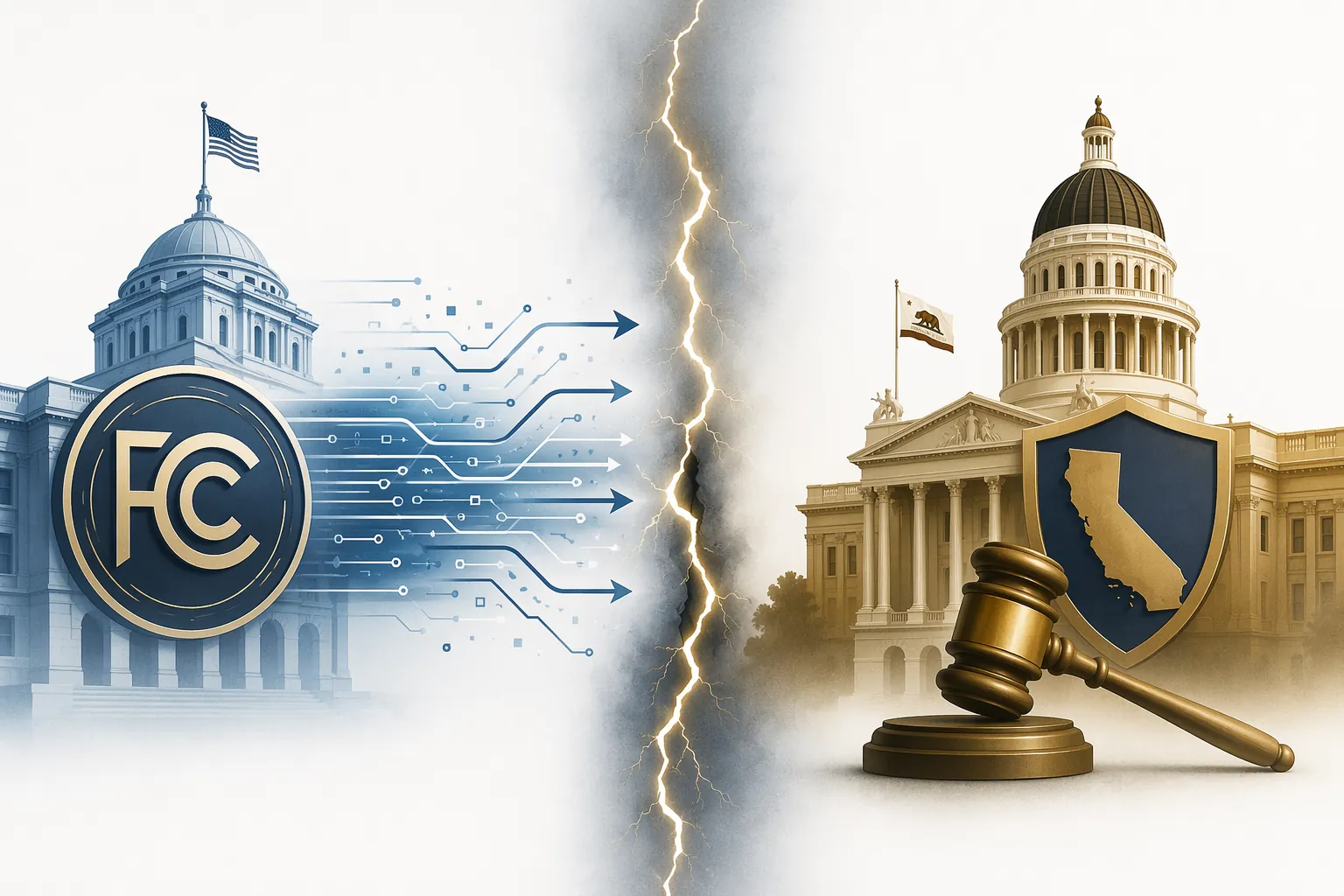
What the injunction ruling does, and does not, decide
AT&T’s theory starts with FCC 26-19, the FCC’s March 26, 2026 Network Modernization Order. As reported in the available coverage of the lawsuit, AT&T argues that the federal order permits carriers to retire copper facilities and that California cannot use state utility obligations to frustrate that retirement.[3] California’s answer is narrower than a defense of copper. The state’s position is that a carrier can leave copper behind while still remaining responsible for basic service in the areas where it has accepted COLR obligations.[3]
That distinction explains why the preliminary-injunction ruling is consequential without being conclusive. If California were ordering AT&T to keep copper in the ground for its own sake, the conflict with a federal copper-retirement framework would be more direct. If California is instead enforcing a technology-neutral obligation to provide basic telephone service, then the preemption question becomes harder: federal permission to retire one network technology does not automatically answer whether a state may require the carrier to serve by some other means.
The ruling also matters because AT&T has already obtained COLR relief in 20 of 21 states, leaving California as the outlier.[2] That fact explains the pressure behind the case. It does not, by itself, decide whether California’s statute and orders are preempted. Federal preemption turns on the legal authority invoked and the conflict actually created, not on whether most other state commissions have already moved out of the way.
The state is defending an obligation, not a technology
California’s strongest move is to separate the facility from the duty. A copper loop is a technology choice. COLR status is a service obligation. The CPUC and state-aligned intervenors are not helped by pretending copper is inherently virtuous, and AT&T is not helped by treating every post-copper obligation as if it were a copper mandate in disguise.
The practical question is whether the replacement service is good enough for the legal obligation being preserved. The answer may vary by terrain, power reliability, emergency exposure, and customer type. A wireless replacement that is acceptable for one household in an urban wire center may be a poor substitute for another customer in a rural fire-prone area, particularly if the customer, the county, or emergency planners are left to absorb the outage risk.
California has pressed that concern in concrete terms. In the preliminary-injunction coverage, the state argued that AT&T’s proposed AT&T Phone-Advanced wireless replacement has a 24-hour backup battery, which California described as inadequate for wildfire- or earthquake-related power outages that can last days or weeks.[1] That point does not prove every copper line should remain. It does show why the case is not just an accounting dispute about a declining platform.
The FCC discontinuance grant is only one piece of the map
The district-court case is running alongside FCC proceedings that can easily be mistaken for a merits answer. AT&T filed federal discontinuance applications in WC Dkt. 26-120 and WC Dkt. 26-121, and the FCC’s discontinuance authority was reported as granted on June 29, 2026, through a procedural auto-grant after the comment period expired.[4] That matters operationally, but it is not the same thing as a federal ruling that California’s COLR regime is preempted.
| Proceeding | Forum | Current status as of July 24, 2026 | Why it matters |
|---|---|---|---|
| Pacific Bell Telephone Co. v. Reynolds, 3:26-cv-03148 | U.S. District Court, Southern District of California | Preliminary injunction denied July 16, 2026 | Tests whether California’s COLR mandate is preempted by the federal copper-retirement framework |
| AT&T discontinuance applications, WC Dkt. 26-120/26-121 | FCC | Procedural auto-grant reported June 29, 2026 | Permits discontinuance through the FCC process but does not itself decide the state-preemption issue |
| AT&T preemption petition, WC Dkt. 26-125 | FCC | Pending | Asks the federal agency to address whether state obligations may block the federal modernization path |
| CPUC challenge to FCC 26-19 | U.S. Court of Appeals for the Ninth Circuit | Petition filed June 25, 2026 | Challenges the validity of the FCC order that AT&T invokes |
The FCC track is therefore both important and limited. It gives AT&T a federal procedural result to point to. It does not erase the separate question whether a state, acting through a technology-neutral COLR mandate, can still require the carrier to ensure basic service. Treating the auto-grant as if it “approved” full withdrawal from California’s state-law obligations skips the preemption step that the parties are actually fighting over.
The customer numbers make the jurisdictional question less abstract
The affected service base is not the old universal landline market. The CPUC proceeding materials identify AT&T applications regarding COLR and eligible telecommunications carrier designation, and reporting on the proposed discontinuance describes 184,000 residential customers and 15,000 business customers across 360 wire centers, with a proposed start date of June 1, 2027.[5][6] The same public discussion identifies about 40,000 Lifeline subscribers affected by AT&T’s separate ETC withdrawal application, A.23-03-002.[5][6]
Those figures should be used carefully. They do not show that copper remains the best network for those customers. They show the scale of the service-continuity problem if the legal obligation is removed before a replacement arrangement is judged adequate for the customers who still depend on basic voice service, subsidized service, or emergency-reliable access.
The 360-wire-center footprint also changes who has to manage the consequences. If replacement service fails during a prolonged outage, the problem is not just a private inconvenience between AT&T and a subscriber. County officials, emergency managers, rural health providers, alarm companies, and public-safety planners may be the ones fielding the downstream effects. That is why RCRC, TURN, CSAC, and CWA sought and received intervention in the case on July 15, 2026.[7]
AT&T’s business case is relevant, but it is not the legal test
AT&T has strong incentives to frame copper as economically irrational. The company has publicly tied California regulatory relief to a $19 billion commitment announced the same day the lawsuit was filed.[8] In the broader public record, AT&T has also advanced its own figures about copper maintenance cost, low POTS usage, copper-theft outages, and investment that would follow relief. Those are advocacy numbers from the carrier, not neutral findings.
The legal question is not whether a rational carrier would prefer to stop maintaining a shrinking copper network. Many would. The question is whether the FCC’s copper-retirement and discontinuance authority reaches far enough to displace a state basic-service mandate when the state says the mandate can be met with non-copper technology. That is a narrower question, and it is the one the preliminary-injunction ruling left alive.
There is also a timing problem embedded in AT&T’s modernization argument. A carrier may be ready to retire copper before every affected community has a tested substitute that performs under local outage conditions. Federal modernization policy can accelerate exit from legacy facilities. It does not automatically answer who must verify substitute service, who must maintain it, and who remains accountable if it fails when the power is out.
The Ninth Circuit challenge keeps the federal order itself in play
California is not only defending its COLR authority in district court. The CPUC filed a petition in the Ninth Circuit on June 25, 2026, asking the court to vacate the FCC order as “arbitrary, capricious, and an abuse of discretion.”[9] That proceeding matters because FCC 26-19 is the federal predicate AT&T is relying on in the California litigation.
The Ninth Circuit case and the district-court case do not ask identical questions. One challenges the federal agency order; the other tests whether that order and related federal authority preempt California’s COLR regime as applied to AT&T. But the proceedings are linked in the practical sense: if the FCC order is narrowed or vacated, AT&T’s preemption theory may look different; if the order stands and the FCC separately grants AT&T’s preemption petition, California’s litigation position may face a different record.
What to track next
For docket-tracking purposes, the first item is the district-court merits phase in Pacific Bell Telephone Co. v. Reynolds. The preliminary-injunction denial tells readers that AT&T did not make the showing needed for early relief. It does not tell them how the court will resolve preemption after fuller briefing, a developed record, and final merits analysis.
The second item is AT&T’s pending FCC preemption petition in WC Dkt. 26-125. A substantive FCC ruling on that petition would be more important to the state-authority question than the procedural auto-grant of the discontinuance applications. The agency’s reasoning, not just its bottom-line result, would shape how much room remains for state COLR rules that are framed as technology-neutral service obligations.
The third item is the CPUC’s Ninth Circuit challenge to FCC 26-19. If California is attacking the federal order while also defending its state mandate, the final allocation of authority may turn on more than one court’s view of one injunction motion. That is why the case should not be reduced to a headline about landlines ending or surviving.
As of July 24, 2026, the clean answer is limited. California has survived AT&T’s first challenge to its technology-neutral COLR theory. AT&T has not lost the merits. The FCC’s discontinuance auto-grant does not decide preemption. The ultimate answer depends on the district-court merits phase, the FCC’s pending preemption petition, and the CPUC’s Ninth Circuit challenge to FCC 26-19.
That makes this dispute the first major test of the FCC’s 2026 copper-retirement framework. Its significance is not copper nostalgia. It is whether federal modernization policy can displace state basic-service mandates when the state’s position is that the carrier may modernize the network, but may not abandon the duty to serve.
References
- AT&T loses key ruling in bid to stop offering basic phone service in California, Ars Technica
- AT&T Sues Calif. To End Copper Wire Service Requirements, Law360
- AT&T Sues California Over Copper Landline Mandate, BroadbandBreakfast
- AT&T wins federal approval to end landline service in California, Mercury News
- AT&T Applications Regarding COLR and ETC Designation, CPUC
- AT&T's push to end California landlines: What to know, Desert Sun
- RCRC Intervenes to Protect Reliable Communications Service, RCRC
- AT&T Makes $19 Billion Commitment, AT&T
- California Regulator Suing FCC Over Copper Preemption Rule, BroadbandBreakfast
Related records
Tool profile
Browse tool evaluations →Governing regulation
Browse the obligations tracker →Preventive workflow
Browse verification workflows →
Report a correction or tip
Spotted an outdated figure, a misstated fact, or a ruling this case record should reflect? Public comments are disabled for this content given the professional cost of a misreported case outcome, penalty amount, or rule text — use the structured correction channel instead.
Report a correction or tip for this record →