
How Two Anti-SLAPP Fee Rulings in the Baldoni Case Compare
The Justin Baldoni litigation produced two distinct anti-SLAPP fee-shifting rulings under New York and California law. This article explains the statutory differences, the amounts awarded or requested, and what practitioners should watch when facing parallel defamation and anti-SLAPP motions.
- Jurisdiction
- US-Federal
- Court
- U.S. District Court for the Southern District of New York
- Judge
- Justice Lebovits, Judge Liman
- AI tool named
- None
- Ruling date
- Jul 1, 2026
- Source document
- View primary court order ↗
- Last verified
- Jul 28, 2026
Lex Machina Review is an independent risk-tracking and reference resource. Nothing on this site is legal advice, and using it does not create an attorney-client relationship. Every record is reviewed against primary sources but may not reflect the most current status of a matter — always verify directly against the cited court order, rule text, or a licensed attorney before relying on it.
Companion explanation — secondary to the source document above
The short answer is that there is not one fee ruling. There is a fixed New York award for The New York Times: $171,616.20, reduced from the $181,622.70 requested, after Justice Lebovits found Wayfarer Studios failed New York’s “substantial basis in fact and law” test for a public-interest article.[1] There is also a California Civil Code § 47.1 ruling in which Judge Liman held Blake Lively could recover fees, while denying treble or punitive damages as procedurally unavailable; the amount of that recovery has not been fixed.[2] Her request remains contested at $7.5 million in fees plus $500,000 in costs, with Baldoni opposing it on July 14, 2026 as far outside what he characterized as comparable defamation fee awards.[3]
That distinction matters because only one dollar figure has crystallized. The New York Times award is resolved. Lively’s entitlement under California § 47.1 has been recognized, but her requested amount is still a live fee dispute as of July 28, 2026. Describing both as “anti-SLAPP fees” without separating the statutes blurs the thing lawyers need most: which rule actually shifts the money.
| Issue | New York Times ruling | Blake Lively ruling |
|---|---|---|
| Statute or doctrine | New York anti-SLAPP framework, including CPLR 3211(g) and Civil Rights Law § 76-a | California Civil Code § 47.1, the Weaponized Defamation Lawsuits Act; not California’s traditional anti-SLAPP statute |
| Protected setting | Claim tied to a public-interest article | Alleged retaliatory defamation claim against a sexual-harassment complainant |
| What the court decided | Fee entitlement and amount | Fee entitlement, but not final amount |
| Current fee status | $171,616.20 awarded and resolved, reduced from $181,622.70 requested[1] | $7.5 million in fees plus $500,000 in costs requested; Baldoni’s opposition filed July 14, 2026[3] |
| Practical posture | Exposure has become a fixed judgment-level number | Exposure remains an amount-of-fees risk |
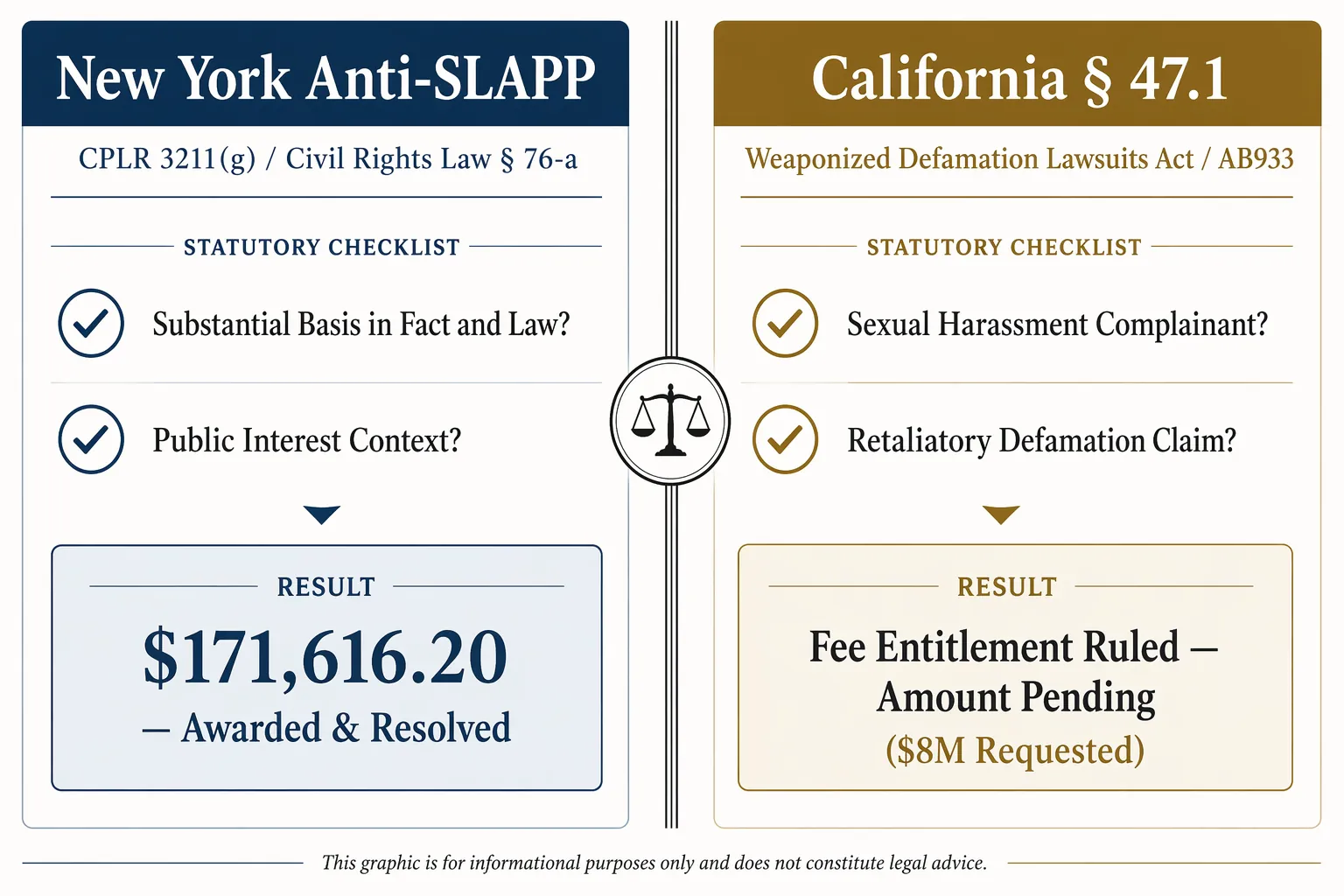
The New York award fixed both entitlement and amount
The New York ruling is the cleaner budgeting event. The court did not merely say that The New York Times could seek fees later. It awarded $171,616.20, trimming the requested $181,622.70 by a little more than $10,000.[1] For fee-exposure purposes, that is the difference between a risk category and a number that can be put into a case assessment.
The statutory hook was New York’s anti-SLAPP regime. The reported basis was that Wayfarer Studios failed to show a substantial basis in fact and law for claims arising from a public-interest article.[1] That is not a generalized “loser pays” rule. It is tied to New York’s treatment of claims involving public petition and participation, and the operative question was whether the suit cleared the statutory threshold.
For a lawyer advising a media defendant, the practical consequence is fairly direct. If the claim falls within the public-interest anti-SLAPP framework and fails the substantial-basis inquiry, fee shifting can move from defensive leverage to a fixed award. The reduction from the requested amount also matters: even where entitlement is established, courts can still audit the bill.
The California ruling recognized entitlement but left the dollar fight open
The California-side ruling sits in a different procedural place. Judge Liman held that Lively could recover fees under California Civil Code § 47.1, a 2023 statute also known as the Weaponized Defamation Lawsuits Act or AB 933.[2] First Amendment Watch described the decision as the first federal application of that statute.[2] That phrase is useful only if it is kept narrow: first federal application is not the same as first-ever § 47.1 judgment.
Section 47.1 should not be collapsed into California’s familiar anti-SLAPP statute. California’s traditional anti-SLAPP mechanism is Code of Civil Procedure § 425.16, part of a broader family of anti-SLAPP laws designed to provide procedural protection against suits targeting protected speech or petitioning activity.[4] Section 47.1 does something more targeted. It creates a qualified privilege and fee-shifting protection for sexual-harassment complainants who face retaliatory defamation claims.
The ruling also drew a line around remedies. Lively could seek fees, but treble or punitive damages were denied as incompatible with federal procedure.[2] That combination is easy to misstate. It was not an all-purpose damages victory. It was a fee-entitlement ruling under a California statute, paired with a refusal to import additional damages remedies into the federal procedural setting.
The pending $8 million request is not a final award
The open issue is the size of the fee recovery. Lively’s request has been reported as $7.5 million in attorney’s fees plus $500,000 in costs. The supporting materials reportedly cite more than 7,000 hours billed and a partner rate of $2,187 per hour.[3] Those figures describe the request, not what the court has awarded.
Baldoni’s July 14, 2026 opposition attacks the amount rather than merely the existence of fee shifting. Forbes reported his argument that the request is roughly 20 times larger than typical comparable defamation fee awards.[3] That is an advocacy position in an unresolved fee proceeding. It should not be converted into a judicial benchmark unless the court adopts it.
This is where many summaries become too loose. Saying that Baldoni must pay $8 million states more than the current record supports. Saying that Lively has an $8 million fee request pending after a fee-entitlement ruling is the narrower and safer formulation.
Why the two fee consequences diverged
The divergence is not a celebrity-litigation oddity. It follows from the statutes. New York’s anti-SLAPP analysis, as reported in the Times fee ruling, turned on whether the claims had a substantial basis in fact and law in a public-interest setting.[1] California § 47.1, by contrast, is aimed at a narrower retaliatory-defamation problem: lawsuits against people who make sexual-harassment complaints.
That difference changes the fee-risk conversation before anyone prices a motion. Under the New York framework, the public-interest character of the speech and the substantial-basis test are central. Under § 47.1, the protected status and context of the complainant matter in a way that would not necessarily map onto a media-defendant anti-SLAPP motion. The label “anti-SLAPP-style” may be functionally helpful, but it is not a substitute for naming the statute.
The motion posture matters just as much. The Times received a reduced but specific fee award.[1] Lively obtained a ruling that she could recover fees, while the court still must decide what amount is reasonable on the pending application.[2][3] Those are different litigation events. One closes the fee ledger for that party. The other opens the billing dispute.
The settlement changes appellate posture, not the pending-fee vocabulary
The broader Lively-Baldoni settlement supplies important procedural context, but it does not make the pending fee request a final award. The May 2026 settlement reportedly involved no money changing hands and included a mutual waiver of appellate rights.[5] That affects what can be appealed or relitigated. It does not answer the amount question on Lively’s fee application.
For settlement drafting, this is not a footnote. Fee provisions, appellate waivers, and carveouts for already-filed or future fee applications can have separate consequences. A settlement that closes merits exposure may still leave a fee amount to be briefed unless the agreement and court orders dispose of it.
The “first” language around § 47.1 needs a qualifier
There is a real novelty point in the Lively ruling, but it is narrower than some shorthand suggests. The decision has been described as the first federal application of California Civil Code § 47.1.[2] That is not the same as the first known § 47.1 judgment anywhere.
Young v. Alameda Health System, a September 2025 state-court judgment discussed by Advocate Magazine, came earlier.[6] Its precedential weight may be more limited than a federal opinion that practitioners are likely to cite in briefing, but it prevents the federal ruling from being accurately described as the statute’s absolute first use.
That qualifier is not pedantry. Novelty claims become legal folklore quickly. A practitioner citing the Lively ruling should be precise: first federal application, not first § 47.1 judgment.
What practitioners should take from the comparison
The two rulings are useful because they separate three questions that often get merged: whether fee shifting is available, whether entitlement has been decided, and whether the amount has been fixed. In New York, the Times crossed all three stages and received $171,616.20.[1] In the California § 47.1 proceeding, Lively has crossed entitlement, but the requested $8 million package remains contested.[2][3]
Before filing, removing, dismissing, or settling a defamation-adjacent case, the risk analysis has to begin with the exact fee-shifting source. New York’s anti-SLAPP statute asks one set of questions. California § 47.1 asks another. California’s traditional anti-SLAPP procedure is a separate statute again. A motion caption, a press summary, or a casual reference to “anti-SLAPP fees” will not tell a client whether exposure is a reduced six-figure award, an unresolved eight-figure request, or no fee award at all.
The record supports a narrow but important judgment: fee exposure in this kind of litigation cannot be estimated from the label “anti-SLAPP” alone. It depends on the forum, the statutory trigger, the protected speech or complainant status at issue, the motion posture, and whether the court has decided entitlement, amount, or both.
References
- Justin Baldoni's Wayfarer Studios Ordered to Pay The New York Times $171K, People.com
- Judge Awards Blake Lively Legal Fees but No More Damages in Dispute Over 'It Ends With Us' Film, First Amendment Watch
- Justin Baldoni Urges Judge To Deny Blake Lively's Request For $8 Million In Attorney's Fees, Forbes
- Anti-SLAPP Laws Introduction, Reporters Committee
- Blake Lively, Justin Baldoni's 'It Ends with Us' legal battle: A timeline, GMA
- New California law protects sexual assault/harassment survivors from retaliatory lawsuits, Advocate Magazine
Related records
Tool profile
Browse tool evaluations →Governing regulation
Browse the obligations tracker →Preventive workflow
Browse verification workflows →
Report a correction or tip
Spotted an outdated figure, a misstated fact, or a ruling this case record should reflect? Public comments are disabled for this content given the professional cost of a misreported case outcome, penalty amount, or rule text — use the structured correction channel instead.
Report a correction or tip for this record →