
How the Berlin Pride attack exposed EU AI Act's operational gap
An analysis of the Ballout case and the Berlin Pride van attack, examining whether the EU AI Act's distinction between prohibited individual risk assessment and high-risk human-in-the-loop tools creates a regulatory gap. The findings point not to a classification failure, but to the absence of binding cross-institutional escalation mechanisms for AI-generated risk classifications.
- Jurisdiction
- Germany
- Court
- German criminal court
- AI tool named
- RADAR-iTE
- Ruling date
- May 1, 2026
- Source document
- View primary court order ↗
- Last verified
- Jul 27, 2026
Lex Machina Review is an independent risk-tracking and reference resource. Nothing on this site is legal advice, and using it does not create an attorney-client relationship. Every record is reviewed against primary sources but may not reflect the most current status of a matter — always verify directly against the cited court order, rule text, or a licensed attorney before relying on it.
Companion explanation — secondary to the source document above
Any serious legal analysis of the Berlin Pride car ramming and its motive has to begin with an uncomfortable procedural fact: Abdul Ballout was not a stranger emerging from nowhere. Public reporting describes him as already convicted in May 2026 of preparing a serious act of violence endangering the state, sentenced to one year and ten months with the sentence suspended, placed under parole supervision, and searched at home roughly three and a half weeks before the 25 July 2026 Berlin Pride van attack.[1][2][3]
Reuters also reported, citing security sources, that Ballout was among hundreds of people classed as potentially dangerous.[1] That phrase matters more than it first appears. It does not prove that a specific German risk-assessment tool produced the label. It does show that some part of the preventive-security system had already translated concern about him into an institutional risk category before the attack.
The public record does not confirm that RADAR-iTE specifically classified Ballout. That uncertainty should stay in the main text, because the legal problem is not helped by pretending the evidentiary file is cleaner than it is. The stronger point is narrower: Germany has a risk-classification architecture for known Islamist-spectrum threats, Ballout was reportedly within a potentially dangerous cohort, and the institutions around him did not converge on custody or another compulsory intervention before the attack.

The first legal question is not whether a machine “failed”
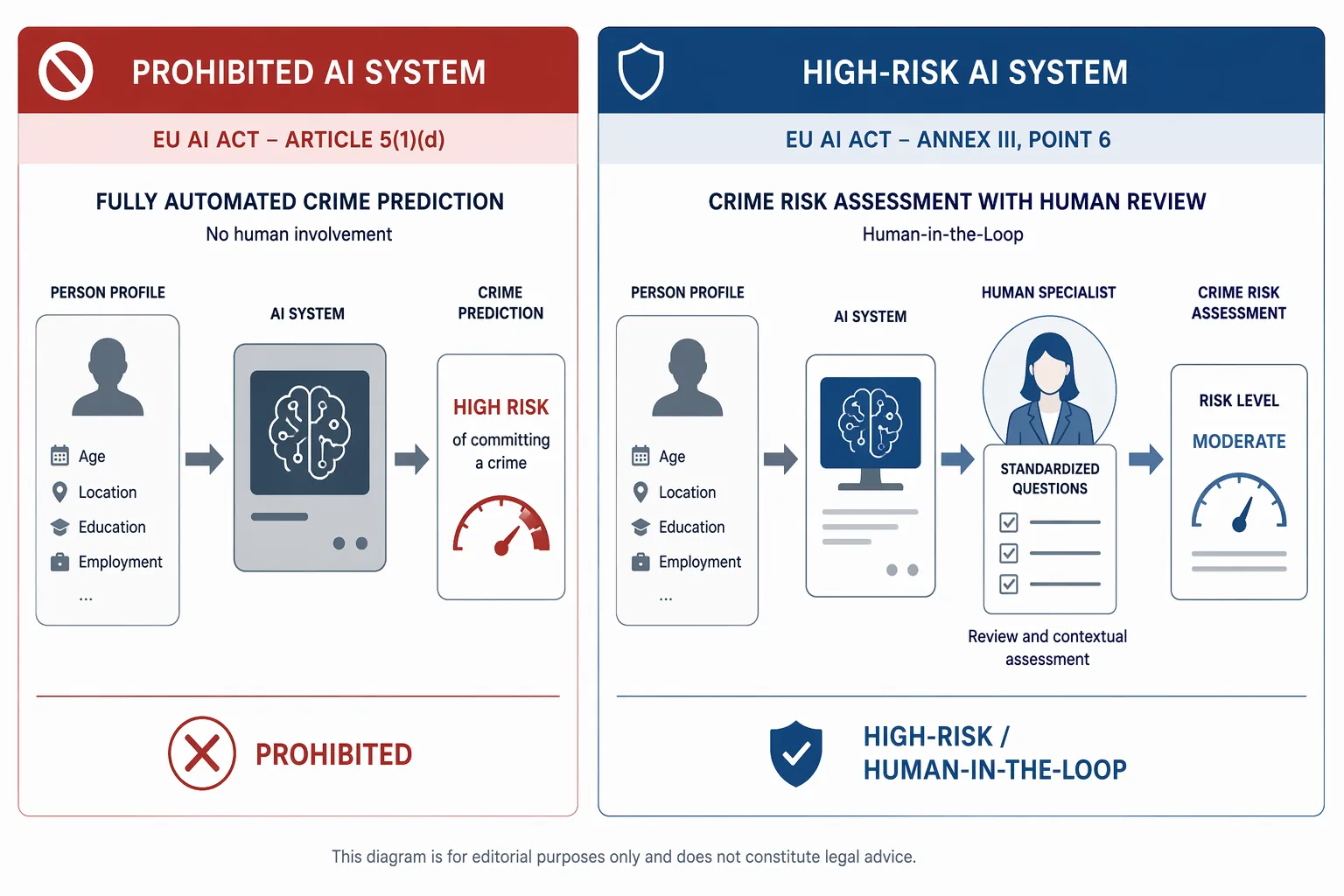
RADAR-iTE is a useful object of analysis precisely because the German Federal Criminal Police Office does not describe it as an autonomous prediction engine. The BKA says the tool was introduced nationwide in 2017, uses standardized behavioral questions, assigns known Islamist-spectrum persons to risk categories, and is applied through trained specialist assessment; its own description characterizes the process as non-automated.[4]
That description is not marketing trivia. It determines which part of the EU AI Act does the legal work. A rule-based questionnaire reviewed by trained officials may still be an AI-relevant or algorithmic risk tool for procurement, governance, audit, and fundamental-rights purposes. But it is not automatically the thing prohibited by Article 5(1)(d) merely because it concerns criminal risk.
There is a recurring shortcut in commentary after attacks of this kind: once a person was risk-scored or classified, Article 5(1)(d) is invoked as though it bans the entire category. That is too loose. The prohibition is not a general ban on law-enforcement risk assessment. As the Future of Privacy Forum’s analysis of the EU AI Act explains, the Article 5(1)(d) prohibition turns on cumulative conditions: an AI system, an assessment or prediction of an individual’s risk of committing a criminal offense, and reliance solely on profiling or personality traits.[5]
| Article 5(1)(d) condition | Why it matters for RADAR-iTE-style assessment |
|---|---|
| Use of an AI system | A tool can fall within AI governance even if officials remain involved, but the analysis cannot stop at the label “AI.” |
| Individual crime-risk prediction or assessment | Criminal-risk assessment is the relevant domain, but the Act does not prohibit every such assessment. |
| Based solely on profiling or personality traits | This is the narrowing condition. A trained-specialist review using objective case material is legally different from a fully automated profile-to-prediction pipeline. |
The Commission’s March 2026 guidance is important for the same reason: systems that require professional human assessment are treated more naturally as high-risk law-enforcement systems rather than as prohibited individual crime-prediction systems, provided the prohibition’s cumulative conditions are not met.[6] That is the distinction procurement teams and public authorities need to keep clear. A high-risk designation is not an acquittal of the tool. It is a different regulatory route.
Why Article 5(1)(d) is the wrong magic answer
The temptation to make Article 5(1)(d) carry the whole case is understandable. The facts are ugly: a person reportedly known to authorities, already convicted for a serious state-security offense, under parole supervision, searched shortly before the attack, and still able to carry out violence at a public event. A prohibition looks cleaner than an inquiry into parole files, prosecutor thresholds, police intelligence channels, and judicial discretion.
But the text does not become broader because the facts are alarming. On the available materials, RADAR-iTE’s architecture is the opposite of the pure machine-personality prediction model that Article 5(1)(d) is designed to exclude. The BKA’s account emphasizes standardized questions and specialist assessment, not an automated decision from personality features to predicted crime.[4] The FPF reading of the prohibition likewise turns on the “solely” condition, which is a real limit rather than decorative wording.[5]
That does not make the tool harmless. It makes the compliance question more demanding. High-risk law-enforcement systems under Annex III, point 6 can still require documentation, human oversight, risk management, data governance, logging, transparency toward deployers, and post-market monitoring depending on the precise system and role. For legal and procurement review, the hard question becomes whether the institution can show how the classification was produced, reviewed, challenged, escalated, and acted upon.
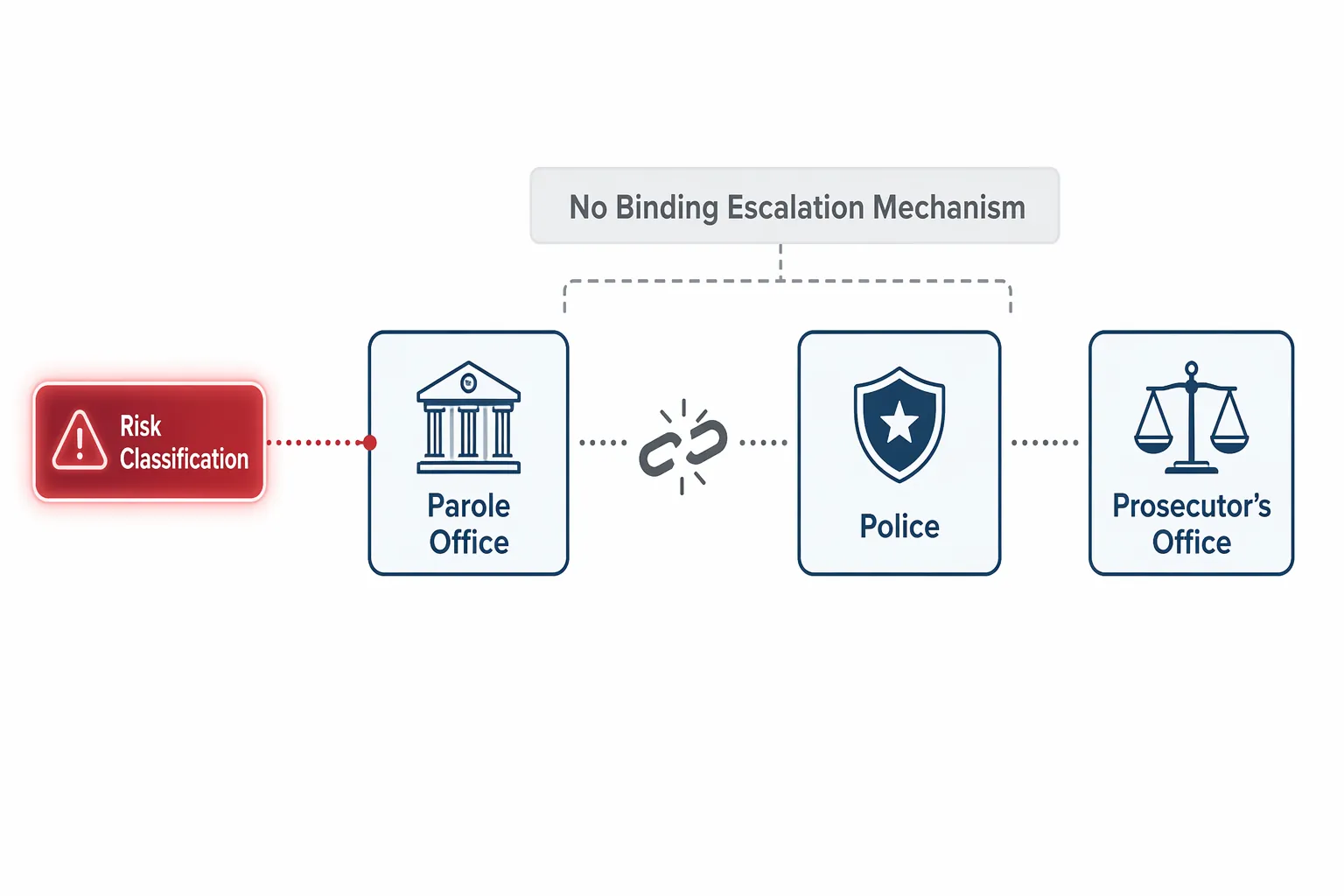
This is where a human-in-the-loop design can create false comfort. If the “human” is present only inside the assessment workflow, the tool may satisfy the legal distinction between prohibited and high-risk. It still may fail to create a mandatory next step outside that workflow. A parole officer can have a risk label. A police unit can have intelligence. A prosecutor can have a file. None of those facts, by themselves, proves that any one institution is legally compelled to seek detention, convene a joint review, or reopen a judicial decision.
A suspended sentence is where classification meets institutional friction
Ballout’s reported procedural posture is the part of the case that deserves more attention than the abstract “AI risk” label. He had been convicted in May 2026, but the reported sentence of one year and ten months was suspended, leaving him under parole supervision rather than in custody.[1][2][3] That means the preventive system was already operating in a legally constrained environment. The relevant actors were not simply deciding whether a suspicious person should be watched. They were dealing with someone whose liberty status had already been processed through criminal proceedings.
The reported home search roughly three and a half weeks before the attack adds another layer.[1] A search can indicate concern, but it is not the same as detention. A parole file can contain warning signs, but it does not automatically revoke suspension. A police risk classification can identify a dangerous person, but it does not itself supply the judicial basis for custody. These distinctions are not excuses; they are where operational responsibility actually lives.
Interior Minister Alexander Dobrindt’s reported statement that “it would have been advisable to place this individual in custody” is politically significant for that reason.[1] It should not be inflated into proof of legal liability by any specific office. It is, however, an admission that the post-attack view from government was not that Ballout was unknowable. The risk signal existed somewhere in the system. The institutions with power to convert concern into compulsion did not do so.
The gap is after the risk label
The legally useful lesson from Ballout is not that Germany used a banned AI system. On the public record, that would be an overclaim. The useful lesson is that a person can pass through several risk-aware institutions without a binding escalation pathway forcing those institutions into the same room, the same file, or the same legal threshold analysis.
For a high-risk law-enforcement system, documentation can explain the model or rule set. Human oversight can ensure a trained official reviews the inputs. Logging can show when an assessment occurred. Accuracy controls can test whether categories are reliable. None of those obligations necessarily answers the operational question that matters in a parole-and-policing sequence: when a person under suspended sentence is also classified as potentially dangerous and is recently searched, who must notify whom, within what time, under which authority, and with what mandatory review outcome?
That is not a model-classification problem. It is a governance design problem. The EU AI Act can say whether a system is prohibited, high-risk, or outside particular obligations. It can require the system provider and deployer to maintain controls. It does not, by that classification alone, create a German parole escalation protocol, a prosecutorial trigger, or a custody-review duty.
This distinction matters for legal-tech buyers as much as for public authorities. A procurement checklist that asks only whether the tool is prohibited under Article 5(1)(d) misses the more expensive question: whether the deploying organization has mapped the downstream decisions that the output is supposed to change.
- If a risk category changes, which office receives the update automatically?
- Does the label create a mandatory review, or merely an informational note?
- Can parole, police, and prosecutors see the same assessment history?
- Who is responsible for deciding that a previous suspended sentence remains tolerable after new intelligence?
- Is there a documented escalation threshold, or only professional discretion distributed across agencies?
OxRec shows a different kind of challenge
The Dutch OxRec matter is relevant, but only within limits. It is not a German analogue to Ballout and should not be treated as a causal comparison. Its value is that it shows probation and parole risk tools can be contested when their outputs are unreliable. The FPF analysis notes that the Dutch recidivism tool misjudged 25% of cases and was ordered adjusted or stopped.[5]
That precedent sits upstream from the Ballout problem. OxRec concerns whether the risk output itself was reliable enough to keep using. The Berlin Pride case, on the public record, points more sharply downstream: a potentially dangerous classification may have existed, but the classification did not appear to force a custody review or other compulsory intervention. Both problems belong in AI governance. They are not the same problem.
Governance reports are right about accountability, but too vague for the file
International governance work has been moving toward the same general conclusion. The OECD’s 2025 report on governing with AI discusses AI use in public-sector contexts including law enforcement and risk management, emphasizing institutional accountability rather than treating technical documentation as sufficient governance.[7] That is directionally right. It still leaves the hard national question: what legal instrument makes one agency act on another agency’s classification?
Germany’s EU AI Act implementation framework is the near-term enforcement context to watch. As of a March 2026 account, Germany was still moving toward national implementation, with the August 2026 EU AI Act deadline for designating market-surveillance authorities approaching.[8] Before anyone relies on a German implementation conclusion in a live matter, the current status should be verified. The timing is close enough that stale compliance assumptions are a real risk.
For readers tracking the related surveillance side of the same attack, the biometric-search issues belong in Berlin Pride Manhunt: Legal Implications for AI Surveillance. The high-risk compliance calendar is a separate question, covered in EU AI Act August 2026 Deadline: What Legal Professionals Must Know After the Digital Omnibus and EU AI Act High-Risk AI Obligations: Compliance Deadlines.
Classification is not coordination
The Ballout case exposes a regulatory gap, but not the one most easily advertised. If RADAR-iTE or a RADAR-iTE-like tool was involved, the available description points toward high-risk human-in-the-loop law-enforcement assessment, not the prohibited Article 5(1)(d) model of individual crime prediction based solely on profiling or personality traits. The public record also does not establish that RADAR-iTE assessed Ballout at all.
What the record does show is enough to trouble any compliance lawyer: a known-risk suspect moved through conviction, suspended sentencing, parole supervision, a recent search, and a potentially dangerous classification without an apparent compulsory escalation pathway tying parole, police, and prosecutors to a binding next step. The EU AI Act may correctly classify tools like RADAR-iTE. Classification is not coordination.
References
- Reuters coverage of the 2026 Berlin Pride van attack, Reuters, July 2026.
- BBC coverage of the 2026 Berlin Pride van attack, BBC News, July 2026.
- CBS News coverage of the 2026 Berlin Pride van attack, CBS News, July 2026.
- RADAR-iTE, Bundeskriminalamt.
- Red Lines under the EU AI Act, Future of Privacy Forum.
- Guidelines on prohibited artificial intelligence practices established by Regulation (EU) 2024/1689 (AI Act), European Commission, March 2026.
- Governing with AI, 2025, OECD, 2025.
- Germany’s AI Act Implementation Act coverage, Technology’s Legal Edge, March 2026.
Related records
Tool profile
Browse tool evaluations →Governing regulation
Browse the obligations tracker →Preventive workflow
Browse verification workflows →
Report a correction or tip
Spotted an outdated figure, a misstated fact, or a ruling this case record should reflect? Public comments are disabled for this content given the professional cost of a misreported case outcome, penalty amount, or rule text — use the structured correction channel instead.
Report a correction or tip for this record →