
Why the Biden Ghostwriter's Tape Deletion Wasn't Obstruction
This record examines why Special Counsel Robert Hur declined to prosecute Biden ghostwriter Mark Zwonitzer for deleting audio recordings during the classified-documents investigation, and what that decision reveals about the narrow line between permissible deletion and obstruction under federal law.
- Jurisdiction
- US-Federal
- Court
- U.S. Department of Justice
- AI tool named
- None
- Ruling date
- Feb 1, 2024
- Source document
- View primary court order ↗
- Last verified
- Jul 30, 2026
Lex Machina Review is an independent risk-tracking and reference resource. Nothing on this site is legal advice, and using it does not create an attorney-client relationship. Every record is reviewed against primary sources but may not reflect the most current status of a matter — always verify directly against the cited court order, rule text, or a licensed attorney before relying on it.
Companion explanation — secondary to the source document above
A person learns of a federal investigation, deletes potentially relevant recordings, and still is not charged with obstruction. That is the practical alarm bell in the Biden classified documents ghostwriter tapes legal controversy—not because deletion is benign, but because Special Counsel Robert Hur’s office explained why the facts did not comfortably prove corrupt obstruction.
This Risk Digest record is not a legal-AI hallucination case, a sanctions order, or a technology-assisted discovery dispute. It is an evidence-spoliation and obstruction-risk record. That still makes it relevant for litigators, in-house counsel, and risk teams who have to give preservation advice before anyone knows which fact will later become the government’s timing exhibit.
Hur considered charging Mark Zwonitzer, President Biden’s ghostwriter, over Zwonitzer’s deletion of audio recordings of conversations with Biden after he learned of the federal classified-documents investigation. The office declined to prosecute, citing a cluster of facts that cut against proving obstruction: plausible innocent reasons for deletion, preservation or recoverability of meaningful alternative evidence, and full cooperation with investigators.[1]

The question is not whether deletion looks bad
Public accounts tend to compress three separate questions into one: Were recordings deleted during a pending investigation? Did the deletion have a corrupt or obstructive purpose under federal obstruction statutes? Did the deletion actually deprive investigators of evidence they needed?
Only the first question is easy on this record. Hur’s report and the House Judiciary document focused on Zwonitzer’s deletion of audio recordings after he learned of the investigation.[1][2] But the harder charging question was whether the government could prove the required mental state and evidentiary harm. That is where the declination becomes useful for preservation counseling.
The relevant statutory discussion in Hur’s report involved obstruction provisions in 18 U.S.C. §§ 1512–1519.[1] For practical purposes, those provisions put pressure on familiar prosecutorial questions: Was the actor trying to impair an investigation or proceeding? Was the investigation foreseeable or pending? Was the deleted material evidence, or at least potentially evidence? Did the conduct actually impede investigators, or were equivalent records preserved, recovered, or voluntarily supplied?
Those questions matter because deletion is not a self-proving obstruction case. It may be powerful evidence. It may also be ambiguous conduct surrounded by privacy concerns, retention habits, device management, or lawyer-supervised remediation. A charging decision has to survive more than the sentence “he deleted the tapes.”
Why the recordings mattered, briefly
The recordings mattered because Zwonitzer had worked with Biden as a memoir ghostwriter, and the investigation concerned classified documents and related information. Public coverage described audio tapes that appeared to show Biden discussing sensitive information with his memoir ghostwriter.[3] That made the recordings an obvious investigative interest, even if the obstruction analysis ultimately turned on narrower facts about deletion, recoverability, and cooperation.
The political background can distract from the evidentiary point. The declination was not a public-relations ruling that the tapes were unimportant. Nor was it a general rule that a witness may delete materials once privacy concerns become inconvenient. It was a case-specific judgment that the available proof did not support an obstruction prosecution beyond the government’s charging threshold.
Hur’s declination rested on three facts that worked together
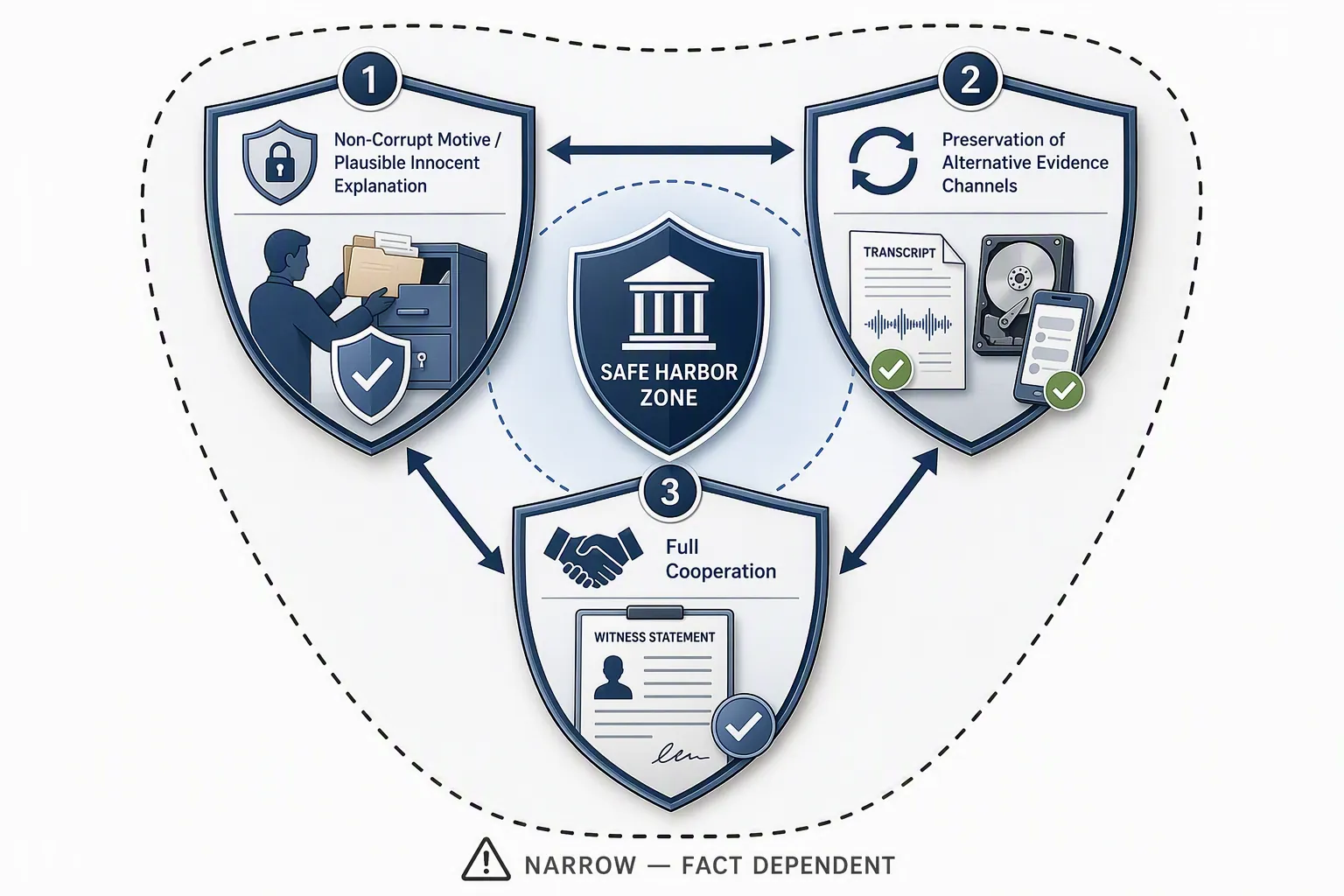
The useful part of the Hur report is not that Zwonitzer avoided prosecution. It is the reason he avoided prosecution. The report identified a factual combination that made corrupt obstruction difficult to prove: Zwonitzer offered plausible innocent reasons for deletion; he preserved transcripts, his computer, and an external hard drive from which most recordings were recovered; and he cooperated fully with investigators.[1]
A plausible innocent explanation reduced the inference of corrupt purpose
Zwonitzer said he deleted the recordings to protect Biden’s privacy and did not believe the recordings contained classified information.[1] That explanation did not make the deletion harmless. It did, however, give prosecutors a non-corrupt account they would have had to disprove or overcome with stronger circumstantial evidence.
For counsel, the distinction is important. A privacy rationale is not a magic phrase. It becomes legally meaningful only if it fits the surrounding conduct. If a custodian deletes the only copy of a plainly relevant file after receiving a preservation demand, labels the act “privacy protection,” and withholds the deletion from investigators, the label will not carry much weight. In Zwonitzer’s case, the explanation mattered because it sat alongside preservation, recovery, and cooperation.
Alternative evidence changed the impairment analysis
Hur’s report did not treat the deleted recordings in isolation. It noted that Zwonitzer preserved transcripts, his computer, and an external hard drive, and that most recordings were recovered from those sources.[1] That fact goes directly to evidentiary harm. If investigators still have transcripts, devices, drives, and recoverable files, the deletion may look less like an effort to deprive the government of evidence and more like a messy, risky act that did not succeed in materially frustrating the inquiry.
This is where many preservation lessons get overstated. The existence of substitute evidence does not erase the deletion. A transcript may not capture tone, pauses, emphasis, or every audio detail. A recovered file may not prove that every original survived. But for obstruction charging, the government must still evaluate whether the deletion impaired the investigation in a way that supports the charged theory. Hur’s declination indicates that the preserved and recovered evidence materially weakened that theory here.[1]
Cooperation supplied evidence rather than concealing it
The cooperation factor is the least forgiving for future clients because it is hardest to recreate after the fact. Hur emphasized that Zwonitzer cooperated fully, including by giving a consensual statement.[1] That cooperation did not merely make him appear helpful. It supplied the government with the key evidence of timing.
The House Judiciary Chapter Seventeen document likewise focuses on the deletion of audio recordings by Zwonitzer and the significance of his own statement in establishing when the deletion occurred.[2] On this record, Zwonitzer’s consensual statement was the only evidence that the deletion happened after he learned of the federal investigation.[1][2] That is an awkward fact for any simple obstruction narrative. The same cooperation that gave prosecutors the incriminating chronology also made it harder to portray him as someone trying to keep the government from discovering what happened.
That point should make records custodians and counsel cautious, not comfortable. Voluntary disclosure can mitigate obstruction risk when it genuinely clarifies the record and comes with preservation of other evidence. It can also create the evidentiary hook for a charge if the surrounding facts show concealment, selective production, false statements, or destruction of unique material. Zwonitzer’s statement helped him because other facts lined up with it.
The timing evidence is the most practical lesson
Timing usually drives the first preservation conversation. Before notice, deletion may be ordinary retention. After notice, the same act can become suspicious. After a subpoena, preservation letter, search warrant, interview request, or internal escalation, it may become the central fact in an obstruction investigation.
Zwonitzer sits in the dangerous middle. He deleted recordings after learning of the investigation, according to the timing evidence described in Hur’s report.[1] But that timing evidence came from his own consensual statement, not from a hidden forensic trail that exposed him after denial. For a prosecutor, that difference matters. For counsel advising a witness, it matters even more.
A client who has already deleted material during an investigation often wants a binary answer: are we in obstruction territory or not? The better answer starts with chronology and proof. Who knew of the investigation? What exactly did they know? What was deleted? Was it unique? What remained? Who authorized the deletion? Was the deletion disclosed before investigators independently discovered it? Were devices, drives, transcripts, or backups preserved? Did the client give a truthful account that helped the government reconstruct the event?
Hur’s declination shows why those questions cannot be treated as housekeeping. They are the difference between a bad fact and a chargeable obstruction theory.
What a typical obstruction pattern would look like by contrast
The Zwonitzer facts are easier to understand against the ordinary charging pattern. Obstruction risk rises sharply when deletion follows notice of an investigation, targets unique or obviously relevant evidence, leaves investigators without a meaningful substitute, is concealed or misrepresented, and is accompanied by conduct suggesting the actor wanted to frustrate the government’s inquiry.
Hur’s analysis moved in the opposite direction on several of those points. The deletion followed notice, which was the dangerous fact. But the surrounding record included a plausible non-corrupt explanation, preserved transcripts and hardware, recovery of most recordings, and cooperation that included the timing admission itself.[1] That is not a typical destruction-and-cover-up fact pattern.
The point is not that each mitigating fact would independently defeat obstruction. A privacy explanation without preserved evidence may fail. Preserved evidence without candor may fail. Cooperation after strategic deletion of unique material may come too late. The declination depended on the combination.
How counsel should read the boundary
There is a narrow boundary visible in the Zwonitzer record, but it is not a deletion policy. The safer reading is this: deletion during a pending federal investigation is not automatically chargeable as obstruction when the actor can credibly show a non-corrupt purpose, preserves or allows recovery of meaningful substitute evidence, and cooperates in a way that strengthens rather than frustrates the investigative record.
That reading has several operational consequences.
- Once a federal investigation is known or reasonably anticipated, suspend ordinary deletion for potentially relevant materials until counsel has assessed preservation duties.
- If privacy or confidentiality concerns exist, address them through segregation, access controls, privilege review, protective orders, or counsel-managed preservation rather than unilateral destruction.
- Map substitute evidence before taking any remedial step: transcripts, source devices, external drives, backups, cloud storage, metadata, and recovery options.
- Document the non-corrupt reason for any retention decision contemporaneously, using factual language rather than litigation slogans.
- Treat cooperation as evidence conduct, not demeanor. The question is whether the client’s actions help investigators reconstruct the record accurately.
A hypothetical contrast shows the boundary. Suppose a company employee learns of a federal probe, deletes meeting recordings because they contain private employee information, but preserves full transcripts, source devices, and backup media, discloses the deletion through counsel, and helps recover the files. That fact pattern is closer to the Zwonitzer mitigation logic. If the same employee deletes the only recordings, keeps no transcript, wipes the device, waits for investigators to discover the gap, and then offers a privacy rationale, the resemblance disappears.
What this record does not prove
The declination does not prove that deletion after investigative notice is permissible. It does not prove that privacy concerns override preservation duties. It does not prove that transcripts are always adequate substitutes for audio. It does not prove that later cooperation cures destruction.
It supports something narrower and more useful: prosecutors may decline obstruction charges where the available facts do not comfortably establish corrupt purpose or meaningful evidentiary impairment. In Zwonitzer’s case, Hur’s office had a deletion-after-notice fact, but also had innocent-explanation evidence, preserved and recovered materials, and cooperation that supplied rather than suppressed the timing record.[1]
For practitioners, that makes the case a boundary marker, not a template. Zwonitzer avoided prosecution because several unusual facts lined up in his favor. Clients should not assume those facts will exist after a deletion decision has already been made.
References
- Report on the Investigation Into Unauthorized Removal, Retention, and Disclosure of Classified Documents Discovered at Locations Including the Penn Biden Center and the Delaware Private Residence of President Joseph R. Biden, Jr., U.S. Department of Justice, February 2024, link
- Chapter Seventeen: Deletion of Audio Recordings by Mark Zwonitzer, House Judiciary Committee Hearing Document, link
- Audio tapes appear to show Biden discussing sensitive information with memoir ghostwriter, PBS NewsHour, link
Related records
Tool profile
Browse tool evaluations →Governing regulation
Browse the obligations tracker →Preventive workflow
Browse verification workflows →
Report a correction or tip
Spotted an outdated figure, a misstated fact, or a ruling this case record should reflect? Public comments are disabled for this content given the professional cost of a misreported case outcome, penalty amount, or rule text — use the structured correction channel instead.
Report a correction or tip for this record →